


AI vs NMT Translation: Security and Accuracy Risks

Most translation technologies still fall short of the compliance demands facing European localization managers in life sciences and legal sectors. When precision matters, relying on standard neural machine translation can cause terminology inconsistencies and risk regulatory breaches. Over 84% of American legal document translations require human oversight to meet European standards. This article untangles the differences between AI and NMT, revealing why only AI+HUMAN workflows provide the clarity, accuracy, and security required for high-stakes technical documentation.
Table of Contents
Key Takeaways
Point | Details |
AI and NMT Are Distinct Technologies | Understanding the differences between AI translation and Neural Machine Translation is essential for selecting the right solution for precise translations. |
Contextual Understanding Matters | AI-driven translation technologies excel in contextual comprehension, producing translations that are more nuanced than those generated by traditional NMT systems. |
Terminology Consistency is Critical | In regulated industries, implementing robust terminology management is vital for compliance and ensuring that translations maintain technical accuracy. |
AI+HUMAN Workflow is Essential | Combining AI efficiency with human expertise leads to higher-quality translations, particularly for complex and nuanced content. |
Defining AI and NMT Translation Technologies
Translation technologies have evolved dramatically, creating a complex landscape of machine translation approaches. Artificial Intelligence (AI) and Neural Machine Translation (NMT) represent two distinct technological paradigms that are often mistakenly conflated. Understanding their fundamental differences is crucial for organizations seeking precise, secure translation solutions.
Neural Machine Translation emerged as a significant advancement over traditional statistical machine translation models. Deep neural network architectures fundamentally transformed how machines process and translate human language. NMT systems utilize sophisticated artificial neural networks that attempt to mimic human language learning processes, generating translations by analyzing extensive bilingual training datasets. These systems can produce more contextually nuanced translations compared to their rule-based predecessors, but they remain fundamentally different from true AI translation technologies.
In contrast, AI translation represents a more advanced technological approach. Unlike NMT, which relies primarily on pattern recognition, AI translation leverages large language models (LLMs) that comprehend contextual meaning, grammatical structures, and semantic nuances. The key distinction lies in the AI system’s ability to understand context, interpret subtle linguistic variations, and generate translations that go beyond literal word-for-word conversion. Translation technology trends indicate that AI-driven solutions are rapidly becoming the preferred method for high-stakes, precision-required translations in regulated industries.
Pro Tip: When evaluating translation technologies, always request detailed information about the underlying technological architecture to understand the true capabilities and potential limitations of the translation system.
How NMT and LLM-Based AI Differ
The translation technology landscape reveals profound architectural differences between Neural Machine Translation (NMT) and Large Language Model (LLM) based AI systems. While both technologies aim to bridge linguistic gaps, their underlying mechanisms and translation capabilities diverge significantly. Translation model architectures demonstrate that these technologies are not interchangeable, but represent distinct approaches to language processing.

Traditional NMT systems operate through encoder-decoder frameworks that focus primarily on direct language conversion. These models analyze bilingual training datasets to generate translations by mapping linguistic patterns, but they remain fundamentally limited in understanding deeper contextual nuances. In contrast, LLM-based AI translation technologies leverage more sophisticated generative models that comprehend semantic structures, cultural contexts, and complex linguistic relationships. The key distinction lies in the AI system’s ability to generate translations that transcend literal word-for-word conversion, interpreting intent and maintaining contextual integrity.
Linguistic Analysis reveals critical performance variations between these technologies. Comparative translation studies demonstrate that LLM translations frequently align more closely with human-generated text, exhibiting superior adaptability across diverse linguistic scenarios. NMT systems, while technologically advanced, often produce translations with recognizable mechanical characteristics that lack the fluidity and contextual understanding inherent in AI-driven approaches. These differences become particularly pronounced in complex, nuanced translation scenarios requiring deep semantic comprehension.
Pro Tip: When selecting a translation technology, request sample translations across multiple domains to truly assess the system’s contextual understanding and linguistic flexibility.
Here’s how Neural Machine Translation (NMT) and AI-based Large Language Models (LLMs) differ in key aspects:
Aspect | NMT Systems | AI-Based LLMs |
Core Technology | Encoder-decoder frameworks | Generative LLM architectures |
Context Understanding | Limited, pattern-based | Deep, semantic comprehension |
Fluency of Output | Often mechanical | Human-like adaptability |
Domain Flexibility | Vulnerable to domain shifts | Strong across diverse domains |
Terminology Enforcement and Industry Compliance
In highly regulated industries, terminology consistency is not just a quality metric—it is a critical compliance requirement. Terminology management strategies play a pivotal role in ensuring that translations maintain precise technical language across complex documentation, particularly in sectors like healthcare, legal, and manufacturing where linguistic accuracy can have significant operational implications.
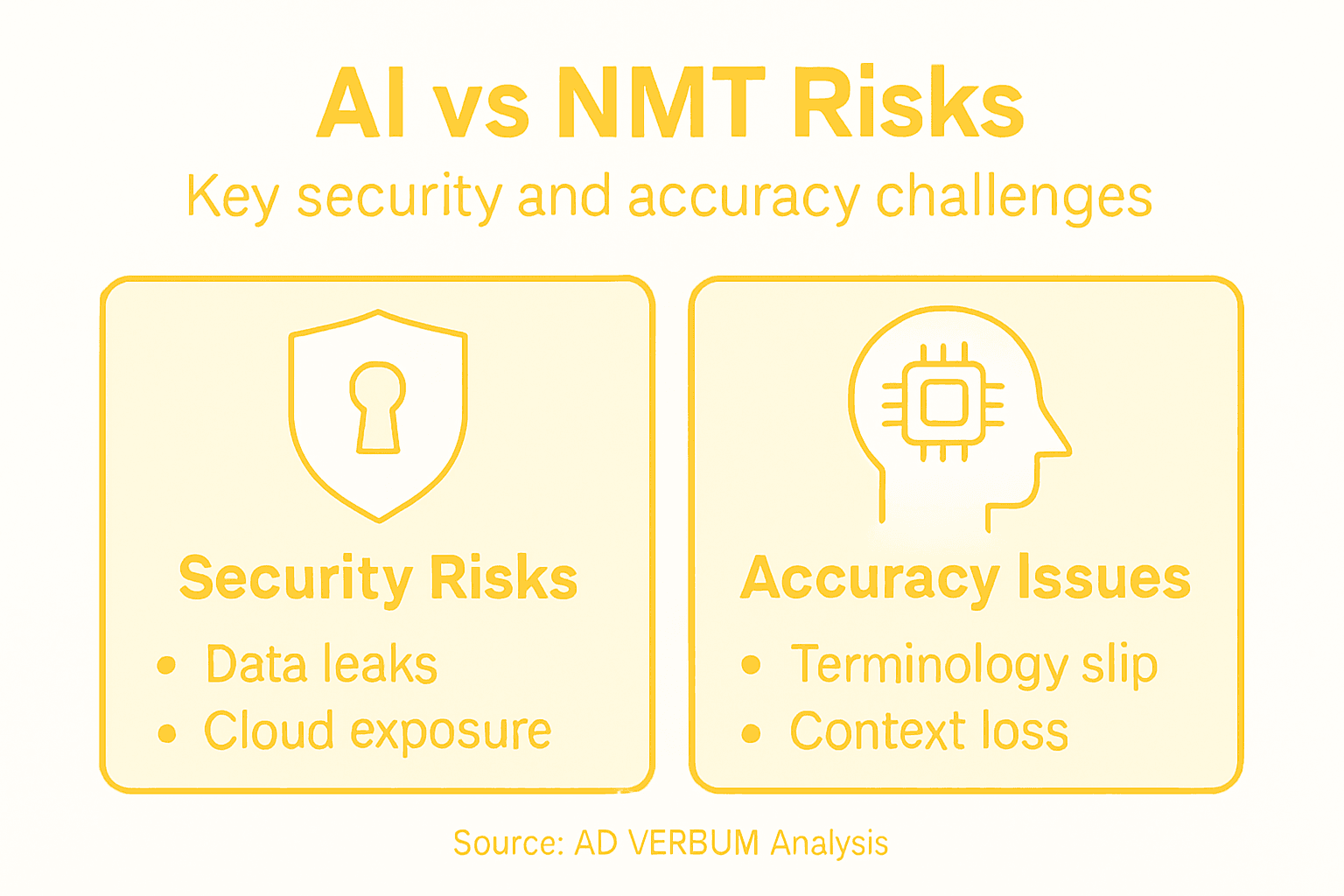
AI and Neural Machine Translation (NMT) technologies approach terminology enforcement through distinctly different mechanisms. Traditional NMT systems rely on statistical pattern matching, which frequently introduces inconsistencies and potential misinterpretations. Large Language Model (LLM) based AI, by contrast, can be programmed with specific terminology constraints, enabling more sophisticated and reliable linguistic enforcement. These advanced systems can dynamically reference industry-specific glossaries, ensuring that critical terms are translated with unwavering precision and contextual accuracy.
Compliance implications for AI translation extend beyond mere linguistic accuracy. Regulated industries demand translation technologies that not only preserve technical language but also respect intricate cultural and regulatory nuances. This requires a sophisticated approach that combines technological capabilities with human expertise—a process that goes far beyond simple word-for-word conversion. The most effective translation workflows integrate rigorous terminology management protocols, ensuring that every translated document meets the stringent standards of industries where communication errors can have serious consequences.
Pro Tip: Develop a comprehensive, domain-specific terminology database before initiating any translation project to establish a robust foundation for consistent and compliant linguistic output.
Data Security Risks in Translation Workflows
In an era of increasing digital complexity, translation workflows present significant data security vulnerabilities that demand meticulous attention. Scientific publishing translation risks underscore the critical need for robust protection mechanisms, particularly when processing sensitive intellectual property and confidential research materials through automated translation platforms.
Cloud-based Neural Machine Translation (NMT) and public AI translation services introduce substantial security risks that can compromise organizational data integrity. These platforms often lack the rigorous security protocols necessary for handling proprietary information. Uncontrolled data transmission through third-party translation services can expose organizations to potential breaches, unauthorized data access, and intellectual property theft. Proprietary information, technical specifications, medical research, and legal documents are particularly vulnerable when processed through unsecured translation infrastructures.
Translation workflow security strategies emphasize the importance of implementing comprehensive data governance frameworks. Effective risk mitigation requires a multifaceted approach that includes encryption protocols, strict access controls, data anonymization techniques, and continuous security audits. Organizations must prioritize translation technologies that provide end-to-end data protection, ensuring that sensitive content remains protected throughout the entire translation lifecycle. This involves selecting translation partners with proven security credentials, such as ISO 27001 certification, and maintaining strict control over data access and transmission.
Pro Tip: Conduct a comprehensive data risk assessment before engaging any external translation service, evaluating their security infrastructure, compliance certifications, and data handling protocols.
Summary of essential data security measures for translation workflows:
Security Measure | Purpose | Example Implementation |
Encryption Protocols | Protect data during transmission | TLS for all file transfers |
Access Controls | Limit who can view documents | Role-based system permissions |
Data Anonymization | Remove sensitive identifiers | Automated text redaction tools |
Security Audits | Identify and resolve vulnerabilities | Regular penetration testing |
Why AI+HUMAN Is Essential for Precision
In the complex world of translation, technological advancement alone cannot guarantee absolute precision. Scientific translation approaches demonstrate that successful linguistic conversion requires a sophisticated integration of artificial intelligence and human expertise—a methodology known as the AI+HUMAN workflow.
Artificial intelligence excels at processing vast amounts of linguistic data with remarkable speed, but it fundamentally lacks the nuanced understanding that human translators bring to complex linguistic challenges. While AI can quickly generate initial translations, human experts are critical for addressing contextual subtleties, cultural interpretations, and industry-specific terminology that automated systems might misinterpret. Linguistic precision strategies reveal that human oversight transforms raw machine translations into refined, accurate communication artifacts.
The AI+HUMAN approach represents more than a simple editing process—it is a symbiotic workflow where artificial intelligence and human expertise complement each other’s strengths. AI rapidly generates initial drafts, processes technical terminology, and maintains consistency, while human experts provide critical context validation, cultural adaptation, and final quality assurance. This collaborative method ensures translations are not just technically accurate, but genuinely meaningful and contextually appropriate across diverse professional domains.
Pro Tip: Implement a structured review process that defines clear roles for AI-generated content and human refinement to maximize translation precision and reliability.
Elevate Translation Security and Accuracy With AD VERBUM
The article “AI vs NMT Translation: Security and Accuracy Risks” highlights critical challenges companies face when relying on public Neural Machine Translation services—ranging from data security vulnerabilities to inconsistent terminology enforcement that can lead to costly errors. When handling sensitive medical, legal, or technical content, simply choosing any AI or NMT tool is a risk you cannot afford. The ambiguous outputs and potential data leaks described underscore the urgent need for a translation partner who prioritizes precision and compliance.
AD VERBUM offers an unmatched solution designed specifically for high-stakes industries. Our proprietary LLM-based AI combined with a 100% AI+HUMAN workflow ensures rigorous terminology enforcement and contextual understanding unmatched by typical NMT systems. Hosted entirely on secure EU servers, our platform guarantees total data sovereignty—protecting your intellectual property and sensitive data under strict ISO 27001 and GDPR standards. By integrating your existing Translation Memories and Term Bases, we deliver translations that are not only faster but verifiably accurate and compliant.
Discover how you can mitigate the risks discussed in the article by choosing a partner that is committed to both security and linguistic excellence. Protect your most valuable data and ensure zero-error compliance today by exploring the full scope of our specialized services at AD VERBUM. Learn more about the advantages of our AI+HUMAN workflow and why our proprietary LLM technology stands apart from standard machine translation solutions.
Take the first step toward safer and more precise translation outcomes for your company now.
Frequently Asked Questions
What are the main differences between AI translation and Neural Machine Translation (NMT)?
AI translation leverages large language models that understand context and semantics, while NMT uses encoder-decoder frameworks focused on direct language conversion and often lacks deep contextual understanding.
How does data security differ between NMT and AI-based translation technologies?
NMT and AI-based translation systems can introduce data security vulnerabilities, particularly with cloud-based solutions. AI systems can offer better mechanisms for data protection, including end-to-end encryption and strict access controls.
Why is human expertise important in translation workflows using AI?
Human experts are essential for providing critical contextual understanding, cultural insights, and quality assurance that AI systems may miss. This collaboration enhances the accuracy and relevance of translations.
How can organizations ensure terminology consistency in translations?
Organizations can implement comprehensive terminology management strategies, such as maintaining industry-specific glossaries and using AI systems that reference these glossaries to enforce consistent technical language.
Recommended
