


ISO 17100 Translation Standards: Ensuring Precision and Security

Over 80 percent of European life sciences firms report challenges when verifying American and international translation compliance for regulatory documents. For companies handling critical medical submissions, every word must meet ISO 17100 standards to avoid costly errors and security risks. This overview clarifies how structured processes and documented qualifications transform translation from a risky guesswork task into a reliable, audit-ready operation protecting patient safety and organizational integrity.
Table of Contents
Key Takeaways
Point | Details |
ISO 17100 Certification is Crucial | Always verify a translation service provider’s ISO 17100 certification to ensure adherence to quality and professional standards. |
Rigorous Qualification Standards | ISO 17100 mandates that translators possess both linguistic skills and specific subject matter expertise for accurate translations. |
Multi-Stage Review Process | A systematic multi-stage review process guarantees translation accuracy and contextual precision, significantly reducing errors. |
Data Security and Risk Management | Implement mandatory data protection protocols to safeguard sensitive information and ensure regulatory compliance in translation processes. |
Defining ISO 17100 Translation Standards
ISO 17100 represents a critical international standard for translation services, establishing comprehensive requirements that ensure precision, quality, and professional integrity in language translation processes. This standardized framework defines specific guidelines for translation service providers, covering everything from core processes to resource management and workflow stages.
At its core, ISO 17100 sets mandatory qualifications for translators, emphasizing not just linguistic skills but professional competence. The standard requires translators to demonstrate professional capabilities through proven education, translation experience, and subject matter expertise. Unlike generic translation approaches, ISO 17100 mandates a rigorous two-stage review process: an initial translation followed by a comprehensive second-person revision to guarantee accuracy and contextual precision.
The standard encompasses several critical components for translation quality management. These include detailed requirements for:
Translator and reviewer qualifications
Translation workflow stages
Resource and process management
Quality control mechanisms
Professional competence verification
Pro Tip: When selecting a translation service, always verify their ISO 17100 certification to ensure systematic quality and professional standards.
Core Requirements for Compliance and Quality
ISO 17100 establishes a comprehensive framework that transforms translation from a simple linguistic task to a rigorous, systematized professional service. Quality assurance through documented workflows becomes the cornerstone of this standard, requiring translation providers to implement meticulous processes that ensure consistent, high-caliber results across diverse language projects.
The standard delineates specific requirements across multiple critical domains. Translator qualifications represent a fundamental pillar, mandating that linguists possess not just language proficiency, but demonstrable expertise in their specific subject domains. This means a medical translator must have both linguistic skills and substantive knowledge of medical terminology, research methodologies, and industry-specific communication protocols.
Key compliance requirements under ISO 17100 include:
Comprehensive translator competency verification
Systematic project management protocols
Rigorous quality control mechanisms
Detailed documentation of translation processes
Continuous performance improvement strategies
These requirements establish a transparent, accountable framework that protects client interests and ensures translation accuracy across complex, high-stakes communication scenarios. By setting clear, measurable standards, ISO 17100 transforms translation from an art into a precise, scientifically managed professional service.
Pro Tip: Request detailed documentation of a translation provider’s ISO 17100 compliance processes to validate their commitment to professional standards.
Qualifications and Roles in the Translation Process
ISO 17100 establishes a stringent framework for professional translation services by defining precise qualifications and roles for human resources involved in translation processes. The standard goes far beyond simple language proficiency, creating a comprehensive ecosystem of professional responsibilities that ensure translation accuracy and reliability.
The standard outlines multiple critical roles within the translation workflow, each with specific qualification requirements. These roles typically include translators, revisers, proofreaders, and project managers. For each role, ISO 17100 mandates demonstrable expertise, including:
Academic credentials in translation or relevant linguistic disciplines
Proven professional experience in specific subject matter domains
Technical competence in translation technologies
Demonstrated ability to maintain consistent quality standards
Particularly for translators, the standard requires deep subject matter knowledge that extends well beyond basic language skills. A medical document translator, for instance, must understand complex medical terminology, research methodologies, and industry-specific communication protocols. This ensures that translations are not merely linguistically accurate but also contextually precise and professionally appropriate.

The multistage review process embedded in ISO 17100 further reinforces quality. Each translation undergoes multiple professional evaluations, with each reviewer bringing specialized expertise to validate different aspects of the document. This systematic approach transforms translation from a potential liability into a robust, reliable communication tool for global businesses.
Here’s a summary of key roles defined by ISO 17100 and their primary responsibilities:
Role | Core Responsibilities | Required Expertise |
Translator | Translate content accurately | Linguistic skills, subject knowledge |
Reviser | Review and refine translations | Advanced language and domain skills |
Proofreader | Final check for errors and style | Detail orientation, language mastery |
Project Manager | Oversee project workflow and delivery | Coordination, process management |
Pro Tip: Always request detailed professional credentials and subject matter expertise verification when selecting a translation service provider.
Workflow, Revision, and Terminology Enforcement
ISO 17100 establishes a meticulously structured translation workflow designed to systematically eliminate potential errors and maintain exceptional quality standards. The standard mandates a comprehensive multi-stage review process that transforms translation from a simple linguistic exercise into a rigorous, quality-controlled professional service.
The workflow typically encompasses several critical stages:
Initial translation by a qualified linguist
Mandatory second-person revision
Optional comprehensive review
Potential proofreading
Final verification and client validation
Terminology enforcement represents a cornerstone of this process. Precise terminology management is critical in preventing ambiguity and maintaining professional accuracy, particularly in high-stakes domains like medical, legal, and technical translations. This involves creating and maintaining robust terminology databases, establishing clear linguistic guidelines, and ensuring consistent application across all translation projects.
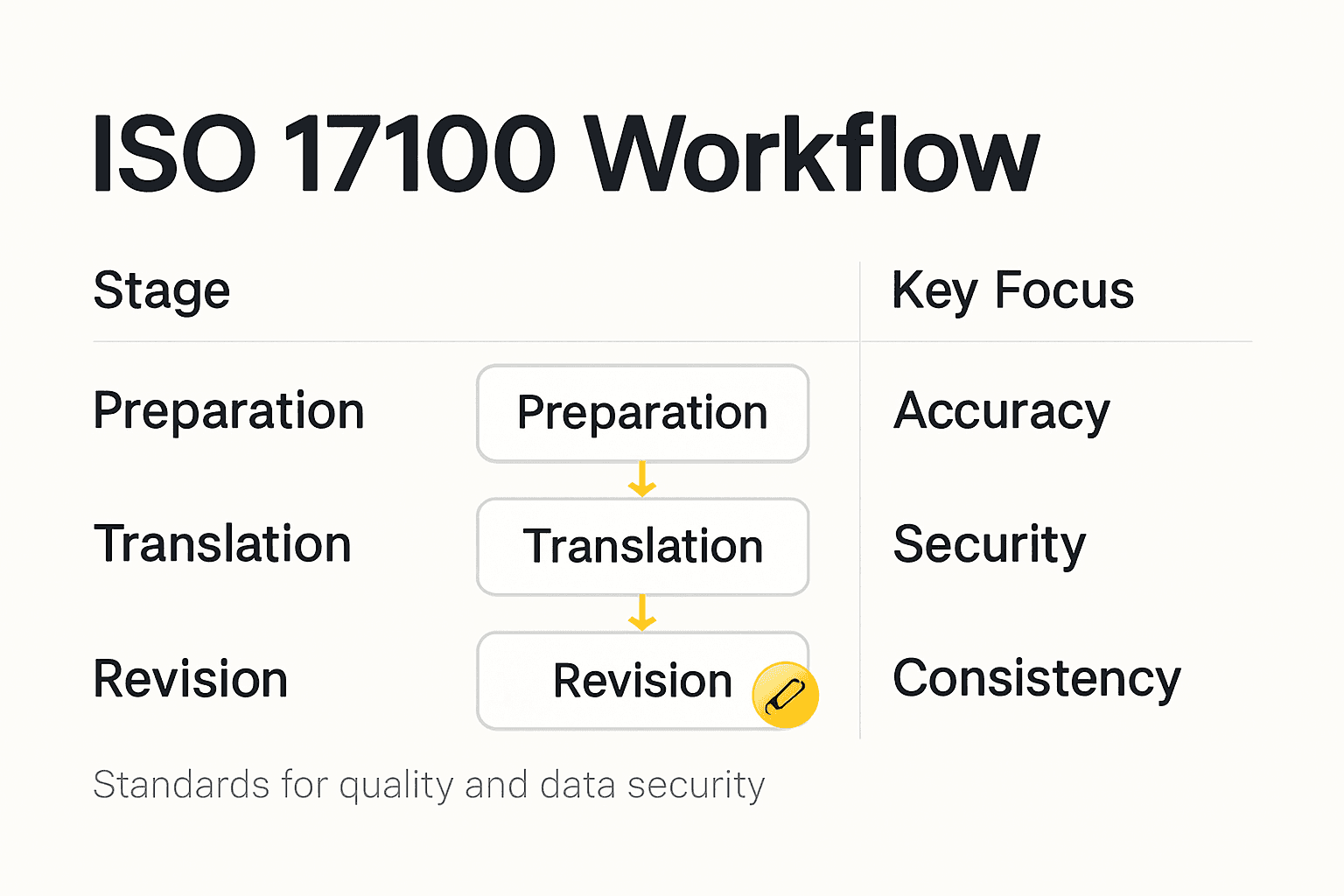
The systematic approach goes beyond simple linguistic translation. Each stage introduces additional layers of quality control, with specialized professionals reviewing specific aspects of the document. A medical translator might handle initial translation, while a subject matter expert in medical research conducts the revision, ensuring not just linguistic accuracy but also technical precision.
Pro Tip: Develop a comprehensive terminology glossary before initiating any translation project to streamline the workflow and ensure consistent linguistic precision.
Risks, Data Security, and Regulatory Implications
ISO 17100 has become increasingly critical in addressing the complex landscape of data security and regulatory compliance for translation services. The standard strategically acknowledges growing concerns about translation risks and regulatory requirements, providing a comprehensive framework that protects sensitive information across multiple professional domains.
The certification process introduces rigorous risk management protocols that extend far beyond traditional translation practices. Certification enhances organizational risk management by mandating secure data handling, comprehensive documentation, and strict confidentiality obligations, particularly crucial in high-stakes sectors like healthcare, finance, and legal services. These requirements create a protective ecosystem that shields organizations from potential legal and reputational damages.
Key risk mitigation strategies embedded in the standard include:
Mandatory data protection protocols
Comprehensive translator background verification
Secure information handling procedures
Clear documentation of translation workflows
Systematic quality control mechanisms
Moreover, the standard recognizes the evolving technological landscape, providing guidelines for integrating advanced translation technologies while maintaining stringent security standards. This approach ensures that organizations can leverage innovative translation solutions without compromising data integrity or regulatory compliance.
The following table compares ISO 17100 compliance with traditional translation approaches:
Aspect | ISO 17100 Approach | Traditional Approach |
Quality Assurance | Structured, documented workflows | Ad hoc or inconsistent processes |
Translator Qualifications | Verified credentials and expertise | Language skills often unverified |
Data Security | Mandatory protection protocols | Basic or variable safeguards |
Risk Management | Systematic risk mitigation steps | Limited or informal risk analysis |
Pro Tip: Conduct a comprehensive risk assessment of your translation workflows annually to identify and address potential security vulnerabilities.
Elevate Your Translation Quality and Security with AD VERBUM
The article “ISO 17100 Translation Standards: Ensuring Precision and Security” highlights critical challenges faced by companies needing accurate translations that meet strict quality and data security standards. Key issues include verifying translator qualifications, enforcing precise terminology, maintaining multi-level revision workflows, and protecting sensitive information to comply with regulations like GDPR and HIPAA. These concerns are especially relevant for industries such as Life Sciences, Legal, and Finance, where errors or data leaks can have serious consequences.
AD VERBUM addresses these exact pain points through its advanced AI+HUMAN workflow that integrates a proprietary LLM-based AI system hosted exclusively on secure EU servers. Unlike generic Machine Translation or public Neural Machine Translation services, our technology ensures strict terminology enforcement and zero data leakage. Combined with our network of 3,500+ subject matter experts possessing demonstrated qualifications aligned with ISO 17100 requirements, we guarantee precision and compliance every step of the way. Our solution embodies the very concepts of documented quality assurance, translator validation, and risk mitigation emphasized by ISO 17100.
Discover how our specialized approach to regulated translation can secure your confidential content and elevate your global communications. Visit AD VERBUM to learn about our specialized AI translation services crafted for high-stakes industries. Take action now to protect your organization from costly mistranslations and data risks by partnering with a verified ISO 17100 compliant provider offering unmatched precision and security.
Frequently Asked Questions
What is ISO 17100?
ISO 17100 is an international standard for translation services that establishes requirements for quality, precision, and the professional integrity of translation processes.
What qualifications are required for translators under ISO 17100?
Translators must have documented education, relevant translation experience, and subject matter expertise to ensure they meet the rigorous standards set by ISO 17100.
How does ISO 17100 ensure the quality of translations?
The standard mandates a two-stage review process where an initial translation is followed by a comprehensive revision to guarantee accuracy and context, along with stringent quality control mechanisms.
What are the key components of ISO 17100 regarding data security?
ISO 17100 includes mandatory data protection protocols, secure information handling procedures, and comprehensive documentation practices to mitigate risks associated with translating sensitive information.
Recommended

