


Machine Translation Risks in 2025: Safeguarding Data and Terminology

Most global pharmaceutical companies in Europe now face a stark reality: even a single mistranslated technical term can trigger costly regulatory delays. As artificial intelligence transforms language processing, reliance on automated translation is skyrocketing—yet up to 30 percent of machine-generated medical translations contain significant errors. For regulatory compliance officers, the challenge is balancing American AI-driven efficiency with strict European data privacy requirements and uncompromising standards for precise terminology. This article reveals how advanced translation systems reduce risk for technical documentation.
Table of Contents
Key Takeaways
Point | Details |
Evolution of Machine Translation | Machine translation has progressed from rule-based systems to advanced neural and AI-driven technologies, improving contextual understanding and output naturalness. |
Major Translation Types | The current landscape features three key types: Machine Translation (MT), Neural Machine Translation (NMT), and Large Language Model (LLM)-Based AI, each enhancing linguistic processing significantly. |
Risks in Machine Translation | Key challenges include translation errors, model hallucinations, and data privacy vulnerabilities, which necessitate rigorous human verification protocols. |
Importance of Human Oversight | Combining AI capabilities with human expertise in translation workflows ensures higher accuracy and compliance, particularly in sensitive industries like healthcare and legal. |
Defining Machine Translation Systems in 2025
Machine translation systems have undergone profound technological transformation, evolving from rudimentary rule-based approaches to sophisticated neural and AI-powered platforms. Researchers tracking translation technology trends now recognize machine translation as a complex ecosystem integrating multiple technological paradigms.
Three primary generations of machine translation define the current technological landscape. First, rule-based systems relied on hardcoded linguistic grammar and dictionary mappings, producing mechanical translations with limited contextual understanding. Second, statistical machine translation introduced probability models that improved linguistic matching. Third, neural machine translation represents the most advanced current approach, utilizing deep learning algorithms that comprehend semantic nuance and contextual meaning.
Modern machine translation systems increasingly incorporate large language models and generative AI technologies, shifting from literal translation to contextually intelligent content transformation. These advanced platforms go beyond word-for-word conversion, analyzing entire document contexts to produce more natural, linguistically sophisticated outputs. The fundamental shift involves moving from translation as a mechanical process to an intelligent, adaptive communication strategy.
Pro Tip: When evaluating machine translation platforms, prioritize systems with robust terminology management capabilities and transparent AI training methodologies.
Key Types: MT, NMT, and LLM-Based AI
The landscape of machine translation technologies comprises three distinct evolutionary stages, each representing a significant leap in linguistic processing capabilities. Researchers analyzing translation technology trends have identified these key types as critical milestones in automated language translation.
Machine Translation (MT) represents the earliest approach, characterized by rigid rule-based systems that relied on predefined grammatical structures and direct dictionary mappings. These systems produced mechanically literal translations with limited contextual comprehension, often resulting in awkward or inaccurate outputs. Their primary strength was consistency, but they struggled with linguistic nuance and idiomatic expressions.
Neural Machine Translation (NMT) emerged as a more sophisticated alternative, utilizing deep learning algorithms that analyze entire sentence structures rather than isolated word translations. These systems can capture semantic relationships, grammatical contexts, and subtle linguistic variations with significantly improved fluency. NMT represents a quantum leap from traditional MT, introducing probabilistic models that learn and adapt from extensive training datasets, enabling more natural and contextually relevant translations.
Large Language Model (LLM)-Based AI represents the most advanced translation technology, integrating generative AI capabilities that extend beyond traditional translation paradigms. These systems don’t merely translate text but comprehend and reconstruct meaning across linguistic boundaries. By leveraging massive multilingual training datasets and sophisticated neural architectures, LLM-based AI can maintain original document tone, style, and contextual subtleties while delivering precise cross-linguistic communication.
Pro Tip: When selecting a translation technology, evaluate systems based on their contextual understanding capabilities rather than just word-for-word accuracy.
Here’s how the main machine translation approaches compare in key areas:
Translation Type | Context Understanding | Output Naturalness | Adaptability |
Rule-Based MT | Minimal | Mechanical | Low |
Statistical MT | Moderate | Improved | Medium |
Neural/LLM-Based | High | Human-like | High |
Common Risks: Errors, Hallucinations, Data Leaks
Research on machine translation risks reveals a complex landscape of technological vulnerabilities that can significantly compromise translation accuracy and data security. These risks manifest in three primary domains: translation errors, model hallucinations, and potential data privacy breaches, each presenting unique challenges for organizations relying on automated translation technologies.
Translation Errors represent the most fundamental risk in machine translation systems. These errors emerge from linguistic ambiguity, contextual misinterpretation, and the inherent limitations of algorithmic language processing. Technical documents, legal contracts, and medical texts are particularly susceptible to mistranslations that can alter critical meanings. For instance, a single misinterpreted medical term could transform treatment instructions from safe to dangerous, highlighting the potential catastrophic consequences of seemingly minor linguistic inaccuracies.

Model Hallucinations pose an increasingly sophisticated threat in advanced translation technologies. Large language models can generate plausible but entirely fabricated content that appears convincing yet contains no factual basis. These hallucinations are particularly dangerous in high-stakes domains like pharmaceutical documentation, legal contracts, and technical specifications, where accuracy is paramount. The AI may confidently produce text that sounds authoritative but contains critical semantic errors or completely invented information, creating significant risks for organizations relying on automated translation.
Data Privacy Vulnerabilities represent another critical risk vector in machine translation workflows. Many public translation platforms inadvertently expose sensitive information during processing, potentially violating strict regulatory requirements like GDPR and HIPAA. Confidential medical records, proprietary business documents, and classified communications can be unintentionally leaked through unsecured translation pipelines, creating substantial legal and reputational risks for organizations.
Pro Tip: Implement rigorous human verification protocols and utilize closed-loop translation systems to mitigate risks associated with automated translation technologies.
Industry-Specific Requirements and Compliance Needs
Academic research examining machine translation compliance reveals the critical importance of understanding industry-specific regulatory frameworks that govern translation technologies. Each sector presents unique challenges, requiring specialized approaches to ensure accurate, secure, and legally compliant communication across linguistic boundaries.
Medical and Pharmaceutical Sectors demand the highest level of precision and security in translation workflows. Regulatory bodies like the FDA and European Medicines Agency impose stringent requirements for clinical documentation, patient information, and research materials. Mistranslations can result in potential patient harm, regulatory penalties, and compromised clinical trial integrity. These industries require translation systems that not only maintain exact medical terminology but also protect sensitive patient data through robust encryption and restricted access protocols.
Legal and Compliance Domains present equally complex translation challenges. International contracts, regulatory filings, and legal documents require absolute linguistic accuracy and contextual preservation. Slight semantic variations can dramatically alter legal interpretations, potentially resulting in significant financial or contractual disputes. Translation technologies must integrate specialized legal glossaries, maintain precise technical language, and ensure complete alignment with jurisdiction-specific legal frameworks.
Manufacturing and Engineering Sectors rely on translation technologies that can accurately convey complex technical specifications, safety instructions, and regulatory compliance documentation. These industries require translation systems capable of preserving exact technical terminology, understanding industry-specific jargon, and maintaining the precise meaning of engineering and safety-critical content across multiple languages.
Pro Tip: Develop a comprehensive terminology management strategy that includes domain-specific glossaries and rigorous human verification processes for critical translation workflows.
This summary shows industry needs and compliance pressures for translation systems:
Industry | Accuracy Demand | Main Compliance Focus | Typical Data Sensitivity |
Medical/Pharma | Extremely high | Patient safety, data protection | Very high |
Legal/Compliance | Absolute | Contract integrity, jurisdiction | High |
Manufacturing | Critical | Tech specs, safety rules | Moderate |
Mitigating Risks With AI+HUMAN Workflows
International translation experts highlight the critical importance of human oversight in managing machine translation risks, emphasizing the need for a collaborative approach that combines technological efficiency with human expertise. The AI+HUMAN workflow represents a strategic methodology designed to leverage artificial intelligence’s processing capabilities while maintaining human critical thinking and contextual understanding.
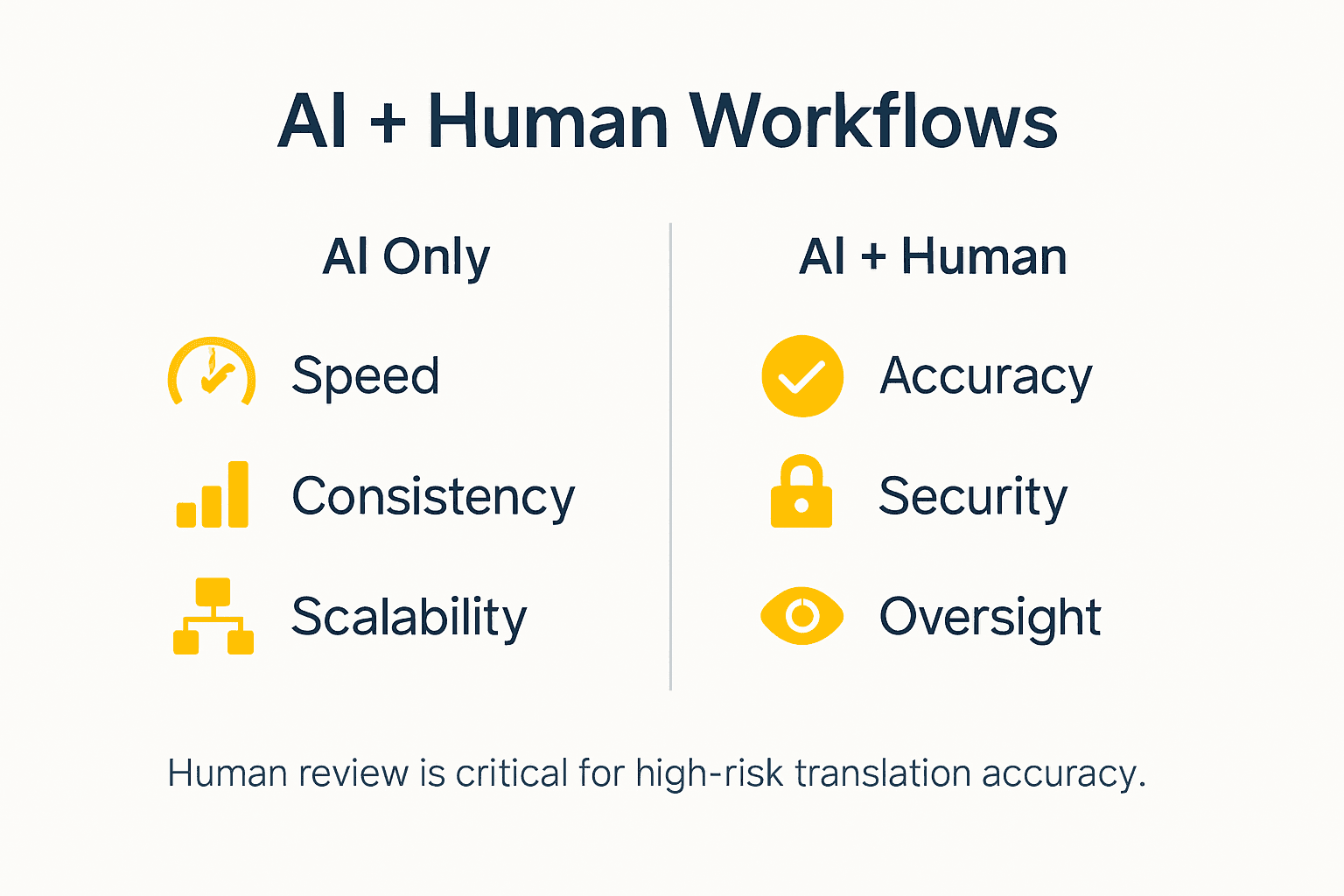
Quality Verification Protocols form the cornerstone of effective risk mitigation. In this approach, AI-generated translations undergo multiple layers of human scrutiny. Subject matter experts review machine-translated content, verifying technical accuracy, preserving semantic nuances, and identifying potential contextual errors that automated systems might introduce. This multi-stage review process ensures that translations maintain the highest standards of precision across complex technical, legal, and medical domains.
Terminology Management represents another critical component of the AI+HUMAN workflow. Unlike traditional machine translation systems, this approach integrates client-specific terminology databases directly into the AI training process. Human linguists continuously update and refine these databases, ensuring that specialized vocabularies remain current and accurately reflect industry-specific language conventions. This dynamic approach allows organizations to maintain consistent, domain-specific language across all translation outputs.
Ethical and Security Safeguards are fundamental to the AI+HUMAN approach. By maintaining human oversight, organizations can implement robust data protection protocols that prevent unauthorized data exposure. Human reviewers serve as a critical checkpoint, ensuring that sensitive information remains confidential and that translations comply with strict regulatory requirements in highly regulated industries such as healthcare, finance, and legal services.
Pro Tip: Develop a comprehensive training program for human reviewers that emphasizes both linguistic expertise and technological literacy to maximize the effectiveness of AI+HUMAN translation workflows.
Ensuring Secure and Accurate Translations for High-Risk Industries
The article highlights critical challenges companies face today with machine translation—including translation errors, AI hallucinations, and data privacy risks. These issues are especially dangerous in regulated sectors like Medical, Legal, and Manufacturing where precise terminology and strict compliance are non-negotiable. Companies need solutions that prioritize both data security and controlled terminology enforcement when handling sensitive multilingual content.
AD VERBUM offers a proprietary technology-first approach that directly addresses these risks. Our AI+HUMAN workflow combines a secure, EU-hosted, LLM-based AI with expert linguists specialized in high-stakes industries. This ensures sensitive data never leaves a protected environment and approved terminology is enforced consistently across all translations. Unlike public machine translation tools prone to errors and data leaks, our service delivers unmatched accuracy, compliance, and peace of mind.
Discover how our specialized AI translation solutions provide the precision and security that your critical business documents demand. Visit AD VERBUM now to learn more and protect your data and terminology today.
Frequently Asked Questions
What are the main risks associated with machine translation systems in 2025?
The primary risks include translation errors, model hallucinations, and data privacy vulnerabilities. These can lead to inaccurate translations, misleading information, and potential data breaches.
How can organizations mitigate translation errors in automated systems?
Organizations can mitigate translation errors by implementing rigorous human verification protocols, where subject matter experts review machine-generated translations for accuracy and contextual understanding.
What is the role of human oversight in machine translation workflows?
Human oversight is crucial for verifying the quality of machine translations. It ensures that semantic nuances are preserved and helps identify any potential errors or ambiguities that AI systems may overlook.
Why is terminology management important in machine translation?
Terminology management ensures that specialized vocabularies are consistently used throughout translations, which is critical for maintaining clarity and compliance in fields like medical, legal, and technical documentation.
Recommended
