


ITAR translation vendors pose 40% higher deemed export risk

Sharing ITAR-controlled technical documents with translation vendors creates a hidden compliance trap. Each time a foreign national accesses your engineering manuals or system specifications during translation, you’ve potentially committed a deemed export violation. Many defense contractors underestimate this risk because vendor workflows remain opaque and regulations evolve rapidly. This guide clarifies the actual exposure and provides strategies to safely outsource ITAR document translation without triggering regulatory penalties.
Table of Contents
Understanding Deemed Export Risks In ITAR-Controlled Documentation
Security And Quality Certifications In Translation Vendors For ITAR
Role Of Subject-Matter Expert Review In ITAR Translation Workflows
Common Misconceptions About ITAR-Related Export Risks In Translation
Practical Risk Mitigation Strategies For Translation Vendor Selection
Summary And Best Practices For Managing ITAR Translation Compliance
Key takeaways
Point | Details |
Deemed export risks | Transfer of ITAR-controlled data to foreign nationals during translation constitutes an export regardless of physical location. |
Technology matters | Proprietary AI with SME review reduces compliance risks compared to public machine translation or neural machine translation systems. |
Certifications required | ISO 27001 and ISO 17100 certifications ensure data security and translation quality for controlled documentation. |
Data sovereignty critical | Private server hosting prevents unauthorized cross-border transfers that violate ITAR regulations. |
Audit trails essential | Translation memories and terminology bases create transparent compliance documentation for regulatory inspections. |
Understanding deemed export risks in ITAR-controlled documentation
Under ITAR regulations, a deemed export occurs when you transfer controlled technical data to a foreign national, even if that person never leaves U.S. territory. Translation vendors handling ITAR documents often employ linguists worldwide, creating immediate exposure. Export administration regulations specify unauthorized release to any foreign national is a violation regardless of physical location.
Several enforcement cases have involved unauthorized access by foreign personnel through outsourced translation services. The violations often surface during audits when contracting officers examine vendor qualifications and data handling practices. Many Tier 2 and Tier 3 contractors assume commercial translation services provide adequate controls. They don’t.
Compliance teams must identify ITAR-controlled content before outsourcing translation. Key documentation categories include:
Technical data packages for defense articles
Engineering drawings and specifications
Manufacturing process documentation
Maintenance and repair manuals
Software source code and algorithms
“The moment controlled technical data enters a vendor’s workflow without proper authorization, you’ve created export liability. Location is irrelevant under deemed export rules.”
Understanding how translations create exposure helps you structure compliant workflows. The risk isn’t limited to final deliverables. Every intermediate step involving foreign national access triggers potential violations. This means your vendor’s entire operational model requires scrutiny, not just their security certifications.
Comparison of translation technologies and compliance risks
Translation technology choices directly impact your ITAR compliance posture. Three primary approaches exist, each with distinct risk profiles.
Machine translation (MT) delivers literal output with weak context handling. These legacy systems process text word by word or phrase by phrase, missing document-level meaning. For ITAR-controlled content, MT raises significant security concerns because most implementations rely on public cloud infrastructure. Your controlled data flows through servers you can’t audit, potentially crossing borders without authorization.
Neural machine translation (NMT) improves context awareness through deep learning models. Popular commercial NMT services handle billions of translation requests daily, making them efficient for general content. However, studies show up to 15% terminology inconsistency in NMT output for defense technical terms, risking compliance errors. Public cloud dependency remains problematic. When your ITAR documentation enters a shared NMT environment, you lose control over data residency and access.
Proprietary large language model AI combined with subject-matter expert hybrid workflows provide superior compliance controls. These systems offer:
Terminology enforcement through integrated term bases
Document-level context handling for technical accuracy
Private server hosting ensuring data sovereignty
SME review catching compliance and technical errors
Audit trail generation for regulatory inspection
Technology | Context handling | Terminology control | Data sovereignty | Compliance suitability |
Machine Translation | Weak | None | Public cloud | Low |
Neural Machine Translation | Moderate | Variable | Usually public cloud | Medium |
Proprietary LLM with SME review | Strong | Enforced | Private infrastructure | High |
Pro Tip: Always verify your vendor’s translation technology architecture and SME involvement before sharing controlled documents. Ask specifically about server locations, access controls, and whether foreign nationals touch your content at any workflow stage.
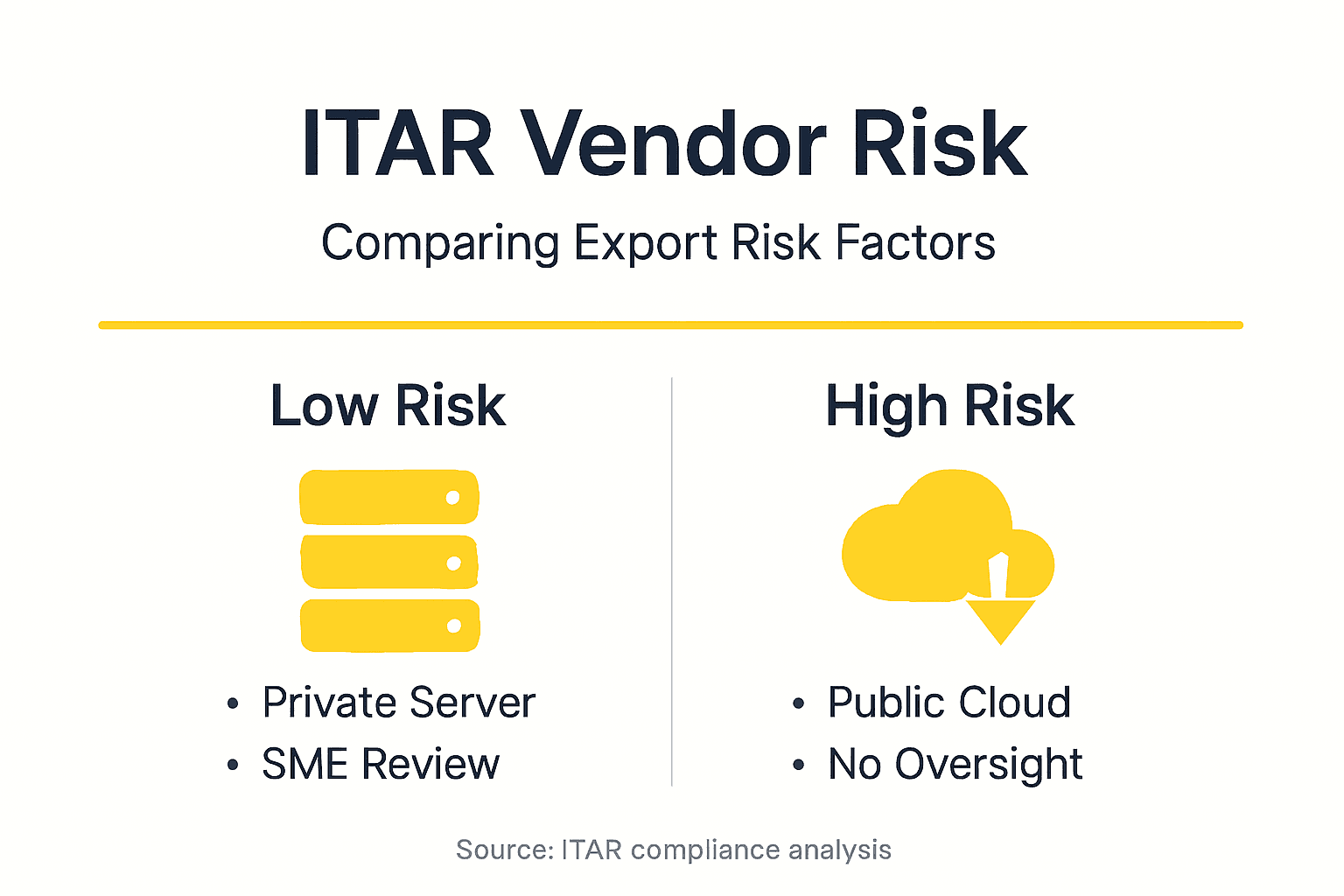
Public cloud dependency creates unauthorized cross-border transfers that violate ITAR requirements. When compliance matters, technology architecture becomes as important as translation quality.
Security and quality certifications in translation vendors for ITAR
Certifications provide verifiable evidence that a vendor implements necessary controls. Not all certifications carry equal weight for ITAR compliance.
ISO 27001 certification validates information security management systems, addressing access controls, incident response, and risk management. ISO 27001 reduces unauthorized data access risks by an average of 40%, a critical factor when handling controlled technical data. This certification requires annual audits, ensuring continuous compliance rather than a one-time assessment.
ISO 17100 establishes translation quality standards, specifying qualification requirements for linguists and project managers. ISO 18587 extends these standards to post-editing machine translation output, ensuring human review maintains quality. For ITAR documents where technical accuracy directly impacts safety and compliance, these certifications are essential.

Data sovereignty requiring private cloud or on-premises servers prevents cross-border data leaks. Many commercial translation platforms process content on shared infrastructure spanning multiple countries. This creates immediate ITAR violations when controlled data crosses borders without authorization. Vendors with private EU-hosted servers or U.S.-based infrastructure offer stronger data residency guarantees.
Quality certifications and secure hosting create audit trails for regulatory inspections. When contracting officers request documentation during compliance reviews, certified vendors provide:
Access logs showing who handled controlled data
Linguist qualifications and citizenship status
Data flow diagrams proving sovereignty controls
Quality assurance records demonstrating review processes
Key certifications to demand when evaluating translation vendors for ITAR work include:
ISO 27001 for information security management
ISO 17100 for translation service quality
ISO 18587 for post-editing processes
Data sovereignty compliance with documented server locations
Background verification programs for linguists
Certifications alone don’t guarantee compliance. You must verify the vendor applies these standards to your specific project, not just maintains them in principle.
Role of subject-matter expert review in ITAR translation workflows
Subject-matter expert linguists provide a critical compliance control that automated systems cannot replicate. Defense industry documentation contains specialized terminology, regulatory requirements, and technical nuances that general translators miss.
SME review improves accuracy by ensuring domain-specific terminology appears correctly in target languages. A mistranslation in a maintenance manual doesn’t just cause confusion. It creates safety risks and potential liability. Qualified SME linguists with defense industry experience understand these stakes and catch errors that would slip past generalist reviewers.
Beyond accuracy, SMEs act as a compliance safeguard. They recognize when content requires special handling, identify potentially controlled information that shouldn’t be translated without authorization, and flag security concerns before documents leave your control. This human judgment layer catches risks that automated checks miss.
Benefits of SME integration include:
Technical accuracy for specialized defense terminology
Compliance validation ensuring regulatory requirements are met
Terminology consistency across document sets
Auditability through documented expert review
Risk mitigation catching potential security issues
Pro Tip: Integrate SMEs early in the translation process rather than only at final review. Early involvement prevents costly rework and catches compliance issues before they propagate through entire document sets. Request SME credentials including citizenship status, security clearances if applicable, and relevant industry experience when evaluating vendors.
The hybrid AI plus human model leverages technology for speed while maintaining human oversight for compliance. Automated systems handle initial translation, then SMEs review for technical accuracy and regulatory adherence. This approach delivers faster turnaround than fully manual translation while preserving the judgment needed for ITAR-controlled content.
Common misconceptions about ITAR-related export risks in translation
Compliance teams often hold incorrect assumptions that weaken their risk management. Clarifying these misconceptions focuses efforts on actual exposure.
Misconception 1: Public cloud machine translation is ITAR safe if the vendor claims security.
Reality: Public cloud services lack necessary access control and data residency guarantees. Your controlled data flows through infrastructure you cannot audit, potentially involving foreign nationals without authorization. Security claims without verifiable architecture details are insufficient.
Misconception 2: Translation errors cause the main compliance violations.
Reality: Unauthorized access or sharing of controlled data represents the primary risk. A perfect translation delivered through non-compliant channels still violates ITAR. Poor translation quality creates operational problems, but deemed export violations occur at the access level.
Misconception 3: No AI translation system can meet ITAR standards.
Reality: Hybrid AI plus human workflows with SME reviews can comply effectively when implemented on private infrastructure. The technology itself isn’t the problem. Public cloud hosting and lack of human oversight create violations.
Misconception 4: Small translation projects don’t trigger deemed export rules.
Reality: ITAR applies regardless of project size. Translating a single page of controlled technical data creates the same exposure as translating a complete technical manual. Volume is irrelevant under deemed export regulations.
Misconception 5: Vendor confidentiality agreements provide adequate protection.
Reality: Legal agreements don’t prevent deemed exports when foreign nationals access controlled data. You need operational controls limiting access to authorized U.S. persons, not just contractual promises. NDAs address confidentiality, not export control compliance.
Common misconceptions and corresponding truths:
Belief: Commercial translation services understand ITAR. Truth: Most lack defense-specific compliance programs.
Belief: Encryption solves data sovereignty issues. Truth: Encrypted data crossing borders still violates transfer rules.
Belief: Post-delivery audits catch problems in time. Truth: Violations occur during processing, making reactive audits too late.
Refocusing compliance efforts on access control and vendor transparency addresses true sources of deemed export violations rather than peripheral concerns.
Practical risk mitigation strategies for translation vendor selection
Evaluating and selecting compliant translation vendors requires systematic assessment across multiple dimensions. Follow these steps to reduce ITAR exposure.
Step 1: Assess vendor certifications and defense industry experience.
Request copies of ISO 27001 and ISO 17100 certificates with current validity dates. Verify certifications cover the specific facilities and personnel handling your content. Ask for client references from other defense contractors and inquire about previous ITAR compliance audits.
Step 2: Confirm vendor uses proprietary AI with SME human review.
Request detailed workflow documentation showing where automation ends and human review begins. Verify that SMEs hold appropriate citizenship status and clearances if required. Avoid vendors relying exclusively on public machine translation or neural machine translation without documented SME oversight.
Step 3: Verify secure hosting environments with data sovereignty controls.
Ask specific questions about server locations, data residency guarantees, and access restrictions. Request network architecture diagrams showing data flow from intake through delivery. Confirm the vendor doesn’t route controlled content through third-party platforms or shared infrastructure.
Step 4: Establish audit trail requirements.
Negotiate contract terms requiring the vendor to maintain detailed records including:
Access logs with timestamps and user identification
Linguist assignments with citizenship verification
Quality assurance documentation
Data handling and disposal procedures
Translation memories and terminology bases provide additional transparency. These assets document previous translation decisions, ensuring consistency and creating a reviewable compliance record.
Pro Tip: Regularly conduct compliance audits requesting detailed workflow and security documentation from vendors. Annual reviews catch capability drift and verify continued adherence to agreed standards. Create a formal RFP process for translation vendor selection, treating it with the same rigor as other sensitive supplier relationships.
Vendor selection isn’t a one-time decision. Continuous monitoring ensures your translation partner maintains compliance standards as your needs and regulations evolve.
Summary and best practices for managing ITAR translation compliance
Sustaining ITAR-compliant translation operations requires both initial vendor qualification and ongoing oversight. Use this framework to maintain continuous compliance.
Vendor evaluation checklist:
Current ISO 27001 and ISO 17100 certifications
Private infrastructure with documented data sovereignty
Hybrid AI plus SME workflows with qualified reviewers
Defense industry experience and client references
Transparent audit trail capabilities
Background verification programs for linguists
Incident response and breach notification procedures
Ongoing monitoring framework:
Quarterly compliance reviews examining vendor processes
Annual security audits requesting updated documentation
Random quality checks on translated deliverables
Access log reviews confirming authorized personnel only
Regulatory update briefings ensuring vendor tracks changes
Balancing speed, security, and accuracy:
Hybrid AI plus human workflows deliver 3x to 5x faster turnaround than traditional manual translation while maintaining compliance controls. Proprietary language operations systems constrained by client terminology and style guidance produce initial output. Certified subject-matter experts then review for technical accuracy, regulatory compliance, and contextual nuance. Quality assurance aligned to ISO 17100 and ISO 18587 standards completes the workflow.
Compliance control | Benefit | Implementation method |
ISO 27001 certification | Reduced data breach risk | Annual third-party audits |
Private server hosting | Data sovereignty assurance | EU or U.S. infrastructure |
SME review | Technical accuracy and compliance validation | Defense industry linguists |
Translation memory | Terminology consistency and audit trail | Integrated workflow asset |
Access controls | Deemed export prevention | Citizenship verification and authorization |
Key takeaways for maintaining continuous oversight:
Treat translation vendor selection with the same rigor as other sensitive supplier relationships
Document your vendor qualification process for regulatory inspections
Establish clear contract terms specifying compliance requirements and audit rights
Maintain internal records of what controlled content you’ve shared with vendors
Update vendor assessments annually or when regulations change
Train your procurement team on ITAR deemed export risks in translation
Compliance isn’t a checkbox exercise. It requires active partnership with qualified vendors who understand defense industry requirements and implement verifiable controls.
Explore compliant translation solutions with AD VERBUM
Managing ITAR translation compliance demands vendors who understand both technical accuracy and regulatory requirements. AD VERBUM operates a proprietary AI ecosystem hosted on EU servers, ensuring strict data sovereignty while delivering the speed of automation with SME oversight.
Their AI plus human translation process integrates client translation memories and term bases first, then generates output through their proprietary language operations system. Certified subject-matter experts with defense industry experience review every document for technical accuracy and regulatory compliance. Quality assurance aligned to ISO 17100 and ISO 18587 standards ensures deliverables meet your requirements.
With ISO 27001 certification and 25 years serving regulated sectors, AD VERBUM provides the secure technical translation workflows defense contractors need. Their private infrastructure eliminates public cloud risks while transparent audit trails support regulatory inspections. Explore how their specialized approach addresses your ITAR compliance challenges or contact their team to discuss your specific documentation requirements.
Frequently asked questions
What specifically triggers a deemed export violation during translation?
A deemed export occurs when a foreign national accesses ITAR-controlled technical data during any workflow stage, including translation. Physical location is irrelevant. If your vendor employs non-U.S. persons who touch controlled content without proper authorization, you’ve committed a violation even if they work from a U.S. office.
How do I audit my current translation vendor for ITAR compliance?
Request documentation including ISO 27001 and ISO 17100 certificates, server location specifications, linguist citizenship verification records, and access control procedures. Ask for network architecture diagrams showing data flow and inquire about previous compliance audits. If the vendor cannot provide transparent answers, that’s a red flag indicating potential exposure.
What qualifications should subject-matter expert linguists possess for defense translation?
SME linguists handling ITAR content should demonstrate relevant technical expertise, typically through engineering degrees or equivalent industry experience, plus professional translation credentials. U.S. citizenship or permanent resident status is essential. Security clearances may be required depending on classification level. Request detailed CVs and citizenship verification before allowing vendor personnel to access controlled documents.
Can any AI translation technology comply with ITAR requirements?
Proprietary AI systems hosted on private infrastructure with enforced access controls and mandatory SME review can comply when properly implemented. Public cloud-based machine translation or neural machine translation services generally cannot meet ITAR standards due to data sovereignty issues and lack of access control. The key differentiators are hosting architecture, terminology governance, and human oversight.
Why are ISO certifications important for ITAR translation vendors?
ISO 27001 validates information security management reducing breach risks by an average of 40 percent. ISO 17100 and ISO 18587 ensure translation quality and post-editing standards necessary for technical accuracy. These certifications require third-party audits providing verifiable evidence of controls rather than self-reported claims. For regulatory inspections, certified vendor partnerships demonstrate due diligence in supplier qualification.
How often should I reassess my translation vendor’s compliance status?
Conduct formal compliance reviews annually at minimum, with quarterly check-ins on security practices and any process changes. Reassess immediately if regulations change, your vendor modifies their technology stack or infrastructure, or you experience quality or security concerns. Continuous monitoring prevents capability drift and ensures your vendor maintains agreed standards as your relationship evolves.
Recommended

