
How translation errors can void arbitration clauses

A single mistranslated word in an arbitration clause can unravel years of M&A negotiation, strip a party of its chosen dispute forum, and expose your client to jurisdictions they never agreed to. This is not a theoretical risk. Certified translations are required for enforcement under New York Convention Article IV, and procedural rejection on translation grounds happens. For M&A counsel and dispute resolution partners advising on cross-border EU transactions, understanding precisely where translation fails, and why, is a front-line competency.
Table of Contents
Key Takeaways
Point | Details |
Translation precision is critical | Mistranslations can invalidate arbitration clauses and block award enforcement. |
Certified translations often required | Many jurisdictions, including France, demand certified translations for enforceability. |
Case law varies by country | China and the US penalize flawed translations more than the EU, where precision is key. |
Early diligence in drafting | Proactive legal and linguistic review is the best safeguard against fatal errors. |
Why translation accuracy matters in cross-border arbitration
Arbitration clauses are not boilerplate. Each element, the seat of arbitration, the language of proceedings, the scope of disputes covered, the governing law, carries legal weight that shifts the moment a word is rendered inaccurately. In a cross-border deal, these clauses are often executed in two or more language versions. When those versions diverge even slightly, courts and tribunals are forced to interpret which version controls, and that interpretation may not favor your client.
The legal foundation is clear. Procedural rejection on translation grounds is a recognized risk under New York Convention Article IV, which requires the party seeking enforcement to provide a certified translation of the arbitral award and the original agreement. Inaccuracy at this stage is not a minor inconvenience. It can result in the award being refused.
In M&A transactions, the stakes multiply. Consider a share purchase agreement (SPA) executed in English and German, with an ICC arbitration clause designating Vienna as the seat. If the German version renders “disputes arising out of or relating to this Agreement” more narrowly as “disputes arising out of this Agreement,” the scope of arbitrable matters contracts. Post-closing disputes over representations, warranties, or indemnities might fall outside the clause entirely in one language version, creating a direct conflict between the parties’ obligations.
Key areas where translation precision is non-negotiable include:
Seat designation. The seat determines the lex arbitri, the procedural law governing the arbitration. A mistranslation that renders “Vienna” as a general reference to Austrian courts rather than the seat of arbitration can trigger seat designation drift and reroute the entire proceeding.
Language of proceedings. Ambiguity here creates disputes about which language governs written submissions, oral hearings, and the award itself.
Scope of disputes. Broad vs. narrow renderings directly affect what claims are arbitrable.
Governing law. A clause specifying “the laws of England and Wales” in English but referencing only “English law” in the French version creates ambiguity about whether Welsh law applies, with real consequences for post-Brexit cross-border deals.
Institutional rules reference. A mistranslation of the administering institution (ICC vs. LCIA, for example) has been cited in disputes about forum selection before enforcement courts.
Investing in certified translation precision is not a cost of doing business. It is a condition of enforceability.
“A translation error in an arbitration clause is not a drafting imperfection to be cured by interpretation. It is a structural defect that shifts the center of gravity of the entire dispute resolution mechanism.”
Common translation errors that jeopardize validity
With the stakes established, let’s examine the specific failure modes that create legal exposure in arbitration clauses. The error categories below are drawn from litigated disputes and enforcement proceedings across multiple jurisdictions.
The four most damaging error types
Non-equivalent legal terminology. Legal systems do not share a one-to-one vocabulary. “Arbitration” in English does not map identically to “arbitrage” in French or “Schiedsverfahren” in German in every procedural context. Choosing the wrong term can shift the proceeding from binding arbitration to a non-binding conciliation mechanism, which a counterparty’s local counsel will exploit at enforcement.
Scope creep through literal translation. A literal rendering of “any dispute, controversy, or claim arising out of, relating to, or in connection with” might collapse in translation to a shorter phrase that excludes tort claims or pre-contractual liability. Literal translation optimizes for word-for-word fidelity, not functional legal equivalence.
Omissions in bilingual clause structures. When a dual-language SPA is drafted under time pressure, translators sometimes omit subordinate clauses or carve-outs that appear in only one language version. These omissions are invisible unless the versions are cross-referenced systematically.
Inconsistency across documents. In the Juarez v. Wash Depot matter, an inconsistent handbook translation between the English and Spanish versions regarding the severability of a PAGA waiver rendered the entire arbitration agreement unenforceable. The divergence was small in word count. The consequence was total.
Literal vs. functional translation: a direct comparison
Dimension | Literal translation | Functional (legal) translation |
Primary goal | Word-for-word fidelity | Legal equivalence of meaning |
Terminology handling | Source-language driven | Target-jurisdiction aligned |
Risk in arbitration clauses | Scope drift, missing nuance | Low, when reviewed by legal SME |
Suitable for | General reference documents | Enforceable legal instruments |
Reviewer required | None assumed | Legal subject-matter expert essential |
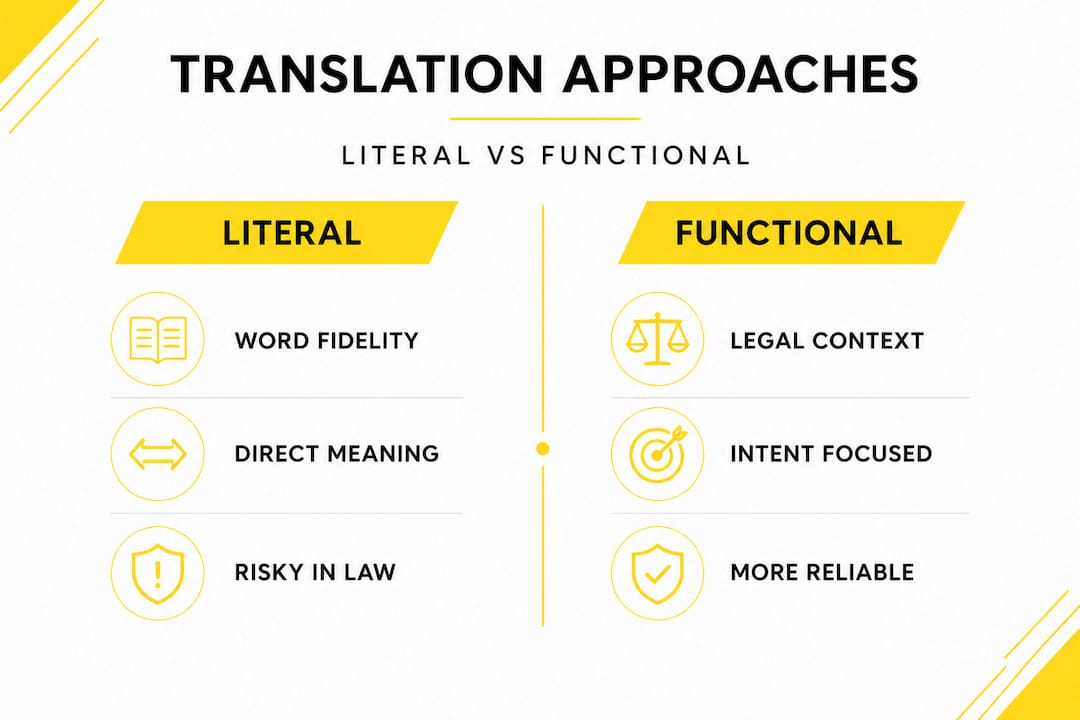
The table makes the choice obvious for regulated, high-value instruments. Yet many deal teams default to general translation vendors under deadline pressure, a habit that avoiding terminology errors in cross-border contracts demands you break.
Pro Tip: Always cross-check bilingual arbitration clauses with local counsel in each enforcement jurisdiction before execution. A clause that reads correctly in English may carry a different procedural meaning in the local legal system, even if the translation is technically accurate. The final check should be legal, not linguistic. For a systematic approach to this, ensuring translation accuracy before signing is worth building into your deal timeline.
Jurisdictional case studies: How courts approach translation errors
Examining how enforcement courts in France, China, and the United States have handled translation discrepancies reveals patterns that directly inform drafting practice.

Jurisdiction-by-jurisdiction breakdown
Jurisdiction | Approach to translation errors | Enforcement posture |
France | Requires certified translations; pro-arbitration overall | Will reject enforcement without certified translation |
China | Strict adherence to Chinese version; party language preference controls | Chinese-language version often deemed authoritative |
United States (California) | Unconscionability doctrine applied if no translation provided | Can invalidate on access grounds, not just accuracy |
EU (Brussels Recast) | Focus on clause precision; translation errors rarely reach invalidation | No direct invalidation precedents found |
France. French courts require certified translations for award enforcement but maintain a generally pro-arbitration stance when the procedural requirements are met. The risk for M&A counsel is procedural rather than substantive: failure to produce a certified translation at the enforcement stage causes procedural rejection, which delays recognition, generates costs, and introduces uncertainty into what should be a clean post-award process. For ICC-seated arbitrations where French enforcement may be sought, the translation package for the award and the underlying arbitration agreement must be prepared in advance.
China. Chinese enforcement courts have taken a strict approach to language versioning. Where the arbitration clause was executed in both Chinese and another language, Chinese courts have consistently treated the Chinese-language version as authoritative when conflicts arise. This has real implications for M&A deals involving Chinese targets or counterparties: the Chinese-language version of the arbitration clause must be drafted with the same care as the English version, not treated as a translation.
United States. California courts have applied the unconscionability doctrine to arbitration agreements where the non-English-speaking party was not provided with an adequate translation. The Juarez v. Wash Depot precedent illustrates that inconsistent translation between language versions can make an arbitration clause unenforceable even when the English version is perfectly drafted. This is relevant for cross-border transactions with US-based parties or where US enforcement is anticipated.
EU and Brussels Recast. No direct cases have been found where translation errors invalidated arbitration clauses under the Brussels Recast Regulation. EU courts currently focus on clause precision and whether the clause meets the formal requirements of the regulation. However, this should not create complacency. The absence of precedent reflects that most enforcement disputes are resolved before reaching the Court of Justice, not that translation errors are consequence-free.
Specific clause elements where enforcement bodies have flagged discrepancies include seat designation language, the reference to institutional rules, and the language specifying which version controls in the event of conflict. For jurisdictional translation compliance in EU transactions, the controlling-language clause must itself be unambiguous in all executed language versions. And when structuring deals with parties across multiple jurisdictions, merchant agreement localization patterns show that drafting the local-language version first, then translating into English, often produces more accurate results than the reverse.
Best practices: Safeguarding arbitration clauses from translation risk
Given the pitfalls revealed in these case studies, it’s crucial to implement systematic safeguards. The following framework reflects what best-in-class M&A and dispute resolution teams actually do.
Require certified translations for all enforcement jurisdictions from the outset. Do not wait until the enforcement stage to commission certified translations. New York Convention Article IV requirements apply at enforcement, but preparing translations after a dispute arises is more expensive, slower, and more likely to generate challenges.
Establish a controlling-language clause and make it identical in all language versions. This sounds obvious, but the controlling-language clause is itself subject to translation. If the English version says “the English version shall prevail” and the French version says “les deux versions font foi” (both versions are authentic), you have a direct conflict before any other dispute arises.
Validate legal equivalence, not just linguistic accuracy. A translation can be linguistically correct and legally wrong. The term “arbitration” must map to the functional equivalent in the target legal system, not just the closest phonetic or semantic match.
Use jurisdiction-specific checklists for high-value or regulated deals. A checklist approach forces systematic comparison of every material clause element across language versions before execution. This is documented diligence that also supports your audit trail. Review a certified translation vendor checklist to understand what a rigorous vendor engagement looks like.
Identify the key clause elements that require SME legal linguist review. Not every document requires the same level of scrutiny. For arbitration clauses, the seat, the scope of disputes, the institutional rules reference, the language of proceedings, and the governing law all require legal subject-matter expert review, not general linguist review. This distinction matters when selecting your translation vendor for arbitration legal translation support.
Pro Tip: For VIAC, LCIA, or ICC-administered arbitrations, check the relevant institution’s guidance on language requirements for submissions and awards before finalizing the arbitration clause. Some institutions have specific requirements about what language the clause itself must be submitted in at the commencement stage, and a translation that departs from the submitted clause language creates an early procedural complication.
Hard-won lessons: Why translation strategy beats post-dispute fixes
Here is the view that most transaction teams do not internalize until it is too late: translation errors in arbitration clauses are not curable defects. They are structural problems that become exponentially harder to address once a dispute is live.
Many experienced M&A counsel operate on a tacit assumption that courts will apply a “spirit over letter” interpretive tolerance when translation discrepancies emerge. This assumption is frequently wrong, and dangerously so. Enforcement courts, particularly in France and China, apply formalistic review to translation requirements. A tribunal seated in Vienna under VIAC rules does not have unlimited discretion to rewrite a clause that means different things in its two executed languages. The doctrine of contra proferentem may be applied against the drafter. The court may choose the interpretation least favorable to the party that prepared the document.
The transactional speed pressure that drives this problem is real. Deal timelines compress. Translation is treated as an administrative step rather than a legal diligence item. The translation is commissioned overnight from a general vendor, and the clause is signed. This is how ISO certified translation for compliance becomes relevant not as a credential to check, but as a workflow standard that forces the right process to happen at the right time.
Best-in-class M&A deal teams treat translation as part of the risk architecture of the transaction. They allocate budget for certified, SME-reviewed legal translation at the drafting stage. They include translation review milestones in the deal timeline. They do not rely on post-signing amendment or side letter to fix what should have been correct in the executed document.
The uncomfortable reality: “translation after signing” is not a safety net. If your counterparty discovers a favorable discrepancy in the foreign-language version of the arbitration clause, they will use it. The diligence you do at the drafting stage may be the direct determinant of whether your client’s chosen arbitration forum holds or collapses under jurisdictional challenge.
Get translation support tailored for cross-border deals
Applying these best practices is seamless with the right expert partner behind you.

AD VERBUM’s legal translation expertise is built specifically for high-stakes, regulated environments. With 25+ years of experience, a network of 3,500+ subject-matter expert linguists including legal scholars, and ISO 17100 and ISO 18587 aligned QA workflows, AD VERBUM supports M&A counsel with certified translations for arbitration clauses, SPAs, and enforcement documentation across 150+ languages. The AI+HUMAN hybrid LangOps System delivers 3x to 5x faster turnaround than traditional workflows while maintaining SME legal review at every stage. Data is processed on private EU-hosted infrastructure under ISO 27001 certification, meeting the data sovereignty requirements of cross-border deal work. Explore AD VERBUM’s full range of localization services to see how translation precision integrates into your deal workflow from day one.
Frequently asked questions
Can a minor translation inconsistency really nullify an arbitration clause?
Yes. As illustrated in the Juarez v. Wash Depot case, even a small divergence between language versions regarding a key term such as a waiver’s severability can render the entire arbitration agreement unenforceable.
Do all jurisdictions require certified translations to enforce arbitration awards?
No, but many enforcement-friendly jurisdictions, including France, require certified translations under New York Convention Article IV, and failure to provide one causes procedural rejection regardless of the award’s merits.
Has the EU Court of Justice invalidated arbitration clauses due to translation errors?
No direct precedents have been found. As recent ECJ case law on asymmetric clauses shows, EU courts focus on clause precision and formal validity rather than translation defects specifically.
What’s the best way to prevent translation errors in cross-border arbitration clauses?
Engage certified translation providers with legal SME linguists, cross-check all language versions with local counsel before execution, and apply jurisdiction-specific checklists to verify that every material clause element carries equivalent legal meaning across all executed language versions.
Recommended

