


How to translate SCCs for GDPR compliance

Standard Contractual Clauses (SCCs) are the backbone of lawful international data transfers under GDPR Chapter V, yet the question of how to handle them across multiple languages trips up even experienced legal teams. The core SCC text must remain unmodified to preserve validity, but multinational organizations still need to execute these agreements across German, French, Polish, Japanese, and dozens of other languages. Get it wrong and you risk not just an invalid transfer mechanism but a supervisory authority audit trigger and fines that can reach 4% of global annual turnover. This article gives you the exact framework to manage that tension.
Table of Contents
Key Takeaways
Point | Details |
Do not translate core SCCs | Always use the official text of Standard Contractual Clauses without modification for GDPR compliance. |
Translate annexes only | Annexes and supporting documents may be translated and certified as needed for local enforcement. |
Official sources matter | Download SCCs from authentic sources like EUR-Lex to ensure validity in court or audits. |
Manage bilingual contracts correctly | Use a cover note to clarify which language version controls if explanatory translations are added. |
Pitfalls carry major penalties | Invalid SCCs due to translation errors can trigger regulatory action and large fines. |
Understanding SCC translation risks and requirements
SCCs are pre-approved legal instruments issued by the European Commission under Article 46(2)© of the GDPR. Their legal force comes precisely from the fact that they have been reviewed and approved in a fixed form. The moment you alter the core text, even to fix a perceived ambiguity or adapt phrasing for a local audience, you are no longer using an approved transfer mechanism. You are using a custom contract that has not been authorized under GDPR.
This is not a technicality. SCCs cannot be modified except to select modules, add optional clauses where the text permits, or fill in the annexes. Any other change, including a translation that introduces even subtle semantic drift in the operative clauses, risks invalidation. A supervisory authority reviewing your transfer records does not need to prove intent. If your executed SCC deviates from the approved text, the transfer mechanism fails.
The stakes are concrete. Unlawful transfers carry fines of up to 4% of global annual turnover under Article 83(5) GDPR. Beyond the financial exposure, an invalid SCC means all personal data transferred under it was transferred without a lawful basis. That triggers breach notification obligations, potential suspension orders from supervisory authorities, and significant reputational damage with enterprise clients who conduct their own transfer impact assessments.
Importantly, no EDPB guidance mandates translation of the core SCC text. The EDPB’s focus in Recommendations 01/2020 and subsequent guidance is on ensuring SCCs are used in unmodified form and that supplementary technical and organizational measures are in place where needed. Translation is an operational question, not a regulatory requirement for the core clauses.
Key principle: The legal validity of an SCC rests on its exact correspondence to the European Commission’s approved text. Translation of core clauses is not a compliance step. It is a compliance risk.
The risks compound when organizations treat SCC invalidation risks as a theoretical concern. In practice, supervisory authorities in Germany, France, and the Netherlands have demonstrated willingness to scrutinize transfer mechanisms closely, particularly following the Schrems II ruling. Any deviation from the approved text becomes an immediate audit flag.
When and how to use translated versions: official languages and operational realities
Here is where the picture becomes more nuanced, and where many organizations either over-restrict or over-permit. The European Commission publishes SCCs in all official EU languages through EUR-Lex. These are authentic national language versions that carry the same legal standing as the English text. If your organization is executing an SCC with a Polish data importer, you can use the Polish language version published on EUR-Lex. That is not a translation. That is an official version.
The practical implication is significant. You do not need to use English exclusively. You need to use an official, unmodified version in one of the languages in which the Commission published the clauses. For EU member state counterparties, this usually means you can find an authentic version in their national language. The controlling version for execution purposes should be clearly identified in the contract.
For transfers involving non-EU counterparties, where no official EUR-Lex version exists in the relevant language, the standard practice is to execute the official English (or other EUR-Lex language) version and attach a translated explanatory document or parallel text for comprehension. The translated version does not replace the executed text. It supplements it.

Document type | Can be translated | Requires certified translation | Controls in dispute |
Core SCC clauses (Modules 1-4) | Only via official EUR-Lex versions | Not applicable | Official EUR-Lex version |
Annex I (data description, parties) | Yes | Recommended for legal effect | Designated controlling language |
Annex II (technical measures) | Yes | Recommended for audit defense | Designated controlling language |
Annex III (sub-processors) | Yes | Recommended | Designated controlling language |
Explanatory/parallel text | Yes | Recommended for comprehension | Does not control |
For jurisdictional language compliance, the annex strategy is where most of the practical work happens. Annexes describe the specific data categories, processing purposes, technical and organizational measures, and sub-processor lists. These are not pre-approved text. They are your organization’s specific content, and they absolutely can and should be translated when local enforceability or regulatory interface requires it.
Pro Tip: Always include a governing language clause in your SCC cover sheet or accompanying agreement. State explicitly which language version controls in the event of a conflict. This is standard practice in bilingual contract execution and provides a clear defense position if a supervisory authority questions which text was operative.
Step-by-step process: Executing SCCs in multinational settings
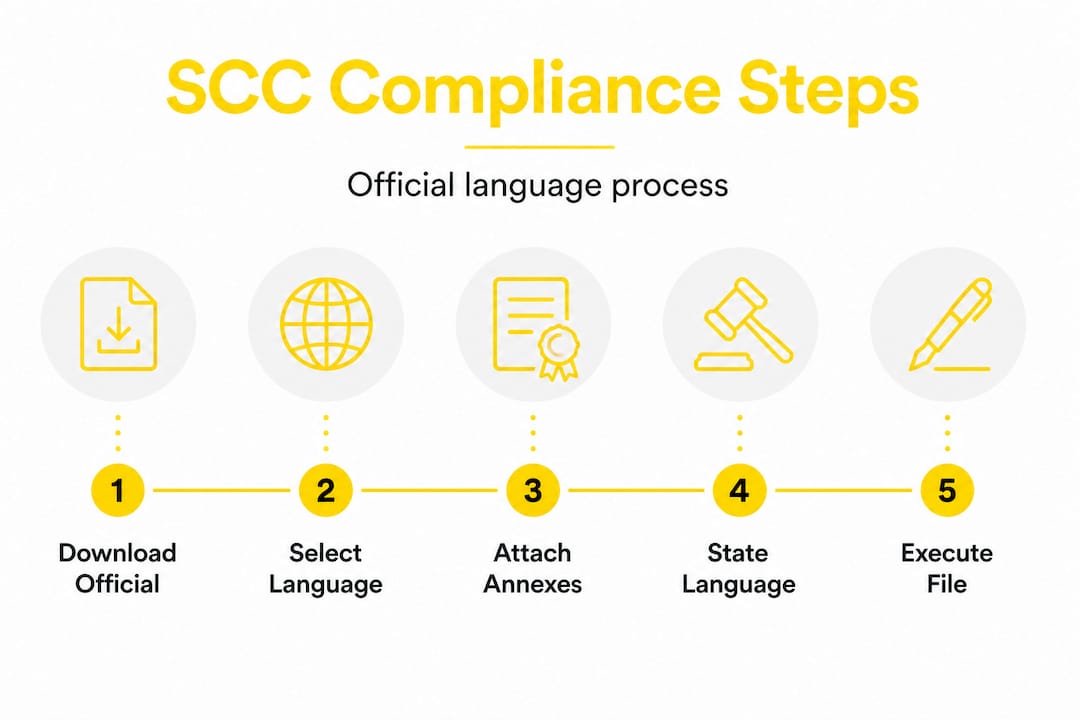
The following process reflects what leading DPOs and data protection counsel actually do when executing SCCs across multiple jurisdictions. It is organized around the four-phase arc of acquire, prepare, execute, and record.
Download the official SCC text. Go directly to the European Commission’s website or EUR-Lex. Do not use third-party templates, law firm adaptations of the core text, or vendor-provided versions unless you have verified they are word-for-word reproductions of the official text. Select the language version appropriate for your counterparty, or use English as the default execution language.
Select the correct module. The 2021 SCCs contain four modules: controller-to-controller (Module 1), controller-to-processor (Module 2), processor-to-controller (Module 3), and processor-to-processor (Module 4). Each module carries different obligations, particularly around Article 28 GDPR requirements for processor relationships. Misidentifying the module is itself a compliance failure, because the obligations embedded in the clauses will not match your actual data processing relationship.
Prepare the annexes. This is where your organization’s specific content goes. Annex I covers the parties, data subjects, categories of personal data, and purposes. Annex II covers technical and organizational measures. Annex III lists approved sub-processors where relevant. Prepare these in the language of the executing parties. If the counterparty is in Japan, prepare an English annex and a Japanese parallel version. Identify which controls.
Commission certified translation of annexes where required. For regulated document translation, annexes attached to SCCs should be translated by certified legal translators with subject-matter expertise in data protection. A generic translation of Annex II that mischaracterizes your encryption standard or access control framework is not just inaccurate. It is a misrepresentation of your supplementary measures, which becomes a direct audit liability.
Execute without altering the core text. Both parties sign the official SCC text in the selected language version. No additions, deletions, or amendments to the operative clauses. Optional clauses may be included only where the official text explicitly provides for them.
Maintain records and manage versions. Document which version was executed, in which language, on which date, and by which parties. For organizations managing large-scale documentation across multiple transfer relationships, version control is a recurring audit vulnerability. A clear records management protocol protects you when a supervisory authority requests evidence of your transfer mechanism.
Phase | Key action | Language requirement | Audit risk if skipped |
Acquire | Download from EC/EUR-Lex | Official version only | Invalid transfer mechanism |
Module selection | Identify processing relationship | N/A | Wrong obligations applied |
Annex preparation | Draft data and measures content | Translate as needed, certify | Misrepresented measures |
Execution | Sign unmodified core text | Official EUR-Lex language | Invalidity, fine exposure |
Records management | Archive executed version | Controlling language documented | Audit gap |
Pro Tip: Pair every executed SCC with a Transfer Impact Assessment (TIA). The TIA evaluates the legal framework of the destination country and justifies why the SCC provides adequate protection in context. A mistranslated or vague TIA is as dangerous as a modified SCC. If your TIA is prepared in English and needs to be shared with a local regulator in another language, that translation also requires certified legal review.
Common compliance pitfalls and how to avoid them
The most common failure mode is not malicious. It is convenience. A legal operations team under time pressure uses a translated SCC template sourced from a vendor or a prior deal, without verifying it against the current official text. The template may have been accurate when it was created. Regulatory texts evolve, and the 2021 SCCs replaced the prior 2010 versions entirely.
Using unofficial translations as the executed text. Any translation not sourced directly from EUR-Lex is not an official version. Executing it as the operative SCC invalidates the transfer mechanism, regardless of how accurate the translation is.
Failing to distinguish core clauses from annexes. Organizations that apply a blanket “do not translate” policy to the entire SCC document miss the legitimate and necessary translation work that should happen in the annexes. Conversely, organizations that translate freely often inadvertently touch operative clauses.
Using generic translators for annexes and TIAs. A freelance translator without legal and data protection expertise will not recognize that “pseudonymization” and “anonymization” have specific and distinct legal meanings under GDPR. Mistranslating these terms in Annex II or a TIA creates a direct discrepancy between your stated measures and your actual practices.
No version control in bilingual contracts. When both an English SCC and a translated parallel document exist, you must specify which controls. Without that designation, a dispute or supervisory authority inquiry can create ambiguity about which text was operative.
Treating supplementary measures as optional. Following Schrems II, supplementary technical and organizational measures are often required alongside SCCs for transfers to high-risk third countries. Translation of the SCC does not substitute for these measures.
Warning: Supervisory authority audit triggers include data subject complaints, breach notifications, and routine compliance reviews. If an auditor finds that your executed SCC deviates from the official text, even in a translated annex that introduces ambiguity into the operative measures, you face an immediate finding of non-compliance.
The data security dimension of SCC translation is also frequently underestimated. When you send SCC drafts, annexes, and TIAs to a translation vendor, you are sharing documents that contain details of your data processing architecture, your sub-processors, and your technical security measures. That information is sensitive. Using a translation vendor that processes your documents through public cloud infrastructure or consumer-grade NMT tools creates a data governance gap that is inconsistent with the security posture your SCC is meant to document.
Why “official only” saves you from compliance disaster: a practical view
There is a recurring temptation in multinational legal teams to treat SCC localization as a form of stakeholder service. The argument goes: our counterparty in Brazil or South Korea will understand the agreement better if the operative clauses are in their language. Their legal team will be more comfortable. The deal will close faster.
This reasoning is understandable. It is also wrong, and experienced DPOs know it. Some providers offer localized SCCs for frameworks like the Swiss FADP, but core EU GDPR SCCs remain English and modular in their official form. The moment you hand a counterparty a translated version of the operative clauses as the executed text, you have created an instrument that no supervisory authority has approved. You have also created a document where any semantic difference between your translation and the official text becomes a potential point of dispute.
What leading DPOs actually do is simpler and more defensible. They execute the official text, in the official language, without modification. They attach a translated explanatory document for counterparty comprehension. They certify the annex translations. They document the governing language. And they pair the whole package with a robust TIA. That approach is auditable, defensible, and consistent with how supervisory authorities expect to see transfer records maintained.
The pressure to customize SCCs often comes from business teams, not legal teams. Managing that internal pressure is itself a core DPO competency. The answer is not to resist localization entirely. It is to channel localization energy into the right documents: the annexes, the TIA, the cover agreement, and the explanatory materials. The translation compliance framework that works in practice is one that is strict about the core and flexible about the periphery.
Take the stress out of SCC translation compliance
Managing SCC execution across multiple jurisdictions requires more than legal knowledge. It requires a translation workflow that is certified, secure, and built for regulated content.

AD VERBUM’s GDPR compliance translation services are designed specifically for organizations executing international data transfers under GDPR Chapter V. With ISO 17100, ISO 18587, and ISO 27001 certification, AD VERBUM provides certified legal SME review for SCC annexes, Transfer Impact Assessments, and parallel explanatory documents. The proprietary LangOps System processes your documents on EU-hosted private infrastructure, with no reliance on public cloud tooling. Every translation follows the AI+HUMAN hybrid workflow: asset integration, LLM generation constrained by your terminology, certified legal expert review, and ISO-aligned QA. For DPOs managing transfer records that need to survive a supervisory authority audit, that level of rigor is not optional. Contact AD VERBUM to discuss your SCC translation requirements.
Frequently asked questions
Can we sign SCCs in a language other than English?
You may use authentic national language versions published on EUR-Lex for EU official languages, but the executed text must exactly match that official version without any modification.
Do annexes and data maps attached to SCCs need certified translation?
Annexes can be translated into the counterparty’s language and should use certified legal translators, as annex translations for local enforcement may need to withstand regulatory scrutiny in multiple jurisdictions.
Is there an approved way to create bilingual SCCs for global contracts?
Yes. Execute the official EUR-Lex language version as the controlling text, attach a translated explanatory document for comprehension, and include a governing language clause specifying which version controls in a dispute.
What is the penalty for using a modified or unofficial SCC translation?
Using non-official or modified SCCs can invalidate your transfer mechanism entirely, and unlawful data transfers expose your organization to fines of up to 4% of global annual turnover under Article 83(5) GDPR.
Is EDPB approval needed for SCC translation?
No. EDPB guidance focuses on unmodified use of SCCs and supplementary measures for high-risk transfers, not on translation approval, so no separate EDPB sign-off is required for translated annexes or explanatory documents.
Recommended
