


Quantify translation risk: calculating true regulatory costs

A pharmaceutical company submits a drug registration dossier across five EU markets. One critical contraindication is mistranslated in the Polish label, softening an absolute prohibition into a relative caution. The error clears internal review because no subject-matter expert verified the output. Six months later, a post-market adverse event triggers a regulatory inquiry. The recall costs exceed €4.2 million. The reputational damage persists for years. This scenario is not hypothetical. It plays out in some form every year in pharma, medical devices, finance, and defense. The core problem is not just that translation errors happen. It is that most organizations have no structured way to calculate what those errors actually cost before they occur.
Table of Contents
Key Takeaways
Point | Details |
Translation errors carry hidden costs | Regulatory, financial, and reputational impacts often exceed initial estimates. |
Quantification framework is essential | Structured cost analysis supports compliance decisions and vendor selection. |
Review and adapt constantly | Ongoing verification and updates ensure your risk calculations stay relevant as regulations change. |
Vendor expertise matters | Premium service providers help reduce total risk and avoid costly errors. |
Understanding translation risk in regulated environments
Translation risk is the probability that a documentation error in a target language will trigger a regulatory, legal, operational, or reputational consequence. That definition sounds straightforward. The challenge is that most compliance programs treat translation as a delivery function rather than a risk category. That gap is expensive.
Translation inaccuracies can affect regulatory compliance and legal standing in ways that vary significantly by sector. In life sciences, a mistranslated dosage instruction on a product label can trigger an EU Medical Device Regulation enforcement action, a product withdrawal, or liability litigation. In financial services, an incorrectly translated prospectus clause can constitute a material misstatement under MiFID II. In defense, a mistranslated maintenance procedure can create AQAP audit failures and contract exposure.
The direct consequences of translation errors in regulated environments include:
Regulatory fines and enforcement actions: Under GDPR, a data breach linked to a mistranslated privacy notice has contributed to fines reaching tens of millions of euros.
Product recalls and market withdrawals: FDA and EMA enforcement records show that labeling errors, including translation failures, represent one of the top causes of Class II and Class III recalls.
Contract invalidation: Poorly translated legal documents can create ambiguity that voids clauses or shifts liability in litigation.
Clinical trial invalidation: In multilingual clinical trials, protocol or informed consent translation errors can lead to trial suspension and patient safety breaches.
Reputational damage: Loss of market confidence, delayed approvals, and publicized compliance failures compound direct financial losses significantly.
“Even minor translation deviations can lead to regulatory breaches that trigger enforcement timelines organizations are entirely unprepared to manage.”
The table below summarizes risk exposure by sector, giving you a working baseline for the quantification model built in later sections.
Sector | Document types at risk | Primary regulatory consequence | Estimated cost range per incident |
Life sciences | Product labels, clinical protocols, IFUs | EMA/FDA recall, MDR enforcement | €500K to €10M+ |
Legal and compliance | Contracts, court filings, compliance manuals | Clause invalidation, litigation | €100K to €5M |
Finance | Prospectuses, fund documents, disclosures | MiFID II enforcement, civil liability | €250K to €8M |
Defense | Technical manuals, maintenance procedures | AQAP audit failure, contract loss | €200K to €4M |
Medical devices | IFUs, labeling, CE documentation | MDR enforcement, market withdrawal | €1M to €15M |
For legal document compliance delivery teams, understanding where your organization sits in this table is the first step toward building a defensible risk model.
Preparation: Mapping risk factors and identifying cost drivers
Before you assign financial values to translation risk, you need a clear inventory of what creates that risk in your organization. The following checklist covers the three primary risk dimensions you should map before running any calculation.
Regulatory risk factors:
Documents subject to jurisdiction-specific translation requirements (e.g., MDR Article 10, FDA 21 CFR Part 801)
Languages required for market authorization across multiple national competent authorities
Update frequency for regulations that affect documentation requirements
Existence of approved terminology lists or controlled vocabulary requirements per regulatory body
Operational risk factors:
Volume and frequency of documentation that requires translation
Presence or absence of verified Translation Memories ™ and Term Bases (TB) for controlled terminology
Internal review capacity, specifically whether subject-matter experts are involved in any review stage
Time pressure on translation turnaround and how it affects QA steps
Vendor-related risk factors:
Whether your current translation provider holds ISO 17100 and ISO 18587 certifications for translation processes
Whether post-delivery QA is performed by a qualified second reviewer, not just the translator
Whether the vendor uses a private, auditable environment or public cloud tools for sensitive documentation
Adherence to a translation data security checklist that covers data handling, access controls, and breach notification
Pro Tip: Post-delivery QA is the most commonly skipped step and simultaneously the point where the highest-value errors are caught. If your vendor cannot demonstrate an independent QA pass aligned to ISO 17100, that alone is a material risk factor for your calculation.
Vendor evaluation protocols for high-risk translation consistently identify that organizations underestimate the cost of switching or remediating a failed translation after submission. Mapping cost drivers before quantification prevents this.

The table below organizes typical cost drivers by category to anchor your financial model.
Cost driver | Category | Example scenario | Estimated annual exposure |
Regulatory penalties | Direct | Mistranslated label triggers enforcement letter | €50K to €2M per incident |
Product rework and relabeling | Direct | Re-print, re-package, re-distribute corrected label | €200K to €3M per recall |
Legal fees | Direct | Contract dispute due to ambiguous translated clause | €75K to €1.5M per case |
Audit delays | Indirect | Inaccurate dossier translation delays market approval | €100K to €5M in delayed revenue |
Lost market share | Indirect | Publicized compliance failure reduces prescriber confidence | €500K to €20M over 3 years |
Internal rework | Operational | QA team re-review and correction of flawed translations | €20K to €250K annually |
Execution: A framework for quantifying the true cost of an error
This is where the model becomes actionable. The following framework gives you a structured method for assigning probability-weighted cost estimates to your translation risk inventory.
Step 1: Identify your error types and document categories
Group your documents by risk tier. Tier 1 covers safety-critical documents: product labels, Instructions for Use (IFUs), clinical trial protocols, informed consent forms, and regulatory submissions. Tier 2 covers compliance-critical documents: legal contracts, audit reports, financial disclosures, and maintenance manuals. Tier 3 covers operational documents: marketing materials, training manuals, and internal communications. Each tier carries different regulatory consequence profiles.
Step 2: Estimate incident probability per document type
Use historical data if available. If not, use industry incident rates. FDA enforcement data and EMA recall databases show that labeling-related errors account for roughly 30 to 40 percent of pharmaceutical recalls annually. For regulated document workflows that lack certified QA, incident probability for Tier 1 documents can reasonably be estimated at 5 to 15 percent per submission cycle, depending on volume and language count.
Step 3: Assign unit costs per error type
For each error type, assign a low, mid, and high cost estimate. Use the cost driver table from the previous section as your input. Then apply probability weighting. The formula is simple: Expected Loss = Probability of Incident x Unit Cost of Incident.
A sample calculation for a pharmaceutical product label translated into eight EU languages:
Document tier: Tier 1
Estimated error probability with uncertified workflow: 10%
Unit cost of a labeling recall (mid estimate): €2.5M
Expected annual loss (uncertified workflow): 0.10 x €2.5M = €250,000
Estimated error probability with ISO 17100 or ISO 18587 certified workflow: 1.5%
Expected annual loss (certified workflow): 0.015 x €2.5M = €37,500
Annual risk reduction value from certified workflow: €212,500
That differential, roughly €212,500 in expected annual loss reduction, becomes your financial justification for investing in a certified language service provider rather than a lower-cost uncertified alternative.
Step 4: Aggregate across your full document portfolio
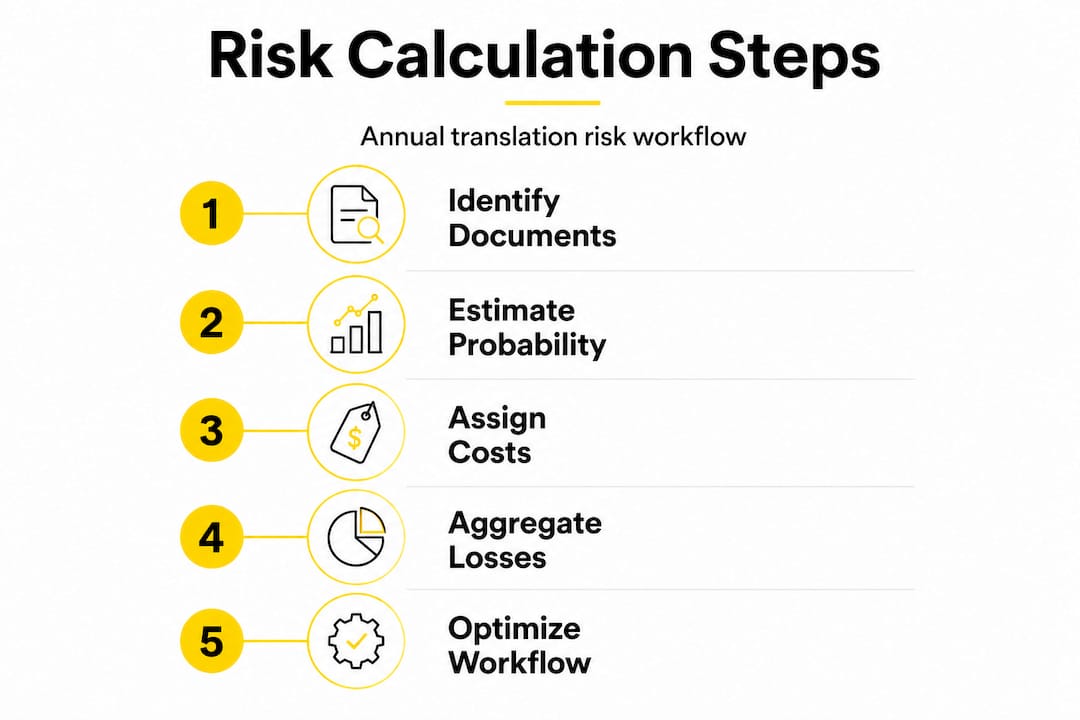
Run the calculation for each document category across your full volume. Sum the expected annual losses under your current workflow. Then rerun with the certified workflow assumptions. The difference is your risk-adjusted return on investment for upgrading your translation supplier.
Pro Tip: Reputational impact is the hardest cost to assign a number to, but it is often the largest. Bring in your marketing, investor relations, and legal teams to estimate the revenue exposure from a publicized compliance failure in your primary markets. A cross-functional session with even rough numbers will improve the accuracy of your model by an order of magnitude.
For additional guidance on translation compliance documentation requirements, cross-referencing your framework with sector-specific audit standards is strongly recommended. You may also find it useful to review established contract certainty frameworks when modeling the legal risk dimension of mistranslated commercial documents.
Verification: Reviewing and optimizing your risk calculation process
A risk quantification model is only as good as the inputs feeding it and the frequency with which you review it. The following review process will help you validate and continuously improve your framework.
Audit against real incident data. Pull your last 24 months of translation-related incidents, near-misses, and QA rejection rates. Map each one to a document tier and error type in your model. Calibrate your probability estimates accordingly.
Cross-check regulatory updates quarterly. Jurisdictional requirements shift. MDR implementing acts, FDA guidance updates, and national transpositions of EU directives can all change what constitutes a compliant translation in a given market. Your probability and unit cost estimates must reflect current requirements.
Validate vendor certification status annually. Confirm that your provider still holds ISO 17100, ISO 18587, ISO 13485 where applicable, and ISO 27001. Lapsed certifications are a direct input into your risk probability estimates.
Reassess language coverage gaps. If your organization enters new markets or adds language pairs, re-tier those documents and run the calculation for the new exposure. Regional language variants are a common blind spot. Strategies for translation data security in cross-border workflows are especially important to review when entering new jurisdictions.
Track regulatory enforcement trends. EU jurisdiction-specific translation compliance requirements vary significantly by member state and are subject to enforcement patterns. If a national competent authority is actively scrutinizing labeling in a particular sector, that shifts your probability estimate upward even without a direct incident in your own portfolio.
“Compliance is a moving target. Review risk formulas at least quarterly or after any regulation change that touches your core document categories.”
The most common failure mode we see is organizations that build a solid risk model in year one and then treat it as static. Regulations change. Your document volume grows. Vendors turn over. A model that is not maintained is not a model. It is a liability.
Why most organizations underestimate translation risk
Here is the uncomfortable reality: most compliance programs dramatically underestimate translation risk, and the methodology gap is rarely about analytical capability. It is about organizational assumptions.
The default assumption is that translation is a support function. Something gets translated, someone reviews it roughly, it gets submitted. The cost model built around that assumption captures direct labor and delivery fees. It almost never captures the probability-weighted exposure to regulatory enforcement, litigation, or market withdrawal that a poor translation creates across its full lifecycle.
The hidden risk categories that most models miss are precisely the ones with the largest financial exposure. Cross-border liability is one. When a medical device is sold across twelve EU markets and the Italian IFU contains a dosage ambiguity, the liability exposure spans every market where the product circulates, not just Italy. Your risk model needs to aggregate across all affected jurisdictions, not just the country where the translation was produced.
Reputational risk is another. Numeric models tend to assign zero or a token figure to reputational damage because it is hard to quantify. But a publicized regulatory enforcement action, driven by a translation failure, can suppress prescriber uptake, trigger distributor renegotiations, and invite parallel investigations by other national competent authorities. That cascade is worth modeling even with conservative assumptions.
The most consistent pattern we observe among veteran quality and regulatory affairs leaders is that they treat supplier selection as the primary risk control point, not just a procurement decision. A certified, workflow-driven translation partner with ISO 17100 and ISO 18587 certification, subject-matter expert oversight, and a private data environment does not just reduce error rates. It shifts the probability distribution of your entire risk model toward the low-consequence tail. When you frame supplier selection in terms of expected annual loss reduction, the cost of premium language services becomes a straightforward risk-adjusted investment, not a budget line to minimize.
Choosing the cheapest provider is rarely the cheapest decision once you account for expected annual loss. The calculation in Section 4 makes that explicit. If a certified workflow reduces your expected annual loss from €250,000 to €37,500, the service premium required to access that workflow is justified at any price below the €212,500 differential.
Take the next step in translation risk management
Your risk quantification framework is only as strong as the translation workflow supporting it. If your current provider cannot demonstrate ISO 17100, ISO 18587, ISO 13485, or ISO 27001 certification, your certified workflow scenario in the model above is theoretical rather than operational.
AD VERBUM’s AI+HUMAN hybrid translation model is built for precisely the compliance risk profile this framework targets. The workflow begins with asset integration of your Translation Memories and Term Bases, proceeds through proprietary LLM-based generation with explicit terminology governance, and is followed by certified subject-matter expert review and QA aligned to ISO 17100, ISO 18587, and MDR requirements. All processing runs on private EU-hosted infrastructure under ISO 27001 certification, with no reliance on public cloud tooling for core operations. Explore industry-specific solutions for life sciences, legal, finance, defense, and manufacturing, or review AD VERBUM’s full localization services to see how the framework translates into a deployable compliance workflow for your organization.
Frequently asked questions
What is the most common cause of translation errors in regulated sectors?
The leading causes are vendor selection based on price over domain expertise and gaps in post-delivery quality review processes. Robust vendor evaluation protocols focused on certification and subject-matter reviewer qualifications address both root causes directly.
How can organizations proactively reduce translation risks?
Implement structured vendor evaluation criteria, require jurisdiction-specific compliance checks for all target markets, and mandate independent QA reviews aligned to ISO 17100 for all Tier 1 and Tier 2 documentation.
What types of documents pose the highest risk?
Regulatory submissions, product labeling, clinical trial materials, and legal contracts present the highest translation risk because translation inaccuracies in these document types carry direct regulatory enforcement and litigation consequences.
How often should translation risk analysis be updated?
Update your risk quantification model at least quarterly and immediately following any major regulation change. EU translation compliance requirements shift frequently across member states, and your probability estimates must reflect current enforcement patterns to remain accurate.
Recommended
