


Secure Translation Workflow: Step-by-Step Guide for 2026

A secure, audit-ready translation workflow runs in this sequence: classify content at ingestion, apply PII detection and masking before any file leaves your perimeter, route to private or on-premises inference based on sensitivity label and jurisdiction, generate a first draft with enforced terminology, gate every regulated output through a certified subject-matter expert (SME), run ISO 17100 and ISO 18587 aligned QA checks, deliver through encrypted channels, wipe ephemeral storage on a defined TTL, and close the audit trail with an immutable log. That sequence satisfies HIPAA, ISO 27001, and the documentation requirements most U.S. regulated buyers impose on their language service providers.
TL;DR — five operational stages and their primary security control:
Ingestion and classification: sensitivity label assigned at the gateway before any processing begins
PII detection and preprocessing: regex plus named-entity recognition (NER) masking or tokenization before inference
Private inference and AI+HUMAN hybrid translation: proprietary LLM constrained by client TM and TB; no public cloud retention for restricted content
SME review and ISO-aligned QA: certified expert signoff, MQM-based scoring, acceptance threshold enforced before delivery
Delivery and deletion: encrypted transfer, ephemeral storage wiped on TTL, deletion confirmed and logged in the immutable audit trail
AD VERBUM’s AI+HUMAN hybrid translation model, certified under ISO 17100, ISO 18587, and ISO 27001 and independently audited by Bureau Veritas, implements this sequence as its default operating procedure.
Table of Contents
What technical security layers does a regulated translation pipeline need?
How do you choose the right workflow approach for regulated content?
What are the most common failure modes in secure translation workflows?
Where does AD VERBUM fit in an enterprise secure translation program?
AD VERBUM handles the compliance complexity so your team does not have to
What does a “secure translation workflow” actually cover?
The term gets used loosely, so a working definition matters here. A secure translation workflow is the combination of privacy controls, access governance, and quality gates applied across the full lifecycle of a translation project: from file ingestion through preprocessing, inference, human review, and final delivery, ending with documented deletion or archival. Security and quality are not separate tracks. They run in parallel because a mistranslated drug dosage and an unmasked patient identifier are both compliance failures.
Scope of this guide
This guide is written for U.S.-regulated content. That means the primary compliance anchors are HIPAA (protected health information), FedRAMP considerations for federal contractors, and ITAR where defense-related technical data is involved. State privacy laws, including the California Consumer Privacy Act (CCPA), add a secondary layer for certain content types. The asset types in scope include clinical study reports (CSRs), instructions for use (IFUs), legal contracts, HR and payroll records, legal opinions, and any document your organization classifies as Confidential or Restricted.
The guide deliberately excludes general marketing localization, consumer-facing content with no PII, and internal communications that carry no regulatory obligation. If your content does not trigger a compliance requirement, a full secure workflow adds cost without proportional benefit. The decision criteria in a later section help you draw that line.
What this guide delivers: an ordered operational step list, a decision matrix for routing and inference placement, technical control specifications, template fields for intake and SME signoff, a failure-mode table with mitigations, and a clear explanation of where AD VERBUM fits in an enterprise program.
Pro Tip: Before scoping any translation project, ask one question: does this content, if disclosed to an unauthorized party, trigger a regulatory notification obligation? If yes, treat it as Restricted from the first byte.
How to build a step-by-step secure translation workflow
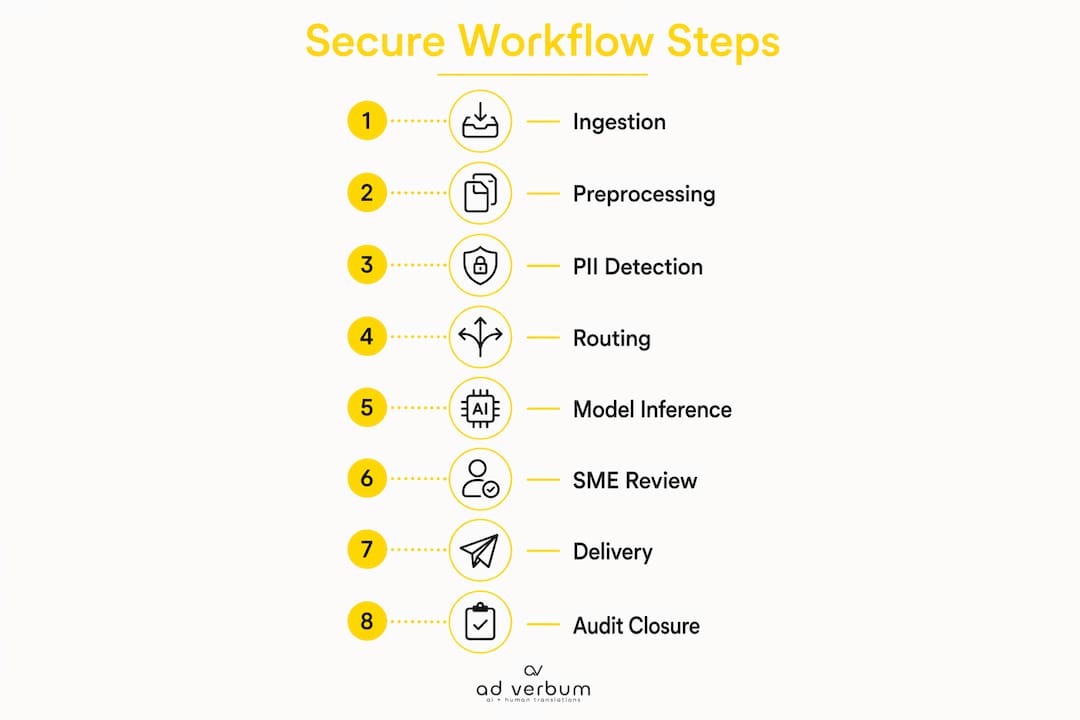
The eight steps below form the operational recipe. Each step names the owner, the required controls, the expected output, and the timing implications. Follow them in order. Skipping or reordering steps, particularly moving PII detection after inference, is the most common source of compliance failures in translation pipelines.

Step 1: Ingestion and content classification
Owner: Project manager or automated intake system.
Every file enters through a single, controlled gateway. The intake form captures: source language, target language(s), content type (clinical, legal, technical, HR), intended jurisdiction, deadline, client-defined sensitivity label, and any contractual restrictions on cloud processing. Automated language detection runs at this point to confirm the declared source language matches the file content.
Assign one of four sensitivity labels: Public, Internal, Confidential, or Restricted. Restricted applies to any content containing PHI, PII, ITAR-controlled technical data, or attorney-client privileged material. The label drives every downstream routing decision, so misclassification here propagates through the entire workflow. Build a secondary human review of the label into the intake SLA for any file above Internal.
Output: Labeled intake record with metadata, stored in the audit log.
Step 2: Preprocessing and asset preparation
Owner: Localization engineer or TMS automation.
TM and TB integration happens first, before any translation engine sees the content. This is not optional sequencing. Loading client-approved terminology into the system before inference constrains the model’s output to approved vocabulary and prevents the model from generating plausible but incorrect domain terms. Placeholder preservation, variable tagging, and non-translatable string identification all run at this stage. Metadata from Step 1 propagates to every segment.
For Restricted files, apply redaction rules to any segment that will be sent outside the controlled perimeter. Document the redaction decisions in the audit log.
Output: Preprocessed bilingual file with TM/TB loaded, placeholders tagged, and redaction map recorded.
Step 3: PII detection and policy application
Owner: Security engineer or automated PII detection layer.
Run a two-layer detector: fast regex patterns for structured PII (Social Security numbers, dates of birth, phone numbers, account numbers) followed by a lightweight NER model for unstructured PII (names, addresses, clinical identifiers). Set confidence thresholds and route low-confidence segments to human review rather than auto-masking.
Apply one of three treatments based on the data type and contractual rules: mask (replace with a category label such as [PATIENT_NAME]), tokenize (replace with a reversible token stored in a secure vault), or redact (remove entirely). The token vault must use a key management service (KMS) or hardware security module (HSM). Reconstitution is permitted only after delivery and only when the contract explicitly allows it. Every masking and tokenization decision is logged with the segment ID, treatment applied, and timestamp.
A privacy-first translation pipeline uses automated PII detection and masking, private infrastructure routing, encrypted API endpoints, role-based access control, and immutable audit logs as its core technical layers.
Output: Masked or tokenized file ready for inference; PII decision log appended to audit trail.
Step 4: Routing and policy engine
Owner: Workflow orchestration layer.
A policy engine maps the sensitivity label plus jurisdiction to an inference target. The decision matrix looks like this:
Sensitivity label | Jurisdiction trigger | Inference target |
Public | None | Cloud LLM (anonymized) |
Internal | None | Cloud LLM with DPA |
Confidential | HIPAA / state privacy | Private EU-hosted LLM or on-premises |
Restricted | HIPAA, ITAR, FedRAMP | On-premises only; no cloud path |
Failover behavior must be defined before go-live. If the private inference endpoint is unavailable, the workflow halts and alerts the project manager. It does not fall back to a public cloud endpoint for Restricted content. SLA expectations for private inference are typically longer than cloud inference; build that into client commitments.
Workflow orchestration enables condition-based triggers to automate translation jobs, QA gating, and exports to repositories, which reduces manual handoff errors at this stage.
Output: Routing decision logged with request ID, classification, and target endpoint.
Step 5: Model inference and AI+HUMAN hybrid translation sequencing
Owner: Translation engine (proprietary LLM) plus post-editor.
The model generates a first draft constrained by the loaded TM, TB, and any style instructions passed in the system prompt. Legacy MT produces literal output with weak context handling and a higher rate of meaning errors in safety-critical text. Public NMT engines, the kind available as consumer SaaS, carry inconsistent terminology control and governance limitations that make them unsuitable for regulated documentation without additional enterprise controls. A proprietary LLM-based system with explicit instruction following and terminology governance, embedded in an AI+HUMAN hybrid translation workflow, handles document-level context and enforces approved terminology throughout.
Post-editing tiers depend on content risk: PE1 (light post-edit for low-risk segments with high TM leverage), PE2 (full post-edit for new content or domain-specific text), and Transcreation (full human authoring for content where literal translation fails the regulatory or legal intent). Assign the tier at the segment level using quality estimation (QE) scores. Segment-level QE scores route segments to the appropriate post-editing tier, improving efficiency while preserving quality.
Output: Post-edited bilingual file with QE scores and tier assignments logged.
Step 6: SME review and linguistic quality assessment
Owner: Certified subject-matter expert linguist.
For regulated content, a post-editor alone is not sufficient. A certified SME, a medical professional for clinical content, a licensed attorney for legal documents, or a credentialed engineer for technical IFUs, reviews the post-edited output for technical accuracy, regulatory compliance, and contextual nuance. This gate is non-negotiable for content that will be submitted to a regulatory body or used in a legal proceeding.
Localization leaders recommend against using public cloud translation services for regulated content and instead using human-in-the-loop pipelines where machine output is treated as a draft and validated by SMEs.
LQA scoring uses MQM or a client-defined error taxonomy. Errors are categorized by severity: critical (meaning change, safety risk, regulatory non-compliance), major (terminology error, omission), and minor (style, punctuation). Acceptance thresholds are defined at scoping. A typical threshold for regulated content is zero critical errors and a major error rate below 0.5 per 1,000 words. Files that fail the threshold return to post-editing, not to the model.
Output: SME signoff record with LQA score, error log, and acceptance attestation stored in the audit trail.
Step 7: Delivery, ephemeral handling, and deletion
Owner: Project manager and security engineer.
Deliver files through encrypted channels only: SFTP with client-managed keys, a secure client portal, or a direct API with mutual TLS. Never deliver Restricted content via email or consumer file-sharing services.
Ephemeral storage patterns require that source files and intermediate outputs are held in encrypted, in-memory or short-lived volumes with a defined TTL. After delivery confirmation, the automated wipe runs. For Restricted content, the upload-translate-delete workflow mandates purging source materials immediately on completion to prevent retention on third-party servers.
TM update policy for Restricted content: approved segments may be added to the client TM only after PII has been removed or the client explicitly authorizes retention. Never populate a shared TM with segments containing PHI or ITAR-controlled text.
Retention and deletion rules must define retention windows, require deletion of local copies after delivery, track deletion confirmations, and record audit evidence.
Output: Delivery confirmation, deletion certificate, and updated TM/TB (PII-clean segments only).
Step 8: Audit trail closure and compliance packaging
Owner: Compliance reviewer.
The immutable audit trail must contain: intake record with sensitivity label, routing decision with justification, PII decision log (treatment applied per segment), model and version used, QE scores and post-edit tier assignments, SME signoff with LQA score, delivery confirmation, and deletion certificate. For HIPAA-covered content, the audit package must be retainable for six years from the date of creation or last effective date, whichever is later.
Observable metadata logged per request should include request ID, routing decision, duration, and redaction applied, while avoiding logging full-text inputs. WORM (write-once, read-many) logs are required for compliance-grade audit trails.
Output: Complete audit package, ready for internal review or external audit.
Pro Tip: Run a 30-day pilot on a set of 50 documents before full rollout. Map your content types, integrate one private LLM endpoint and your TMS, build automated QA checks, and add post-editors and LQA. A structured pilot validates the workflow before it handles production-volume regulated content.
What technical security layers does a regulated translation pipeline need?
The step-by-step workflow above describes what to do. This section describes how to build the infrastructure that enforces it.
Ingress design
The API gateway is the first enforcement point. Every inbound request carries a per-request policy header declaring the sensitivity label, tenant ID, and target jurisdiction. Mutual TLS authenticates both client and server at the transport layer. An inline sensitivity classifier runs on the payload before it reaches any processing queue, providing a second check against the declared label. Mismatches between declared and detected sensitivity trigger a hold and alert.
PII detection stack
Fast regex handles structured patterns: SSNs, dates of birth, phone numbers, NPI numbers, and account identifiers. A lightweight NER model runs on unstructured text for names, addresses, and clinical identifiers. Set a confidence threshold, typically 0.85 or above, for automatic masking. Segments below the threshold go to a human reviewer rather than being auto-masked or passed through unmasked. The token vault uses a KMS or HSM; tokens are single-use per project unless the contract specifies otherwise.
Inference placement tradeoffs
Choosing where inference runs is the most consequential architectural decision in a secure translation pipeline. Five tradeoffs govern the choice:
Dimension | On-premises / private LLM | EU-hosted dedicated infrastructure | Cloud LLM with contractual safeguards |
Output quality | High (fine-tuned on domain data) | High (same class) | Variable (model-dependent) |
Latency | Moderate to high | Low to moderate | Low |
Cost | High CAPEX, lower OPEX at scale | Moderate OPEX | Low CAPEX, variable OPEX |
Compliance posture | Strongest for ITAR, FedRAMP | Strong for HIPAA, GDPR | Acceptable for Internal; risky for Restricted |
Maintenance burden | High (your team owns it) | Shared with provider | Minimal |
A hybrid inference strategy, on-premises preprocessing plus selective cloud use for anonymized text, produces the best balance of quality and compliance for most enterprise programs in 2026. Restricted content stays on-premises or on private infrastructure; anonymized Internal content can route to a cloud LLM under a signed data processing agreement.
For guidance on selecting specific LLM models for translation use cases, the model selection criteria from Gleef provide a useful independent reference on inference tradeoffs.
Storage and retention
Never log raw source text. Log hashes, metadata, and routing decisions. Encrypted ephemeral volumes with auto-wipe on TTL prevent data from persisting beyond the project lifecycle. WORM logs satisfy the tamper-evidence requirement for HIPAA and FedRAMP audit trails. Separate the audit log store from the processing infrastructure so a compromise of the translation pipeline does not give an attacker access to the audit record.
Access controls and observability
OAuth2 scopes limit each service account to the minimum permissions required for its function. Fine-grained API keys are issued per project, not per team. Private links or VPC endpoints prevent translation traffic from traversing the public internet. Every request generates a telemetry record: request ID, model used, token counts, redaction applied, routing decision, and duration. That record feeds the SIEM. No full-text content appears in telemetry.
Audit trace example: An auditor reviewing a HIPAA-covered CSR translation should be able to pull a single request ID and retrieve: the intake record showing the Restricted label, the PII decision log showing three patient identifiers tokenized, the routing record showing the private EU-hosted LLM endpoint, the QE score and PE2 tier assignment, the SME medical reviewer signoff with LQA score of 98.4 and zero critical errors, the delivery confirmation timestamp, and the deletion certificate. That chain of evidence, with no raw PHI in any log, satisfies a HIPAA audit.
How do you choose the right workflow approach for regulated content?
The decision is not primarily about cost or speed. It starts with the sensitivity of the content and the jurisdiction that governs it.
Gating questions
Work through these in order. The first “yes” that triggers a hard requirement stops the decision tree:
Does the content contain PHI as defined under HIPAA? If yes, on-premises or private EU-hosted inference is required; public cloud SaaS is not acceptable without a signed Business Associate Agreement (BAA) and documented data processing controls.
Is the content ITAR-controlled technical data? If yes, on-premises inference within the U.S. perimeter is required; EU-hosted infrastructure may not satisfy ITAR unless the provider holds the appropriate export authorization.
Does the client contract prohibit cloud processing? If yes, on-premises regardless of content sensitivity.
Does the project require an immutable audit trail for a regulatory submission? If yes, WORM logging and a documented chain of custody are mandatory.
Is the content subject to attorney-client privilege? If yes, treat as Restricted and apply the same controls as PHI.
If none of the above apply, the content is likely Internal or Confidential, and a hybrid approach with a signed DPA is acceptable.
When AI+HUMAN hybrid translation is the right choice
AI+HUMAN hybrid translation is recommended when the content is regulated, the project requires documented SME signoff, terminology governance is contractually required, and the client needs an audit package. The minimum configuration to meet ISO 17100 and ISO 18587 expectations includes: TM and TB loaded before inference, a proprietary or fine-tuned LLM (not a public NMT engine), PE2 or higher post-editing for all regulated segments, and a certified SME review with LQA scoring.
For a detailed comparison of MT versus AI+HUMAN approaches and the controls each requires, see this analysis of MT vs AI+HUMAN for compliance.
Cost and quality tradeoffs
On-premises inference carries the highest infrastructure cost but the lowest per-word marginal cost at scale. Private EU-hosted infrastructure (such as AD VERBUM’s LangOps System) offers a middle path: no CAPEX, predictable OPEX, and a compliance posture that satisfies HIPAA and GDPR without the maintenance burden of running your own GPU cluster. Public cloud NMT is the cheapest option per word but is not appropriate for Restricted content and requires careful contractual controls even for Confidential content.
SME hours are the largest variable cost driver in a secure workflow. Reducing SME time without reducing quality requires high TM leverage (pre-approved segments that do not need SME review), accurate QE scoring to limit full post-edit to segments that actually need it, and a well-maintained TB that prevents terminology errors from reaching the SME stage.
Vendor validation checklist
Before signing with any language service provider for regulated content, require written evidence of:
ISO 27001 certification (information security management), independently audited
ISO 17100 certification (translation services quality)
ISO 18587 certification (post-editing of machine translation output)
A signed BAA for HIPAA-covered content
Documented ephemeral storage and deletion policy
Named SME credentials for your content domain
Independent audit evidence (Bureau Veritas or equivalent)
For a structured vendor selection checklist, the translation provider selection guide covers contractual clauses and procurement criteria for regulated content.
Applied examples and template artifacts
Scenario A: Clinical study report translation
A pharmaceutical company needs a Phase III CSR translated from English into German and Japanese for EMA submission. The document contains patient-level data, adverse event narratives, and proprietary compound identifiers.
Intake: Project manager assigns Restricted label. Intake form records HIPAA applicability, EMA submission deadline, and client prohibition on cloud processing.
Preprocessing: TM loaded with previously approved CSR terminology. Compound identifiers tagged as non-translatable. Adverse event narratives flagged for PII review.
PII detection: NER identifies 47 patient identifiers across adverse event narratives. All tokenized; token map stored in HSM-backed vault. Routing locked to private EU-hosted LLM.
Inference: LangOps System generates first draft constrained by CSR terminology TB. QE scores assign PE2 to all clinical narrative segments.
SME review: Medical linguist with pharmacology credentials reviews all PE2 segments. LQA score: zero critical errors. SME signoff recorded with credential attestation.
Delivery and deletion: Files delivered via SFTP with client-managed keys. Ephemeral volumes wiped within four hours of delivery confirmation. Deletion certificate issued.
Audit package: Complete chain of custody delivered to client for EMA submission dossier.
Scenario B: Federal contractor terms translation
A U.S. defense contractor needs procurement terms translated for a NATO partner. The document references export-controlled technical specifications subject to ITAR.
Intake: Restricted label assigned. ITAR flag recorded. Routing locked to on-premises inference within U.S. perimeter.
Preprocessing: Export-controlled part numbers and technical specifications tagged as non-translatable or redacted per ITAR export authorization scope.
PII detection: Minimal PII; primary concern is ITAR-controlled technical data. Redaction applied to controlled specifications.
Inference: On-premises LLM with defense-domain TB. PE2 assigned to all technical segments.
SME review: Legal linguist with defense procurement credentials reviews for ITAR compliance and contractual accuracy. Signoff includes attestation that no controlled technical data appears in translated output beyond authorized scope.
Delivery: Secure portal with access limited to named recipients. Retention schedule defined per ITAR record-keeping requirements.
For additional guidance on legal document translation controls, see best practices for legal document translation.
Intake checklist template fields
Project name and reference number
Source language (confirmed by automated detection)
Target language(s) and locale(s)
Content type (clinical, legal, technical, HR, financial)
Sensitivity label (Public / Internal / Confidential / Restricted)
Applicable regulations (HIPAA, ITAR, CCPA, FedRAMP, other)
Cloud processing restriction (yes / no; if yes, specify scope)
Required SME domain and credential level
Retention schedule and deletion deadline
Client TM and TB files attached (yes / no)
Redaction flags (PII types present; pre-redaction required before upload)
Authorized contacts for SME escalation
SME signoff template checklist
Segment count reviewed and percentage of total project
Critical errors found: [number] (threshold: 0)
Major errors found: [number] (threshold: define per project)
LQA score: [score] (acceptance threshold: define per project)
Terminology compliance confirmed against [TB name and version]
Regulatory phrasing verified against [applicable standard or submission requirement]
No PHI or ITAR-controlled data present in final output: [yes / no]
Reviewer name, credential, and credential number
Review date and signature metadata (stored in audit trail)
Attestation: “I confirm that the translated content meets the quality and compliance requirements specified in the project scope.”
What are the most common failure modes in secure translation workflows?
Most failures in secure translation workflows are not technical. They are process failures: a file classified at the wrong level, a PII detector that misses an unstructured identifier, or a TM populated with segments that should have been redacted first.
Failure mode matrix
Failure mode | Detection signal | Immediate remediation | Long-term fix |
Misclassification of sensitive file | Auditor flags PHI in Internal-labeled project | Reclassify, re-route, notify client | Add secondary human label review for all files above Internal |
PII detector false negative | Spot audit finds unmasked identifier in translated output | Halt delivery, quarantine file, notify privacy officer | Retrain NER model; increase sampling rate for spot audits |
On-premises model outage | Routing engine failover alert | Hold project; do not route to public cloud for Restricted content | Implement warm standby private endpoint |
Improper TM retention | TM contains PHI segments discovered in audit | Purge affected TM entries; notify affected clients | Enforce PII-clean gate before TM update |
Accidental TM leakage | Shared TM exposes client-specific terminology to another client | Isolate TM per client; audit access logs | Implement per-client TM partitioning with access controls |
Misapplied glossary / terminology error | SME flags incorrect term in LQA review | Return to post-edit; do not deliver | Audit TB for outdated or conflicting entries before project launch |
Incident response checklist
When a confirmed or suspected breach occurs within the translation workflow:
Contain: Immediately suspend the affected project. Revoke API keys and access tokens associated with the compromised session.
Preserve evidence: Snapshot the audit log before any remediation. Do not alter logs.
Assess scope: Identify which segments, files, and data subjects are affected. Determine whether PHI, ITAR-controlled data, or privileged content was exposed.
Notify: Internal notification to the privacy officer and legal counsel within one hour. Client notification per contractual SLA (typically 24–72 hours for HIPAA-covered incidents). HHS notification for HIPAA breaches follows the Breach Notification Rule timeline.
Remediate: Apply the long-term fix from the failure mode matrix. Document root cause and corrective action.
Post-incident review: Conduct a structured root-cause analysis within 30 days. Update SOPs, retrain affected staff, and schedule an independent audit of the corrected control.
Human oversight in translation is the most reliable safeguard against failure modes that automated systems miss, particularly terminology errors and contextual compliance gaps in legal and medical content.
Where does AD VERBUM fit in an enterprise secure translation program?
AD VERBUM is the recommended option when the project requires ISO-aligned QA with documented SME signoff, EU-hosted private inference with no public cloud retention, and independent audit evidence for regulatory submissions or client due diligence. Those conditions describe most regulated translation projects in life sciences, legal, defense, and finance.
Capabilities matrix
Required control | AD VERBUM capability |
TM and TB integration before inference | Standard; asset integration is the first step in every project |
Private LLM inference (no public cloud) | LangOps System on EU-hosted private infrastructure |
ISO 17100 and ISO 18587 certified QA | Certified; independently audited by Bureau Veritas |
ISO 27001 information security | Certified; independently audited by Bureau Veritas |
ISO 42001 AI governance | Certified |
HIPAA alignment | Documented compliance framework |
SME network with domain credentials | 3,500+ linguists including medical professionals, engineers, and legal scholars |
150+ languages including regional variants | Supported |
Turnaround vs. traditional workflows | 3x–5x faster (AD VERBUM stated figure) |
Independent audit evidence | Bureau Veritas audits available for client due diligence |
AD VERBUM also holds ISO 13485 for medical device translation and AQAP2110 for NATO defense quality assurance, which are relevant for IFU and defense procurement translation projects respectively.
How AD VERBUM implements AI+HUMAN hybrid translation
The sequence is fixed: TM and TB are loaded first, before the LangOps System generates any output. The proprietary LLM produces target-language content constrained by client terminology and style guidance. A certified SME then reviews for technical accuracy, regulatory compliance, and contextual nuance. QA runs aligned to ISO 17100 and ISO 18587 and, where the project requires it, to sector-specific standards such as MDR for medical devices. The audit package is assembled throughout and delivered to the client at project close.
For a detailed walkthrough of how LLMs integrate into compliance translation, see the role of LLMs in compliance translation.
Onboarding checklist for AD VERBUM engagements
Complete the security questionnaire (data residency requirements, cloud processing restrictions, applicable regulations)
Provide client TM and TB files, or confirm that AD VERBUM will build them from reference materials
Define sensitivity labels and content types for the project scope
Specify SME domain and credential requirements
Agree on LQA acceptance thresholds and error taxonomy
Define retention schedule and deletion deadline
Confirm audit evidence deliverables required (SME signoff records, LQA scores, deletion certificates, routing logs)
Key Takeaways
A secure, audit-ready translation workflow requires classification at ingestion, PII masking before inference, private routing for restricted content, certified SME review, ISO-aligned QA, and an immutable audit trail closed at delivery.
Point | Details |
Classify at the gateway | Assign a sensitivity label at intake; every downstream routing and security decision depends on it. |
Mask PII before inference | Apply regex plus NER detection and tokenize or mask before any content reaches a translation model. |
Route by label and jurisdiction | Restricted and HIPAA-covered content requires on-premises or private EU-hosted inference; public cloud is not acceptable without a BAA and documented controls. |
Gate regulated output through a certified SME | ISO 17100 and ISO 18587 require human expert review; zero critical errors is the standard acceptance threshold for regulated content. |
AD VERBUM for regulated projects | AD VERBUM’s AI+HUMAN hybrid translation, LangOps System, and Bureau Veritas-audited ISO certifications satisfy the controls required for HIPAA, ITAR, and regulatory submission workflows. |
|
Pro Tip: The minimum audit artifact set for any regulated translation project is: intake record with sensitivity label, routing decision log, PII decision log, SME signoff with LQA score, delivery confirmation, and deletion certificate. Build your contracts to require all six from any language service provider.
The classification problem nobody talks about enough
The industry conversation about secure translation workflows focuses heavily on encryption and model selection. Those matter, but in practice the failure that causes the most damage is misclassification at intake, and it almost always happens because the person filling out the intake form does not know what they are looking at.
A clinical operations team submitting a CSR excerpt for translation may not recognize that the adverse event narratives contain PHI. An HR manager sending payroll records for localization may not know that state privacy laws apply. The technical controls downstream are only as good as the label that triggers them. If the label is wrong, the routing is wrong, the inference target is wrong, and the audit trail documents a process that never should have run.
The practical fix is not a better NER model, though that helps. It is a mandatory secondary review of the sensitivity label for any file above Internal, performed by someone with compliance training, before preprocessing begins. That one gate catches the majority of misclassification events before they propagate.
The other underestimated tradeoff is speed versus auditability. Private inference is slower than cloud inference. SME review adds hours or days. Teams under deadline pressure find ways to compress these steps, and that is where compliance failures originate. The answer is not to skip the gates; it is to build realistic SLAs that account for them from the start, and to use TM leverage and QE-based tier assignment to reduce the volume of content that needs full SME review without reducing the quality of the review itself.
AD VERBUM’s default configuration, TM and TB first, private LLM inference, PE2 for regulated segments, certified SME review, Bureau Veritas-audited QA, delivers 3x–5x faster turnaround than traditional translation workflows while maintaining the audit trail that regulated buyers require. That speed comes from TM leverage and QE-based routing, not from skipping controls.
AD VERBUM handles the compliance complexity so your team does not have to
Regulated translation projects carry real risk: a misclassified file, an unmasked patient identifier, or a missing SME signoff can turn a routine localization project into a HIPAA breach or a failed regulatory submission. AD VERBUM’s AI+HUMAN hybrid translation service is built specifically for that risk profile.
AD VERBUM brings ISO 17100, ISO 18587, ISO 27001, and ISO 42001 certifications, all independently audited by Bureau Veritas, together with a network of 3,500+ credentialed SME linguists and a private EU-hosted LangOps System that processes your content without public cloud retention. For HIPAA-covered clinical content, defense procurement documents under ITAR, or legal contracts requiring attorney review, AD VERBUM delivers a complete audit package at project close: intake record, routing log, PII decision log, SME signoff, LQA score, and deletion certificate.
Projects in life sciences, legal, finance, defense, and manufacturing across 150+ languages are in scope. Turnaround runs significantly faster than traditional workflows, with no compromise on the compliance controls your auditors will check. To discuss your project requirements and receive a scoped proposal, contact the AD VERBUM team or review the full service capabilities.
Useful sources and standards references
The sources below back the technical claims and operational guidance in this article. Each is listed with the sections it most directly supports and its relevance to auditors and practitioners.
Translate with Privacy: Secure Translation Pipeline (2026) — Primary reference for PII detection architecture, ephemeral storage patterns, WORM logging, and hybrid inference strategy. Supports Sections 3, 4, and 5.
Localization QA Pipeline: Human-in-the-loop & AI Speed — Evidence base for AI+HUMAN hybrid translation recommendations, automated QA checks, and the case against public cloud SaaS for regulated content. Supports Sections 3 and 5.
Secure Translation Workflow: Privacy Controls and Vendor Checklist — Operational reference for upload-translate-delete workflows, retention and deletion policy, and vendor contractual requirements. Supports Sections 3, 7, and 8.
AI-Powered Translation Workflows: From Machine Translation to Post-Editing — Source for QE-based tier routing, 30-day pilot structure, and post-editing workflow design. Supports Sections 3 and 6.
How to Automate Your Translation Workflow — Reference for workflow orchestration, condition-based triggers, and automated handoff design. Supports Section 3.
ISO 17100:2015 (Translation services) — The governing standard for translation service quality requirements, including translator competence, revision, and project management. Required citation in contracts for regulated content.
ISO 18587:2017 (Post-editing of machine translation output) — Defines full and light post-editing requirements and post-editor competence. Required for any workflow using MT or LLM-generated first drafts.
ISO 27001:2022 (Information security management) — The baseline standard for information security controls in translation pipelines. Auditors will ask for this certification from any language service provider handling Restricted content.
HIPAA Breach Notification Rule (45 CFR §§ 164.400–414) — Governs notification timelines and obligations when PHI is exposed in a translation workflow incident. Directly relevant to Section 7 incident response.
Bureau Veritas — Independent certification body that audits ISO compliance for language service providers. Requiring Bureau Veritas (or equivalent accredited body) audit evidence in vendor contracts provides a verifiable third-party check on certification claims.
Source | Primary sections supported | Audit relevance |
Secure Translation Pipeline (2026) | Technical controls, step-by-step workflow | PII architecture, WORM logging |
Localization QA Pipeline | Workflow steps, decision criteria | Human-in-the-loop evidence |
Privacy Controls and Vendor Checklist | Delivery/deletion, failure modes | Retention policy, vendor contracts |
AI-Powered Translation Workflows | Workflow steps, examples | QE routing, pilot validation |
ISO 17100 | QA gates, SME review | Translator competence standard |
ISO 18587 | Post-editing tiers | Post-editor competence standard |
ISO 27001 | Technical controls, vendor validation | Information security certification |
HIPAA Breach Notification Rule | Incident response | PHI breach obligations |
Bureau Veritas | Vendor validation, audit evidence | Independent certification auditor |
Recommended