


AQAP certification: 37% of faults linked to translations
- Mar 4
- 11 min read

Many defense suppliers believe achieving AQAP 2110 certification solves all documentation compliance challenges. In reality, multilingual translation errors contribute to 37% of major manufacturing deficiencies during NATO audits. For small European defense manufacturers and MRO providers, certification is only the starting point. Sustaining compliance across language markets requires robust translation governance, terminology control, and audit-ready workflows that most certified organizations underestimate.
Table of Contents
Key takeaways
Point | Details |
AQAP 2110 certification mandates NATO-specific quality management beyond ISO 9001 | Defense suppliers must implement augmented QMS requirements to qualify for NATO contracts |
37% of major deficiencies relate to translation-induced documentation inconsistencies | Poor multilingual documentation governance causes critical compliance failures during audits |
Hybrid AI+human translation workflows ensure linguistic and regulatory compliance | Proprietary AI with SME oversight delivers terminology-controlled, audit-ready translations |
EU-hosted infrastructure with strict access governance is critical for data sovereignty | Non-EU cloud providers introduce export control risks that jeopardize certification status |
Continuous quality management and audit readiness maintain certification advantages | Ongoing documentation vigilance sustains competitive standing in defense markets |
AQAP 2110 certification overview
AQAP 2110 certification is mandatory for suppliers delivering military-grade products to NATO member armed forces. The standard builds on ISO 9001 but adds NATO-specific quality management system augmentations. These requirements focus on process rigor, consistent product quality, and audit preparedness.
Unlike commercial manufacturing standards, AQAP 2110 imposes strict traceability requirements across all quality records. Every technical specification, corrective action report, and process instruction must maintain verifiable lineage. When your organization operates across multiple European language markets, this traceability requirement multiplies exponentially.
Certification provides competitive advantage by demonstrating your ability to meet defense contract obligations. It opens doors to NATO supply chains and allied defense procurement systems. However, the standard itself doesn’t prescribe specific multilingual documentation protocols. That gap creates risk for certified suppliers serving French, German, Italian, and Polish defense customers simultaneously.
Quality managers at certified small manufacturers often discover translation volume scales faster than anticipated. A single engineering change notice might require synchronized updates across six language versions of technical manuals, training materials, and safety protocols. Language service providers for AQAP 2110 documentation must understand these cascading requirements from day one.
Multilingual documentation compliance challenges
Translation inconsistencies represent a hidden compliance landmine for AQAP-certified organizations. When translated procedures contain subtle meaning variations, technical accuracy dissolves. A mistranslated torque specification in German maintenance documentation can trigger equipment failures that trace back to your quality management system during root cause analysis.
Asynchronous document updates across language versions create dangerous discrepancies. Your English master procedure reflects the latest revision, but the French translation lags three versions behind. Auditors flag this immediately during surveillance assessments.
Key risks in multilingual quality documentation include:
Terminology drift where technical terms receive inconsistent translations across document families
Negation errors that reverse safety instructions in target languages
Unit conversion mistakes in specifications and tolerances
Omitted regulatory references required in specific language markets
Untraceable revision histories when translation workflows lack version control
Process synchronization becomes critical when corrective actions generate documentation updates. You must propagate changes across all active language versions simultaneously while maintaining audit trails. Most small defense suppliers lack the internal capacity to manage this coordination without specialized translation infrastructure.
Terminology governance failures cause the majority of translation-induced compliance defects. Without centralized term bases that enforce consistent technical vocabulary, each translator makes independent judgment calls. This variability accumulates into systemic quality management breakdowns that auditors identify as major nonconformities.

Translation technology comparison: MT vs NMT vs proprietary AI
Choosing the wrong translation technology introduces compliance risks that undermine your AQAP certification. Understanding how different approaches handle defense documentation helps you make informed decisions.
Technology | Strengths | Compliance risks |
Legacy MT | Fast processing, low cost | Literal translations miss context, high error rates in technical content |
Public NMT | Better fluency than MT, widely available | Inconsistent terminology, weak negation handling, limited governance controls |
Proprietary LLM AI | Context-aware generation, terminology enforcement | Requires robust implementation with SME oversight and audit trails |
Legacy MT produces literal but error-prone outputs unsuited for safety-critical defense documentation. These systems translate word by word without understanding technical context. A phrase like “torque to failure” might render as “twist until broken” in the target language, completely altering the engineering instruction.
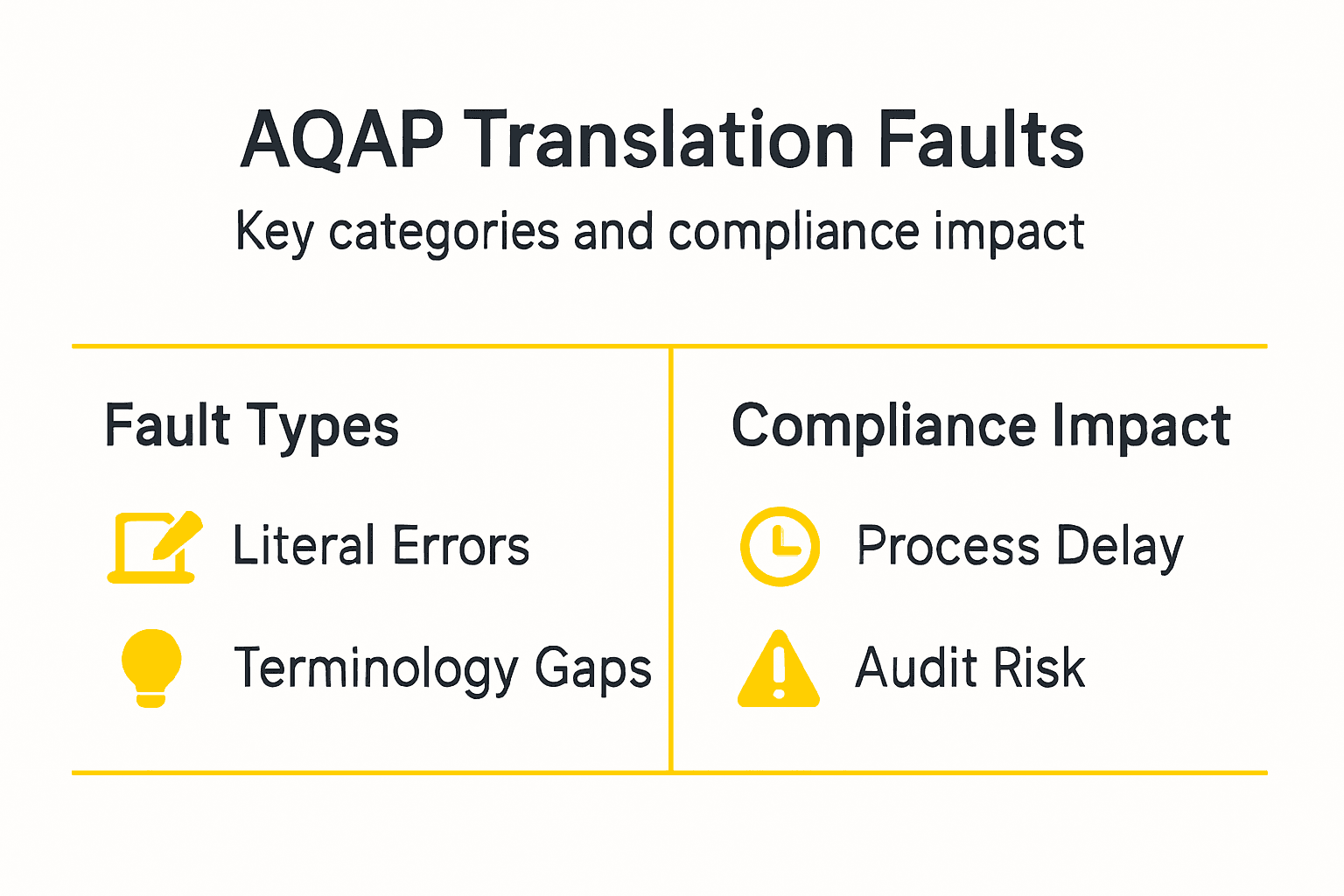
Public neural machine translation engines offer improved fluency but lack reliable terminology control. Consumer-grade NMT services can’t enforce your organization’s approved technical vocabulary. They also struggle with negation, sometimes reversing the meaning of safety warnings. For AQAP-regulated quality records, this variability creates unacceptable audit risk.
Proprietary AI systems built specifically for regulated industries offer context-sensitive translation with explicit terminology governance. These platforms ingest your translation memories and term bases first, constraining output to approved vocabulary. When paired with certified SME review, proprietary AI delivers audit-ready translations that maintain technical accuracy across language versions.
Pro Tip: Evaluate translation technology by running your most complex technical specification through each system. Compare terminology consistency, handling of units and tolerances, and preservation of regulatory references. Only proprietary AI with human oversight reliably passes this test for AQAP documentation.
Decision framework for defense suppliers:
Use proprietary AI+human hybrid for all quality records, corrective actions, and technical specifications
Reserve public NMT for internal communications and draft translations only
Avoid legacy MT entirely for AQAP-regulated documentation
AI+human hybrid translation for AQAP compliance
Hybrid workflows combine AI efficiency with human expertise to deliver translations that satisfy AQAP audit requirements. The process follows a structured sequence aligned with ISO 17100 and ISO 18587 standards.
Asset integration. The workflow begins by ingesting your organization’s translation memories and term bases. This step ensures every translation enforces your approved technical vocabulary and style guidance from the start.
LLM generation. A proprietary AI system produces target language output constrained by your terminology rules. The AI handles document-level context, maintaining consistency across sections while respecting technical constraints.
Certified subject-matter expert review. Defense industry linguists with engineering or quality management backgrounds verify technical accuracy. They catch nuances the AI might miss and ensure regulatory compliance in the target market.
Quality assurance validation. Final QA checks align with ISO standards and AQAP requirements. This step generates the audit trail documentation your certification demands.
This workflow delivers three critical advantages for AQAP-certified suppliers. First, it scales efficiently as your translation volume grows. The AI handles initial heavy lifting while SMEs focus on validation rather than translation from scratch. Second, terminology governance becomes systematic rather than dependent on individual translator judgment. Third, every step generates verifiable documentation for audit purposes.
Pro Tip: Implement regulated document translation workflows that mirror your internal document control procedures. Translation should integrate into your existing quality management system, not operate as a separate uncontrolled process.
Certified SMEs bring domain expertise that generic translators lack. An engineer who understands fastener specifications will correctly translate torque values, thread pitches, and material grades. This expertise prevents the subtle errors that cause field failures and compliance violations. Translation workflows for regulatory compliance must include SME verification as a mandatory gate.
Audit readiness requires documented evidence that you control your translation process. Hybrid workflows generate quality records at each step: terminology validation logs, SME review reports, and QA sign-off certificates. When auditors ask how you ensure compliant translations, you present a complete paper trail that demonstrates process control.
Data sovereignty and security in defense translation
EU data sovereignty isn’t optional for AQAP-certified defense suppliers. Your technical documentation contains export-controlled information that NATO regulations restrict to authorized jurisdictions. Hosting translation infrastructure on non-EU cloud platforms creates immediate compliance violations.
Consider the numbers: 97% of European cloud capacity relies on non-EU providers, primarily US-based hyperscalers. These platforms operate under US legal frameworks including the CLOUD Act, which grants US law enforcement extraterritorial data access. For defense documentation containing ITAR or export-controlled technical data, this jurisdictional exposure triggers audit failures.
Critical security requirements for defense translation infrastructure:
EU-hosted servers with no data transit to non-EU jurisdictions
Strict access governance limiting personnel to cleared individuals
Detailed audit trails logging every document access and modification
Encryption at rest and in transit using approved cryptographic standards
Regular security assessments aligned with ISO 27001 frameworks
Self-hosted or cleared facility translation services offer the strongest data sovereignty posture. When your translation provider operates dedicated infrastructure within EU borders, you eliminate the jurisdictional risks inherent in public cloud platforms. This approach also simplifies your own AQAP audit preparation by reducing the number of third-party dependencies auditors must verify.
EU versus self-hosted translation for defense compliance presents a critical decision point. Public cloud convenience comes with governance complexity that small defense suppliers often can’t manage effectively. Self-hosted solutions with ISO 27001 certification provide cleaner audit trails and clearer data custody.
Translation providers serving defense clients must demonstrate robust information security management. Look for ISO 27001 certification as a baseline indicator. Beyond certification, verify they maintain detailed access logs, enforce need-to-know principles, and conduct regular security audits of their infrastructure and processes.
Audit and compliance in translation infrastructure
NATO auditors scrutinize how you control sensitive documentation throughout its lifecycle, including translation. Your translation service provider’s infrastructure becomes an extension of your quality management system. Weak controls at the provider level create audit findings that jeopardize your certification.
Public cloud platforms rarely meet defense export control requirements without extensive additional governance layers. Most cloud service agreements explicitly disclaim responsibility for customer compliance with export regulations. You inherit full liability for any unauthorized data exposure, even if caused by provider infrastructure vulnerabilities.
Self-hosted or cleared facilities enable proper access control aligned with defense security requirements:
Physical access limited to security-cleared personnel only
Network segmentation isolating defense documentation from other workloads
Detailed logging capturing every user action and data movement
Regular penetration testing and vulnerability assessments
Incident response procedures coordinated with your security team
ISO 27001 certification demonstrates systematic information security management. Certified providers implement documented security controls, conduct regular risk assessments, and maintain audit-ready evidence of their security posture. This certification streamlines your own audit preparation by providing third-party validation of provider controls.
NATO-aligned quality assurance frameworks go beyond generic security standards. They address defense-specific requirements like export control, classification handling, and supply chain security. Translation providers serving AQAP-certified manufacturers should implement QA procedures that mirror defense industry expectations.
Effective audit readiness requires documented evidence of provider qualification. Maintain records showing how you evaluated the provider’s security controls, verified their infrastructure location, and validated their personnel clearance status. Auditors will ask for this documentation during surveillance assessments.
Benefits of AQAP certification beyond initial compliance
AQAP 2110 certification supports competitive advantage by demonstrating your ability to maintain consistent product quality and manage defense contract risks. The certification opens doors to NATO procurement systems and allied defense supply chains that exclude non-certified suppliers.
Strategic advantages of maintaining AQAP certification:
Preferred supplier status with defense prime contractors and government procurement agencies
Reduced customer audit burden through third-party certification validation
Systematic risk management that prevents costly quality failures
Process discipline that scales efficiently as contract volume grows
Reputational differentiation in competitive bid situations
Certification isn’t a one-time achievement. You must maintain your quality management system through continuous improvement and regular surveillance audits. Documentation accuracy across all language versions becomes an ongoing operational requirement, not a project with an end date.
Multilingual documentation maintenance consumes more resources than most certified small suppliers anticipate. Every engineering change, every corrective action, every process improvement generates translation requirements. Without robust workflows, this volume quickly overwhelms internal capacity.
Long-term contract success depends on sustaining the process rigor that earned your certification. Quality managers must treat translation governance as a core QMS function, not an administrative afterthought. Build translation requirements into your document control procedures, change management protocols, and corrective action systems from the start.
Your AQAP certification represents significant investment in process capability. Protect that investment by ensuring your multilingual documentation maintains the same quality standards as your English master documents. Inconsistent translation quality erodes the competitive advantage your certification provides.
Bridging compliance to practical translation strategy
Small European defense suppliers need actionable guidance for implementing compliant translation processes. Abstract best practices don’t help when you’re managing simultaneous documentation updates across six languages under tight delivery schedules.
Practical steps for maintaining AQAP multilingual compliance:
Evaluate translation providers based on defense industry experience, not just language capability or price
Verify provider infrastructure location and data sovereignty posture before sharing any technical documentation
Require certified SME review for all quality records, specifications, and regulatory submissions
Implement centralized terminology management that enforces consistent technical vocabulary
Integrate translation workflows into your existing document control and change management systems
Maintain detailed audit trails documenting translation process controls and quality verification
Schedule regular translation quality audits aligned with your internal audit calendar
Technology selection matters significantly. Hybrid AI+human workflows offer the best balance of efficiency and quality for defense documentation. Pure machine translation introduces unacceptable risks, while purely human translation can’t scale cost-effectively for the volume AQAP certification generates.
Pro Tip: Build translation requirements into your engineering change management process from the beginning. When change notices automatically trigger multilingual documentation updates, you prevent the synchronization gaps that cause audit findings. AI+human translation tutorials show how to structure these integrated workflows.
Provider qualification should mirror your supplier approval process. Audit translation providers using the same rigor you apply to component suppliers. Verify their quality management systems, inspect their security controls, and validate their personnel qualifications. Defense localization strategies that work for large primes scale down effectively for small manufacturers when properly implemented.
Documented workflows provide audit evidence that satisfies AQAP requirements. Your regulated document translation workflow should specify exactly how translations flow through quality gates, who approves them, and where records are stored. This documentation demonstrates process control when auditors review your multilingual documentation management.
Optimize your defense translations for AQAP compliance
Maintaining multilingual documentation compliance shouldn’t drain resources from core manufacturing operations. AD VERBUM’s proprietary AI+human hybrid translation workflow delivers audit-ready translations aligned with AQAP 2110 requirements. Our EU-hosted infrastructure eliminates data sovereignty risks while certified defense industry SMEs ensure technical accuracy in every language version.
Our process integrates your translation memories and term bases first, enforcing terminology consistency from the start. Proprietary LLM technology handles document-level context while maintaining your approved technical vocabulary. ISO 17100 and ISO 18587 aligned QA generates the audit trails your certification demands. Explore our AI+human translation process tutorial to see how this workflow supports defense compliance. Learn practical techniques for optimizing AI and human translation processes that scale with your certification requirements.
Frequently asked questions
What risks do generic machine translation tools pose for AQAP 2110 documentation?
Generic MT systems produce literal translations that miss technical context and fail to enforce terminology consistency. They introduce meaning errors in safety-critical instructions, mistranslate units and tolerances, and create audit trail gaps. For AQAP-regulated quality records, these tools generate compliance risks that outweigh any cost savings.
How does EU data sovereignty affect translation provider selection?
Defense documentation often contains export-controlled technical data restricted to authorized jurisdictions. Providers using non-EU cloud infrastructure expose you to unauthorized data access and jurisdictional compliance violations. AQAP auditors verify your translation providers maintain proper data sovereignty controls. Select providers with EU-hosted infrastructure and documented security governance.
What is the role of subject-matter experts in defense translation workflows?
Certified SMEs bring domain expertise that prevents subtle technical errors generic translators miss. An engineer validates torque specifications, material grades, and manufacturing tolerances accurately. A quality professional ensures regulatory references translate correctly for each target market. SME review transforms AI-generated drafts into audit-ready compliance documentation.
How often should multilingual documentation be reviewed for AQAP compliance?
Review multilingual documentation whenever master documents change, at minimum. Engineering changes, corrective actions, and process improvements all trigger translation updates. Schedule formal translation quality audits annually, aligned with your internal audit calendar. Continuous monitoring prevents the synchronization gaps that cause audit findings during surveillance assessments.
Recommended
5 Language Service Providers That Understand AQAP 2110 Documentation Requirements in 2026
7-Step Translation Quality Assurance Checklist for Compliance
You Won the Subcontract. Now Comes the Documentation Avalanche. Master Compliance Fast
7 Steps to a Translation Quality Checklist for Regulated Sectors
