


Legal Translation Data Security 2026: 60% Error Reduction

Most legal professionals assume encryption alone protects sensitive documentation during translation. This misconception puts regulated firms at risk. Effective data security in legal translation demands layered compliance controls, certified infrastructure, and rigorous human oversight beyond basic encryption protocols.
Table of Contents
Key Takeaways
Point | Details |
GDPR and ISO 27001 form the regulatory backbone securing legal translation data | Combined frameworks create enforceable data protection and operational security standards for EU providers. |
Hybrid AI+Human workflows reduce translation errors by up to 60% in regulated legal contexts | Subject-matter expert review catches critical nuance and regulatory requirements AI systems miss. |
Private EU-hosted infrastructure is essential to maintain data sovereignty and compliance | Proprietary servers eliminate third-party cloud risks and satisfy strict EU data residency mandates. |
Operational best practices include TM/TB integration and regular security audits | Translation memories and term bases enforce consistency while audits verify ongoing compliance readiness. |
Misconceptions about MT/NMT risks can lead to costly compliance failures | Generic machine translation lacks terminology governance and human verification critical for legal accuracy. |
Introduction to Data Security in Legal Translation
Data security in legal translation encompasses three pillars: confidentiality, integrity, and availability of sensitive legal documentation throughout the translation lifecycle. Legal texts contain privileged client information, intellectual property, and regulatory filings that demand protection beyond standard document handling.
The risks are concrete. Data breaches expose confidential litigation strategies or merger negotiations. Unauthorized access by unvetted translators violates attorney-client privilege. Most critically, inaccurate translation can alter legal meaning, invalidating contracts or triggering regulatory penalties.
The EU regulatory environment imposes strict obligations. GDPR mandates lawful, transparent data processing with breach notification within 72 hours and penalties reaching €20 million or 4% of global turnover. ISO 27001 requires information security management systems controlling access, encryption, and risk assessments. Translation providers handling EU legal documents must demonstrate compliance with both frameworks.
Multilingual legal workflows compound complexity. Each language pair introduces terminology variation. Document versions proliferate across jurisdictions. Tracking changes, maintaining audit trails, and ensuring consistent legal interpretation across 150+ languages requires systematic controls and technology governance.
Key security challenges include:
Preventing unauthorized access to confidential legal files during transmission and storage
Maintaining terminology precision across complex multilingual legal frameworks
Documenting complete audit trails for regulatory inspection and dispute resolution
Ensuring translation accuracy that preserves legal intent and contractual obligations
Understanding Regulatory Compliance: GDPR and ISO 27001
GDPR establishes data protection rights for EU residents, requiring lawful basis for processing personal data in legal documents. Transparency obligations mandate clear disclosure of how translation providers handle client information. Data subjects retain rights to access, correction, and erasure. Controllers must notify supervisory authorities of breaches within 72 hours. Non-compliance triggers fines up to €20 million or 4% of worldwide annual revenue, whichever is higher.

ISO 27001 provides the operational framework. This certification requires information security management systems controlling confidentiality, integrity, and availability. Role-based access limits document exposure to authorized personnel. Encryption protects data in transit and at rest. Regular risk assessments identify vulnerabilities before they become breaches.
The frameworks complement each other strategically. GDPR focuses on individual data protection rights and legal accountability. ISO 27001 delivers the systematic controls making GDPR compliance operationally achievable. Together, they create enforceable standards for secure legal translation workflows.
“ISO 27001 certification demonstrates to clients that a translation provider has implemented systematic security controls, while GDPR compliance ensures those controls specifically protect individual privacy rights throughout the translation process.”
Overlapping requirements reinforce security posture. Both mandate documented policies, regular audits, and incident response procedures. ISO 27001 certification streamlines GDPR compliance by establishing required technical and organizational measures. Legal translation providers serving EU clients need both certifications to demonstrate comprehensive data protection capabilities.
Implementing dual compliance requires:
Documented information security policies aligned to ISO 27001 standards
Privacy impact assessments for translation workflows processing personal data
Technical controls including encryption, access restrictions, and secure data transfer protocols
Staff training on data protection obligations and security procedures
Technology Comparison: MT, NMT, and Proprietary AI in Legal Translation Security
Legacy Machine Translation produces literal, word-by-word output without contextual understanding. This approach struggles with legal terminology requiring precise interpretation. Weak context handling increases risk of critical meaning errors in safety-critical or regulated text. For legal documents where a single mistranslated negation can reverse contractual obligations, MT presents unacceptable accuracy risks.
Neural Machine Translation improves on MT by learning patterns from large training datasets. Consumer-grade NMT engines deliver faster translation at lower cost. However, terminology control remains inconsistent without enterprise governance. NMT systems may handle routine correspondence adequately but lack the domain-specific training, terminology enforcement, and audit controls regulated legal documentation demands.
Proprietary LLM-based AI systems offer context-sensitive generation with explicit instruction following. These platforms integrate client-specific term bases and translation memories, enforcing consistent legal terminology across document sets. ISO 27001 certified infrastructure hosted on private EU servers maintains data sovereignty. Subject-matter expert supervision catches nuance and regulatory requirements the AI cannot verify independently.
Feature | MT | NMT | Proprietary LLM AI |
Security posture | Basic encryption | Variable by provider | ISO 27001 certified, EU-hosted |
Terminology control | Minimal | Inconsistent | Enforced via TM/TB integration |
Accuracy in legal context | High error risk | Moderate with oversight | Low error rate with SME review |
Compliance risk | Significant | Depends on implementation | Minimized through governance |
Infrastructure ownership | Third-party cloud | Often public cloud | Private, provider-controlled |
Pro Tip: Choose technology based on document sensitivity, not just speed or cost. Routine correspondence may suit NMT with human review, while regulated filings, litigation documents, and contracts require proprietary AI with certified SME oversight and ISO-aligned quality assurance.
The Role of Hybrid AI+Human Translation in Data Security and Accuracy
Hybrid workflows integrate proprietary AI capabilities with certified human expertise, creating layered quality control that significantly reduces errors. This approach reduces translation errors by up to 60% compared to AI-only or MT-only workflows in regulated legal contexts.
The workflow proceeds in four sequential steps:
Asset integration ingests client Translation Memories and Term Bases first, establishing terminology governance before translation begins.
LLM generation produces target language output constrained by client terminology and style guidance embedded in the system.
Certified subject-matter experts review output for technical accuracy, regulatory compliance, and contextual nuance the AI cannot verify.
Quality assurance applies ISO 17100 and ISO 18587 standards, with additional sector-specific checks for MDR or other regulatory frameworks.
Subject-matter expert review addresses limitations inherent in AI systems. Legal terminology often carries jurisdiction-specific meaning. Contractual phrases require interpretation within broader legal frameworks. Regulatory language must align with current legislation. Human experts trained in law verify these elements AI cannot reliably assess without human judgment.
ISO 17100 establishes translation service requirements including competence criteria, workflow controls, and resource management. ISO 18587 extends these standards specifically to post-editing machine translation output. Together, they provide quality assurance frameworks supporting audit readiness and regulatory compliance.
Pro Tip: Integrate SME review and ISO quality checks into every regulated legal translation project, not just high-risk documents. Consistent application of hybrid workflows builds audit trails demonstrating systematic quality control to regulators and clients.
Operational Best Practices for Secure Legal Translation
Integrating client Translation Memories and Term Bases establishes terminology consistency from project initiation. TMs store previously approved translations, ensuring identical legal phrases receive identical translation across document sets. TBs enforce approved terminology for jurisdiction-specific legal concepts. This integration creates traceability, enabling auditors to verify translation decisions against approved reference materials.
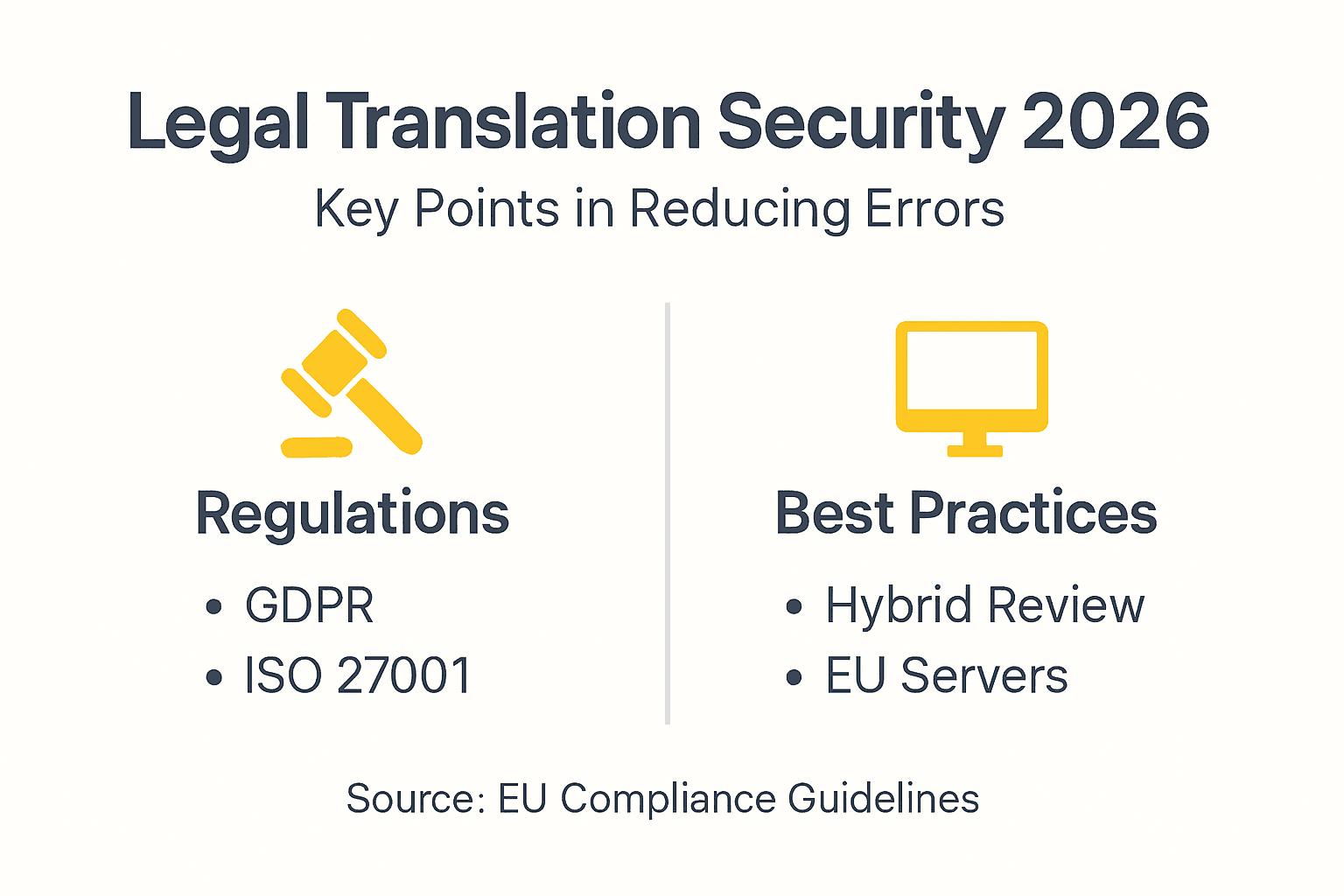
Private EU-hosted servers with ISO 27001 certification ensure data sovereignty and regulatory compliance. Hosting translation infrastructure within EU borders keeps sensitive legal data under EU jurisdiction. ISO certification demonstrates systematic security controls governing access, encryption, and vulnerability management. This approach eliminates reliance on third-party public cloud services that may process data outside EU regulatory oversight.
Documented incident response plans enable timely breach notification. GDPR requires notification within 72 hours of discovering a personal data breach. Translation providers need predefined escalation procedures, communication templates, and designated response teams ready to execute immediately upon incident detection.
Routine security audits and risk assessments maintain ongoing compliance. GDPR and ISO 27001 both mandate regular reviews of security controls, data processing activities, and risk exposure. Annual audits verify controls remain effective as threats evolve. Quarterly risk assessments identify new vulnerabilities introduced by technology changes or workflow modifications.
Implementation steps for operational controls:
Conduct initial security assessment mapping current data flows, access controls, and compliance gaps.
Deploy ISO 27001 certified infrastructure with private EU hosting and encrypted data transfer protocols.
Integrate client TM/TB assets into translation platform before beginning any document processing.
Document incident response procedures including breach notification workflows and stakeholder communication.
Schedule quarterly risk assessments and annual comprehensive security audits with independent certification.
Key operational controls include:
Role-based access limiting document exposure to personnel with verified need and security clearance
Encryption of data at rest and in transit using current cryptographic standards
Multi-factor authentication for all system access points handling sensitive legal documentation
Automated logging and monitoring capturing all data access and modification events for audit trails
Understanding regulatory risks in Central Europe and client responsibilities in complex projects helps legal professionals anticipate compliance requirements across jurisdictions.
Common Misconceptions in Secure Legal Translation
Many organizations assume MT or NMT alone suffices for secure, accurate legal translation if the platform offers encryption. This belief ignores the distinction between data security and translation accuracy. Encryption protects confidentiality during transmission but does not verify legal meaning remains intact after translation. Subject-matter expert human review remains essential to catch terminology errors, contextual misinterpretation, and regulatory non-compliance that encryption cannot address.
Some professionals believe using public cloud AI tools with encryption meets EU data sovereignty and compliance requirements. Encryption alone does not satisfy GDPR data residency principles or ISO 27001 infrastructure controls. Public cloud providers may process data across multiple jurisdictions, store encryption keys outside EU borders, or lack the systematic security governance ISO 27001 certification requires. Private EU-hosted infrastructure provides the data sovereignty and control regulated sectors demand.
Another misconception holds that ISO 27001 certification alone ensures full GDPR compliance for translation providers. ISO 27001 addresses information security management systems. GDPR imposes broader data protection obligations including lawful basis for processing, individual rights, transparency requirements, and privacy impact assessments. While ISO 27001 supports GDPR compliance by providing required technical and organizational measures, providers need both frameworks implemented to demonstrate comprehensive data protection.
Common false assumptions include:
AI translation has achieved human-level accuracy eliminating need for expert review in legal contexts
Generic NMT platforms provide adequate terminology control for regulated legal documentation
Encryption alone satisfies data protection requirements without considering data residency and access controls
Translation speed and cost reduction justify accepting higher error rates in legal document workflows
Conclusion and Practical Recommendations
GDPR and ISO 27001 compliance forms the foundation of secure legal translation in EU regulated sectors. These frameworks establish enforceable standards for data protection rights and operational security controls that translation providers must implement systematically, not as optional enhancements.
For sensitive, regulated legal content, proprietary AI plus human hybrid workflows deliver superior accuracy and compliance compared to MT or NMT alone. The combination of context-sensitive AI generation, subject-matter expert review, and ISO-aligned quality assurance reduces errors significantly while maintaining audit trails regulators require.
Choose ISO-certified providers with private EU data hosting when handling confidential legal documentation. This infrastructure decision directly impacts data sovereignty, regulatory compliance, and risk exposure. Public cloud platforms introduce jurisdictional complexity and third-party control that regulated legal workflows cannot accept.
Integrate Translation Memories and Term Bases from project initiation to enforce terminology consistency and create verifiable audit trails. Implement rigorous security audit processes including quarterly risk assessments and annual comprehensive reviews. These controls demonstrate systematic governance to regulators and clients.
Situational technology guidance:
Routine internal correspondence with no confidential content: NMT with light human review acceptable
Client communications and standard legal documents: NMT with subject-matter expert review and terminology enforcement
Regulatory filings, litigation documents, and contracts: Proprietary LLM AI with certified SME oversight and full ISO-aligned QA
Highly sensitive matters involving privileged information: Hybrid workflow with enhanced security controls and dedicated project infrastructure
Enhance Your Legal Translation Security with AD VERBUM
Securing sensitive legal documentation requires more than generic translation tools. AD VERBUM operates ISO 27001 certified infrastructure hosted exclusively on private EU servers, ensuring data sovereignty and systematic security governance from project initiation through delivery.
Our proprietary AI ecosystem integrates client Translation Memories and Term Bases before generating output, enforcing terminology precision across 150+ languages. Certified legal scholars and subject-matter experts review every document, catching regulatory nuance and contextual requirements AI cannot verify independently. This hybrid AI+Human workflow delivers 3x to 5x faster turnaround than traditional translation while reducing errors by up to 60% in regulated contexts.
With 25+ years serving Life Sciences, Legal, Finance, and Defense sectors, AD VERBUM understands the compliance pressures legal professionals face. Our GDPR-aligned workflows, ISO 27001 security controls, and network of 3,500+ expert linguists provide the precision and protection your sensitive legal documentation demands. Contact AD VERBUM to discuss your secure legal translation requirements and receive a customized compliance-focused solution.
FAQ
What makes legal translation data particularly sensitive under GDPR?
Legal documents frequently contain personal data of clients, witnesses, or parties to litigation, triggering GDPR protection requirements. Attorney-client privilege demands strict confidentiality that unauthorized translation access would violate. Translation providers become data processors under GDPR, inheriting controller obligations for lawful processing, security measures, and breach notification.
How does ISO 27001 certification improve trust in translation providers?
ISO 27001 certification demonstrates systematic implementation of information security controls through independent third-party audit. Certified providers maintain documented security policies, conduct regular risk assessments, and implement role-based access controls. This certification provides verifiable evidence of security governance rather than relying on provider self-assessment or marketing claims.
Why is human expert review essential despite advanced AI translation capabilities?
AI systems lack legal judgment to interpret jurisdiction-specific terminology, assess regulatory compliance, or verify contractual intent. Legal translation requires understanding of broader legal frameworks, current legislation, and precedent that AI cannot reliably process. Subject-matter experts trained in law provide the contextual verification and regulatory knowledge AI cannot replicate.
Can public cloud AI translation tools comply with EU data protection laws?
Public cloud tools can technically comply if providers implement robust enterprise controls including EU data residency, encryption key management within EU jurisdiction, and contractual data processing agreements. However, most consumer-grade public cloud translation services lack these controls. Private EU-hosted infrastructure eliminates jurisdictional risk and third-party dependencies that complicate compliance verification.
What are the initial steps to secure existing legal translation workflows?
Conduct a security assessment mapping current data flows, access controls, and compliance gaps against GDPR and ISO 27001 requirements. Verify translation providers hold ISO 27001 certification and host infrastructure within EU jurisdiction. Implement documented incident response procedures including 72-hour breach notification workflows. Integrate Translation Memories and Term Bases to enforce terminology governance and create audit trails.
Recommended
