Regulated translation: definition, standards, and compliance guide

Certified does not mean compliant. That distinction matters enormously when you are responsible for getting a clinical protocol, patent filing, or regulatory submission across a language boundary without exposing your organization to legal liability or a failed approval. Many compliance professionals assume that any credentialed translator can handle regulated documentation, but regulated translation operates under a completely different set of obligations than general or even certified translation. This article gives you a precise definition, maps the governing standards and laws, identifies exactly when regulated translation is mandatory, and walks you through the practical steps to keep every project audit-ready.
Table of Contents
Key Takeaways
Point | Details |
Regulated translation | It ensures that critical documents meet legal and industry compliance requirements to avoid penalties and delays. |
Standards and accreditation | Only accredited professionals or agencies should handle regulated translation for high-stakes sectors. |
Workflow rigor | A documented process and quality controls are essential in regulated translation to satisfy audit requirements. |
When mandatory | Use regulated translation for documents in legal, life sciences, finance, and whenever law or compliance demand it. |
Avoid shortcuts | Cutting corners with unqualified translation vendors increases compliance risk and potential legal exposure. |
What is regulated translation?
Regulated translation is not simply a translation produced by a certified professional. The distinction is foundational. As defined in established language services practice, regulated translation involves adherence to legal norms, industry standards, and official procedures that govern how specific documents must be rendered and validated in another language to comply with regulatory requirements. That definition has operational weight: it means the process itself, not just the credentials of the person performing it, must satisfy external requirements.
Consider what this looks like in practice. A certified translator working on a marketing brochure applies linguistic skill and professional ethics. A regulated translation of a clinical trial protocol, by contrast, must follow specific procedural steps, use approved terminology, align with the governing regulatory framework (such as the EU Clinical Trials Regulation), and produce an auditable record of how quality was verified. The output is inseparable from the process that created it.
How regulated translation differs from adjacent concepts:
Certified translation: A translator or agency provides a signed attestation that the translation is accurate. There is no universal process standard, and the requirement varies by jurisdiction. A certified translation of a birth certificate is not the same as a regulated translation of a drug labeling document.
Sworn translation: A translator appointed by a court or governmental authority provides a legally recognized version of a document. Common in civil law countries. Sworn status is a credential, not a compliance process.
Regulated translation: Governed by external regulatory frameworks and standards. The process, reviewer qualifications, terminology controls, and documentation trail are all subject to audit or legal scrutiny.
Industries where regulated translation is non-negotiable include life sciences (pharmaceutical, biotechnology, medical devices), legal services, financial services, and defense. Document types that routinely require regulated handling include clinical protocols and informed consent forms, device labeling under the EU Medical Device Regulation (MDR), patent specifications, compliance reports, regulatory submissions to agencies such as the FDA or EMA, and financial prospectuses governed by securities law.
Attribute | General translation | Certified translation | Regulated translation |
Primary driver | Communication quality | Attestation of accuracy | Regulatory compliance |
Process standard | Translator’s discretion | Varies by jurisdiction | Defined by law or standard |
Terminology control | Recommended | Inconsistent | Mandatory |
Audit trail required | No | Sometimes | Yes |
Subject-matter expertise | Helpful | Not mandated | Required |
Quality framework | Optional | Optional | ISO 17100, ISO 18587, sector-specific |
The table above shows why treating regulated translation as simply “a more careful certified translation” creates compliance risk. The underlying operational logic is structurally different.
Standards and laws: What governs regulated translation?
With the definition clear, it is critical to understand the backbone: which laws, standards, and certifying bodies govern regulated translation?

The answer is layered. International standards provide process frameworks, while national or regional regulations create legal mandates. Both operate simultaneously, and compliance professionals need to track both layers.
Key standards that shape regulated translation:
The medical translation standards most relevant to life sciences organizations include ISO 17100 (translation services process requirements), ISO 18587 (post-editing of machine translation output), and ISO 13485 (quality management for medical devices, which directly affects device labeling translation). ISO 9001 provides the broader quality management foundation that supports all of these. These are not aspirational guidelines; in regulated markets they function as baseline expectations that authorities reference during inspections.
EU translation compliance risks are especially acute because European regulatory frameworks require technical translations to be performed by vetted, licensed professionals or organizations. The EU MDR, for example, requires that device labeling and instructions for use are accurately translated into all official languages of the member states where the device will be placed on the market. Using an unvetted provider is not just a quality concern; it is a regulatory exposure.
Scope | Governing instrument | Applicable region |
Medical device labeling | EU MDR (2017/745) | European Union |
Drug approvals and labeling | 21 CFR Part 201, Part 314 | United States (FDA) |
Clinical trials | EU CTR (536/2014), ICH E6 GCP | EU, global |
Financial prospectuses | Prospectus Regulation, SEC rules | EU, US |
Patent translations | EPC Rule 6, national patent offices | Europe, jurisdiction-specific |
General process standard | ISO 17100:2015 | Global |
Key governing bodies by region:
EU: European Medicines Agency (EMA), national competent authorities (NCAs), European Patent Office (EPO)
US: Food and Drug Administration (FDA), United States Patent and Trademark Office (USPTO), Securities and Exchange Commission (SEC)
Global: International Organization for Standardization (ISO), International Council for Harmonisation (ICH) for pharmaceutical sectors
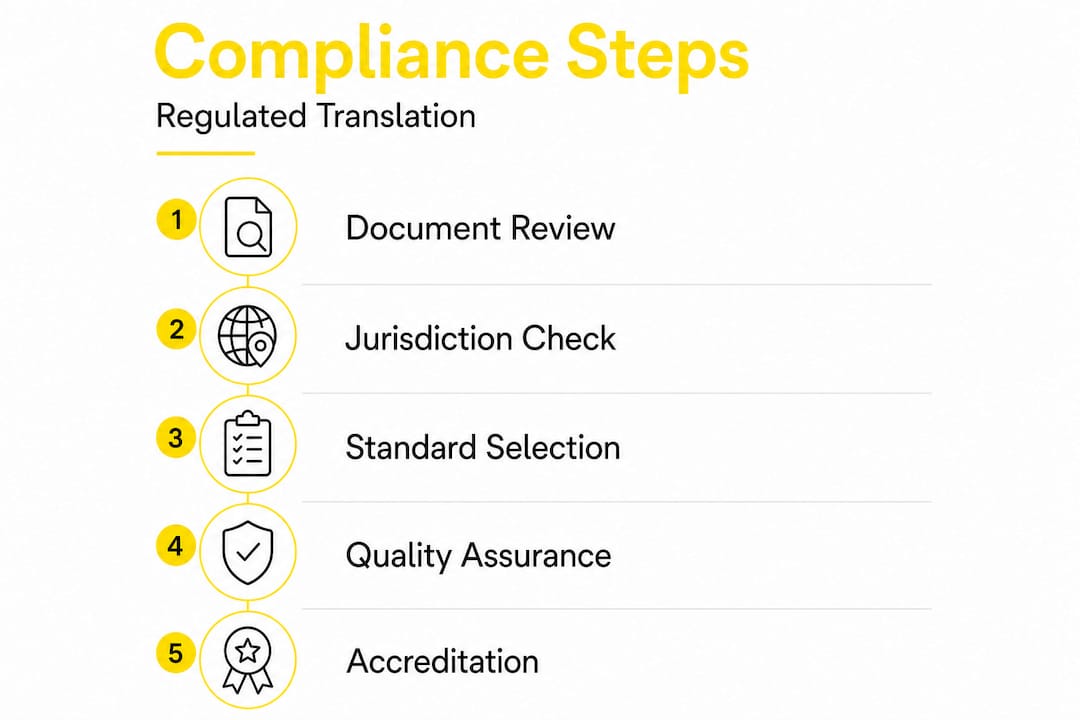
Compliance steps for any regulated translation engagement:
Identify the governing regulatory framework for the specific document and target jurisdiction.
Verify that the translation provider holds relevant certifications (ISO 17100, ISO 13485 where applicable, ISO 27001 for data security).
Confirm that translators have verified subject-matter expertise in the relevant sector, not just the target language.
Require a documented terminology management protocol, including Translation Memories and Term Bases.
Confirm that a quality assurance step, independent of the translator, is built into the workflow.
Obtain and retain the full audit trail, including revision history and reviewer credentials, for the duration required by the applicable regulation.
Pro Tip: Always verify translator accreditation for your specific jurisdiction before signing a contract. A provider certified for EU pharmaceutical work may not meet FDA submission requirements, and vice versa. Ask for documentation, not just assurances.
When is regulated translation mandatory?
Once the standards are known, the next step is recognizing the scenarios when regulated translation is not just recommended but absolutely necessary.
The clearest trigger is regulatory submission. Any document submitted to a government authority as part of an approval process requires translation that is traceable, accurate, and defensible. There is no gray area here. Regulated translation is mandatory for documents like clinical trial data, patent filings, compliance reports, contracts, and regulatory submissions. These categories share a common characteristic: their legal or regulatory validity depends on the accuracy and traceability of the translation.
Document types where regulated translation is required or strongly advisable:
Clinical trial protocols, informed consent forms, and patient-facing materials
Investigational medicinal product dossiers (IMPDs) and common technical documents (CTDs)
Device labeling, instructions for use (IFU), and safety warnings
Patent claims and specifications filed with patent offices
Legal contracts with cross-border enforceability requirements
Financial statements and prospectuses subject to securities regulation
Environmental, health, and safety (EHS) documentation for manufacturing operations
Regulatory correspondence with agencies such as the FDA, EMA, or national competent authorities
The regulated industries where these requirements apply most intensively are life sciences, pharmaceutical manufacturing, medical device development, legal services, financial services, and defense contracting. In each of these sectors, a translation error is not a quality inconvenience; it can invalidate a submission, create product liability exposure, or trigger enforcement action.
A concrete example: if a medical device manufacturer translates its IFU using a general translation service and the output contains an ambiguity in the dosing or usage instructions, that error can result in a recall, a regulatory warning letter, or patient harm. The regulatory authority does not distinguish between an intentional misstatement and a careless translation. The outcome is the same.
Pro Tip: Build a document classification map at the start of each project. Separate documents into three tiers: those requiring regulated translation with full audit trail, those requiring certified translation, and those suitable for standard professional translation. Applying regulated-level rigor to everything is expensive; failing to apply it where required is far more costly.
A note on statistical context: Documentation errors, including translation failures, consistently appear in FDA warning letters and EU non-conformity reports as contributing factors in regulatory actions. While aggregate figures vary by year and sector, the pattern is consistent enough that regulatory consultants routinely cite poor documentation quality as a top-five source of submission delays and enforcement risk.
How to ensure compliance in regulated translation
Even with requirements mapped, compliance is a moving target. Here is how to maintain your translation’s audit-readiness across the full project lifecycle.
“A non-compliant translation can jeopardize entire regulatory submissions, not just the translated document itself, but the credibility of the complete dossier it belongs to.”
That reality shapes everything about how a compliant regulated translation workflow must be structured. A defined, step-by-step workflow is essential in producing compliant regulated translations for audit trails and legal defensibility. Without it, you cannot demonstrate to an auditor or a regulatory body that the translation was produced under controlled conditions.
Compliance workflow for regulated translation projects:
Preparation. Gather all source documents, applicable regulatory requirements for the target market, and existing terminology assets (Translation Memories and Term Bases). Incomplete source documentation is one of the most common causes of downstream quality failures.
Provider qualification. Verify certifications (ISO 17100, ISO 9001, ISO 13485 for medical devices, ISO 27001 for information security). Review the provider’s subject-matter expertise, particularly whether their linguists have professional backgrounds in your sector, not just language training.
Terminology governance. Establish or import a controlled Term Base before translation begins. Terminology inconsistencies across a regulatory dossier are a red flag for reviewers and a risk factor for submission failure.
Translation with SME oversight. Translation must be performed or reviewed by a subject-matter expert who understands both the regulatory context and the technical domain. Linguistic fluency alone is not sufficient.
Independent quality review. A second reviewer, separate from the translator, checks for technical accuracy, regulatory compliance, and contextual appropriateness. This is the structural equivalent of double-blind review in research.
Certification and documentation. Obtain a formal certification of translation accuracy and retain all supporting records, including reviewer credentials, version history, and QA sign-off, for the duration required by the applicable regulatory framework.
The translation compliance guidance that governs best practice in regulated sectors consistently emphasizes that the audit trail is as important as the translation itself. Regulators review process documentation, not just output quality.
For a structured approach to QA, the translation quality checklist for regulated sectors provides a practical framework to verify that each step has been completed and documented. Similarly, a certified vendor checklist helps compliance teams evaluate whether a provider meets the baseline requirements before engagement.
Pro Tip: Build ongoing due diligence into your vendor relationships, not just initial qualification. Request annual certification renewals, review any changes in their QA processes, and conduct periodic spot audits of translation deliverables. Vendor qualification is not a one-time event in regulated sectors.
Risk mitigation practices worth implementing:
Require ISO 27001 certification from any provider handling confidential regulatory data. Data sovereignty matters. A provider that routes your clinical trial data through public cloud infrastructure may create GDPR or HIPAA exposure.
Specify required turnaround times in your service agreement, but do not allow speed to override QA steps. Shortcuts in regulated translation typically cost more to fix than they save in delivery time.
Maintain a centralized repository of all translated regulatory documents, including version history, so that updates to source documents trigger a controlled re-translation process rather than ad hoc corrections.
Why regulated translation demands more than just linguistic expertise
Here is a candid assessment of what the translation industry often gets wrong when it comes to regulated documentation.
The most common misconception among compliance teams that are new to managing translation vendors is that certification equals competence for regulated work. It does not. A translator can hold advanced language certifications and still be entirely unqualified to handle a device labeling document under MDR requirements, because the qualification gap is not linguistic; it is regulatory and procedural.
What actually differentiates a capable regulated translation provider from a capable general translation provider is workflow architecture, not just talent. The provider needs to operate under a process framework that was designed for regulated outputs from the ground up. That means documented procedures, role-separated quality review, terminology governance tools, and an information security posture that matches the sensitivity of the content being handled.
Speed and cost are not irrelevant, but in regulated sectors they are subordinate criteria. The consequences of a failed regulatory submission because of a translation error, whether a misrendered contraindication, an ambiguous patent claim, or a mistranslated compliance obligation in a financial prospectus, almost always exceed the cost of doing the translation correctly the first time. The specialized translation insights most experienced compliance professionals share after a regulatory incident follow the same pattern: the savings from using an unqualified provider were a fraction of the remediation cost.
Invest in compliance partnerships. Vet your providers against the standards listed in this article. Require documented processes, not just reassurances. And build your internal document classification system so that the right level of rigor is applied to the right documents, every time.
Partner with experts for compliance-grade regulated translation
The standards, workflows, and risk factors covered in this article reflect the operational reality for any compliance team managing regulated documentation across languages. Knowing the requirements is the first step. Working with a provider built to meet them is the second.

AD VERBUM’s regulated translation services are designed specifically for the demands described here. With 25+ years of experience in life sciences, legal, finance, and defense sectors, AD VERBUM operates a proprietary AI+HUMAN hybrid workflow: client Translation Memories and Term Bases are integrated first, followed by LLM-based generation constrained by your terminology, then reviewed by certified subject-matter experts, and finalized through QA aligned to ISO 17100 and ISO 18587. All processing runs on EU-hosted, ISO 27001 certified infrastructure, with GDPR and HIPAA alignment built in, delivering 3x to 5x faster turnaround than traditional workflows without compromising the audit trail your regulators will expect.
Frequently asked questions
What qualifies as a regulated document for translation?
Regulated documents include legal, medical, financial, and technical records governed by compliance frameworks such as FDA regulations, EU MDR, or securities law. If the document’s validity or legal effect depends on its accuracy in a target language, it qualifies as regulated.
How is regulated translation different from certified translation?
Regulated translation involves compliance with regulatory requirements and procedures, while certified translation focuses on the translator’s certification or attestation. Regulated translation requires a documented process and audit trail; certified translation typically does not.
Who can perform regulated translations?
Certified and accredited professionals are mandated to perform regulated translations under strict standards, but accreditation alone is not sufficient. Providers must also operate under a process framework aligned to relevant ISO standards and sector-specific regulatory requirements.
What are common risks of non-compliant translations?
Non-compliance can result in regulatory fines, failed submissions, product liability exposure, and legal challenges to the validity of the translated document. In life sciences, the consequences can also include patient safety incidents and product recalls.
Recommended