


Technical Translation Step by Step: Achieve Secure, Accurate Results

Precision in clinical translation can make or break regulatory approval for pharmaceutical leaders from American to European markets. Nearly 60 percent of regulatory affairs managers say inconsistent terminology is their biggest obstacle in submitting documents to health agencies. With rapidly evolving compliance demands, staying ahead means adopting AI plus human translation solutions that guarantee data security and satisfy ever-tightening standards. Uncover how integrating your assets, leveraging advanced technology, and expert oversight leads to error-proof submissions across every European jurisdiction.
Table of Contents
Quick Summary
Key Point | Explanation |
1. Integrate Terminology Assets Effectively | Collect and standardize terminology to ensure consistent translations across sectors, especially in regulatory environments. |
2. Utilize AI for Initial Drafts | Employ a proprietary LLM to generate accurate translation drafts that respect established terminology, enhancing efficiency. |
3. Engage Subject Matter Experts for Review | Conduct thorough reviews with experts to validate translations, focusing on technical accuracy and compliance for quality assurance. |
4. Verify Compliance with ISO Standards | Implement an audit trail of processes following ISO standards to ensure translations meet regulatory requirements and maintain integrity. |
Step 1: Integrate Translation Assets for Terminology Consistency
Integrating translation assets ensures your technical translations maintain precise terminology across all documents. This process involves carefully mapping and standardizing key terms to create consistent, accurate translations that meet regulatory requirements.
Start by collecting existing terminology extraction methodologies from your current translation resources. This means gathering glossaries, previous translation memories, style guides, and industry specific term lists. For regulatory sectors like pharmaceuticals or medical devices, your terminology database becomes the foundational blueprint for translation accuracy. Pay special attention to domain specific terms that have critical meanings where even minor variations could introduce significant risks.
Next, structure your terminology assets by creating a centralized reference guide. Categorize terms by their technical domain medical, legal, engineering and assign precise definitions. Ensure each term includes its authorized translation, contextual usage guidelines, and any specific regulatory compliance requirements. Work closely with subject matter experts who can validate the nuanced meanings and confirm the terminology matches industry standards.
Pro tip: Regularly update your terminology database by conducting quarterly reviews with technical specialists to capture emerging industry language and maintain translation precision.
Step 2: Initiate AI-Generated Draft with Proprietary LLM
Initiating an AI generated draft using a proprietary Large Language Model transforms your technical translation workflow by generating precise initial content while maintaining strict compliance standards. This step leverages AD VERBUM’s advanced AI technology to produce a foundational translation that captures domain specific nuances.

Begin by uploading your source document into the proprietary LLM system. Unlike public translation tools, AD VERBUM’s AI understands specialized technical contexts and generates comprehensive draft translations that respect industry specific terminology. The system analyzes your uploaded document against the previously integrated terminology assets from step 1, ensuring each technical term matches your established glossary. This approach prevents potential mistranslations by constraining the AI to your predefined linguistic parameters.
As the AI generates the draft, carefully review the output against your original document. Pay special attention to technical terms, regulatory language, and context specific phrases. The draft serves as a sophisticated starting point that requires human expert refinement. Your subject matter experts will verify accuracy, validate technical meanings, and make any necessary adjustments to align the translation with precise regulatory requirements.
Pro tip: Configure your LLM settings to prioritize terminology consistency by setting strict language model parameters that match your predefined industry glossary.
Step 3: Refine Output with Subject Matter Expert Oversight
Refined translation requires meticulous expert review to ensure absolute accuracy and regulatory compliance. This critical step transforms the AI generated draft into a precise technical document that meets the highest professional standards for your specific industry.
Engage subject matter experts strategically for content validation, selecting professionals with deep domain knowledge matching your translation requirements. These experts will systematically analyze the AI generated draft against the original document, focusing on technical terminology, contextual accuracy, and regulatory alignment. They will scrutinize every technical term, scientific concept, and specialized phrase to verify the translation maintains the exact meaning and technical integrity of the source material.
During the expert review process, create a structured feedback mechanism that allows subject matter experts to mark specific sections requiring modification. Encourage detailed annotations that explain why certain translations need adjustment. This collaborative approach ensures not just linguistic accuracy but technical precision. Your SMEs will identify nuanced contextual issues that automated systems might miss transforming the draft into a document that reads like it was originally written in the target language.
Pro tip: Develop a standardized review template with specific evaluation criteria to streamline subject matter expert feedback and maintain consistent quality across different translation projects.
Step 4: Verify Compliance and Quality Against ISO Standards
Verifying translation compliance requires a systematic approach that aligns with rigorous international standards. This crucial step ensures your technical translation meets the most stringent quality requirements for regulated industries.
Implement a comprehensive review process that follows translation quality standards established by ISO 17100 and ISO 18587. These internationally recognized frameworks provide a structured methodology for validating translation accuracy. Focus on key compliance elements such as verifying translator qualifications, implementing independent revision processes, and documenting each stage of the translation workflow. Pay special attention to sector specific requirements that go beyond standard linguistic checks.
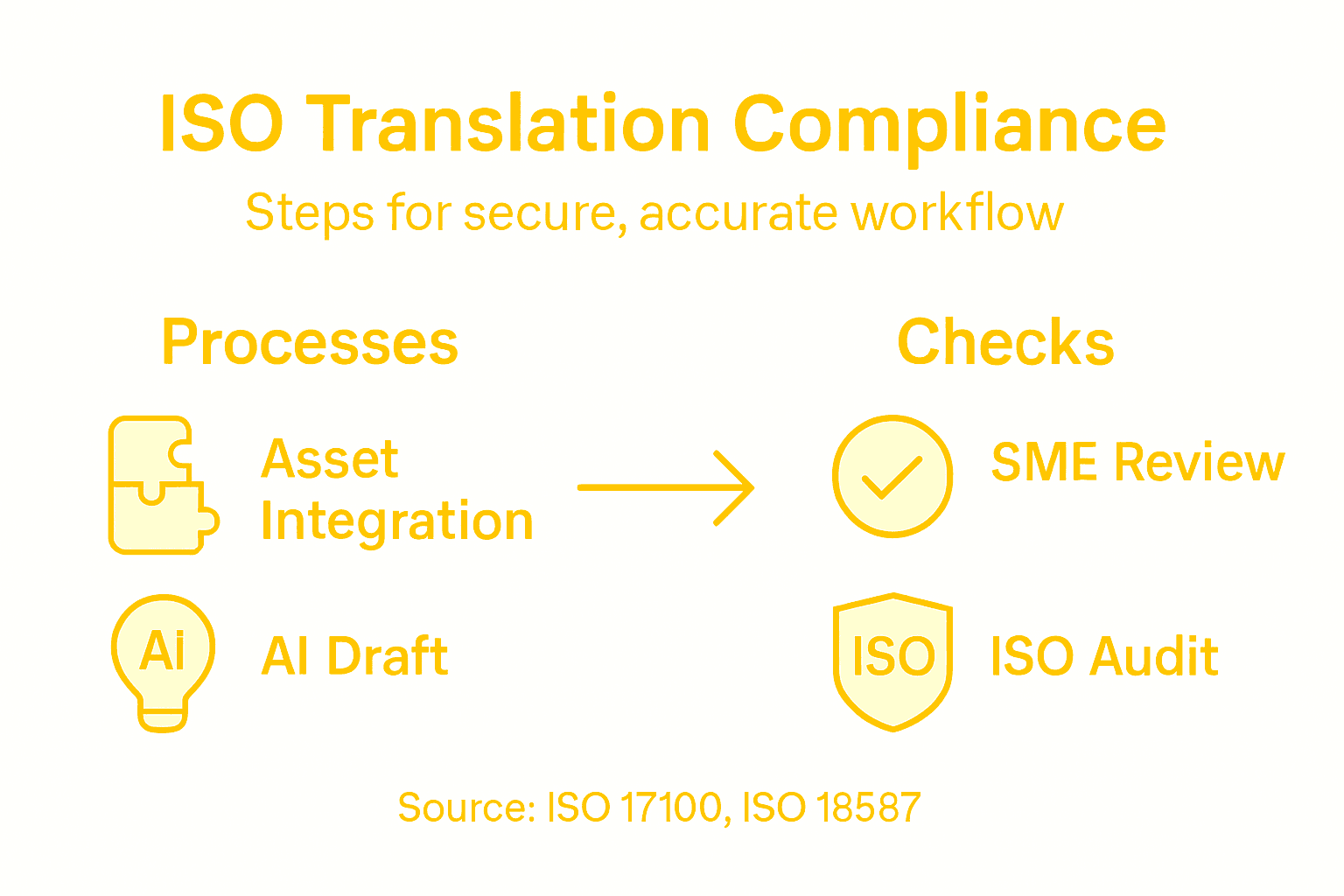
Carefully document every aspect of the translation process to create an audit trail that demonstrates regulatory compliance. This includes capturing detailed review notes from subject matter experts, tracking changes made during the refinement process, and maintaining version control. Your documentation should clearly show how the translation meets industry specific standards and maintains the technical integrity of the original document. By meticulously following these ISO guidelines, you transform the translation from a simple language conversion into a precisely calibrated technical communication that meets the highest professional standards.
Pro tip: Create a standardized compliance checklist that maps each ISO requirement to specific verification steps in your translation workflow.
See how ISO standards differ in technical translation:
ISO Standard | Main Focus | Application in Workflow |
ISO 17100 | Translation process and qualifications | Ensures qualified translators and revision steps |
ISO 18587 | Post-editing of machine translation | Validates human oversight after AI drafts |
Here’s a summary of the roles and contributions at each translation step:
Step | Main Responsible Party | Key Contribution |
Integrate Terminology Assets | Terminology Managers, SMEs | Standardize and validate technical terms |
AI-Generated Draft | LLM Engineers, Translators | Produce draft translation within glossary constraints |
Expert Oversight | Subject Matter Experts | Review for accuracy and regulatory compliance |
ISO Compliance Verification | Quality Assurance Leads | Audit process, ensure ISO standard adherence |
Secure and Precise Technical Translation Starts Here
The journey to secure and accurate technical translation begins with managing terminology consistency and overcoming risks linked to generic machine translation tools. This article highlights critical challenges such as maintaining strict terminology enforcement and ensuring regulatory compliance across complex documents. Companies in Life Sciences, Legal, and Engineering require a solution that integrates authoritative terminology assets with human expertise to prevent costly errors and data breaches.
AD VERBUM offers a proven AI+HUMAN translation workflow designed specifically to address these pain points. Our proprietary Large Language Model operates exclusively within secure EU servers, eliminating the risk of data leakage common to public machine translation services. By tightly integrating your terminology databases and leveraging over 3,500 subject matter expert linguists, we guarantee translations that uphold industry standards like ISO 17100 and ISO 18587 while safeguarding your sensitive information.
Experience the difference of a technology-first partner who delivers fast, compliant, and precise technical translations. Learn more about our Specialized AI Translation and why companies trust AD VERBUM for regulated sector projects. Ready to achieve flawless technical translation outcomes? Visit AD VERBUM today and secure your compliance with our advanced AI+HUMAN services.
Frequently Asked Questions
How can I ensure consistency in terminology for technical translations?
To ensure consistency in terminology for technical translations, start by integrating translation assets such as glossaries and previous translation memories. Create a centralized reference guide categorized by technical domains and regularly update it to capture any emerging language trends.
What role does AI play in generating initial drafts for technical translations?
AI plays a crucial role in generating initial drafts by producing precise content that adheres to specific terminology. Upload your source document to a proprietary AI system, which will analyze it against your established glossary to create a draft that maintains technical accuracy.
How can I involve subject matter experts in the translation process?
Involve subject matter experts (SMEs) during the review phase to validate the accuracy and compliance of the translation. Engage them strategically to analyze AI-generated drafts and provide detailed feedback on technical terminology and contextual nuances.
What steps should I take to ensure compliance with international translation standards?
To ensure compliance with international translation standards, implement a systematic review process that aligns with ISO guidelines. Document each stage of the translation workflow, capturing review notes and changes to demonstrate adherence to specific standards effectively.
How often should I update my terminology database?
You should update your terminology database regularly, ideally conducting quarterly reviews with technical specialists. This practice will help you capture emerging industry language and maintain translation precision in your documentation.
What are the main responsibilities for each step in the technical translation process?
Each step in the technical translation process involves specific roles like Terminology Managers standardizing terms, LLM Engineers producing draft translations, SMEs verifying accuracy, and Quality Assurance Leads ensuring ISO standard adherence. Clearly outline these responsibilities to streamline the workflow and maintain quality.
Recommended

