


Achieve AQAP 2110 compliance: close NATO documentation gaps in 2026

Non-primary contractors in NATO supply chains face a persistent challenge: documentation gaps that trigger audit non-conformances under AQAP 2110. These gaps jeopardize contract renewals and competitive positioning. Multilingual operations amplify the risk when quality plans, inspection records, and test protocols lack technical precision across languages. This guide delivers practical steps to build compliant documentation systems that satisfy NATO auditors and close critical gaps before they become contract liabilities.
Table of Contents
Key takeaways
Point | Details |
AQAP 2110 extends ISO 9001 requirements | Defense-specific documentation demands traceability, configuration control, and risk management records beyond standard quality systems. |
Traceability and configuration management shortfalls dominate non-conformance findings during third-party assessments. | |
Multilingual accuracy is non-negotiable | Translation errors in quality documentation directly trigger compliance faults and audit rejections. |
Systematic preparation improves audit outcomes | Structured documentation workflows with version control and specialized language support reduce risk and strengthen contract competitiveness. |
Understanding AQAP 2110 and its documentation requirements
AQAP 2110 is a NATO standard ensuring quality in defense products through controlled documentation. It operates as an extension of ISO 9001, adding defense-specific controls that address the heightened risk profile of military procurement. For subcontractors supplying components or services to prime defense contractors, understanding this distinction is critical.
The standard builds on ISO 9001’s process-based approach but mandates additional layers of documentary evidence. These layers include:
Traceability documentation: Complete records linking materials, components, and processes to specific contract requirements and inspection results.
Configuration management: Controlled change processes with versioned documentation that tracks modifications to designs, specifications, and procedures.
Risk management records: Documented risk assessments, mitigation plans, and evidence of ongoing monitoring tied to product safety and performance.
Nonconformance and corrective action: Structured reporting and resolution workflows that demonstrate systematic problem-solving.
Why does this matter for audits? Third-party assessors verify that your documentation system can reconstruct the complete production history of any deliverable. Gaps in traceability or configuration control signal systemic weaknesses that threaten contract compliance. When your supply chain spans multiple NATO member states, linguistic accuracy becomes a technical requirement, not an administrative detail.
The ECTA AQAP 2110 standard framework emphasizes that documentation must be accessible, auditable, and accurate across all operational languages. This requirement places unique pressure on non-primary contractors who may lack in-house multilingual quality assurance capabilities.
Preparing your documentation system for audit readiness
Successful AQAP 2110 compliance starts with systematic preparation. Before auditors arrive, your documentation architecture must demonstrate control, completeness, and traceability. Here’s how to build that foundation:
Inventory existing documentation: Catalog all quality plans, inspection procedures, test protocols, work instructions, and nonconformance records currently in use.
Map documentation flows: Identify how information moves from design specifications through production to final inspection, noting handoff points and approval gates.
Assign accountability: Designate document owners responsible for creation, review, approval, and version control at each stage.
Implement configuration management: Establish a formal change control process with revision tracking, impact assessments, and stakeholder notifications.
Build traceability matrices: Create linkage tables connecting contract requirements to specific procedures, inspection records, and product identifiers.
Document risk management activities: Record risk assessments, mitigation strategies, and monitoring results tied to product characteristics and delivery milestones.
Configuration management and traceability form the backbone of audit readiness. Configuration management ensures that when a design change occurs, all affected documents update simultaneously and stakeholders receive notification. Traceability documentation proves that each component meets specified requirements through verifiable inspection data.
Risk management documentation integrates these elements by identifying where failures could occur and demonstrating proactive controls. Approximately 30% of audit non-conformances stem from documentation gaps in traceability and configuration management, making these areas audit focal points.
Pro Tip: Maintain version control timestamps and audit trails in a centralized system. Scattered spreadsheets and local file servers create gaps that auditors flag immediately. When subcontractors face the documentation avalanche after winning NATO work, centralized control prevents chaos.
Executing multilingual documentation control in NATO supply chains
NATO supply chains operate across linguistic boundaries. A subcontractor in Poland may report to a prime contractor in France while using technical specifications drafted in English. This multilingual reality creates specific compliance challenges.
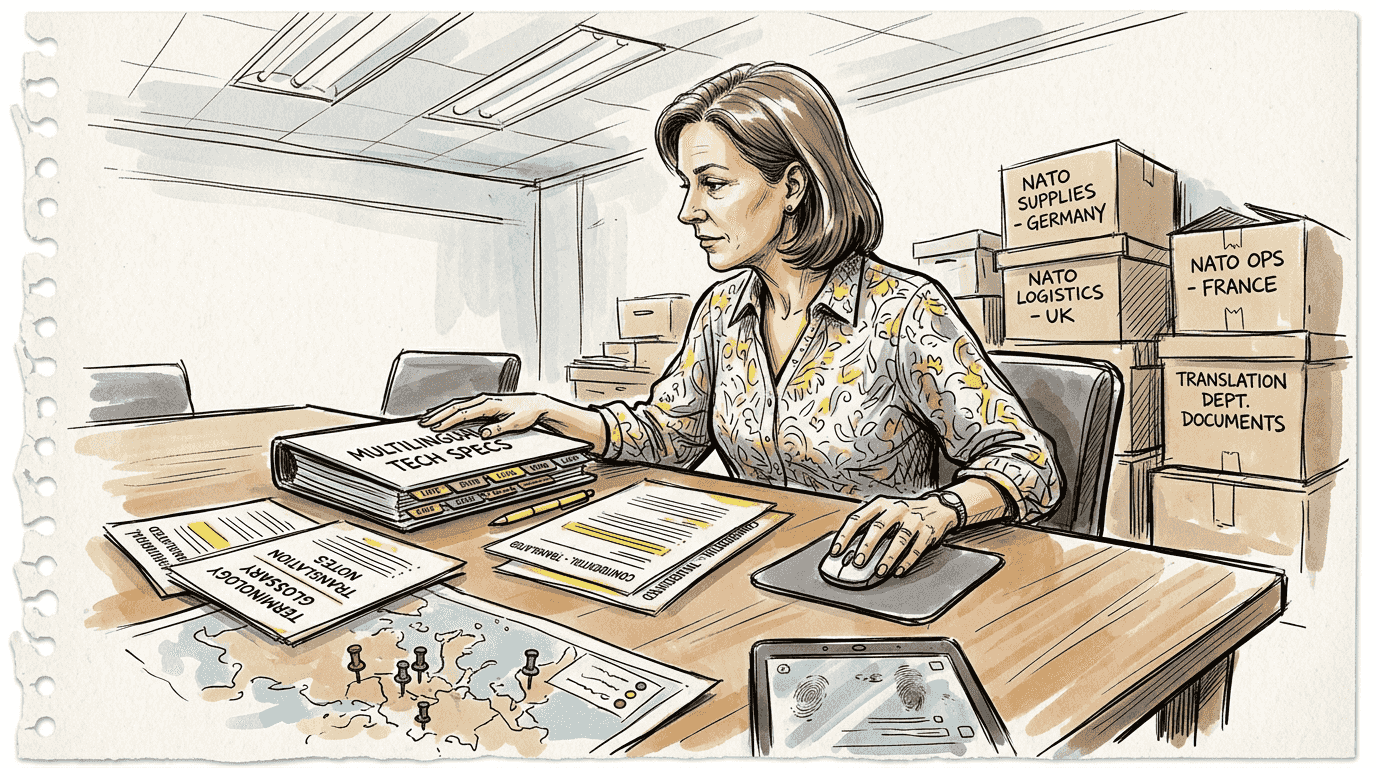
Translation errors in quality documentation have direct consequences. A mistranslated tolerance specification can lead to nonconforming parts. An incorrectly rendered inspection procedure can produce invalid test data. Translation compliance faults trigger audit findings because they demonstrate inadequate control over critical information.
Best practices for multilingual documentation control include:
Centralized terminology management: Build and maintain glossaries of technical terms, product names, and regulatory phrases with approved translations in all operational languages.
Version synchronization: Ensure that when a document updates in one language, all language variants update simultaneously with matching revision codes.
Qualified translation resources: Use linguists with subject matter expertise in defense manufacturing, not generalists unfamiliar with technical context.
Translation quality assurance protocols: Implement independent review cycles where translated documents undergo technical verification before release.
Effective multilingual documentation management is critical to meeting AQAP 2110 demands and preventing translation errors that cause compliance faults. When subcontractors rely on generic translation services without defense sector experience, terminology inconsistencies and contextual errors proliferate.
Specialized language service providers familiar with AQAP 2110 documentation requirements bring structured workflows aligned to quality standards. They understand that a quality plan is not marketing content and that inspection terminology must remain consistent across languages to support traceability.
Pro Tip: Combine AI assistance with expert human review for defense documentation accuracy. AI-driven translation tools can accelerate initial drafts and enforce terminology consistency, but subject matter experts must verify technical accuracy and regulatory compliance before documents enter controlled use.
Verifying compliance: audit readiness and common documentation pitfalls
Audit preparation requires systematic verification. Use this checklist to assess readiness:
Traceability completeness: Can you trace any component from raw material receipt through final inspection to delivery?
Configuration control evidence: Do change records show impact assessments, approvals, and notification to affected parties?
Risk management integration: Are risk assessments linked to specific product characteristics with documented controls?
Nonconformance resolution: Do corrective action records demonstrate root cause analysis and verification of effectiveness?
Multilingual accuracy: Have all translated quality documents undergone technical review by qualified experts?
Version control consistency: Do all controlled documents display current revision levels with matching dates across languages?
Common documentation pitfalls versus best practices:
Common Gap | Best Practice |
Incomplete traceability records | Maintain serialized tracking from material receipt through delivery with linked inspection data |
Informal change management | Implement formal change control with impact assessments and stakeholder approvals |
Generic risk assessments | Tie risk documentation to specific product characteristics and contract requirements |
Delayed corrective actions | Close nonconformances promptly with verified effectiveness checks |
Inconsistent multilingual terminology | Use controlled glossaries and qualified technical translators |
Frequent non-conformances emerge when subcontractors treat documentation as administrative overhead rather than compliance evidence. Auditors look for systematic control, not perfect paperwork. Successful AQAP 2110 certification requires transparent, controlled quality management systems verified by third parties.

Continual review strengthens compliance. Conduct internal audits quarterly, focusing on traceability and configuration management. Simulate external audits by having cross-functional teams verify documentation completeness against contract requirements. Use findings to refine workflows before third-party assessors arrive.
A translation QA checklist tailored to AQAP 2110 helps verify that multilingual documents meet technical accuracy standards. This checklist should cover terminology consistency, numerical accuracy, format preservation, and regulatory alignment across all language variants.
Streamline your AQAP 2110 documentation with expert localization services
Closing documentation gaps requires both systematic processes and specialized expertise. When multilingual accuracy determines audit outcomes, generic translation workflows introduce unacceptable risk.
AD VERBUM delivers precision localization services designed for defense sector compliance. With 25+ years serving regulated industries and a network of 3,500+ subject matter expert linguists, we understand that AQAP 2110 documentation demands technical accuracy, not just linguistic fluency. Our proprietary AI+HUMAN hybrid translation workflow integrates client terminology, applies context-sensitive generation, and routes every document through certified defense sector experts for technical verification. This approach aligns with ISO 17100, ISO 18587, and ISO 9001 standards, providing the quality assurance framework NATO auditors expect. Our EU-hosted infrastructure and ISO 27001 certification address data sovereignty requirements critical for defense subcontractors. Whether you need quality plans, inspection procedures, or nonconformance reports translated across NATO member state languages, our document translation services deliver audit-ready accuracy. Contact us to streamline your multilingual documentation control and strengthen your AQAP 2110 compliance posture.
What is AQAP 2110 and why is it critical for non-primary contractors?
What is AQAP 2110 and why is it critical for non-primary contractors?
AQAP 2110 is a NATO quality assurance standard that extends ISO 9001 with defense-specific documentation and control requirements. For non-primary contractors, it serves as the gatekeeper to NATO procurement participation. Without AQAP 2110 certification, subcontractors cannot bid on or fulfill contracts within the alliance supply chain. The standard mandates rigorous traceability, configuration management, and risk documentation that general ISO 9001 compliance does not fully address.
How can non-primary contractors effectively manage multilingual documentation to meet AQAP requirements?
Partner with specialized language service providers who understand defense sector terminology and regulatory context. Implement centralized terminology management with approved glossaries in all operational languages. Use quality assurance protocols that include technical review by subject matter experts, not just linguistic proofreading. Leverage AI-driven translation tools for consistency and speed, but always route output through qualified human reviewers before documents enter controlled use.
What are the most common documentation gaps found during AQAP 2110 audits, and how can they be avoided?
Traceability and configuration management gaps dominate audit findings. Subcontractors often lack complete records linking materials to inspection results or fail to document change impacts systematically. Poor risk management documentation and delayed corrective actions also trigger non-conformances. Avoid these by implementing structured documentation workflows with version control, centralized change management, and regular internal audits. When language barriers exist, ensure translated documents undergo technical verification to prevent terminology inconsistencies that auditors flag as control weaknesses.
Why do multilingual operations increase AQAP 2110 compliance risk?
Multilingual environments multiply the points where technical accuracy can degrade. Each translation introduces potential terminology inconsistencies, numerical errors, or contextual misunderstandings. When quality plans, inspection procedures, and test protocols exist in multiple languages, maintaining version synchronization and technical accuracy across variants becomes a compliance challenge. Common documentation mistakes compound when linguistic complexity layers onto process complexity, creating gaps that auditors identify quickly.
Recommended
