


SAR typology translation: Avoid costly AML liability
- Apr 27
- 10 min read

Compliance professionals at EU credit institutions tend to treat suspicious activity report (SAR) narratives as an area where some linguistic flexibility is acceptable. That assumption is wrong, and increasingly expensive. When AML typology descriptions in SARs use non-standard language rather than the vocabulary published by national financial intelligence units (FIUs) or aligned to FATF typology glossaries, the consequences range from false negatives in financial intelligence analysis to escalating regulatory liability. This guide explains the regulatory framework, the specific ways imprecise typology translation creates exposure, and the practical governance steps your institution needs now, before AMLA-mandated standardization arrives in 2027.
Table of Contents
From ambiguity to enforcement: The EU’s evolving AML SAR terminology standards
How non-standard typology translation creates liability: Scenarios and sanctions risk
Practical steps: Terminology governance for AML SAR translation compliance
Most compliance teams overlook this: Safe-harbor, negligence, and the real risk window
Need expert SAR translation compliance? How AD VERBUM supports your AML program
Key Takeaways
Point | Details |
Terminology precision is critical | Inaccurate or non-standard translations in SAR typology descriptions now create significant regulatory risk due to new EU compliance expectations. |
EU rules are rapidly evolving | Upcoming 2026-2027 AMLA and AMLR frameworks will enforce standardized SAR formats and indicator lists, raising the bar for translation governance. |
Documented good-faith processes matter | Systems for approval, review, and terminology governance can provide safe-harbor protection when translation errors occur. |
Cross-border reporting requires extra vigilance | Multi-jurisdictional SARs are at greater risk of terminology confusion and compliance failures if translations are not managed closely. |
Fines can be severe | Systemic translation or terminology lapses may result in fines up to €5M or 10% of turnover post-2026. |
Why SAR typology translation is a regulatory flashpoint
Suspicious activity reports, known in some EU jurisdictions as suspicious transaction reports (STRs), are the primary mechanism through which obligated entities communicate suspected money laundering or terrorist financing to their national FIU. The narrative section of a SAR is not just administrative paperwork. It is forensic documentation. Every word in that narrative informs whether an FIU analyst identifies a match, escalates a case, or dismisses a filing as ambiguous.
AML typology descriptions are the core vocabulary of that narrative. Terms like “structuring,” “layering through trade-based transactions,” “funnel accounts,” or “professional money laundering network” carry precise meanings within FATF typology frameworks and within the indicator taxonomies published by national FIUs operating goAML systems. When an institution files a SAR in a second language because it operates cross-border, or when a compliance translation vendor uses a paraphrase rather than the established term, the FIU’s automated matching systems may not flag the relevant pattern. That is a false negative, and it is exactly the kind of outcome that supervisors are now trained to detect.
A common misconception is that there is an official list of “approved” versus “non-approved” AML typology terms that institutions must follow to the letter. The actual picture is more nuanced. No explicit regulatory requirement mandates a specific glossary of approved typology terms in EU SARs right now. However, the absence of a formal mandate does not mean terminology is flexible. Narrative precision and indicator accuracy are the operative standards, and regulators evaluate both in the context of your institution’s overall control environment.
“There is no formal approved terminology list in EU AML frameworks today. But regulators do assess whether your narrative descriptions are sufficiently precise to support FIU analysis. Imprecision is not a neutral outcome — it is a potential control failure.”
This matters for terminology consistency in SARs more broadly because inconsistency across filings from the same institution is a pattern supervisors recognize as systemic. Consider the risk this creates: your institution files SARs in German and Dutch for the same underlying typology, but the translation vendor uses different phrase structures in each language. The FIU in jurisdiction A and the FIU in jurisdiction B both receive reports, but neither captures the full picture because the vocabulary diverges. The translation consequences in compliance extend well beyond a single document.
Key characteristics of SAR typology translation risk:
Automated FIU systems rely on keyword and indicator matching, not on interpretive reading
Paraphrased typology terms create classification gaps in FIU analytics
Cross-border SARs filed in multiple languages amplify the risk of divergent terminology
Supervisors can identify inconsistency across a portfolio of filings during routine audits
Translation errors that affect indicator precision may be classified as inadequate reporting
Pro Tip: Build a SAR-specific term base aligned to the goAML indicator taxonomy and your national FIU’s published vocabulary. Treat it as a living document updated every time your FIU releases new guidance. The translation liability risks that flow from ignoring this step are not theoretical.
From ambiguity to enforcement: The EU’s evolving AML SAR terminology standards
The regulatory environment governing SAR terminology is not static. The EU’s fourth and fifth Anti-Money Laundering Directives (AMLD4, AMLD5) established baseline reporting obligations without prescribing exact narrative formats. That era of relative flexibility is ending.

AMLR (EU 2024/1624) mandates the new Anti-Money Laundering Authority (AMLA) to develop standardized formats for suspicious activity reports by July 2026, with guidelines on suspicion indicators following by 2027. Non-compliance with these standardized formats after implementation could expose institutions to sanctions under harmonized EU AML frameworks, with fines reaching up to 10% of annual turnover. This is a structural shift from a principles-based approach to a format-and-terminology-governed regime.
The implications for cross-border institutions are especially acute. Consider the following transition:
Dimension | Pre-AMLR (current) | Post-AMLR (post-2027) |
Typology terminology | Institution-defined, FIU-guided | AMLA-standardized indicator vocabulary |
SAR format | National format, variable | Harmonized EU format |
Enforcement basis | National supervisory discretion | Harmonized sanction tiers |
Liability for terminology errors | Indirect, audit-triggered | Direct, format non-compliance |
Multi-language SAR consistency | Best practice | Regulatory expectation |
What this means practically is that the translation compliance gap your institution may currently treat as a minor operational imperfection will become a formally sanctionable gap post-implementation. Institutions filing SARs in multiple EU languages need to treat each language version as legally equivalent, with identical indicator precision.
The key milestones your compliance calendar should capture:
July 2026: AMLA publishes standardized SAR formats, creating the reference standard for all obligated entities.
2027: AMLA indicator guidelines take effect, establishing the vocabulary baseline for typology descriptions across EU jurisdictions.
Ongoing from 2026: National competent authorities begin auditing for format alignment as a standalone compliance metric.
Post-2027: Institutions with documented terminology governance programs are better positioned to demonstrate good-faith compliance during supervisory review.
The forensic reporting requirements emerging across major AML jurisdictions reinforce this direction. Regulators increasingly expect institutions to demonstrate not just that they filed a SAR, but that the filing was analytically useful.
A critical point for MLRO teams: the 10% turnover fine threshold is not reserved for egregious violations. Under the harmonized sanctions framework, systemic process failures — including persistent terminology inconsistency across a portfolio of SARs — qualify for escalating enforcement tiers. This is not a risk to defer to a future project cycle.
How non-standard typology translation creates liability: Scenarios and sanctions risk
Understanding the rules is necessary but not sufficient. What follows is a breakdown of how terminology missteps in SAR translation actually produce regulatory consequences, with reference to the specific sanctions architecture.
Using non-standard or inaccurately translated terminology in SAR descriptions risks regulatory scrutiny because it may hinder FIU analysis, trigger supervisory audits, or be classified as a systemic control failure under AMLD6 Article 53. That classification escalates to Category 3 or 4 breaches, carrying fines up to €5M or 10% of annual turnover.
Consider a concrete scenario. A payment institution operating in three EU member states files SARs relating to suspected trade-based money laundering (TBML). In French, the typology is described accurately using the FATF-aligned term “manipulation des prix de transfert commerciaux” (trade price manipulation). In the Dutch translation, a generalist translation vendor renders the same activity as “verdachte handelsactiviteiten” (suspicious trade activities). The Dutch filing lacks the specific indicator, fails to match any TBML pattern in the FIU’s goAML taxonomy, and the case is not escalated. Six months later, during a supervisory review, the Dutch FIU identifies the gap. The institution cannot demonstrate that its translation process was governed by a finance-specialist compliance linguist or that a term base aligned to FIU indicators was in use.
Typology translation error type | Regulatory risk outcome |
Paraphrase replaces FATF indicator term | FIU automated match failure, false negative |
Inconsistent terminology across jurisdictions | Pattern not identified, supervision gap |
Literal legacy machine translation of typology | Meaning distorted, narrative fails precision standard |
Missing negation or qualifier in translated narrative | Case incorrectly classified by FIU system |
No documented review by compliance linguist | Control failure evidence during audit |
Analogous enforcement precedent exists. An OFSI fine of £160,000 against a bank for Russian sanctions breaches demonstrates that regulators treat imprecise compliance documentation as a sanctionable failure, even when intent was not fraudulent. The parallel for SAR terminology is direct: regulators do not require malicious intent to impose sanctions. Systemic process failure is sufficient.
The key triggers for supervisory audit include:
SAR rejection or return by an FIU citing insufficient narrative detail
Pattern analysis by the supervisor identifying divergent terminology across an institution’s SAR portfolio
Whistleblower or internal audit report referencing translation quality gaps
Cross-border referral revealing inconsistency between same-institution SARs in different languages
For guidance on building compliant SAR translations and preventing these outcomes, terminology governance is the central control. The translation errors and regulatory risk literature from adjacent regulated sectors confirms this pattern: terminology gaps in regulated documentation are not stylistic issues, they are control failures.
Pro Tip: Maintain a translation rationale log for every SAR typology description where a standard FATF or FIU term was not available in the target language. Documented rationale for a deviation is substantially more defensible than an unexplained paraphrase.
Practical steps: Terminology governance for AML SAR translation compliance
After mapping the risk, the question is what your institution can do now to close the exposure. The following governance structure reflects current best practice and anticipates AMLA-mandated standardization.
EU credit institutions must ensure that SARs use precise, consistent terminology matching FIU indicators and goAML fields to avoid rejection, delays, or fines for inadequate reporting under national implementations and the incoming AMLA standards.
Step-by-step governance framework:
Build a SAR-specific term base. Compile the indicator vocabulary from your national FIU’s goAML guidance, FATF typology reports, and AMLA pre-publication drafts. This becomes your authoritative translation reference. Treat it as a controlled document with version history.
Map term bases to each target language. For every language in which your institution files or may file SARs, validate that each FATF typology term has an approved target-language equivalent verified by a finance-specialist compliance linguist.
Establish a formal approval workflow. Every SAR translation should pass through a two-stage review: first, a compliance-aware translator with finance sector expertise; second, a compliance officer review for indicator alignment before filing.
Align with goAML field structures. If your FIU uses goAML, the system’s field taxonomy is your de facto indicator vocabulary. Translations must map to those fields precisely, not approximate them.
Audit your existing SAR archive. Run a retrospective review of past multilingual filings. Identify inconsistent typology terms and document remediation steps. This demonstrates proactive control to supervisors.
For more detail on translation compliance best practices specific to regulated financial documentation, the alignment between FIU indicator frameworks and your term base is the most critical single control.
Top 5 avoidable pitfalls in SAR translation compliance:
Routing SAR narratives through consumer-grade NMT tools without terminology enforcement
Using translation vendors without demonstrated finance-sector regulatory expertise
Treating each language version of a SAR as a separate document rather than a legally equivalent parallel text
Failing to update term bases when FIUs release updated indicator guidance
Not documenting the rationale for any terminology choice that deviates from the FIU’s published vocabulary
For terminology consistency strategies that extend beyond SARs to other regulatory disclosures, the principle is the same: regulatory vocabulary is a controlled asset, not a stylistic preference.
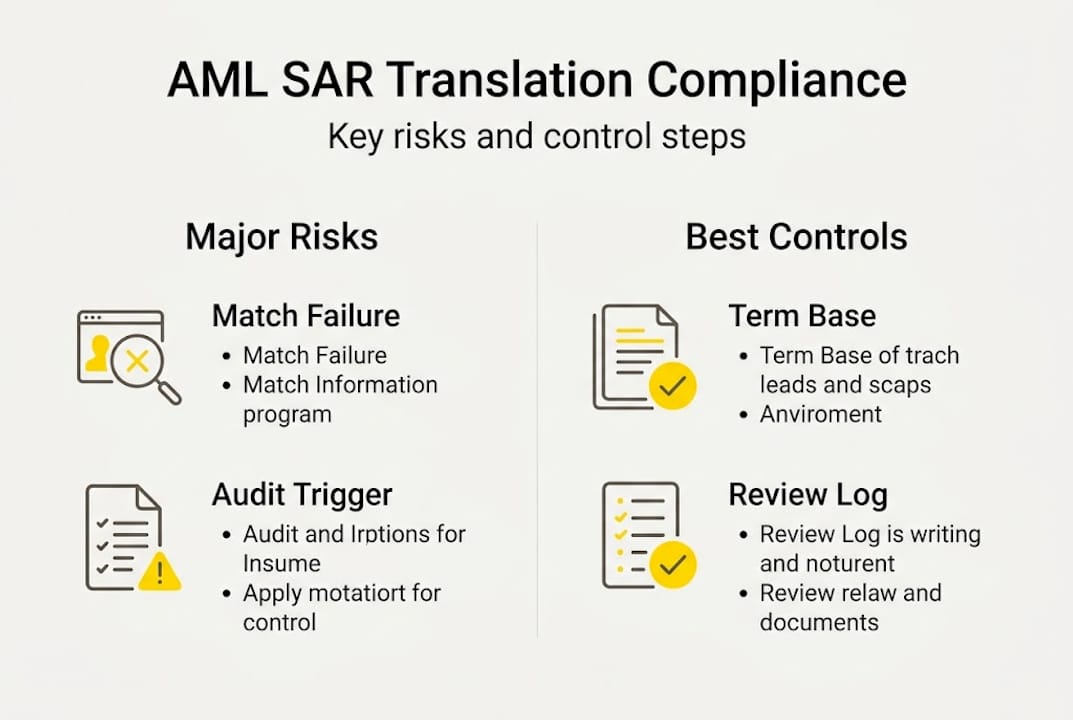
Pro Tip: Request that your translation provider share their term base governance records during the next vendor review. If they cannot produce a finance-specific term base maintained against FIU indicator lists, that is a governance gap in your compliance chain.
Most compliance teams overlook this: Safe-harbor, negligence, and the real risk window
Here is a less-publicized truth that gets lost in the noise around AML enforcement: not every translation gap creates actionable liability. Good-faith SAR filings provide safe-harbor protection, and liability typically emerges from negligence in controls or inaccurate reporting, not from isolated imprecision in a single filing.
This matters for how you prioritize your governance investment. Regulators — even post-AMLA — will distinguish between an institution with a documented, maintained terminology governance program that produced one imperfect SAR, and an institution with no program at all. The former can demonstrate good faith. The latter cannot.
The real risk window is not the occasional edge case. It is the institution that has no term base, uses a general-purpose translation vendor for SAR narratives, and cannot show an auditor any evidence of compliance-aware review. That is where the cross-border terminology errors become genuinely dangerous.
Good faith is not a guarantee of immunity, but it is a meaningful mitigation. Document your controls, version your term bases, and log your reviewer decisions. Those records are your defense posture.
Need expert SAR translation compliance? How AD VERBUM supports your AML program
Navigating the terminology governance requirements described here requires more than a general translation vendor. It requires finance-specialist compliance linguists, controlled term base infrastructure, and an ISO 17100 and ISO 27001 certified workflow designed for regulated documentation.
AD VERBUM’s localization compliance services are built for exactly this context. The AI+HUMAN hybrid workflow starts with ingestion of your existing translation memories and term bases, applies a proprietary LLM-based system constrained by your FIU-aligned terminology, and routes every SAR narrative through subject-matter expert review before ISO 17100 and ISO 18587 aligned QA. All processing runs on private EU-hosted infrastructure, fully GDPR-aligned, with no reliance on public cloud tooling. Explore AD VERBUM’s full translation solutions or contact the team for a compliance-focused project review.
Frequently asked questions
Are there approved AML typology terminology lists for EU SARs as of 2026?
No explicit regulatory requirement mandates official approved typology terminology in EU SARs today, but AMLA is developing harmonized formats and indicator lists targeted for enforcement by 2027.
What is the regulatory penalty for using non-standard SAR typology translations?
Fines may reach up to €5M or 10% of annual turnover for systemic failures to use precise, standardized terminology after AMLA-mandated standards take effect post-2027.
How can institutions defend against liability for translation errors in SARs?
If an institution can demonstrate good-faith processes and documented terminology controls, safe-harbor protections can apply and liability from isolated imprecision may be substantially mitigated.
Can rejected SARs due to terminology issues trigger audits?
Yes. Imprecise translations that cause FIU match failures or SAR returns can prompt supervisory audits, with regulators treating repeated gaps as evidence of systemic control failure.
Is there evidence of direct fines for SAR translation terminology in the EU?
No direct public cases exist yet, but analogous sanctions breaches resulting in a £160,000 fine against a bank demonstrate that terminology-driven compliance failures in regulated documentation carry real financial consequences.
Recommended
