


Master jurisdiction-specific translation compliance across the EU
- Apr 25
- 9 min read

Cross-border document submissions inside the EU fail more often than most legal teams expect, and the cause is rarely a drafting error. A corporate resolution notarized correctly in the Netherlands lands on a Polish registry desk and gets rejected. A power of attorney sworn before a French notaire is returned by a Romanian court because the translation lacks a locally registered sworn translator’s seal. Cross-border compliance failures remain common even after EU regulatory reforms, because jurisdiction-specific translation and certification rules operate at a granular level that no single regulation has fully resolved. This guide maps those divergences and shows how to build a supplier and workflow strategy around them.
Table of Contents
Understanding notarization, apostille, and sworn translation: EU context
The reality of jurisdictional divergence: Notarization, apostille, and translation pitfalls
Strategy first: Building workflows around destination jurisdiction
Digital tools and future trends: Toward smoother cross-border compliance
Perspective: The overlooked risk in cross-border legal translation compliance
Get expert legal translation support for cross-border compliance
Key Takeaways
Point | Details |
Know your document type | Regulation 2016/1191 covers some public documents, but most business or legal files require full local validation. |
Check the destination rules | Always base your legalization and translation process on the requirements of the receiving country, not just the sending country. |
Avoid rejected translations | Use locally sworn translators when required, and pre-verify document acceptance before submission. |
Digital isn’t a shortcut yet | Emergent digital notarization and apostille tools are promising, but legal reliability varies widely by jurisdiction. |
Understanding notarization, apostille, and sworn translation: EU context
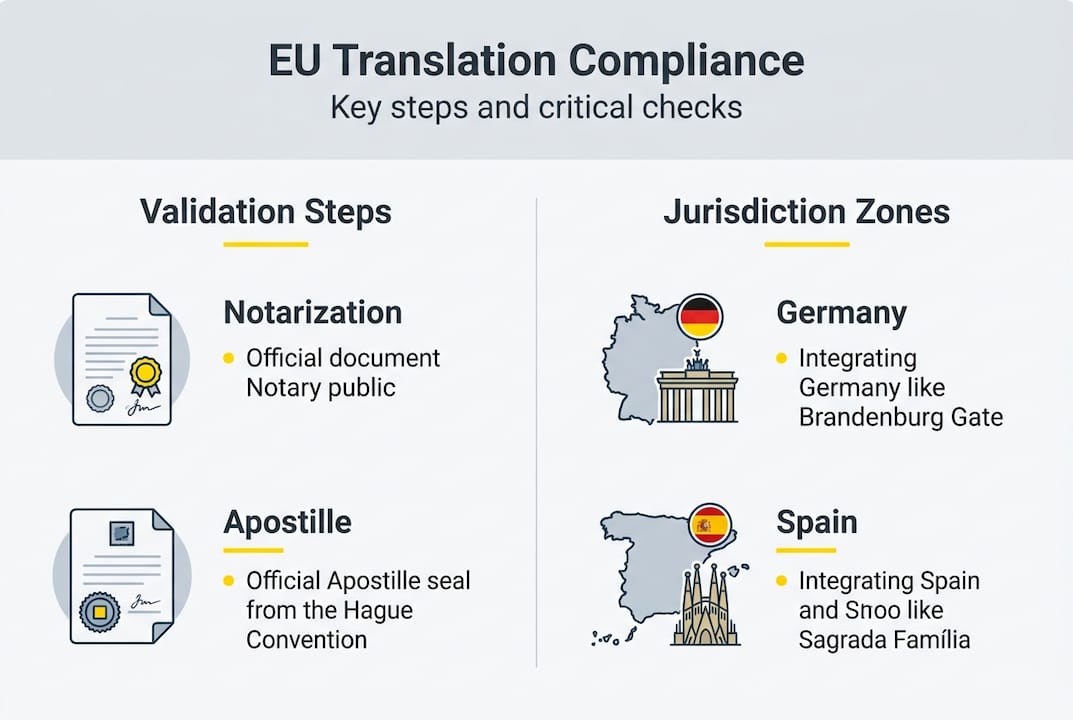
Before addressing where compliance breaks down, it helps to be precise about what each validation step actually does. Notarization is a domestic process: a notary authenticates a signature or document under the legal framework of their own country. Apostille is an international certification under the Hague Convention that allows a notarized document to be recognized in another signatory state. Sworn translation is a rendering of a document by a translator who holds a formal court appointment or state credential, making the translation legally equivalent to the original in the receiving jurisdiction.
The important shift came with Regulation (EU) 2016/1191, which removed the apostille requirement and the certified translation requirement for certain public documents circulating between EU member states, provided a multilingual standard form is used. Birth certificates, marriage certificates, and similar civil status documents now move more freely. That is genuine progress.
But the regulation’s scope is narrow. Here is what it covers and what it does not:
Covered: Civil status documents (birth, death, marriage, registered partnership, adoption, nationality documents, domicile, legal capacity)
Not covered: Corporate documents, powers of attorney, regulatory filings, court judgments, commercial contracts, educational certificates used for professional licensing
Excluded by design: Situations where the receiving authority exercises discretion, or where additional national requirements apply
For legal operations teams, the critical insight from ISO 17100 certified translation practice is that the Regulation creates a narrow corridor of simplification, not a general EU-wide equivalence. Everything outside that corridor still requires a full legalization chain, and the specific steps depend entirely on the destination.
Document type | Apostille required (non-EU origin) | Sworn translation required | Reg 2016/1191 applies |
Birth/marriage certificate | Often waived (EU-to-EU) | Often waived with standard form | Yes |
Corporate resolution | Yes | Yes, country-specific | No |
Power of attorney | Yes | Yes | No |
Regulatory filing | Yes | Yes | No |
Court judgment | Varies | Yes | Partial |
“Regulation (EU) 2016/1191 reduces friction for civil status documents, but the vast majority of commercial and regulatory documents legal teams handle every day sit entirely outside its scope.”
The reality of jurisdictional divergence: Notarization, apostille, and translation pitfalls
The six member states where corporate and regulatory document failures cluster most frequently are Germany, France, the Netherlands, Poland, Romania, and Bulgaria. Each has distinct rules, and a document chain built for one will often fail in another.
Germany requires that translations of legal documents be produced by a beeidigter Übersetzer (sworn translator) appointed by a German court. A translation certified in France by a traducteur assermenté is not automatically accepted. The German registry office or court will look for the local court appointment number. France applies similar logic in reverse: French authorities want translators registered with a French appellate court (Cour d’appel). Poland and Romania both maintain national registers of sworn translators, and documents destined for those countries must route through translators on those specific lists. Bulgaria adds a further complication for corporate documents: the translation must often be notarized by a Bulgarian notary in addition to the sworn translation step. Netherlands is comparatively flexible for EU documents but still requires sworn translation for non-Dutch regulatory submissions.

Corporate and business documents are entirely outside Regulation 2016/1191, meaning requirements for sworn translation vary by destination with no harmonized shortcut. And UK-certified translations are frequently rejected in civil law countries because the UK certification model does not map to sworn translator registration systems on the continent.
Spain adds a time dimension: many Spanish authorities require that foreign documents have been issued within 90 days of submission. A notarized corporate resolution that sat in a deal pipeline for three months may need to be re-executed.
The digital workflow challenges of managing these variations at scale are real. Most rejections happen at step four or five of a five-step process, after significant time and cost have already been invested.
Use this checklist before submitting any document cross-border:
Identify the receiving authority and its specific acceptance criteria.
Confirm whether the document type falls inside or outside Regulation 2016/1191.
Verify whether a sworn translator registered in the destination country is required.
Check issuance date requirements (notably Spain’s 90-day window).
Confirm apostille requirement based on document origin and destination.
Validate whether notarization in the destination country is additionally required (notably Bulgaria).
Pro Tip: Rejection letters from foreign authorities rarely explain exactly which requirement was missed. Build a rejection log across your cross-border matters and you will identify the most frequent failure points within two or three transactions.
A regulated translation workflow that embeds destination-jurisdiction checks at intake, rather than at submission, eliminates most of these failures before they occur. The risks with unvetted translators for regulated documents are not theoretical: an unregistered translator’s work can invalidate an entire filing.
Strategy first: Building workflows around destination jurisdiction
Most compliance failures share a common structural error: the document chain was built around what the source country’s system requires, not what the destination authority will accept. Fix that inversion and most problems resolve upstream.
The translation strategy that works consistently is one that starts with the receiving country. Sworn translators registered locally in civil law states are the baseline requirement for most corporate and regulatory documents. Multilingual standard forms under Regulation 2016/1191 should be used wherever they apply, to eliminate unnecessary steps. But neither tool replaces a direct check with the receiving authority.
Here is what a destination-first workflow looks like in practice:
Step 1: Identify the receiving authority before drafting or executing the document.
Step 2: Pull that country’s requirements from the EU e-Justice Portal, which maintains country-specific translator registries and document-specific rules.
Step 3: Engage a sworn translator registered in the destination country, not just a certified translator from the origin country.
Step 4: Confirm apostille requirements based on whether the issuing state and receiving state are both Hague Convention signatories and whether the document type qualifies.
Step 5: Apply translation quality assurance checkpoints before the document leaves your team.
Step 6: Verify data security in translation protocols when transmitting sensitive legal documents to external providers.
Core questions to ask before any cross-border submission:
Does the receiving authority maintain a registered list of accepted translators?
Is the document type inside or outside the scope of Regulation 2016/1191?
What is the maximum permissible age of the original document?
Does the receiving country require additional notarization of the translation itself?
Has the sworn translator’s registration been verified against the official national or court-maintained list?
Pro Tip: A five-minute call or written inquiry to the receiving registry, court, or agency before submission is the single most effective risk mitigation step available. Authorities will usually confirm their specific requirements in writing if asked directly.
Digital tools and future trends: Toward smoother cross-border compliance
Digital notarization platforms and e-apostille systems are expanding, and several EU member states now issue apostilles electronically through the Hague Conference’s e-APP (electronic Apostille Program). That is meaningful progress for document authentication speed.
But the picture for translation and full legalization chains is more complicated. Digital tools are emerging but remain jurisdiction-specific, and private or commercial documents still often require the full legalization chain regardless of whether digital channels are used. An e-apostille does not replace the sworn translation requirement. A digitally signed notarial act in one member state is not automatically read as equivalent by another.
Watch for these signals when monitoring regulatory change:
Announcements from the Hague Conference on Private International Law regarding e-APP expansion
EU Digital Identity Wallet rollout timelines and their intersection with document authentication
Member state-level updates to sworn translator registration requirements
Any extension of Regulation 2016/1191’s scope to cover commercial documents (currently not on the legislative agenda, but worth tracking)
Bilateral agreements between member states on specific document categories
The scrutiny applied to clinical evaluation translations illustrates a broader pattern: even as digital tools advance in regulated sectors, human expert review and formal credentialing requirements are not retreating. They are, in some sectors, intensifying.
“Digital tools reduce administrative friction at the edges of cross-border document workflows, but they do not replace the legal expertise required to navigate what each jurisdiction will actually accept. The fragmentation is a feature of legal systems, not a bug waiting for a technology fix.”
Perspective: The overlooked risk in cross-border legal translation compliance
The most expensive assumption in cross-border legal work is that the EU operates as a unified legal space for document purposes. It does not. Even experienced general counsels get caught by this because the harmonization narrative is genuinely compelling: one regulation, one market, simplified movement of documents. The reality is a patchwork held together by national legal traditions that predate the EU by centuries.
What separates teams that execute cleanly from those that spend weeks recovering rejected filings is not access to better rules. It is the decision to treat each destination as its own compliance problem from day one. That means building relationships with translation suppliers who hold country-specialist legal expertise, not just general legal translation capability. It means verifying translator registration against destination-country lists, not assuming that legal translation risk is managed by any ISO certification alone.
The teams that move fastest are not the ones who found a shortcut. They are the ones who stopped looking for one and built a repeatable, jurisdiction-aware process instead.
Pro Tip: Never treat a digital tool or a regulatory reform as a blanket solution. Always verify directly with the receiving authority before submitting a novel document type or entering a new jurisdiction.
Get expert legal translation support for cross-border compliance
Cross-border legal translation compliance is not a documentation problem. It is a supplier selection and workflow design problem. The right partner anticipates jurisdiction-specific requirements before your document reaches the receiving authority, not after it gets returned.

AD VERBUM’s network of 3,500+ subject-matter expert linguists includes legal scholars with country-specific sworn translator credentials across EU member states. Working to ISO 17100 and ISO 27001, with EU-hosted infrastructure and an AI+HUMAN hybrid workflow that enforces terminology governance at every step, AD VERBUM is built for the kind of high-stakes, audit-sensitive work that cross-border legal operations demand. Explore localization solutions tailored to legal workflows, or request an assessment of your current professional translation supply chain.
Frequently asked questions
Which EU documents no longer need an apostille or certified translation?
Public documents like birth and marriage certificates generally do not require an apostille or translation when a multilingual standard form is used under Regulation (EU) 2016/1191. This exemption applies only between EU member states and only for the civil status document categories explicitly listed in the Regulation.
When must legal teams still obtain a sworn translation?
Sworn translation is required for most private and commercial documents, including corporate resolutions, powers of attorney, and regulatory filings, since corporate and business documents fall entirely outside Regulation 2016/1191. Destination countries that require locally registered sworn translators will not accept general certified translations as a substitute.
How can I find an approved sworn translator in another EU country?
The EU e-Justice Portal maintains country-specific lists of certified sworn translators, searchable by language pair and country. Always cross-reference with the specific receiving authority, as some courts and registries maintain their own supplementary lists.
Why are UK certified translations sometimes rejected in the EU?
Many EU civil law countries require sworn translators who are formally registered with a national or court authority in that jurisdiction, and the UK certification model does not satisfy that requirement. UK certified translations are therefore routinely rejected in Germany, France, Poland, and Romania for documents requiring locally registered sworn translators.
Are digital notarization and apostille solutions fully accepted in the EU?
Digital tools are emerging across EU member states, but acceptance depends entirely on each jurisdiction’s specific laws and the document type involved. An e-apostille does not eliminate sworn translation requirements, and not all member states have implemented equivalent digital authentication frameworks.
Recommended

