Avoid translation errors in PSD2 and PCI DSS documents

Payment service providers operating across the EU face dual compliance documentation burdens under PSD2 and PCI DSS. Each framework generates technical and legal documentation requiring accurate localization for every jurisdiction. A single terminology error in translated terms of service, security policies, or API integration guides can trigger audit failures, customer disputes, and regulatory penalties. Yet many compliance and localization managers underestimate the precision required for regulated payments documentation, assuming basic translation suffices for complex legal texts.
Table of Contents
Why Payments Firms Struggle With Psd2 And Pci Dss Documentation Translation
Decoding Psd2 And Pci Dss Requirements Critical For Translation Accuracy
Common Pitfalls And Terminology Errors In Psd2 And Pci Dss Document Translation
Best Practices For Accurate Translation Of Psd2 And Pci Dss Compliance Documents
How Professional Localization Services Ensure Psd2 And Pci Dss Translation Accuracy
Frequently Asked Questions About Psd2 And Pci Dss Translation
Key takeaways
Point | Details |
Poor translation triggers compliance failures | Terminology drift between language versions creates audit risk, regulatory exposure, and customer disputes. |
Manual and MT-only processes add delays | Traditional workflows slow compliance cycles and introduce critical errors in legal terminology. |
Specialized expertise is essential | Subject-matter expert review ensures accuracy in PSD2 SCA clauses and PCI DSS security controls. |
Rigorous quality checks prevent penalties | ISO-aligned QA workflows catch formatting breaks and term inconsistencies before regulatory review. |
Understanding regulatory specifics is crucial | PSD2 consumer protection clauses and PCI DSS v4.0 requirements demand precise legal translation. |
Why payments firms struggle with PSD2 and PCI DSS documentation translation
Payment service providers often treat compliance documentation as a straightforward translation task. This misconception leads to costly errors. Manual translation workflows contribute to delayed disclosures and erosion of investor confidence. Compliance managers face pressure to deliver localized documentation quickly, yet manual processes create bottlenecks that slow regulatory approvals.
Machine translation without expert review introduces critical errors in legal terminology. A mistranslated PSD2 Strong Customer Authentication clause can invalidate consumer consent mechanisms across an entire market. Machine translation risks escalate when technical negations or conditional clauses are rendered incorrectly. The result is compliance documentation that appears complete but fails regulatory scrutiny.
Formatting issues degrade document integrity, affecting review and audits. PCI DSS security policies rely on precise table structures to map controls to requirements. When translation tools break formatting, auditors cannot verify control mappings. Bullet points collapse into paragraphs. Reference numbers shift. These structural failures force compliance teams to rebuild documents manually, duplicating effort and introducing new errors.
Poor data management and siloed workflows hinder accuracy. Many firms lack centralized terminology databases for PSD2 and PCI DSS terms. Translation teams work from outdated glossaries or none at all. Version control breaks down when legal, compliance, and localization functions operate independently. One team updates the English master document while translators work from an obsolete version.
Misunderstanding PSD2 and PCI DSS requirements leads to non-compliance. Compliance managers assume general financial translation expertise transfers to payments regulation. It does not. PSD2 third-party payment access mandates and PCI DSS continuous scoping validation demand specialized knowledge that generalist translators lack.
Common struggles include:
Inconsistent translation of regulatory terms across document sets
Failure to preserve legal clause structure in target languages
Inability to validate translated security controls against PCI DSS mappings
Delayed regulatory filings due to translation rework cycles
Audit findings citing terminology discrepancies between language versions
Decoding PSD2 and PCI DSS requirements critical for translation accuracy
PSD2 compliance documentation centers on consumer protection and third-party access. PSD2 mandates Strong Customer Authentication for online card payments exceeding €30. This threshold must be accurately stated in every language version. Mistranslating the exemption criteria or authentication factors creates legal exposure. Terms of service that incorrectly describe SCA obligations leave providers liable for unauthorized transactions.
Third-party payment access introduces complex documentation requirements. Payment initiation service providers and account information service providers must disclose API access terms, data handling practices, and liability frameworks. These disclosures involve technical and legal terminology that shifts meaning when translated poorly. A mistranslated data retention clause can violate GDPR obligations in one jurisdiction while remaining compliant in another.
Enhanced consumer protection clauses affect contractual terms. PSD2 strengthens refund rights, liability limits, and dispute resolution procedures. Translated customer agreements must preserve these protections precisely. Ambiguous translation of refund timelines or liability thresholds exposes providers to litigation and regulatory sanctions.
PCI DSS v4.0 includes stronger phishing and MFA expectations, expanded e-commerce script integrity controls, and continuous scoping validation. These updates demand precise translation of security controls and implementation guidance. Key requirements include:
Multifactor authentication for all access to cardholder data environments
Enhanced phishing-resistant authentication mechanisms
Continuous validation of PCI DSS scope boundaries
Script integrity controls for payment page elements
Expanded logging and monitoring for anomalous activity
Each control maps to specific technical requirements. Mistranslating a logging retention period from “90 days” to “90 weeks” invalidates the entire compliance posture. Security policies translated without subject-matter expertise fail to communicate control objectives accurately. Auditors cannot validate controls when policy translations introduce ambiguity.

Continuous scope validation demands accuracy in environment definitions. PCI DSS requires ongoing assessment of which systems, networks, and applications store, process, or transmit cardholder data. Translated scoping documentation must use consistent terminology for environment types, segmentation boundaries, and data flows. Terminology drift across language versions creates confusion during audits and increases remediation costs.
Common pitfalls and terminology errors in PSD2 and PCI DSS document translation
Machine Translation without proper post-editing by subject matter experts causes legal and technical errors. MT systems lack the regulatory context to distinguish between similar terms with different compliance implications. “Authentication” and “authorization” are distinct concepts in PCI DSS, yet MT often conflates them. The result is security policies that misstate access control requirements.
Incorrect translation of terms like Strong Customer Authentication leads to misinterpretation. SCA has a specific regulatory definition under PSD2. Translating it as “robust customer verification” or “enhanced user authentication” creates legal ambiguity. Customers and regulators interpret these variations differently, exposing providers to disputes over whether SCA was properly implemented.
Formatting inconsistencies break clauses and table data essential for audits. Precision in regulated translation requires maintaining document structure. PCI DSS control mappings use tables to link requirements to implementation evidence. When translation tools corrupt table formatting, auditors cannot trace controls. Compliance teams waste hours reconstructing tables manually.
Siloed processes delay regulatory document updates. Compliance functions update English master documents without triggering translation workflows. Localization teams discover changes weeks later. By then, outdated translations have been filed with regulators or published to customers. Correcting these errors requires formal amendments, triggering additional regulatory review cycles.
Approach | Terminology Control | Review Process | Compliance Risk | Turnaround |
Manual Translation | Inconsistent, relies on translator knowledge | Single linguist review, no SME validation | High, legal terms often misinterpreted | Slow, 4-6 weeks typical |
MT-Only | None, statistical patterns drive output | Automated QA checks only | Critical, regulatory terms frequently mistranslated | Fast but requires extensive rework |
Human Expert + AI | Enforced via term bases and LLM constraints | SME post-editing plus ISO-aligned QA | Low, regulatory precision maintained | 3-5x faster than manual |
Pro Tip: Establish a central terminology database for PSD2 and PCI DSS terms before starting translation projects. Lock critical regulatory terms to prevent unauthorized changes. This single step eliminates the majority of compliance translation errors.
The difference between machine translation and human review becomes stark in regulated documentation. MT produces draft output quickly but lacks the legal judgment to assess whether a translation preserves compliance meaning. Human experts recognize when a term has regulatory significance and must be translated consistently across all documents.
Best practices for accurate translation of PSD2 and PCI DSS compliance documents
Select translation vendors with payments industry expertise. Generic language service providers lack the regulatory knowledge to translate PSD2 and PCI DSS documentation accurately. Compliance managers must prioritize qualified vendors and rigorous QA. Vendors should demonstrate experience with financial regulation, ISO 17100 certification, and access to subject-matter expert linguists who understand payments compliance.
Use SME post-editing after machine translation. AI-generated translations provide speed, but human experts ensure regulatory precision. Subject-matter experts review drafts for legal accuracy, technical correctness, and contextual appropriateness. This hybrid approach combines efficiency with the judgment required for compliance documentation.
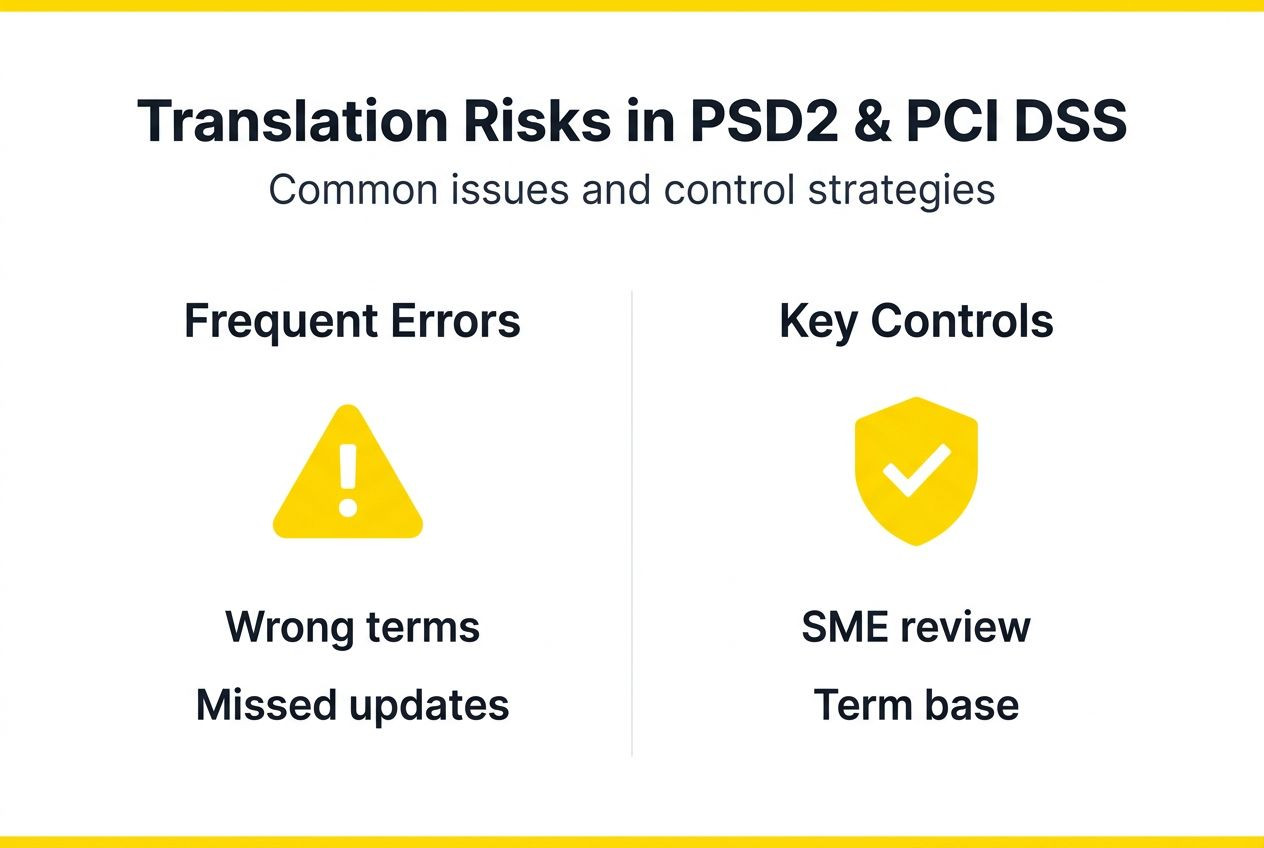
Implement version control and formatting preservation tools. Regulated document translation workflows must track changes across language versions. When the English master document updates, translation management systems should flag affected segments and trigger retranslation. Formatting preservation tools maintain table structures, clause numbering, and reference links during translation.
Employ terminology glossaries for PSD2 and PCI DSS terms. Build comprehensive term bases that define how regulatory concepts should be translated in each target language. Lock critical terms to prevent variation. Examples include:
Strong Customer Authentication (PSD2)
Payment Initiation Service Provider
Cardholder Data Environment (PCI DSS)
Compensating Control
Segmentation (network isolation context)
Conduct regular audits and localization testing for compliance. Ensuring compliant translations requires ongoing validation. Review translated documentation against regulatory updates. Test localized customer interfaces to verify that translated terms match backend system terminology. Conduct side-by-side reviews of English and translated versions to catch terminology drift.
Pro Tip: Schedule translation reviews immediately after regulatory updates are published. PCI DSS releases new versions annually, and PSD2 technical standards evolve through regulatory technical standards. Updating translations proactively prevents compliance gaps and reduces emergency translation costs when regulators request updated documentation.
Quality assurance processes should align with ISO 17100 and ISO 18587 standards. These frameworks define requirements for translation service providers, including competence criteria for translators, revision procedures, and project management controls. Vendors certified to these standards demonstrate systematic quality management.
How professional localization services ensure PSD2 and PCI DSS translation accuracy
Payment service providers cannot afford compliance translation errors. AD VERBUM specializes in regulated sector translations, ensuring PSD2 and PCI DSS documentation meets audit requirements across jurisdictions. Our workflows combine proprietary AI technology with certified subject-matter expert review to eliminate the terminology drift and formatting breaks that cause regulatory failures.

We maintain terminology governance through Translation Memories and Term Bases ingested at project start. Our LLM-based LangOps System generates target language output constrained by your approved terminology and style guidance. Subject-matter experts then review for technical accuracy, regulatory compliance, and contextual nuance. Final QA aligns to ISO 17100 and ISO 18587 standards, with additional validation against PCI DSS and PSD2 requirements.
This hybrid approach delivers turnaround 3 to 5 times faster than traditional workflows while maintaining the precision compliance functions demand. Our EU-hosted infrastructure ensures data sovereignty for sensitive regulatory documentation. Partner with our localization services to protect your business, reduce audit risk, and stay regulatory-ready. Explore how we serve regulated industries and review our full professional translation services portfolio.
Frequently asked questions about PSD2 and PCI DSS translation
Is translation just converting words between languages for compliance documents?
No. Regulatory translation requires preserving legal meaning, technical accuracy, and document structure. A word-for-word conversion of a PSD2 Strong Customer Authentication clause may use correct grammar but misstate the legal obligation. Compliance translation demands subject-matter expertise to ensure the target language version creates identical legal rights and obligations as the source.
Can machine translation handle PCI DSS security policies without expert review?
Machine translation alone introduces critical compliance risk. MT systems lack regulatory context and frequently mistranslate technical terms with specific PCI DSS meanings. Security controls, scoping definitions, and compensating control descriptions require human expert validation to ensure accuracy. Using MT without SME post-editing often results in audit findings and remediation costs exceeding the translation savings.
How does inaccurate translation impact revenue and customer trust?
Mistranslated terms of service create customer disputes over fees, refund rights, and liability limits. Resolving these disputes consumes compliance and legal resources. Regulatory penalties for documentation errors can reach millions of euros under PSD2 enforcement actions. Customer trust erodes when localized documentation contradicts the service experience, driving churn in competitive payments markets.
What qualifications should translation vendors have for PSD2 and PCI DSS work?
Vendors should hold ISO 17100 certification and demonstrate payments industry experience. Subject-matter expert translators should have backgrounds in financial regulation, payments technology, or compliance. Look for vendors with established terminology management processes, version control systems, and quality assurance aligned to regulated sector requirements. References from other payment service providers provide validation.
Why do local regulatory nuances matter for PCI DSS and PSD2 compliance?
PSD2 is an EU directive implemented through national laws that vary by member state. Strong Customer Authentication exemptions, liability frameworks, and dispute resolution procedures differ across jurisdictions. PCI DSS applies globally but intersects with local data protection laws, consumer protection statutes, and banking regulations. Accurate translation must account for how regulatory requirements are interpreted and enforced in each target market to ensure documentation aligns with local compliance expectations.
Recommended