


ISO Standards in Language Services: Precision and Security

For compliance officers in life sciences, strict ISO standards are more than regulatory obligations. Over 60 percent of American and European regulators cite ISO certification as central to avoiding costly documentation errors. In an increasingly multilingual landscape, the right language service can mean the difference between flawless audits and compliance headaches. Discover what separates truly robust ISO-standard providers from the rest in safeguarding sensitive data and precision translation.
Table of Contents
Key Takeaways
Point | Details |
Importance of ISO Standards | ISO standards provide a critical framework for ensuring quality and consistency in language services across various sectors. |
Compliance Benefits | Adhering to ISO certifications demonstrates a commitment to professional excellence and enhances client trust. |
Impact on Translation Quality | ISO standards establish clear guidelines for translator qualifications and quality management processes, improving overall translation accuracy. |
Risks of Non-Compliance | Non-compliance can lead to significant operational vulnerabilities, legal issues, and damage to reputation in regulated industries. |
Defining ISO Standards in Language Services
Language service providers operate in a complex global ecosystem where precision and consistency are paramount. The International Organization for Standardization (ISO) has developed specific standards that establish comprehensive guidelines for translation, interpreting, and localization services.
ISO standards in language services represent a critical framework for ensuring quality, reliability, and professional excellence. These standards, developed through rigorous international collaboration, cover multiple dimensions of language service delivery. Key standards like ISO 17100 and ISO 18587 define specific requirements for translation processes, including translator qualifications, technical infrastructure, and quality management systems.
The primary objective of these standards is to create a universal benchmark for language service quality. They address critical aspects such as:
Translation workflow management
Translator competency requirements
Quality assurance protocols
Project management guidelines
Technical and technological infrastructure standards
By establishing these comprehensive guidelines, ISO standards help language service providers like AD VERBUM maintain consistent, high-quality outputs across diverse industry sectors. These standards are not merely recommendations but detailed specifications that enable organizations to demonstrate their commitment to professional excellence.
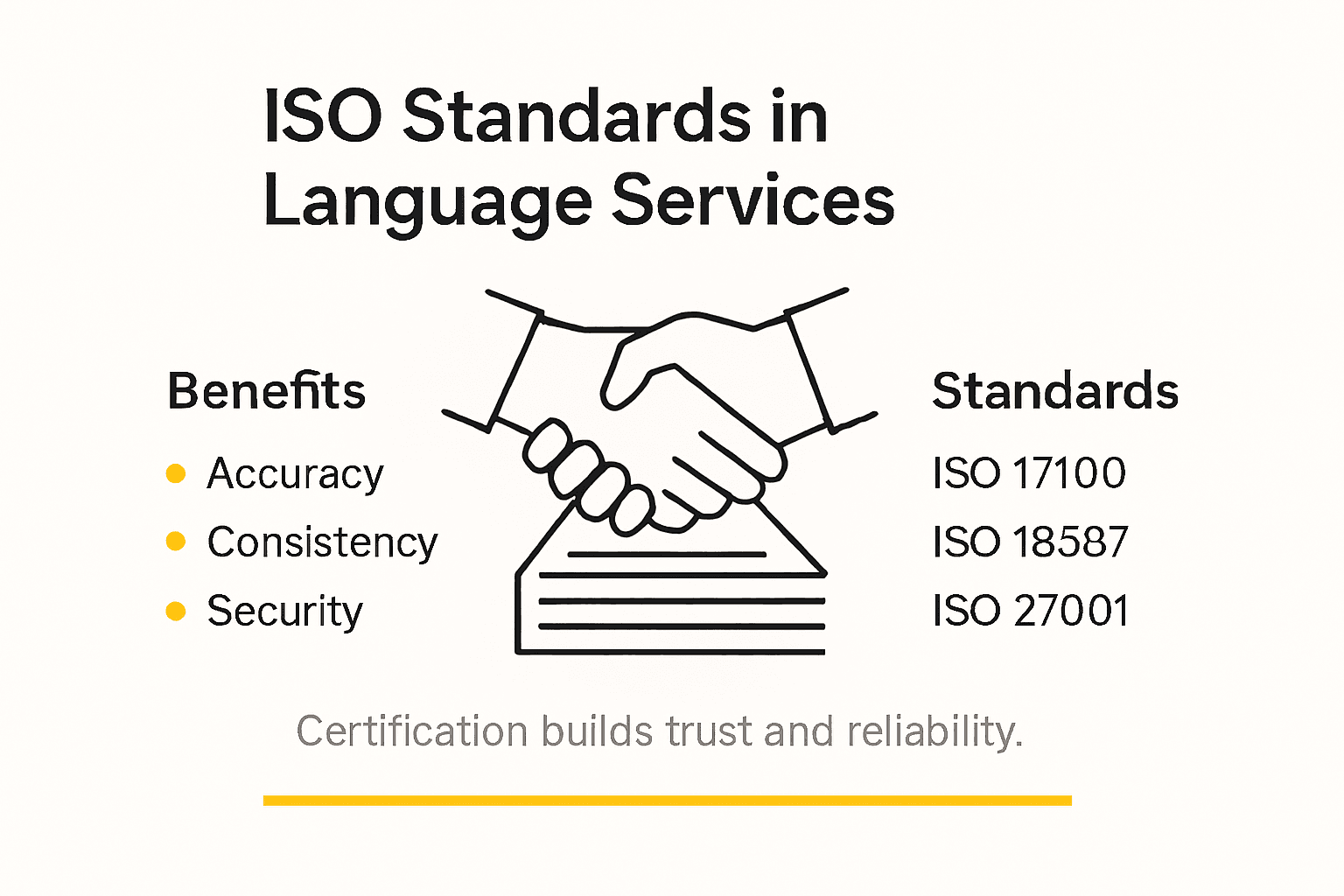
Pro tip: When selecting a language service provider, always verify their ISO certification to ensure they meet international quality and precision standards.
Major Types and Their Compliance Roles
ISO standards for language services encompass several critical areas, each designed to address specific aspects of translation and interpreting professionalism. Standards developed by ISO/TC 37/SC 5 provide comprehensive guidelines for different service domains, ensuring quality and reliability across various specialized fields.
The primary ISO standards in language services include:
ISO 17100: Translation Services Standard
Defines translator qualifications
Establishes project management requirements
Sets quality assurance protocols
ISO 18587: Machine Translation Post-Editing Standard
Guides hybrid translation workflows
Establishes quality control mechanisms for AI-assisted translations
Defines competency requirements for post-editors
Domain-Specific Interpreting Standards
Legal interpreting guidelines
Healthcare interpreting protocols
Community and conference interpreting specifications
These standards play a crucial role in defining compliance requirements across different language service contexts. For AD VERBUM, adhering to these standards means implementing rigorous quality control processes that go beyond basic translation requirements, ensuring precise and reliable communication across multiple professional domains.
Here’s a quick reference comparing major ISO standards for language services and their primary business benefits:
ISO Standard | Main Focus | Application Context | Business Impact |
ISO 17100 | Human translation quality | Professional translation projects | Ensures consistent process and output |
ISO 18587 | Post-editing machine translation | AI-assisted localization workflows | Improves efficiency and quality control |
ISO 27001 | Information security management | Data handling and storage | Protects client confidentiality and legal compliance |
Each standard serves as a comprehensive framework that addresses not just linguistic accuracy, but also professional conduct, technological infrastructure, and service delivery methodologies. By establishing clear benchmarks, these standards help language service providers maintain exceptional quality and build trust with clients in highly regulated industries.
Pro tip: When evaluating language service providers, request detailed documentation of their ISO certifications to understand their specific compliance capabilities.
How ISO Impacts Translation Accuracy
Translation accuracy is a complex challenge that requires more than linguistic skill. ISO standards provide a systematic framework for evaluating and enhancing translation quality, establishing precise criteria that go beyond traditional assessment methods.
The impact of ISO standards on translation accuracy manifests through several critical mechanisms:
Rigorous Translator Qualification Requirements
Defined educational and professional competency standards
Mandatory subject matter expertise verification
Continuous professional development tracking
Standardized Error Classification
Objective categorization of translation errors
Quantifiable assessment of linguistic and contextual accuracy
Clear severity levels for different types of mistranslations
Comprehensive Quality Evaluation Processes
Structured review methodologies
Multiple-stage quality checks
Consistent performance measurement across different projects
AD VERBUM leverages these ISO standards to implement a comprehensive approach to translation accuracy, ensuring that each translation meets the highest possible quality benchmarks. By integrating these standards into our AI+HUMAN workflow, we create a robust system that combines technological precision with human expertise.
The standards do more than simply measure accuracy—they provide a proactive framework for preventing errors. By establishing clear guidelines for translator qualifications, review processes, and error classification, ISO standards transform translation from an art into a systematically managed professional service.
Pro tip: Request a detailed ISO compliance report when selecting a translation service to understand their specific quality assurance mechanisms.
Data Security and Sovereignty Requirements
In the landscape of global language services, data security represents a critical battleground where precision meets protection. ISO standards provide comprehensive frameworks for managing information security within language service ecosystems, establishing rigorous protocols that safeguard sensitive multilingual content across international jurisdictions.
The core data security requirements enforced by ISO standards encompass several critical dimensions:
Confidentiality Protocols
Strict access control mechanisms
Encrypted data transmission channels
Comprehensive user authentication procedures
Data Sovereignty Management
Geographic data storage restrictions
Compliance with regional data protection regulations
Transparent data handling documentation
Breach Prevention Infrastructure
Continuous security monitoring
Proactive vulnerability assessment
Rapid incident response frameworks
AD VERBUM distinguishes itself by hosting its entire AI+HUMAN ecosystem on private EU servers, ensuring maximum data sovereignty and compliance with the most stringent international regulations. This approach goes beyond standard security measures, providing clients with an unprecedented level of protection for their sensitive linguistic assets.

Unlike public cloud solutions that expose data to potential global vulnerabilities, our proprietary infrastructure creates an isolated environment where confidentiality is not just a promise but a structural guarantee. By integrating ISO 27001 standards into every aspect of our technological and human workflows, we transform data security from a compliance checkbox into a comprehensive protective strategy.
Pro tip: Always request a detailed ISO 27001 certification audit report to understand the specific data protection mechanisms of your language service provider.
Risks of Non-Compliance and Common Mistakes
Non-compliance with ISO standards in language services represents a significant operational and legal vulnerability, with consequences that extend far beyond simple procedural failures. The landscape of language services demands precision, and overlooking standardized protocols can trigger catastrophic professional repercussions.
The most prevalent risks and common mistakes in ISO standard implementation include:
Personnel Qualification Failures
Hiring translators without verified credentials
Insufficient ongoing professional development
Lack of specialized domain expertise
Quality Control Deficiencies
Inconsistent review processes
Absence of systematic error tracking
Inadequate terminology management
Documentation and Compliance Gaps
Incomplete project documentation
Improper confidentiality protocols
Failure to maintain comprehensive audit trails
AD VERBUM mitigates these risks through our rigorous AI+HUMAN workflow, which embeds ISO compliance into every stage of translation. Our approach transforms potential vulnerabilities into structured, measurable quality assurance checkpoints. Unlike traditional language service providers that treat standards as optional checklists, we view them as fundamental architectural elements of our service delivery.
The consequences of non-compliance extend beyond immediate project failures. Organizations can face significant legal challenges, reputational damage, and potential contract terminations. In highly regulated industries like pharmaceuticals, legal, and medical sectors, a single translation error can trigger compliance investigations, financial penalties, or even complete service disqualification.
Compare key risks from ISO non-compliance and their potential consequences:
Common Mistake | Risk Type | Business Consequence |
Unverified translator credentials | Quality assurance failure | Project errors and client loss |
Inadequate error tracking systems | Process vulnerability | Unresolved mistakes and legal exposure |
Poor documentation practices | Compliance gap | Audit failure and contract termination |
Pro tip: Conduct a comprehensive ISO standard gap analysis annually to proactively identify and address potential compliance vulnerabilities in your language service workflows.
Ensuring Precision and Security with AD VERBUM’s AI+HUMAN Workflow
The challenges of adhering to stringent ISO standards in language services require more than traditional translation approaches. The article emphasizes critical pain points such as translator qualifications, rigorous quality assurance, robust data security, and preventative error management. Companies operating in regulated industries need precise, secure, and fully compliant language solutions that prevent costly mistakes and uphold confidentiality.
AD VERBUM addresses these challenges head-on through its proprietary LLM-based AI ecosystem combined with expert human oversight in the AI+HUMAN workflow. Unlike legacy machine translation or public neural platforms, our technology ensures exact terminology enforcement and zero data leakage by operating exclusively on private EU servers. This infrastructure supports compliance with ISO 17100, ISO 18587, ISO 27001, GDPR, and HIPAA standards—earning trust in life sciences, legal, finance, and manufacturing sectors where security cannot be compromised.
Take control of your translation accuracy and data sovereignty today by partnering with a provider who makes compliance foundational—not optional. Discover how AD VERBUM’s specialized AI translation and certified quality management exceed typical language service offerings at AD VERBUM. Explore the advantage of a fully integrated, secure, and scalable AI+HUMAN system designed specifically for your industry needs in this detailed company overview. Ensure your next translation project meets the highest global standards by visiting our landing page and contacting us now for a personalized compliance consultation.
Frequently Asked Questions
What are ISO standards in language services?
ISO standards in language services are comprehensive guidelines established by the International Organization for Standardization to ensure quality, reliability, and professional excellence in translation, interpreting, and localization services.
How do ISO standards impact translation accuracy?
ISO standards enhance translation accuracy by providing rigorous qualification requirements for translators, standardized error classification, and comprehensive quality evaluation processes designed to systematically manage language service quality.
What are the key ISO standards relevant to language services?
Key ISO standards include ISO 17100 for translation services, ISO 18587 for machine translation post-editing, and various domain-specific interpreting standards. Each focuses on quality assurance, translator qualifications, and industry-specific compliance requirements.
Why is ISO certification important when choosing a language service provider?
ISO certification is vital because it demonstrates a language service provider’s commitment to adhering to international quality and precision standards, ensuring reliable and consistent service across various professional sectors.
Recommended

