


You Won the Subcontract. Now Comes the Documentation Avalanche. Master Compliance Fast

Winning a subcontract in the life sciences sector often means facing a surge of deliverables with tight deadlines and exacting compliance needs. The complexity multiplies when documents must align with detailed technical expectations, multiple language requirements, and strict standards like AQAP 2110 or MDR. For regulatory affairs managers, mastering both terminology governance and quality assurance from the start is the key to maintaining clarity and audit readiness across all program documentation.
Table of Contents
Quick Summary
Key Point | Explanation |
1. Understand contract requirements thoroughly | Read the contract’s statement of work and technical requirements fully to avoid misinterpretations that cause downstream issues. |
2. Map deliverables and language needs | Create a matrix detailing every deliverable, its due date, required formats, languages, and compliance standards to guide planning. |
3. Use AI and human hybrid translation | Implement a translation process that combines automated speed with expert human review to meet tight deadlines while ensuring compliance. |
4. Adhere to AQAP 2110 standards | Establish a quality management system for documentation that ensures compliance and audit readiness for defense-related projects. |
5. Ensure consistency across documents | Implement a consistency verification checklist for all deliverables to prevent contradictory statements that could trigger audit findings. |
Step 1: Assess contract requirements and deliverable scope
Your contract win arrives with a stack of documents that defines what you must deliver, when, and in which formats. Before you move forward, you need to understand exactly what the prime or consortium expects. Misinterpreting the scope at this stage creates downstream chaos that no amount of last-minute work can fix.
Start by reading the contract statement of work (SOW) and the technical data requirements list (TDRL) in full. These documents specify every deliverable: design documents, test reports, quality assurance plans, configuration baselines, and progress reports. Identify which deliverables require multiple language versions, which ones are controlled documents (meaning they lock in compliance requirements), and which ones flow to external regulators or customer approval gates.
Next, map the deliverable schedule against the language requirements. Many subcontractors discover too late that their first technical report is due in 45 days—and it must be delivered in English, German, and French simultaneously. The prime may also require language alignment with NATO contracts, which introduces additional terminology and format standards that your documentation must follow.
Create a simple matrix of all deliverables with these columns:
Deliverable name and description
Due date (calendar and day count from now)
Formats required (PDF, Word, XML, or other)
Languages required
Audience (prime approval, regulator, customer, internal)
Compliance standards (AQAP 2110, MDR, ISO 13485, or others)
Page count estimate
This matrix becomes your reference for the next step: resourcing and timeline planning. Without it, you will underestimate both time and cost, and your team will be reactive instead of prepared.
Pay special attention to terminology governance requirements. If the prime has a controlled terminology database or Translation Memory, you must integrate with it from day one. Drift in key terms across multiple versions of the same document creates audit findings and requires costly rework.
Map every deliverable, language, and compliance requirement before you build a single team or allocate a single resource. This baseline protects you from scope creep and reveals conflicts early.
Pro tip: Request the prime’s documentation standards package and terminology glossary immediately—do not wait for the formal kickoff meeting. These assets shape how you structure every deliverable and should guide your resource planning from week one.
Step 2: Integrate prime terminology and translation assets
The prime contractor likely maintains a controlled terminology database and Translation Memory that governs how all program documents must use critical terms. Your deliverables must align with this framework from the first draft—not after review cycles. Integration at the start prevents terminology drift and ensures your documents pass compliance audits.
Request the prime’s terminology glossary and any Translation Memory files they have already built. These assets contain approved terms, definitions, and context rules for the program. If the prime has documented these in a controlled format, they represent the single source of truth for the program’s technical vocabulary.

Load the prime’s terminology and Translation Memory into your own systems immediately. If you are working with a language service provider, share these assets with them before any translation begins. Terminology enforcement through specialized term extraction and glossary integration ensures consistent translation of domain-specific vocabulary across all deliverables and languages.
Create a process for how your team will use these assets:
Check any new technical term against the prime’s glossary before writing it into a document
Flag any term the prime has not yet defined, and escalate it for approval
Maintain a local term list that tracks all approved terms your team uses
Provide this list to your translation partner with clear guidance on context and usage
Review translated documents for terminology consistency against the prime’s master list
Version control matters here. If the prime updates their glossary midway through the program, your team and your language service provider must both receive the updated version. Many programs create a shared terminology repository that all subcontractors access, preventing duplication and reducing rework.
Terminology drift across multiple deliverables creates audit findings. A regulator reviewing your design document, test report, and quality plan will flag inconsistency if the same concept is called by three different names. This forces you to rewrite and resubmit, delaying delivery.
Treat the prime’s terminology assets as binding constraints on every word you write and translate. Non-compliance creates audit risk and delays approval.
Pro tip: Establish a monthly terminology sync call with the prime’s documentation team to catch new terms and glossary updates before they derail your schedule. This prevents surprises at formal deliverable reviews.
Step 3: Activate AI+human hybrid translation for speed and accuracy
Traditional translation workflows cannot match the speed your subcontract demands. You have technical documents due in weeks, not months, across multiple languages simultaneously. AI+human hybrid translation combines automated speed with expert human review, delivering both velocity and compliance accuracy.
Start by selecting a language service provider that offers a true hybrid model. The provider should ingest your prime’s terminology and Translation Memory, use AI to generate initial translations rapidly, and then have certified subject-matter experts review for technical accuracy and compliance alignment. This approach is fundamentally different from turning documents over to freelancers or relying on generic machine translation.
Define the scope of translation work clearly with your provider. Which documents require full human translation from scratch? Which can leverage AI generation plus expert review? Which technical reports or quality plans must have AI and human expertise combined to meet both speed and regulated sector accuracy standards? Clarity here shapes both cost and timeline.
Ensure the provider operates under quality standards aligned to your program’s compliance framework:
ISO 17100 compliance for translation services
ISO 18587 alignment for AI+human translation workflows
AQAP 2110 audit readiness for defense documentation
Full data traceability and EU-hosted infrastructure if handling sensitive content
Request a pilot translation of one small technical document (2,000 to 5,000 words) before committing to the full program volume. This lets you validate the provider’s terminology handling, review turnaround, and quality standard without risk. If the pilot shows terminology drift or missed compliance requirements, address them before scaling up.
Establish clear revision workflows. AI+human hybrid translation is not final on first pass. Budget for one revision cycle minimum. Your team will catch context-specific issues the initial review missed, and the provider will incorporate feedback efficiently.
Here’s a quick reference comparing typical translation workflows for subcontract technical documentation:
Workflow Type | Speed to Completion | Accuracy Risk | Compliance Audit Readiness |
Human-Only | Slowest | Very low risk | High, with proper controls |
AI-Only | Fastest | High risk | Poor, often non-compliant |
AI+Human Hybrid | Fast & reliable | Minimal risk | Strong with quality review |
AI speed without human oversight creates compliance risk. Human review without AI speed defeats the deadline. Both together deliver what your program requires.
Pro tip: Request your language service provider’s certified linguist roster and their specific expertise in your regulatory domain before signing. A provider with medical device engineers, defense engineers, or life sciences specialists on staff catches errors generic translators miss.
Step 4: Align documentation with AQAP 2110 quality assurance
If your subcontract involves defense work, your documentation must meet AQAP 2110 standards. This NATO quality assurance requirement goes beyond ISO 9001 by mandating rigorous documentation controls, traceability, and audit readiness specific to defense supply chains. Your deliverables must demonstrate compliance from day one, not after customer review.
AQAP 2110 requires you to establish and maintain a quality management system that covers every document your team produces. This means defining document control procedures, approval workflows, version numbering, and change tracking for all technical deliverables. A single document circulating in three versions with different revision dates creates a compliance violation.
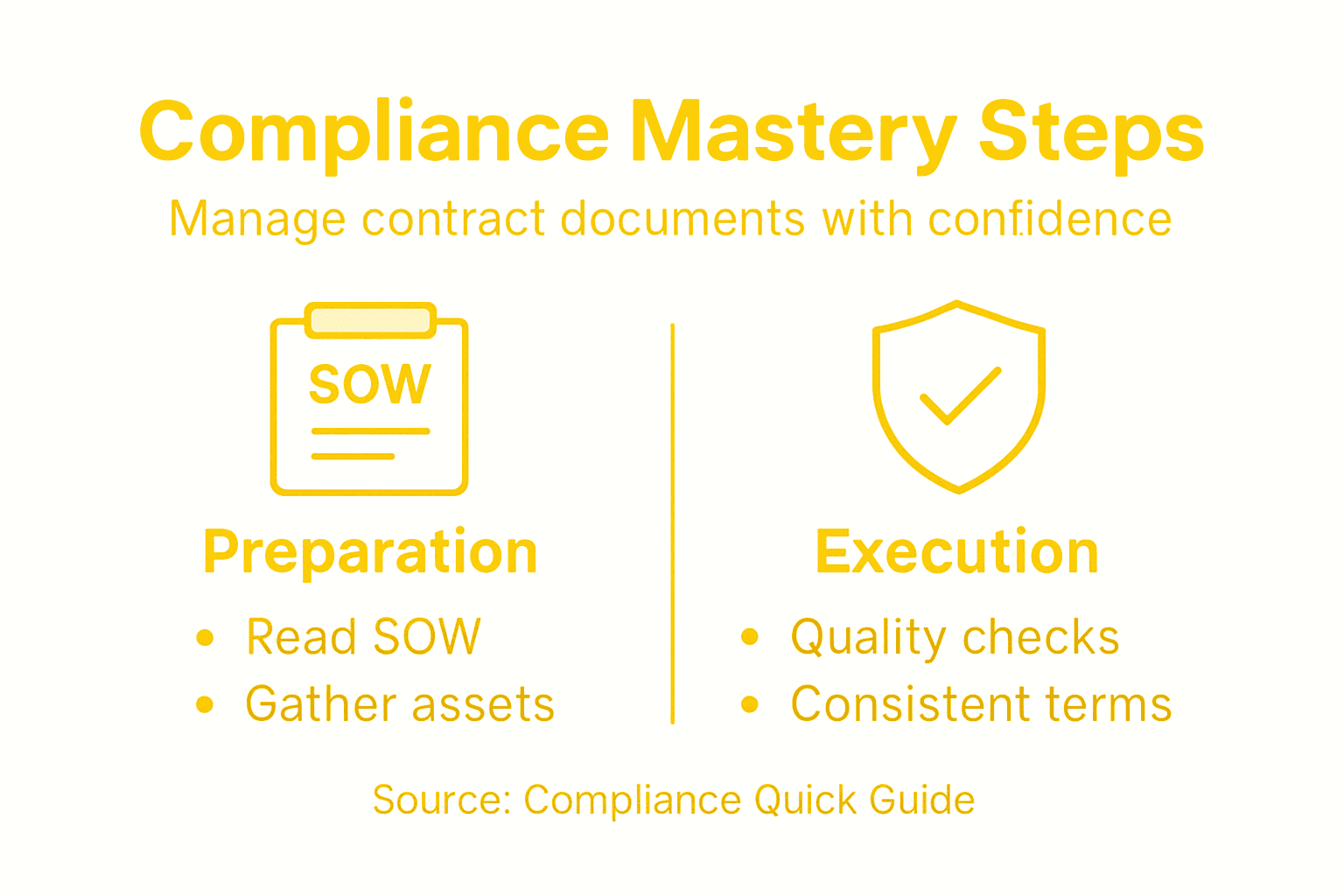
Understand what NATO quality assurance standards require for defense supplier documentation. You must demonstrate that every deliverable has undergone defined quality checks, that reviewers are qualified and authorized to approve, and that you maintain evidence of that approval. This is not optional paperwork—auditors verify this during program assessments.
Build quality assurance into your translation and documentation workflow:
Define a document control procedure that assigns a responsible reviewer for each deliverable type
Require sign-off from both technical and compliance reviewers before delivery
Maintain a change log showing what changed between versions and why
Store all versions (drafts included) with timestamps proving when reviews occurred
Create a traceability matrix linking each deliverable to the requirements it addresses
This creates what auditors call “objective evidence” of quality control. Without it, you cannot prove compliance even if your documents are technically sound.
When working with your language service provider, ensure they understand AQAP 2110 requirements. Their translation quality assurance must be documented and traceable. You need certificates or signed statements proving certified linguists reviewed translations for accuracy and compliance, not just that the work was completed.
Use this summary to understand how AQAP 2110 shapes your document workflow:
AQAP 2110 Requirement | Impact on Documentation | Business Benefit |
Document control procedures | Tracks all revisions and versions | Enables transparent audits |
Qualified reviewer sign-off | Ensures expertise and compliance | Reduces risk of rejection |
Change tracking and justification | Explains every update | Minimizes disputes over content |
Complete traceability records | Links docs to requirements | Proves contract fulfillment |
AQAP 2110 compliance is not a checkbox activity added after documents are finished. It is a framework that shapes how you organize, review, approve, and track every deliverable from the first draft forward.
Pro tip: Create a simple one-page AQAP 2110 checklist for each deliverable type listing all required quality steps, reviewers, and sign-off dates. Your team completes it as they work, and you attach it to final submissions as proof of compliance.
Step 5: Verify consistency for audit and program cohesion
Consistency across all your deliverables—terminology, formatting, technical accuracy, and compliance claims—determines whether auditors pass or fail your documentation. A single contradictory statement across design documents, test reports, and quality plans triggers audit findings that delay program approval and require costly rework.
Start by defining what consistency means for your program. Consistency includes identical terminology across all documents, matching quality statements, aligned technical requirements, and unified compliance claims. If your design document says Component A operates at 50 megahertz and your test report says 45 megahertz, an auditor will flag that discrepancy and demand clarification.
Create a consistency verification checklist that your team applies to every deliverable before submission. The checklist should reference the prime’s terminology baseline and your internal term tracking. Auditors use structured verification processes and consistent language to assess program integrity, so your documentation must reflect that same rigor.
Identify cross-document dependency points and verify them explicitly:
Design assumptions stated in the design document match assumptions in test plans
Quality acceptance criteria in one document align with success criteria in another
Risk mitigation strategies mentioned in multiple deliverables describe the same control
Compliance claims reference the same regulatory requirements consistently
Technical specifications use identical units and precision across all reports
Use your terminology database and Translation Memory as enforcement tools. When your language service provider generates translations, the system should flag any term that does not match the prime’s approved glossary. This automated check catches drift before human review.
Conduct a final cross-document audit before delivery. Assign one person who is not involved in creating individual documents to read them as a coherent set. This reviewer will spot contradictions, terminology mismatches, and inconsistent claims that subject-matter authors might miss.
Consistency is not perfection. It is alignment. Every document must tell the same story about what you built, tested, and verified.
Pro tip: Create a one-page consistency reference sheet listing the five to seven critical terms, requirements, or claims your program depends on. Give every team member and your language service provider a copy. It becomes your shared checklist for every deliverable.
Streamline Your Documentation Avalanche with Expert AI+Human Translation
Winning the subcontract is just the beginning. The real challenge lies in mastering compliance fast while handling a complex avalanche of multilingual documentation. If managing detailed deliverables, strict terminology enforcement, and rapid turnaround under AQAP 2110 or other regulatory frameworks keeps you awake at night, AD VERBUM offers a specialized solution tailored for your exact needs. Our proprietary AI+Human hybrid translation system integrates your Translation Memories and Term Bases seamlessly, delivering precision, speed, and audit-ready quality for regulated sectors including defense, life sciences, and manufacturing.
Our network of 3,500+ subject-matter expert linguists ensures that every deliverable perfectly adheres to your program’s terminology and compliance standards. Supported by an ISO-certified, EU-hosted proprietary LangOps System, AD VERBUM guarantees your subcontract documentation meets stringent requirements without risking terminology drift or compliance gaps. Get 3x to 5x faster turnarounds than traditional workflows and avoid costly rework that audit findings cause.
Do not let your documentation avalanche overwhelm you. Discover how to align your contract deliverables with expert AI+human translation and rigorous quality assurance. Connect with us today at AD VERBUM Contact and start mastering your compliance challenges now.
Ready to reduce risk and accelerate delivery? Reach out now and equip your team with trusted language solutions designed for regulated programs at AD VERBUM Contact. Learn more about how our specialized AI translation and compliance expertise support your subcontract management at AD VERBUM Contact.
Frequently Asked Questions
How do I assess contract requirements and the deliverable scope after winning a subcontract?
Start by thoroughly reading the contract’s statement of work and technical data requirements list to understand all deliverables. Create a matrix that outlines each deliverable’s description, due dates, required formats, languages, and compliance standards to keep your team organized.
What steps should I take to integrate the prime’s terminology and translation assets?
Immediately request the prime contractor’s terminology glossary and any available Translation Memory files. Load these assets into your systems before any translation begins to ensure consistency and compliance with technical vocabulary.
How does AI+human hybrid translation improve the speed and accuracy of my documentation?
AI+human hybrid translation combines automated translations with expert human reviews, allowing for faster turnaround times while maintaining compliance accuracy. Choose a language service provider that implements this model to help meet your tight deadlines without sacrificing quality.
What must I do to align my documentation with AQAP 2110 quality assurance standards?
Establish a quality management system that includes document control procedures, approval workflows, and change tracking for all deliverables. Ensure that you have qualified reviewers sign off on documents, creating a traceability matrix that links each deliverable to specific requirements.
How can I verify consistency across all my deliverables?
Define what consistency means for your program by aligning terminology, technical accuracy, and compliance claims across all documents. Conduct a final cross-document audit before submission, using a checklist to ensure that key terms and requirements match up.
What is the significance of maintaining clear revision workflows in my documentation process?
Clear revision workflows help track changes and ensure that each document undergoes thorough review and approval. Budget for at least one revision cycle to catch context-specific errors and ensure all documentation meets compliance standards.
Recommended

