


Why ISO Certification Matters for Life Sciences
- Feb 11
- 7 min read

What makes regulatory documentation truly reliable in the Life Sciences sector? Across Northern Europe, Compliance Directors are challenged by demanding global standards and the need for consistent quality. ISO certifications provide internationally recognized guidelines that support product safety, data integrity, and regulatory compliance, making them a cornerstone for organizations aiming to meet strict requirements. This article explores how ISO standards reshape quality management, clarify compliance strategies, and reduce business risks in Life Sciences.
Table of Contents
Key Takeaways
Point | Details |
Importance of ISO Certification | ISO certification provides a critical framework for quality management and regulatory compliance in life sciences organizations. |
Key ISO Standards | Relevant standards include ISO 9001, ISO 13485, ISO 27001, ISO 15189, and ISO 17025, each addressing specific quality and compliance aspects. |
Benefits of Certification | Achieving ISO certification enhances organizational credibility, improves operational efficiency, and reduces risks associated with non-compliance. |
Risks of Non-Certification | Companies without certification face increased regulatory scrutiny, compromised product quality, and potential legal and financial penalties. |
Defining ISO Certification in Life Sciences
ISO certification represents a structured framework for quality management and regulatory compliance in life sciences organizations. ISO standards provide internationally recognized guidelines that establish rigorous protocols for maintaining product safety, data integrity, and operational excellence.
In the life sciences sector, ISO certifications serve multiple critical functions:
Ensuring consistent product quality and reliability
Establishing standardized risk management processes
Supporting regulatory compliance across global markets
Improving organizational governance and accountability
Facilitating systematic approach to quality control
The most relevant ISO standards for life sciences include:
ISO 9001: Quality Management Systems
ISO 13485: Medical Devices Quality Management
ISO 27001: Information Security Management
ISO 17025: Laboratory Testing and Calibration
Quality Management Systems like ISO 9001 provide a flexible framework for organizations to establish reproducible processes, manage stakeholder expectations, and drive continuous improvement. These standards enable life sciences companies to attract investments, scale operations, and meet complex global regulatory requirements.
Certification Benefits extend beyond compliance, offering strategic advantages such as:
Enhanced credibility with regulatory agencies
Improved operational efficiency
Systematic risk mitigation
Demonstrable commitment to quality
Pro tip: Conduct regular internal audits to maintain ISO certification standards and identify potential improvement areas before external assessments.
Key ISO Standards and Their Distinctions
Biotechnology industry standards play a crucial role in ensuring comprehensive quality management, safety protocols, and regulatory compliance across various operational domains. Each ISO standard addresses specific organizational needs, providing targeted frameworks for different aspects of life sciences management.
Key ISO standards in life sciences include:
ISO 9001: General Quality Management Systems
ISO 13485: Medical Device Quality Management
ISO 27001: Information Security Management
ISO 15189: Medical Laboratory Competence
ISO 17025: Testing and Calibration Laboratory Competence
These standards differ significantly in their focus and application:
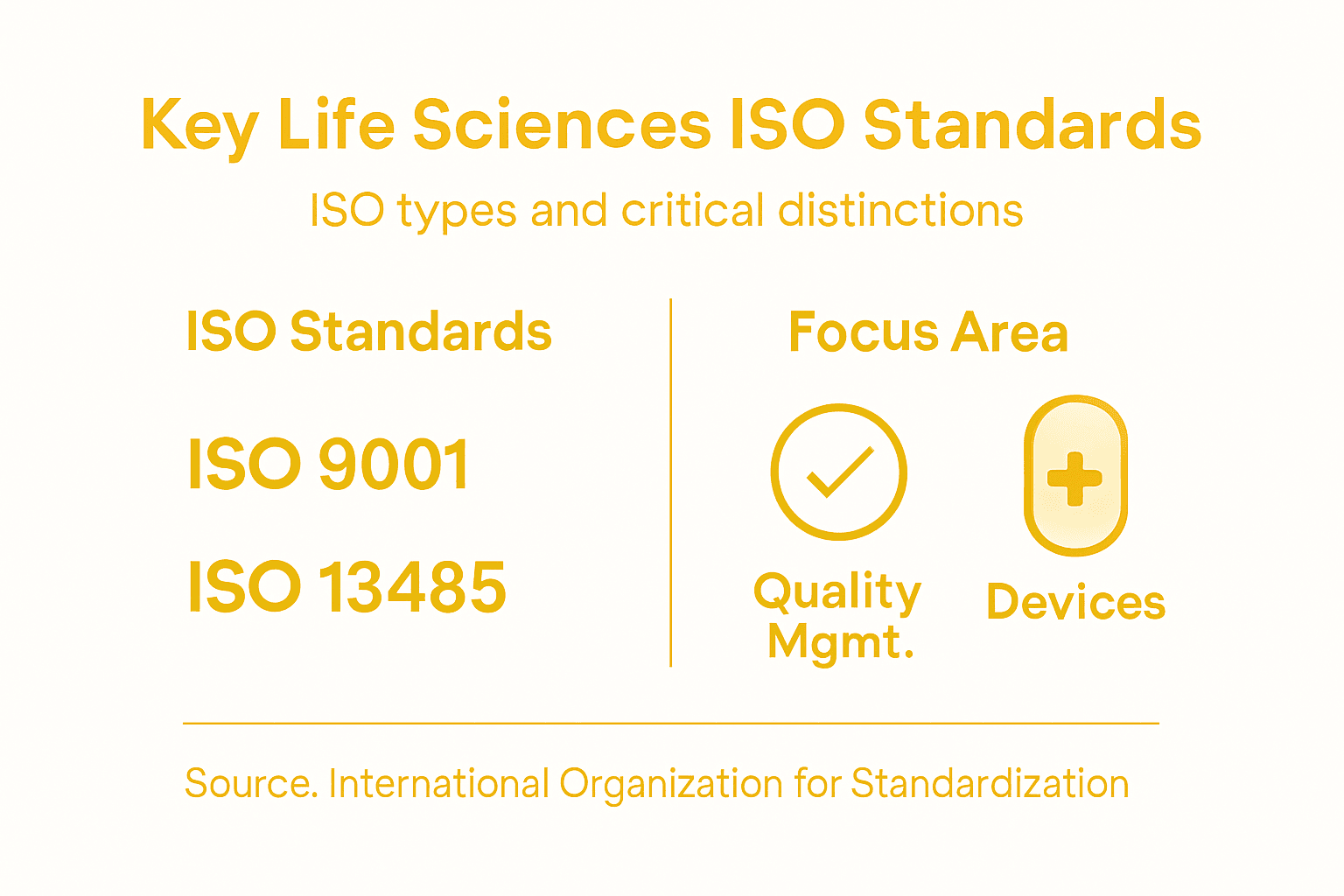
Here’s a concise comparison of core ISO standards relevant to life sciences organizations:
ISO Standard | Primary Focus | Typical Application | Unique Feature |
ISO 9001 | Quality management | Pharma and biotech companies | Universal industry applicability |
ISO 13485 | Medical devices | Device manufacturers | Emphasizes risk and regulation |
ISO 27001 | Information security | Bioinformatics, labs | Advanced data protection |
ISO 15189 | Laboratory competence | Clinical testing labs | Medical lab reliability |
ISO 17025 | Testing and calibration | Research labs | Calibration authority |
ISO 9001 provides a universal quality management framework applicable across multiple industries
ISO 13485 specifically targets medical device manufacturers, emphasizing risk management and regulatory compliance
ISO 27001 concentrates on information security and data protection protocols
ISO 15189 ensures medical laboratory technical competence and reliability
Comparative Characteristics of these standards reveal nuanced differences in scope and implementation. Popular ISO standards address unique organizational challenges, from general quality control to specialized technical requirements.

The strategic selection of appropriate ISO standards depends on an organization’s specific operational needs, regulatory environment, and quality management objectives. Different standards offer tailored approaches to maintaining excellence across various life sciences domains.
Pro tip: Carefully evaluate your organization’s specific requirements before selecting ISO certifications to ensure maximum regulatory alignment and operational effectiveness.
ISO Certification Requirements and Compliance Impact
ISO certification involves an independent verification process that ensures organizations meet rigorous quality and performance standards. This comprehensive assessment goes beyond simple documentation review, requiring organizations to demonstrate systematic implementation of management protocols and continuous improvement mechanisms.
Key requirements for achieving ISO certification include:
Developing comprehensive documented management systems
Implementing consistent quality control processes
Establishing clear organizational policies and procedures
Maintaining detailed performance records
Conducting regular internal audits
Demonstrating commitment to continuous improvement
The certification process typically involves multiple critical stages:
Initial application and documentation submission
Comprehensive system documentation review
On-site audit and performance assessment
Certification recommendation
Periodic surveillance and recertification
Compliance Impact extends far beyond simple regulatory adherence. Successful ISO certification delivers strategic advantages such as enhanced organizational credibility, improved operational efficiency, and reduced risk exposure. Organizations gain a competitive edge by demonstrating their commitment to internationally recognized quality standards.
Organizational Benefits include:
Increased stakeholder confidence
Improved internal process standardization
Enhanced market reputation
Potential reduction in operational risks
Better regulatory alignment
Pro tip: Develop a comprehensive internal audit strategy that anticipates potential compliance gaps before external certification assessments.
Business Risks of Non-Certification
Life sciences companies face significant operational risks when they fail to obtain appropriate ISO certification. Non-certification creates substantial vulnerabilities across multiple critical business domains, potentially compromising organizational credibility, market access, and financial performance.
Primary business risks associated with non-certification include:
Increased regulatory scrutiny
Diminished partner and stakeholder trust
Compromised product quality assurance
Higher probability of compliance failures
Restricted market participation
Potential legal and financial penalties
Specific consequences of non-certification manifest through multiple challenging scenarios:
Reduced global market accessibility
Higher audit failure rates
Compromised competitive positioning
Increased operational vulnerability
Potential contractual disqualification
Compliance Implications extend beyond immediate operational challenges. Organizations without proper certification become significantly more vulnerable to product recalls, regulatory penalties, and compromised patient safety. These risks can fundamentally undermine an organization’s long-term sustainability and growth potential.
Below is a summary of business risks for life sciences firms without ISO certification:
Risk Area | Example Consequence | Long-Term Impact |
Regulatory compliance | Increased scrutiny, fines | Limited global market access |
Stakeholder credibility | Loss of trust | Difficult investor relations |
Product quality | Recalls, audit failures | Damage to brand reputation |
Operational vulnerability | Contract disqualification | Ongoing financial penalties |
Potential Financial Impacts demonstrate the comprehensive nature of certification risks:
Potential contract losses
Increased insurance premiums
Higher compliance investigation costs
Reduced investor confidence
Potential market exclusion
Pro tip: Conduct a comprehensive gap analysis before certification to identify and proactively address potential compliance weaknesses.
Real-World Applications: AD VERBUM Hybrid Translation
Life sciences translation demands rigorous compliance frameworks that ensure data integrity, security, and precision throughout complex multilingual documentation processes. AD VERBUM’s hybrid translation approach integrates advanced technological capabilities with human expertise to meet the most demanding regulatory requirements.
Key operational characteristics of AD VERBUM’s hybrid translation include:
Proprietary LLM-based AI generation
Subject-matter expert linguistic refinement
ISO 17100 and ISO 18587 aligned quality assurance
EU data sovereignty compliance
Comprehensive terminology governance
The translation workflow follows a systematic four-stage process:
Client terminology and Translation Memory integration
Constrained AI language generation
Professional subject-matter expert review
Rigorous quality assurance validation
Technical Differentiation emerges through precise implementation of documented procedures that minimize translation errors and maximize regulatory compliance. This approach transforms translation from a potential risk point into a strategic operational advantage for life sciences organizations.
Translation Performance Metrics demonstrate the hybrid approach’s effectiveness:
3x-5x faster than traditional workflows
100% AI+HUMAN verification
Consistent terminology enforcement
Sector-specific linguistic precision
Audit-ready documentation
Pro tip: Request comprehensive translation memory and terminology base integration to maximize translation consistency and compliance.
Elevate Your Life Sciences ISO Compliance with Precision Translation
The article highlights crucial challenges life sciences organizations face in maintaining ISO certification and regulatory compliance, especially where precise documentation, stringent quality control, and data integrity are essential. Ensuring such standards is critical to avoid risks like regulatory penalties, audit failures, and operational vulnerabilities. To meet these demands, linguistic accuracy paired with robust terminology governance and data security is non negotiable for translation of technical and regulatory materials.
AD VERBUM’s Specialized AI Translation service bridges this gap by combining proprietary LLM-based AI with expert human oversight delivering:
ISO-aligned quality assurance tailored for life sciences including ISO 13485 and ISO 17100 standards
End-to-end terminology enforcement supported by your Translation Memories and Term Bases
EU-hosted secure infrastructure complying with GDPR and ISO 27001 for sensitive data safety
Subject-matter expert review ensuring contextual correctness and regulatory adherence
This AI+HUMAN hybrid translation workflow ensures faster turnaround with uncompromised precision—3 to 5 times faster than traditional methods—perfect for organizations seeking to uphold the highest compliance standards without sacrificing speed or security.
Ready to safeguard your life sciences documentation and streamline your ISO compliance with trusted expert linguistic support Visit AD VERBUM Contact now to learn how our translation solutions align with your certification goals.
Ensure your life sciences organization stays audit ready and compliant with specialized translation precision. Connect with us today at AD VERBUM Contact and take the decisive step toward ISO-aligned documentation excellence.
Frequently Asked Questions
What is ISO certification and why is it important for life sciences?
ISO certification provides a quality management framework that helps life sciences organizations maintain product safety, data integrity, and regulatory compliance, ensuring consistent quality and operational excellence.
What are the most relevant ISO standards for life sciences?
The key ISO standards include ISO 9001 for quality management systems, ISO 13485 for medical device quality management, ISO 27001 for information security management, and ISO 17025 for laboratory testing and calibration, among others.
How does ISO certification benefit life sciences organizations?
ISO certification enhances credibility with regulatory agencies, improves operational efficiency, provides systematic risk mitigation, and demonstrates a commitment to quality, ultimately giving organizations a competitive edge.
What are the risks of not obtaining ISO certification in the life sciences sector?
Non-certification can lead to increased regulatory scrutiny, diminished stakeholder trust, compromised product quality, higher compliance failures, and potential legal and financial penalties, jeopardizing market access and long-term sustainability.
Recommended

