


ISO 27001 in Language Services: Securing Sensitive Data

Handling sensitive legal or medical documents often means facing tough questions about data security. For Compliance Directors in regulated European sectors, the stakes can be high when confidential content moves through translation workflows. ISO 27001 stands out as a trusted framework for managing risks and protecting information across every stage. This guide explains how language service providers use ISO 27001 protocols to secure document translation within strict compliance environments.
Table of Contents
Key Takeaways
Point | Details |
Importance of ISO 27001 | ISO 27001 provides a structured framework for language service organizations to manage information security effectively, safeguarding sensitive data throughout translation workflows. |
Hybrid Workflow Security | Implementing a hybrid AI+HUMAN translation workflow enhances security processes and ensures accuracy and confidentiality in sensitive areas like healthcare and legal documentation. |
Robust Risk Management | Continuous risk assessment and adherence to comprehensive security protocols are essential for protecting against operational risks and maintaining compliance with international standards. |
Client Data Protection | Establishing strict access controls and encryption standards under ISO 27001 is crucial for preventing unauthorized access and ensuring the integrity of client information. |
Defining ISO 27001 for Language Services
ISO 27001 represents a critical framework for securing sensitive information within language service organizations. Information security management systems provide comprehensive protocols for protecting critical data throughout translation workflows.
The standard establishes rigorous requirements for managing information security risks, specifically tailored to help language service providers implement systematic data protection strategies. Key aspects include:
Identifying organizational information assets
Assessing potential security vulnerabilities
Developing comprehensive risk management protocols
Establishing consistent security control mechanisms
Creating documented processes for ongoing security monitoring
Language service providers deal with highly sensitive documents across legal, medical, technical, and financial domains. Information confidentiality becomes paramount when handling proprietary or regulated content. ISO 27001 provides a structured approach to mitigating potential data breaches and ensuring robust protection mechanisms.
ISO 27001 enables systematic management of sensitive information across all organizational processes and translation workflows.
The standard applies universally, regardless of organizational size or complexity. For language service providers, this means developing an Information Security Management System (ISMS) that addresses unique risks inherent in multilingual communication environments.
Security implementation typically involves multiple strategic components:
Comprehensive risk assessment
Technical control implementation
Staff training and awareness programs
Regular security audits and evaluations
Continuous improvement processes
Pro tip: Integrate ISO 27001 requirements into your translation workflow early to establish a proactive security culture and minimize potential vulnerabilities.
Types of Translation Technologies and Risks
Language service technologies have rapidly evolved, introducing complex security challenges across multiple platforms. Translation technology landscape encompasses diverse tools ranging from computer-assisted translation (CAT) to advanced AI-powered language models, each presenting unique security considerations.
The primary translation technologies include:
Computer-Assisted Translation (CAT) Tools: Desktop and cloud-based platforms enabling translator productivity
Machine Translation (MT): Rule-based and statistical translation systems
Neural Machine Translation (NMT): AI-driven translation using deep learning algorithms
AI-Powered Language Models: Advanced systems capable of contextual language generation
Security risks emerge from the inherent vulnerabilities in these technologies. Cloud-based platforms, for instance, introduce potential data exposure risks, while AI systems may inadvertently compromise confidential terminology through training data interactions.
Here is a comparison of primary translation technologies and their main security challenges:
Technology Type | Security Challenge | Mitigation Strategy |
CAT Tools | Cloud data exposure risks | Encrypted platform storage |
Machine Translation (MT) | Limited user control over output | Restrictive access permissions |
Neural Machine Translation | Confidential terminology leakage | Secure AI training data handling |
AI-Powered Language Models | Unintended data retention | Strict audit trails and review |
Modern translation technologies require sophisticated risk management strategies to protect sensitive linguistic assets.
The COVID-19 pandemic accelerated digital transformation, dramatically increasing remote translation platform adoption. This shift exposed organizations to heightened operational risks such as:
Unauthorized data access
Potential information leakage
Inadequate encryption protocols
Cross-border data transfer complications
Compliance challenges with international security standards
Each translation technology demands specialized security protocols. Cybersecurity measures must align with the specific technological infrastructure, ensuring comprehensive protection against evolving digital threats.
Pro tip: Conduct regular security audits of your translation technology ecosystem to identify and mitigate potential vulnerabilities before they become critical risks.
Key ISO 27001 Requirements for Providers
ISO 27001 compliance requirements represent a comprehensive framework for establishing robust information security management systems tailored specifically to language service providers. The standard demands a holistic approach to protecting sensitive linguistic and operational data across multiple organizational domains.
The key requirements span several critical domains:
Organizational Context: Understanding internal and external security environments
Leadership Commitment: Establishing clear security responsibilities and governance
Resource Management: Allocating appropriate personnel, technology, and infrastructure
Operational Controls: Implementing systematic risk management protocols
Performance Monitoring: Continuous evaluation and improvement of security mechanisms
Information Security Management Systems (ISMS) must address four primary control categories:
Organizational Controls
People-Related Controls
Physical Security Measures
Technological Infrastructure Protection
Modern language service providers must develop comprehensive security strategies that transcend traditional compliance checklists.
The certification process requires extensive documentation demonstrating:
Systematic risk assessment methodologies
Clear security policy frameworks
Detailed implementation procedures
Evidence of continuous improvement mechanisms
Staff training and awareness programs
Each language service provider must develop customized security controls that align with their specific operational landscape, technological infrastructure, and potential vulnerability points.

Pro tip: Develop a comprehensive internal audit schedule that proactively identifies and mitigates potential security gaps before external certification assessments.
AI+HUMAN Hybrid Workflow for Secure Translation
Hybrid translation workflows represent a sophisticated approach to securing sensitive linguistic data through strategic collaboration between artificial intelligence and human expertise. This methodology ensures rapid processing while maintaining the highest standards of accuracy, context preservation, and confidentiality.
The hybrid workflow follows a precise sequence of technological and human interventions:
Asset Integration: Ingest client Translation Memories and Term Bases
AI Generation: Proprietary LLM produces initial translation output
Expert Review: Subject-matter expert validates technical accuracy
Quality Assurance: Alignment with ISO 17100 and sector-specific requirements
Compliance Verification: Final security and regulatory checks
Technological safeguards are critical in managing potential security vulnerabilities. Each stage includes multiple protection mechanisms:
Controlled AI generation with explicit terminology constraints
Human oversight preventing unintended data exposure
Encryption of translation assets during processing
Restricted access to sensitive linguistic content
Comprehensive audit trail documentation
AI+HUMAN hybrid workflows transform translation from a potential security risk into a controlled, compliant process.
The human component provides essential security layers that pure machine translation cannot achieve. Certified linguists with deep domain expertise act as critical gatekeepers, identifying potential confidentiality risks, cultural nuances, and regulatory compliance issues that automated systems might overlook.
Regulated sectors such as healthcare, legal, and defense require especially rigorous translation security protocols. The AI+HUMAN hybrid approach ensures that every translation undergoes multiple verification checkpoints, dramatically reducing the risk of sensitive information compromise.
Pro tip: Implement a multi-stage review process with clear escalation protocols to ensure no single point of failure compromises your translation security ecosystem.
Operational Risks and Legal Implications
Operational risk management in language services requires comprehensive strategies that address complex technological, legal, and regulatory challenges. Language service providers must develop sophisticated frameworks to mitigate potential security vulnerabilities and ensure compliance with international data protection standards.
Key operational risks in translation environments include:
Unauthorized data access
Potential information leakage
Cross-border data transfer complications
Inadequate encryption protocols
Inconsistent security management practices
Legal compliance demands careful navigation of multiple regulatory landscapes. Organizations must address critical requirements across different domains:
Data privacy regulations
International information security standards
Sector-specific compliance mandates
Cross-border data transfer restrictions
Contractual confidentiality obligations
Effective risk management transforms potential legal vulnerabilities into structured, defensible operational processes.
Regulatory frameworks provide essential guidance for managing complex security environments. Certification under ISO 27001 demonstrates a proactive approach to identifying, assessing, and mitigating potential risks before they escalate into significant legal challenges.
Language service providers must implement robust mechanisms to track, document, and respond to potential security incidents. This includes developing clear escalation protocols, maintaining comprehensive audit trails, and ensuring transparent reporting mechanisms that satisfy regulatory expectations.
Pro tip: Develop a comprehensive incident response plan that outlines specific steps for addressing potential security breaches, ensuring rapid and systematic mitigation of operational risks.
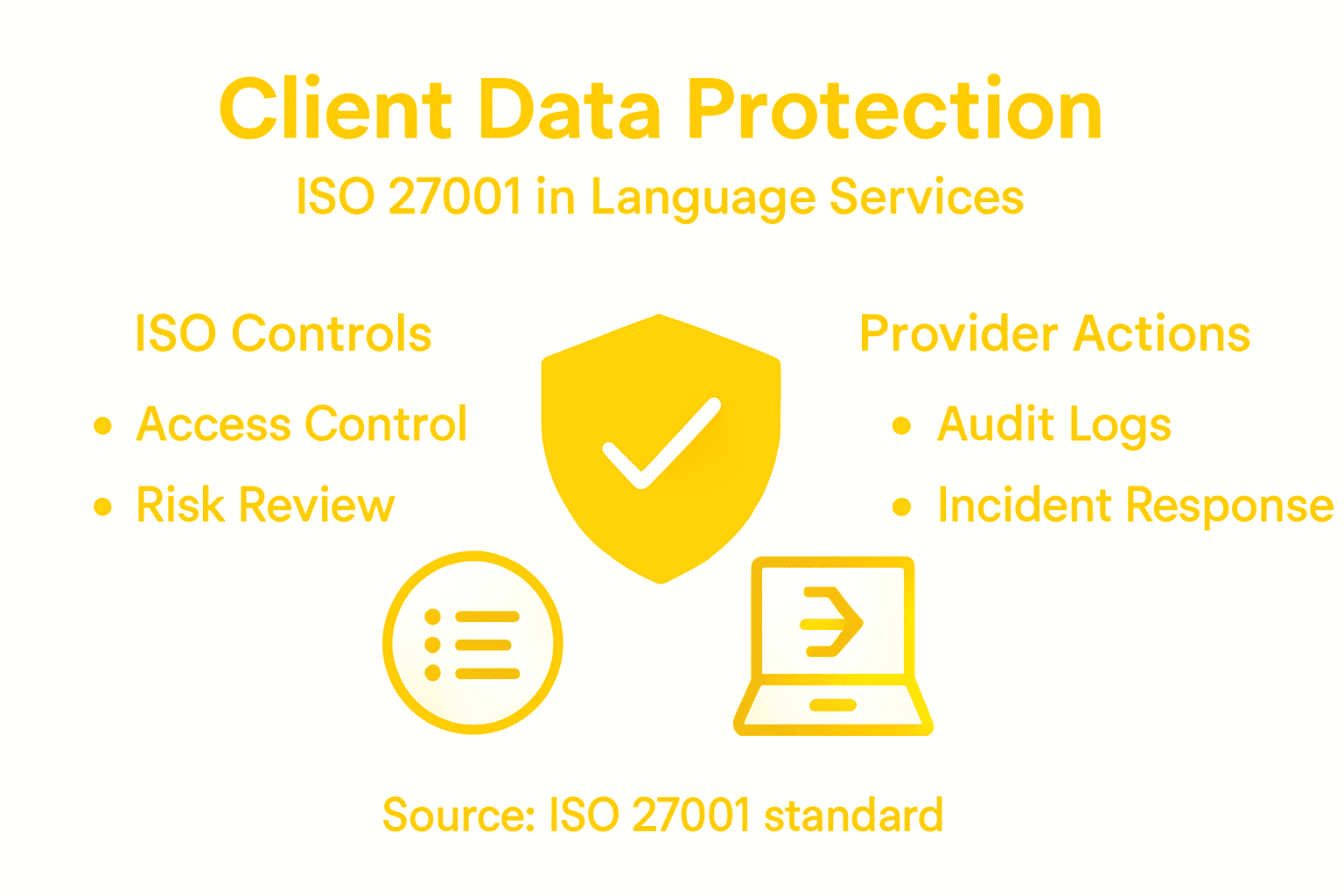
How ISO 27001 Improves Client Data Protection
Client data protection strategies in language services require comprehensive, systematic approaches that go beyond traditional security measures. ISO 27001 provides a robust framework for ensuring the confidentiality, integrity, and availability of sensitive client information throughout translation processes.
Key data protection mechanisms include:
Strict access control protocols
Comprehensive encryption standards
Continuous risk assessment procedures
Detailed information classification systems
Systematic incident response planning
Information Security Management Systems (ISMS) establish critical safeguards across multiple operational domains:
Below is a summary showing how ISO 27001 supports client data protection at every stage:
ISO 27001 Feature | Benefit for Clients | Example in Translation Workflow |
Access Control | Prevents unauthorized access | Only vetted translators permitted |
Encryption Standards | Protects data integrity | Secure file transfer protocols |
Risk Assessment Procedures | Identifies potential exposures | Regular tech vulnerability checks |
Audit Trail Documentation | Ensures accountability | Track all workflow modifications |
Personnel security screening
Technological infrastructure protection
ISO 27001 transforms data protection from a reactive compliance requirement into a proactive organizational strategy.
Regulatory compliance demands more than simple technological controls. The standard requires organizations to develop holistic approaches that integrate:
Technical security measures
Organizational policy frameworks
Continuous monitoring and improvement processes
Clear accountability mechanisms
Systematic documentation of security practices
The certification process ensures that language service providers implement rigorous controls preventing unauthorized data access, minimizing potential security breaches, and maintaining client confidentiality across complex translation workflows.
Pro tip: Conduct regular internal audits and maintain comprehensive documentation to demonstrate ongoing commitment to client data protection and regulatory compliance.
Secure Your Sensitive Data with AD VERBUM’s ISO 27001-Certified Solutions
The article highlights critical challenges language service providers face when implementing ISO 27001 to secure sensitive information throughout complex translation workflows. Common pain points include managing proprietary data within evolving AI-powered translation technologies and ensuring compliance with stringent regulatory standards like GDPR and HIPAA. AD VERBUM addresses these issues through its proprietary AI+HUMAN hybrid translation workflow that integrates client Translation Memories and Term Bases upfront, applies a context-sensitive LLM-based system hosted on private EU servers, and incorporates expert SME review calibrated to ISO 17100 and ISO 18587 quality standards. This approach ensures terminology enforcement, robust audit trails, and operational security required for regulated sectors such as Life Sciences and Legal.
AD VERBUM combines cutting-edge AI technology with 25+ years of industry experience and a network of 3,500+ subject-matter expert linguists across medical, legal, technical, and defense domains. With ISO 27001 certification and data sovereignty guaranteed by private infrastructure, AD VERBUM fulfills the most demanding compliance and data protection requirements. For organizations seeking to overcome operational risks and legal complexities outlined in the article, our tailored security controls and agile LangOps System deliver faster turnaround times while minimizing vulnerabilities.
Looking to secure your translation workflows with certified, industry-aligned expertise? Discover how AD VERBUM’s specialized AI translation solutions elevate your data protection and compliance posture.
Explore the benefits of our ISO 27001-secure services and AI+HUMAN hybrid workflow at AD VERBUM Contact Page. Reach out today to discuss tailored translation security strategies that meet your sector’s regulatory needs with precision and confidence.
Frequently Asked Questions
What is ISO 27001, and how does it relate to language services?
ISO 27001 is an international standard for establishing and managing an Information Security Management System (ISMS) that ensures the protection of sensitive data across language service organizations. It provides protocols for safeguarding critical information during translation workflows.
What are the key requirements for ISO 27001 compliance in language service providers?
Key requirements include understanding the organizational context, leadership commitment, resource management, operational controls, and performance monitoring, which together help establish a robust ISMS tailored to language services.
How can language service providers implement ISO 27001 effectively?
Language service providers can implement ISO 27001 by conducting comprehensive risk assessments, developing clear security policies, creating documentation for ongoing monitoring, training staff, and regularly auditing their security practices to ensure continuous improvement.
What are the common security challenges associated with translation technologies?
Common security challenges include unauthorized data access, potential information leakage, inadequate encryption protocols, and difficulties in managing cross-border data transfers, all of which require specialized security measures tailored to the specific technology used.
Recommended
