


Role of Subject-Matter Experts in Localization Success
- Feb 17
- 6 min read

Complex compliance challenges often surface when translating technical documentation for Life Sciences and Medical Device companies operating across the European Union. Precision is non-negotiable and regulatory stakes are high, which means standard translation can fall short. Subject-matter expert localization combines linguistic skill with proven technical and regulatory knowledge, forming a foundation for reliable and compliant content. This approach delivers nuanced accuracy that builds trust with both regulators and stakeholders.
Table of Contents
Key Takeaways
Point | Details |
Importance of SME Localization | Specialized translation by subject-matter experts ensures accuracy in technical documents and regulatory compliance in industries like Life Sciences and Medical Devices. |
Role of Hybrid Translation | Combining AI with human expertise improves translation efficiency while maintaining technical precision and contextual accuracy. |
Compliance and Risk Management | A structured approach to compliance helps mitigate translation-related risks and ensures that documentation meets industry standards. |
Comparison of Approaches | SME-driven translations offer high accuracy and compliance; automated methods are fast but often lack contextual understanding, making hybrid models the most effective. |
Defining Subject-Matter Expert Localization
Subject-matter expert (SME) localization represents a specialized translation approach where domain professionals with specific industry expertise directly contribute to linguistic and technical adaptation of content. This method goes beyond traditional translation by integrating deep contextual understanding from professionals who possess both linguistic skills and specialized technical knowledge.
In regulated industries like Life Sciences and Medical Devices, SME localization becomes critically important. These professionals understand nuanced terminology, regulatory requirements, and technical complexities that generic translators might miss. Technical document localization processes require precision that only experts can consistently deliver.
Key characteristics of SME localization include:
Direct involvement of professionals with industry-specific credentials
Advanced understanding of technical and regulatory terminology
Ability to maintain technical accuracy during translation
Contextual interpretation beyond literal language conversion
Compliance with sector-specific documentation standards
The process typically involves multilingual professionals who not only translate but comprehend the underlying technical concepts, ensuring that translated materials retain their original technical integrity and communicate exactly as intended.
Pro tip: When selecting subject-matter experts for localization, prioritize professionals with both linguistic certification and verifiable industry credentials.
Types of Experts in Regulated Sectors
In regulated industries such as Life Sciences, Medical Devices, and Pharmaceuticals, subject-matter experts represent a diverse and highly specialized group of professionals critical to accurate localization. Secure technical translation processes demand professionals with intricate understanding of both linguistic nuances and sector-specific technical requirements.
The primary categories of subject-matter experts in these sectors include:
Medical Professionals: Doctors, researchers, clinical specialists
Regulatory Compliance Experts: Professionals with deep knowledge of FDA, EMA, and international regulatory frameworks
Technical Engineers: Specialists in medical device design, manufacturing processes
Legal Experts: Professionals understanding international medical and pharmaceutical legal standards
Linguistic Specialists: Multilingual professionals with advanced scientific and technical translation credentials
Each expert category brings unique capabilities that ensure translation accuracy goes beyond linguistic conversion and addresses complex technical, regulatory, and contextual requirements. Medical professionals, for instance, can validate clinical terminology translations, while regulatory compliance experts ensure documentation meets international standards.
These experts typically possess multiple qualifications, including advanced academic degrees, professional certifications, and extensive practical experience in their respective domains. Their multidisciplinary backgrounds enable them to provide nuanced translations that preserve technical precision and regulatory compliance.
Pro tip: When selecting subject-matter experts, prioritize professionals with demonstrable expertise across multiple domains - linguistic skills, technical knowledge, and regulatory understanding.
AI and Human Hybrid Translation Process
Hybrid translation represents a sophisticated approach that integrates artificial intelligence capabilities with human linguistic expertise. Hybrid translation approaches leverage machine intelligence to generate initial translations while preserving critical human oversight and contextual understanding.
The hybrid translation workflow typically involves several key stages:
Initial AI-generated draft translation
Comprehensive human expert review
Contextual and technical accuracy verification
Cultural and nuanced language refinement
Final quality assurance validation
In regulated industries like Life Sciences and Medical Devices, the human component becomes particularly critical. Artificial intelligence can rapidly process technical documentation, but human subject-matter experts ensure precise terminology, regulatory compliance, and contextual accuracy that automated systems might overlook.

Pro tip: Implement a structured review process where human experts systematically validate AI-generated translations, focusing on technical accuracy and regulatory compliance.
Compliance, Quality, and Risk Management
In regulated industries, compliance and risk management represent critical frameworks for ensuring translation accuracy and regulatory adherence. Quality risk management principles provide structured methodologies for systematically identifying, assessing, and mitigating potential translation-related risks.
Key elements of comprehensive compliance and risk management include:
Systematic risk identification and assessment
Continuous monitoring of translation accuracy
Robust documentation and audit trail maintenance
Rigorous quality control processes
Regulatory framework alignment
Proactive error prevention strategies
Subject-matter experts play a pivotal role in managing compliance risks by applying deep domain knowledge to validate technical translations. Their expertise helps organizations navigate complex regulatory environments, ensuring that translated documentation meets stringent industry standards and maintains critical technical precision.
The below table summarizes the business impact of utilizing SME localization in regulated industries:
Benefit | Business Impact | Example Sector |
Fewer Compliance Errors | Reduces costly regulatory fines | Medical Devices |
Enhanced Product Credibility | Builds trust among stakeholders | Life Sciences |
Faster Regulatory Approvals | Speeds up market access | Pharmaceuticals |
Accurate Technical Documentation | Minimizes safety risks | Healthcare Technology |
Effective risk management requires a holistic approach that integrates technological capabilities with human expertise and systematic oversight.
Pro tip: Develop a comprehensive risk assessment matrix that maps potential translation errors against their potential regulatory and operational impacts.
Comparing SME-Driven and Automated Approaches
Translation methodologies vary significantly between subject-matter expert (SME)-driven and automated approaches, with each method presenting distinct advantages and limitations. Comparative localization studies reveal critical differences in accuracy, contextual understanding, and technical precision across translation strategies.
Key comparative characteristics include:
SME-Driven Approach:
High contextual accuracy
Deep cultural understanding
Nuanced technical interpretation
Complex regulatory compliance
Automated Approach:
Rapid processing speeds
Lower per-word translation costs
Consistent terminology usage
Limited contextual comprehension
In regulated industries like Medical Devices and Pharmaceuticals, subject-matter experts provide irreplaceable value by interpreting complex technical language and ensuring regulatory alignment. Automated systems excel at initial draft generation and basic terminology consistency, but cannot independently validate intricate scientific or legal content.
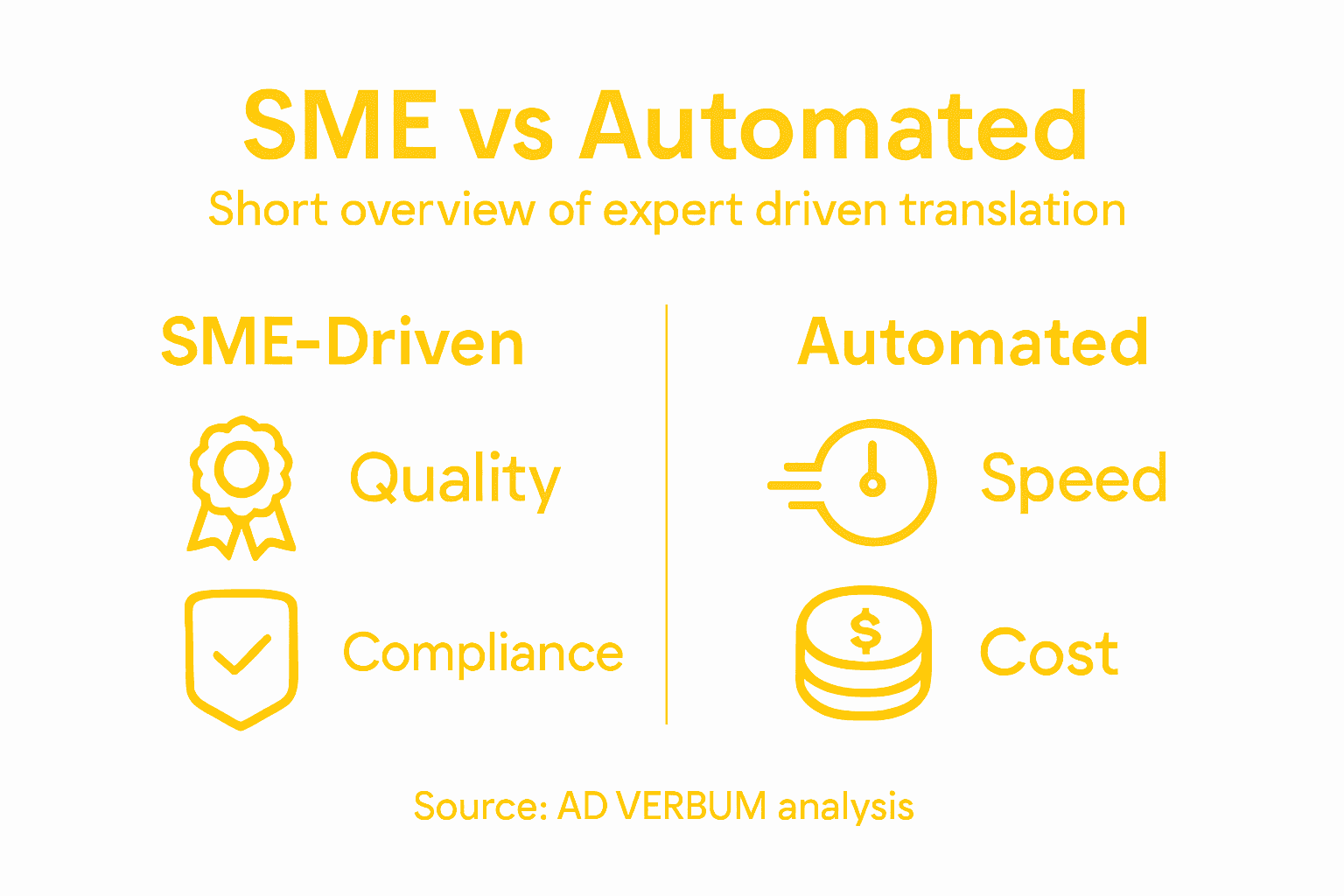
Here’s a comparison of SME-driven, automated, and hybrid translation approaches:
Criteria | SME-Driven Translation | Automated Translation | Hybrid Translation |
Technical Accuracy | Highest, experts involved | Moderate, may miss nuances | High with expert validation |
Speed of Delivery | Slower, manual process | Very fast, instant output | Balanced, faster than manual |
Regulatory Compliance | Fully aligned | Often inadequate | Reliable with SME oversight |
Cost Efficiency | Higher cost per word | Lowest per-word cost | Moderate overall cost |
Scalability | Limited by expert supply | Easily scalable | Scalable with review capacity |
Hybrid translation models represent the optimal strategy, combining AI’s efficiency with human expertise’s precision and contextual understanding.
Pro tip: Develop a staged translation workflow that leverages automated initial drafts followed by comprehensive SME review and validation.
Elevate Your Localization Accuracy with AD VERBUM’s SME-Powered Hybrid Solutions
In regulated industries like Life Sciences and Medical Devices, translation accuracy and regulatory compliance are not optional. The article highlights how subject-matter expert localization is crucial for handling technical terminology and complex regulatory environments. These pain points demand not only linguistic precision but also deep domain expertise that ensures every translation aligns with strict industry standards.
At AD VERBUM, we address these challenges head-on through our Specialized AI Translation powered by an exclusive AI+HUMAN hybrid workflow. Our proprietary Language Operations System supports over 150 languages with integrated Translation Memories and Term Bases to enforce consistent terminology. Certified subject-matter experts review every translation for technical accuracy, regulatory compliance, and contextual nuance. This approach reduces risk, accelerates turnaround times, and guarantees compliance with standards like ISO 17100 and MDR.
For organizations seeking to mitigate compliance errors, maintain audit readiness, and secure sensitive data within the EU, AD VERBUM offers a tested end-to-end solution. Discover how our hybrid model goes beyond legacy MT or public NMT with expert oversight and advanced AI to meet the exacting demands of regulated localization.
Take the first step toward more reliable technical translations tailored to your industry’s needs. Explore how our combination of AI efficiency and expert human insight can help you reduce costly errors and accelerate approvals.
Get in touch with AD VERBUM experts today
Contact AD VERBUM to secure your next localization project with trusted subject-matter expertise and advanced AI technology.
Frequently Asked Questions
What is subject-matter expert localization?
Subject-matter expert localization is a specialized translation approach that involves industry professionals with specific expertise contributing to the linguistic and technical adaptation of content, ensuring accurate and contextually appropriate translations.
Why is SME localization important in regulated industries?
SME localization is crucial in regulated industries like Life Sciences and Medical Devices as it ensures compliance with specific regulatory requirements and maintains technical accuracy that generic translators may overlook.
What types of experts are involved in SME localization for regulated sectors?
Experts involved in SME localization for regulated sectors include medical professionals, regulatory compliance experts, technical engineers, legal experts, and linguistic specialists, each providing unique insights for accurate translations.
How does the hybrid translation process integrate AI and human expertise?
The hybrid translation process leverages AI for initial draft translations, followed by a thorough review by human subject-matter experts who ensure contextual understanding, technical accuracy, and compliance with regulatory standards.
Recommended