


Lost in Translation No More: AI for Defense

Managing language operations in defense is never just about translation. When a single terminology error in a technical document can trigger mission risk, compliance and data sovereignty become non-negotiable for every defense contractor operating across European borders. As regulatory demands and operational tempo accelerate, the right AI-powered translation solution offers speed and control—but only if it delivers true auditability, robust terminology governance, and meets the security needs unique to defense environments.
Table of Contents
Key Takeaways
Point | Details |
Importance of Language Operations | Language operations are crucial for military effectiveness, requiring not just translation skills but also cultural and operational context understanding. |
AI+HUMAN Hybrid Model | Combining AI with human linguists enhances speed and consistency while ensuring quality and compliance, especially in high-stakes contexts. |
Terminology Governance | Establishing a robust Term Base and maintaining audit trails are essential for compliance and consistent communication across defense operations. |
Phased Implementation | A structured rollout approach allows organizations to validate, scale, and continuously optimize their language operations effectively. |
Language Operations in Defense Explained
Language operations in defense are the backbone of military effectiveness, diplomatic coordination, and intelligence gathering across global operations. These operations involve far more than translation—they require deep cultural knowledge, real-time decision-making, and integration with tactical and strategic objectives. Military personnel must understand not just what words mean, but what they signify in geopolitical, cultural, and operational contexts.
Defense organizations recognize this reality. The Defense Language Institute Foreign Language Center provides rigorous training that integrates language proficiency with cultural literacy, preparing military and federal personnel to operate effectively in linguistically complex environments. Similarly, the Language Enabled Airman Program develops linguistically proficient personnel who strengthen coalition interoperability and support mission success across diverse global contexts.
However, traditional language operations face structural challenges:
Resource constraints. Bilingual and multilingual experts are expensive to maintain and difficult to scale across all required language pairs and domains.
Personnel availability. Linguists cannot always be deployed in real-time, particularly for surge requirements or regional operations that demand immediate linguistic support.
Terminology consistency. Military and defense terminology evolves rapidly, and maintaining consistent glossaries across operational units is labor-intensive without digital governance tools.
Quality variability. Human translation quality depends on individual expertise, fatigue, and contextual knowledge—all variables that affect critical documents handling weapons systems, procurement specifications, or intelligence analysis.
This is where AI+HUMAN hybrid translation changes the operational calculus. Rather than replacing human linguists, hybrid models augment their capability, allowing specialist teams to handle high-stakes documentation while reducing turnaround time and enforcing terminology precision.
The core principle: humans make judgment calls about meaning, context, and compliance; AI enforces consistency, governance, and speed.
Defense language operations require more than generic translation tools. When you translate a weapons system specification, procurement contract, or operational instruction, terminology drift, hidden security exposures, and missing audit trails create operational risk. Commercial translation engines lack the domain knowledge, terminology governance, and compliance framework that defense operations demand.
AD VERBUM’s approach to language operations aligns specifically with defense requirements. The system ingests your organization’s Term Bases and Translation Memories, then uses proprietary LLM-based processing to generate target language output constrained by your terminology standards. Subject-matter expert linguists—including defense engineers and military specialists—review for technical accuracy and regulatory compliance. Quality assurance is aligned to ISO 17100 and AQAP 2110 standards, creating a documented, auditable workflow.
The operational advantage is measurable: 3x to 5x faster turnaround than traditional workflows, combined with full audit trail and EU-hosted data sovereignty (ISO 27001 certified, private infrastructure, no reliance on public cloud processing). This means your organization can scale language operations without scaling linguist headcount proportionally, while maintaining compliance and terminology control.
Here is a comparison of translation workflows relevant for defense organizations:
Workflow Type | Turnaround Time | Consistency Control | Audit Trail Availability |
Human-Only | Slowest | High (manual effort) | Possible but labor-intensive |
Generic AI-Only | Fast | Weak | Not available |
AI+Human Hybrid | Fast (3-5x gain) | Strong (Term Base used) | Fully documented, auditable |
When you’re coordinating multinational defense initiatives, translating technical procurement documents, or managing regulatory submissions across European standards, language operations must integrate security, compliance, and speed. Generic NMT tools cannot deliver this. Hybrid approaches built specifically for defense provide the control, auditability, and expertise your operations require.
Pro tip: Map your organization’s critical terminology before implementing AI translation. Language operations succeed when your system knows your domain—invest in Term Base governance from the start, and you’ll see turnaround improvements of 50% or more within the first quarter.
Types of AI Translation and Their Risks
AI translation systems fall into distinct categories, each with different capabilities and vulnerabilities. Understanding these types is critical for defense organizations because the choice directly impacts operational security, accuracy, and compliance. A translation tool that works for general business correspondence may introduce serious risk when handling weapons specifications, procurement contracts, or intelligence analysis.
Machine Translation (MT) and Neural Machine Translation (NMT)
Machine Translation (MT) represents the legacy approach—rule-based systems that apply grammatical dictionaries and syntactic rules to produce literal word-for-word output. These systems lack contextual reasoning and produce translations that are technically correct but often nonsensical in meaning.
Neural Machine Translation (NMT) improved this by using neural networks to understand context across longer stretches of text. Commercial platforms like Google Translate, DeepL, and similar SaaS tools rely on NMT. While more fluent than legacy MT, NMT systems carry significant defense risks:
Terminology inconsistency. NMT systems cannot enforce your organization’s glossaries or maintain consistent technical terminology across large documents. A term translated one way in paragraph one may be rendered differently in paragraph fifty.
Security exposure. Commercial NMT platforms process your data through cloud infrastructure. Even with contractual assurances, your sensitive defense documentation flows through third-party servers, creating audit and compliance exposure.
No audit trail. When an error occurs, you cannot trace why the system produced a specific translation choice. This violates regulatory requirements for traced decision-making in defense and regulated sectors.
Domain mismatch. NMT models trained on general internet text perform poorly on specialized vocabulary. Defense terminology—from weapons systems to procurement regulations—lies outside the training data of public models.
Commercial translation engines are designed for speed and volume, not for precision in high-stakes, regulated contexts.
Large Language Models (LLMs) and Proprietary AI Translation
Large Language Models (LLMs) represent the current generation of AI translation. These models generate text based on learned patterns from massive text corpora, handling context better than NMT and producing more nuanced output. However, LLMs face persistent challenges including domain mismatch, rare word prediction, and evaluation alignment—all critical in defense translation.
Propriety LLM-based AI translation systems differ fundamentally from consumer LLMs. Instead of relying on general models, defense-focused systems integrate LLM generation with organizational controls:
Terminology governance. The system constrains output using client-provided Term Bases, ensuring consistent terminology across all translations.
Domain specialization. Models are fine-tuned or prompted with defense-specific knowledge, improving accuracy on technical and regulatory content.
Human oversight integration. Subject-matter expert linguists review all AI-generated output for accuracy, compliance, and contextual nuance before delivery.
Audit trail and compliance. Every translation decision is logged and traceable, meeting regulatory requirements for AQAP 2110, ISO 27001, and other defense standards.
The Operational Risk of Unvetted AI Translation
Military AI translation systems face vulnerabilities including adversarial attacks, hallucinations, and model manipulation. Hallucination—where the AI generates plausible-sounding but false information—is particularly dangerous in defense contexts. A translation that invents technical specifications or misrepresents procurement terms can compromise mission effectiveness or create legal liability.
When your organization uses a generic NMT tool or an unconstrained LLM, you accept these risks without visibility:
Below is a summary of major risks linked to using unvetted AI translation in defense:
Risk Type | Defense Impact | Example Scenario |
Terminology Error | Incorrect equipment specs lead to mission failure | “Safety lock” mistranslated |
Security Breach | Sensitive data exposure during cloud processing | Cloud leak of classified files |
Audit Gap | Cannot trace decisions, failing compliance checks | No log for translation errors |
Hallucination | AI invents plausible but false information | Nonexistent contract terms added |
Accuracy errors in critical terminology can propagate through operational planning, intelligence analysis, or compliance documentation.
Bias embedded in training data may skew translations in ways that favor certain interpretations or overlook cultural nuance critical to international military coordination.
Security breaches occur when sensitive content transits commercial platforms without organizational control or encryption.
Compliance violations arise when translations lack audit trails or fail to meet regulatory standards for traced decision-making.
AD VERBUM’s approach mitigates these risks by combining LLM generation with certified subject-matter expert review, organizational terminology governance via Term Bases, ISO 17100 and AQAP 2110-aligned QA workflows, and EU-hosted private infrastructure with full audit trail. This is the AI+HUMAN hybrid model—AI handles consistency and speed; humans make judgment calls about meaning, compliance, and context.
Pro tip: When evaluating any AI translation system, demand access to your organization’s audit trail and confirmation that your data never transits public cloud platforms. If the vendor cannot provide this guarantee, the system is not suitable for regulated defense documentation.
Terminology Governance and Audit Requirements
Terminology governance and audit trails are not optional luxuries in defense translation—they are regulatory obligations. When your organization translates procurement specifications, weapons system documentation, or intelligence analysis, every word choice must be traceable, consistent, and compliant with your organization’s standards and applicable regulations. Without this infrastructure, you cannot prove what was translated, why specific terminology was chosen, or whether errors occurred through negligence or system failure.

Why Terminology Governance Matters in Defense
Defense organizations operate under multiple layers of regulatory oversight. Federal regulations, executive orders, and departmental guidance all mandate that AI systems used in defense contexts maintain consistent governance and oversight. When you deploy an AI translation system, you are deploying a decision-making tool that must align with these requirements.
Terminology governance is the mechanism that ensures this alignment. A Term Base is a centralized repository of your organization’s approved terminology—how you translate specific technical terms, how negation is handled, how domain-specific concepts are rendered in target languages. When properly integrated into AI translation workflows, the system constrains output to enforce these standards automatically.
Without terminology governance:
A weapons system specification might translate “safety interlock” inconsistently across five subsections, creating confusion for European partners or regulatory bodies.
Procurement terms might drift in meaning across a 200-page contract, potentially affecting legal interpretation.
Technical terminology used in one department might conflict with the glossary used in another, creating operational inefficiency and compliance risk.
There is no record of which terminology choices were made deliberately and which resulted from system error.
Terminology governance transforms translation from a document conversion task into a controlled, auditable process.
The Audit Trail Requirement
Defense and regulated sectors require full audit trails for compliance. The Department of Defense compliance framework mandates that AI activities be documented, traceable, and subject to oversight through the Chief Digital and Artificial Intelligence Officer (CDAO) Council. This means every translation decision must be logged.
An audit trail documents:
Input metadata. Source language, target language, document classification, client Term Base version, date of translation request.
Processing steps. Which Term Base constraints were applied, which specialized terminology rules were enforced, which SME linguist reviewed the output.
Quality assurance results. What QA checks were performed, what errors were flagged and corrected, what compliance validations passed or failed.
Output delivery. Final translated document, delivery timestamp, who accessed the document, any modifications made post-delivery.
Error resolution. If an error was discovered, what corrective action was taken, who approved the change, when the corrected version was re-delivered.
Commercial NMT tools provide none of this. When you use Google Translate or a generic SaaS translation service, there is no audit trail. You cannot prove what the system did, why it made specific choices, or whether it complied with your organization’s standards. This creates regulatory exposure and operational liability.
Terminology Enforcement in Practice
When AD VERBUM ingests your Term Base and Translation Memory, the proprietary LLM-based system uses this knowledge to constrain its output. The system does not guess at terminology—it applies your organization’s authoritative glossary to every sentence. A subject-matter expert then reviews the AI-generated output, validating accuracy, compliance, and contextual appropriateness before delivery.
This hybrid approach provides measurable advantages:
Consistency. Your specialized terminology is enforced across all translations, eliminating drift.
Traceability. Every translation is logged with full context, allowing auditors to reconstruct how and why specific terminology was used.
Compliance alignment. ISO 17100 and AQAP 2110 quality assurance workflows are built into the process, meeting regulatory requirements without manual overhead.
Risk mitigation. If a terminology error is discovered post-delivery, the audit trail enables rapid identification of root cause and corrective action.
Examples of terminology governance in practice include enforcing regulatory translations (“Evaluation and Monitoring” must always render consistently in target languages), maintaining domain-specific glossaries (how your organization translates weapons system components or procurement categories), and ensuring negation and conditional language are handled precisely (“should not” versus “must not” carry different legal weight).
Pro tip: Before implementing any AI translation system, audit your organization’s existing terminology standards across departments. Map your authoritative Term Base first, then require any vendor to demonstrate how their system enforces these standards and provides full audit trail documentation. This foundational work will reduce implementation risk by 60% and accelerate compliance validation.
Why AI+Human Hybrid Model Is Essential
The choice between pure AI translation and AI+HUMAN hybrid translation is not a preference—it is a compliance and operational necessity in defense. AI systems excel at speed and consistency, but they lack the judgment, cultural awareness, and accountability that human experts provide. When your organization translates weapons specifications, operational directives, or procurement contracts, you need both capabilities working together, not one replacing the other.
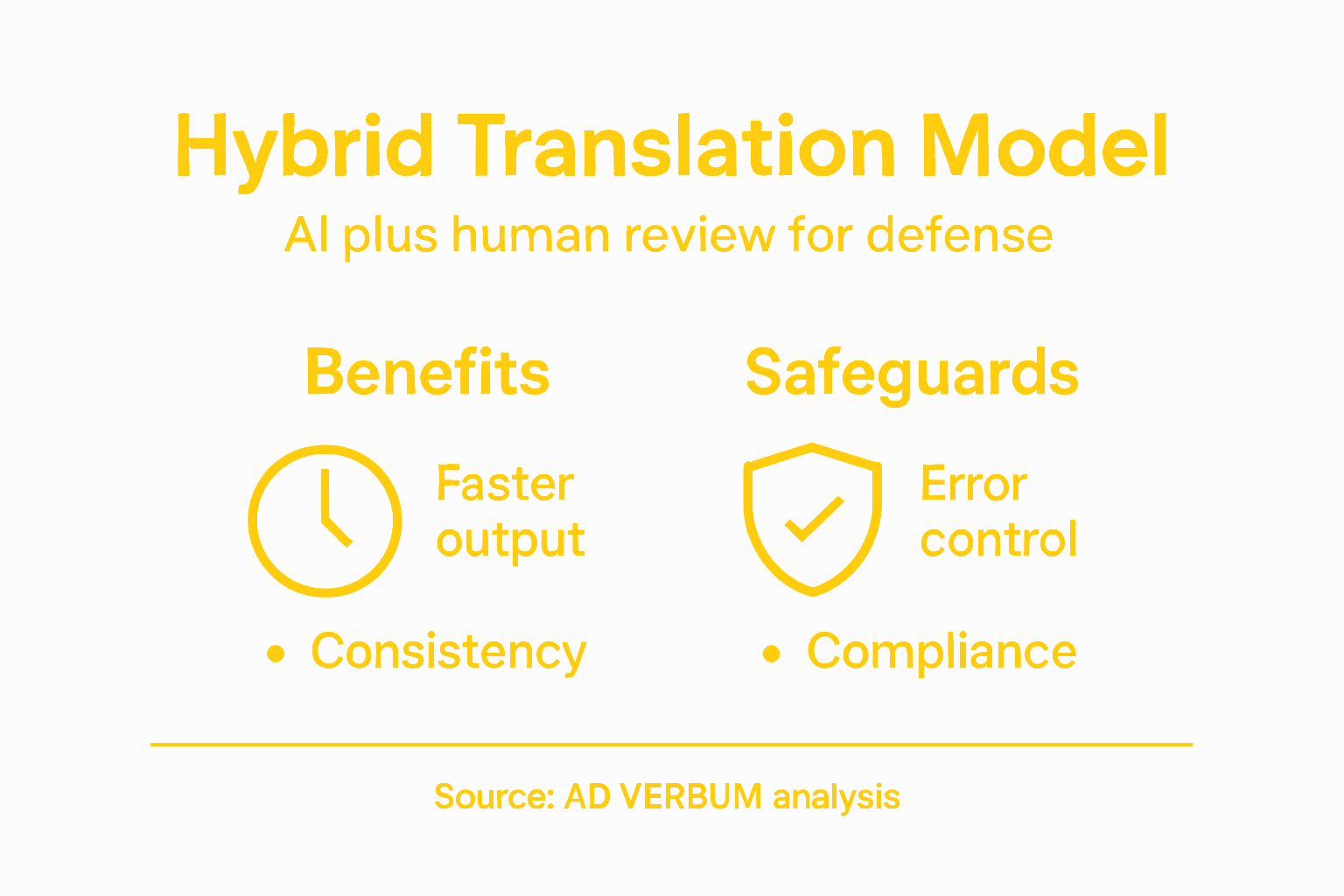
The United States military has already made this choice. The U.S. Army employs hybrid approaches that leverage AI’s ability to accelerate information processing while preserving human expertise for critical judgment. This model ensures accuracy, contextualization, and operational relevance in defense communications. The principle is straightforward: AI handles the mechanical work; humans make the judgment calls.
What AI Does Well
AI translation systems excel at specific, measurable tasks:
Speed and scale. AI processes documents in hours that would require weeks of human translation. This matters when you need to translate 500 pages of procurement documentation before a contract signing.
Consistency enforcement. When configured with your Term Base, AI applies terminology rules mechanically across every sentence, eliminating human inconsistency and fatigue.
Context handling. Modern LLMs understand longer passages and can handle complex sentence structures, negation, and conditional language better than rule-based systems.
Cost efficiency at scale. For high-volume, lower-stakes documentation, AI translation reduces per-word costs significantly.
But AI has hard limits. It cannot understand intent. It cannot make judgment calls about what the source text really means. It cannot verify compliance or catch errors that require domain expertise. It hallucinates—generating plausible-sounding but false information. It embeds bias from training data. And without human review, it operates without accountability.
What Humans Do That AI Cannot
Subject-matter expert linguists bring irreplaceable capability:
Judgment about meaning. A defense engineer reviewing a weapons system translation can determine whether a technical term was rendered correctly in context. A compliance specialist can verify that regulatory language meets legal standards. An AI system cannot make these calls.
Cultural and operational context. When translating communications for coalition operations, human linguists understand how terminology is used in partner militaries, what connotations matter, what could create misunderstanding.
Error detection and correction. Humans catch AI hallucinations, identify when terminology was misapplied, and fix errors that automated QA would miss.
Accountability. When an error occurs in a human-reviewed translation, you can identify who reviewed it, what they checked for, and why they approved it. This creates legal and operational accountability.
Compliance validation. Humans verify that translations meet regulatory requirements—AQAP 2110 standards, ISO 17100 quality gates, your organization’s specific governance rules.
AI handles consistency; humans handle judgment. Together, they create translation that is fast, accurate, auditable, and compliant.
The Operational Case for Hybrid Translation
Defense organizations face a resource problem: you cannot scale linguist headcount to match translation volume, particularly for surge requirements. Integrating AI with human expertise enhances operational effectiveness by allowing specialists to focus on high-stakes judgment while AI handles mechanical consistency.
The hybrid workflow looks like this:
AI processing. Your proprietary LLM-based system ingests your Term Base and processes the source document, generating target language output constrained by your terminology and style standards.
Specialist review. Subject-matter expert linguists review the AI output for technical accuracy, compliance, and contextual correctness. They catch errors, adjust terminology where context requires nuance, and validate against your organization’s standards.
QA validation. Automated and manual QA checks verify that the translation meets ISO 17100 and AQAP 2110 standards, that no terminology drift occurred, and that compliance requirements are satisfied.
Delivery with audit trail. The final translation is delivered with full documentation of how it was produced, who reviewed it, what checks were performed, and what the audit trail shows.
This model achieves what neither pure AI nor pure human translation can alone. You get 3x to 5x faster turnaround than traditional human-only workflows. You maintain terminology consistency that pure AI cannot guarantee. You preserve accountability and compliance that neither approach delivers independently. You scale language operations without proportionally scaling your linguist headcount.
Why This Matters for Defense Procurement and Operations
When you translate a defense contract or operational directive, errors are not mere inconveniences—they carry cost, legal, and safety consequences. A terminology error in a procurement specification could lead to purchasing the wrong component. An error in an operational instruction could create mission risk. An audit trail gap could expose your organization to regulatory violations.
Pure AI translation introduces these risks without mitigation. Pure human translation is too slow and expensive for modern operational tempos. The hybrid model is the only approach that addresses the full requirement set: speed, accuracy, consistency, compliance, and accountability.
Pro tip: When evaluating an AI translation vendor, ask to see their hybrid workflow process and request examples of their subject-matter expert review process. Verify that they employ defense-domain specialists (engineers, procurement experts, military linguists) who actually understand your sector. This single factor—expert reviewer qualifications—predicts translation quality more reliably than any other metric.
Four-Phase Rollout Guide for Defense Organizations
Implementing AI translation in a defense organization is not a switch you flip all at once. The Department of Defense and military branches follow a phased approach to AI deployment that prioritizes experimentation, removes bureaucratic barriers, invests in infrastructure and talent, and culminates in widespread integration. The same structure applies to introducing AI+HUMAN hybrid translation. This guide breaks down the four phases your organization should follow to minimize risk, build organizational confidence, and achieve operational capability.
Phase One: Pilot and Proof of Concept
Start small. Select a non-critical but representative document set—perhaps procurement specifications, technical manuals, or routine operational correspondence. This should be material that matters operationally but does not represent your highest-stakes translations.
Your Phase One objectives:
Baseline your current state. Measure how long your organization currently takes to translate these documents, what the cost per word is, and what quality metrics you currently track.
Select a pilot workflow. Work with your chosen AI translation vendor to ingest your Term Base and Translation Memory. Run a small batch of 20-50 pages through the hybrid workflow.
Evaluate output. Have your subject-matter experts review the AI-generated translations alongside human-only translations. Document what the AI did well, where it stumbled, and what adjustments are needed to terminology or style guidance.
Measure outcomes. Track turnaround time, cost, and quality scores. Compare hybrid translation results against your baseline.
Phase One typically lasts 4-8 weeks. The goal is not perfection—it is to confirm that the hybrid model works in your operational environment and to identify what adjustments are needed before scaling.
Phase One proves the concept works; Phase Two proves you can scale it.
Phase Two: Scaling and Operationalization
Once you have validated that hybrid AI translation improves your turnaround and cost metrics while maintaining quality, expand the scope. Begin translating 10-15% of your total translation volume through the hybrid workflow. This is where you identify operational friction—scheduling review linguists, integrating translations into your document management systems, handling workflow handoffs.
Phase Two focuses on:
Building workflow integration. How do translations enter the system? Who schedules SME reviews? How do revised versions get distributed? What happens when an error is discovered post-delivery?
Scaling terminology governance. Your Term Base will grow as you translate more content. Establish governance: who can add new terms, how are conflicts resolved, how do you version and control the Term Base.
Training your team. Your linguists and project managers need to understand the hybrid workflow. They need to know what to expect from AI output, what their review responsibilities are, and how to use the audit trail.
Optimizing linguist allocation. You will discover which reviewers are most effective, which document types require more SME oversight, where you can use junior linguists with supervision versus when you need senior specialists.
Phase Two typically lasts 12-16 weeks. By the end, you should have operational confidence that the hybrid model works at modest scale and you understand how to allocate resources effectively.
Phase Three: Full Organizational Integration
Once you have validated operations at 10-15% of volume, expand to 50% or more. This is where you achieve the measurable operational benefits: 3x to 5x faster turnaround, reduced per-word cost, improved consistency, and full audit trail compliance.
Phase Three activities:
Expand linguist network. Recruit additional subject-matter expert linguists. You will not need proportionally more linguists than Phase Two—that is the economic benefit of the hybrid model—but you will need more than you started with.
Integrate into procurement. Update your procurement processes and supplier documentation to specify hybrid AI+HUMAN translation as your standard. Establish SLAs (service level agreements) for turnaround time and quality.
Compliance validation. Conduct formal validation that your hybrid translation workflow meets AQAP 2110, ISO 17100, ISO 27001, and other applicable standards. Document your audit trail capabilities.
Cross-functional alignment. Coordinate with your legal, compliance, and security teams. They need to understand how the hybrid model meets their requirements and what audit capabilities they can rely on.
Phase Three typically lasts 16-24 weeks. Your organization should now be translating the majority of documentation through the hybrid model with operational confidence and regulatory compliance.
Phase Four: Continuous Optimization
U.S. Army Cyber Command’s strategic roadmap emphasizes that AI integration does not end at deployment—it requires continuous optimization, rapid iteration, and human-machine teaming refinement. Phase Four is ongoing.
Continuous optimization includes:
Monitoring outcomes. Track turnaround time, cost per word, quality metrics, and error rates over time. Use this data to identify improvement opportunities.
Refining terminology. As new defense terminology emerges or your organization’s standards evolve, update your Term Base and retrain the system.
Expanding language pairs. Once you have mastered the hybrid workflow in your primary language combinations, expand to additional languages or dialects.
Identifying new use cases. Look for other areas where hybrid translation could accelerate operations—intelligence analysis summaries, technical documentation localization, regulatory submissions.
Refreshing your linguist network. Maintain relationships with your SME reviewers, refresh training as the AI system evolves, and continuously recruit specialized expertise.
Phase Four never ends. Your hybrid translation capability will become a strategic asset that evolves with your organization’s needs.
Realistic Timeline and Resource Planning
From pilot to full integration typically takes 12-18 months, depending on your organization’s size and complexity. Budget for:
Vendor fees. Licensing for the proprietary AI+HUMAN translation system, based on volume and language pairs.
Linguist time. SME reviewer time during Phases Two and Three, as you transition from external vendor reviews to internal capacity.
Project management. Coordination across departments, workflow implementation, and change management.
Infrastructure. Integration with your document management systems, data security validation, and compliance auditing.
Pro tip: Document your Phase One pilot results aggressively. Quantify turnaround improvements, cost per word reductions, and quality metrics. This data becomes your business case for funding Phases Two through Four. Defense decision-makers respond to measurable outcomes—make sure you have them before requesting budget for scale-up.
Enhance Your Defense Language Operations with Precision AI+Human Hybrid Translation
The challenge of maintaining strict terminology governance and regulatory compliance in defense translation is critical to mission success and operational security. If you struggle with inconsistent terminology, delayed turnaround, or lack of audit trails, AD VERBUM offers a tailored solution. Our proprietary AI-powered Language Operations System, combined with a global network of 3,500+ subject-matter expert linguists, ensures your sensitive defense documents meet ISO 17100, AQAP 2110 standards, and strict data sovereignty requirements.
With AD VERBUM you get:
Integration of your existing Translation Memories and Term Bases for consistent, compliant output
3x to 5x faster turnaround compared to traditional human workflows
EU-hosted, ISO 27001 certified infrastructure protecting your sensitive data
100 percent human oversight by linguists specialized in defense, engineering, and legal domains
Experience the operational advantage of AI+HUMAN hybrid translation designed specifically for regulated defense environments. Ready to elevate your language operations and eliminate risks tied to generic AI translation?
Contact AD VERBUM today and discover how our specialized AI Translation solutions can transform your defense communications. Take the next step toward secured, audited, and precise language services by visiting our contact page or learn more about the benefits of hybrid translation in high-stakes sectors like defense.
Explore how hybrid translation meets your compliance, security, and terminology governance needs with AD VERBUM’s Specialized AI Translation. Start securing your translations with proven expertise now.
Frequently Asked Questions
What are language operations in defense?
Language operations in defense refer to the integration of language proficiency with cultural knowledge, enabling military personnel to effectively communicate, gather intelligence, and coordinate diplomatically in various international contexts.
How does AI+HUMAN hybrid translation improve defense language operations?
The AI+HUMAN hybrid translation model combines the consistency and speed of AI with human judgment and contextual understanding. This approach allows for faster turnaround times while ensuring accuracy and compliance with specialized defense terminology.
What risks are associated with using generic AI translation tools in defense?
Using generic AI translation tools can lead to terminology inconsistencies, security exposure from data transiting through commercial platforms, a lack of audit trails, and potential inaccuracies in coded military language due to domain mismatches.
Why is terminology governance important in defense translations?
Terminology governance ensures that translations maintain consistent and compliant use of specialized vocabulary, which is crucial for reducing errors in technical documents and meeting regulatory requirements in defense operations.
Recommended

