


Securing Defense Localization: AI and Human Oversight

Managing defense localization as an SME in the European market means facing strict compliance requirements and handling sensitive technical documentation with care. The European Defence Fund empowers smaller enterprises to develop innovative and agile localization solutions, but balancing rapid adaptation with rigorous data security can be daunting. This article clarifies how SMEs can harness advanced AI-driven translation technologies with robust human oversight to achieve secure, regulated multilingual communication while maintaining precise terminology governance.
Table of Contents
Key Takeaways
Point | Details |
Role of SMEs | Small and medium-sized enterprises are essential for innovation and agility in European defense localization. |
Importance of Cybersecurity | Robust cybersecurity protocols are critical for compliance and protection of sensitive information in defense sectors. |
Hybrid Translation Workflows | Combining AI technology with human expertise enhances accuracy and regulatory compliance in translation processes. |
Terminology Governance | Effective terminology management is crucial for ensuring precise communication and regulatory adherence in defense contexts. |
Defense Localization in SMEs Explained
Small and medium-sized enterprises (SMEs) play an increasingly critical role in European defense technology development and localization. The European Defence Fund represents a pivotal mechanism supporting these innovative organizations, providing crucial resources for technological advancement.
Defense localization for SMEs involves several complex dimensions:
Navigating strict regulatory compliance requirements
Developing secure translation infrastructures
Managing sensitive technical documentation
Ensuring precise terminology governance
Maintaining data sovereignty standards
The strategic importance of SMEs in defense localization stems from their ability to provide specialized, agile solutions that larger organizations might overlook. These enterprises frequently possess deep technical expertise and can rapidly adapt to emerging technological challenges.
Here’s how defense SMEs benefit compared to large organizations:
Aspect | SMEs in Defense | Large Organizations |
Innovation Speed | Rapid adaptation | Often slower to respond |
Technical Specialization | Niche expertise | Broad, generalized teams |
Flexibility in Localization | High—agile strategies | Lower—rigid processes |
Risk from Regulatory Change | Greater impact, less buffer | More resilient, larger teams |
Key considerations for successful defense localization include:
Implementing robust cybersecurity protocols
Developing multilingual technical communication capabilities
Creating secure AI-enhanced translation workflows
Maintaining strict information control mechanisms
Technical translation in defense sectors demands extraordinary precision. Mistranslated technical specifications could potentially compromise operational security or equipment functionality. SMEs must therefore invest in sophisticated linguistic infrastructure that combines advanced AI technologies with human subject matter expertise.
SMEs represent the innovative backbone of European defense technological development, providing nimble and specialized solutions across complex regulatory landscapes.
Pro tip: Invest in comprehensive linguistic compliance training and develop robust terminology management systems to minimize potential translation-related risks.
AI Translation Types and Security Risks
AI translation technologies have dramatically transformed linguistic capabilities, but they also introduce significant security challenges. AI translation risks demand careful evaluation across multiple domains, particularly in sensitive sectors like defense and legal services.
Multiple AI translation approaches exist, each with distinct security implications:
Machine Translation (MT): Basic algorithmic translation with minimal contextual understanding
Neural Machine Translation (NMT): More sophisticated, context-aware translation systems
Large Language Model (LLM) Translation: Advanced AI-driven translation with complex linguistic processing
Hybrid AI+Human Translation: Combining machine efficiency with human expert validation
Security risks associated with AI translation include:
Potential data confidentiality breaches
Inaccurate technical terminology translation
Unintended bias propagation
Inadequate cultural and contextual interpretation
Technical documentation in defense contexts requires extraordinary precision. Translation tools carry significant operational risks that could potentially compromise communication integrity and mission-critical information.
AI translation technologies must be implemented with rigorous security protocols and continuous human oversight to mitigate potential misunderstandings and data vulnerabilities.
Pro tip: Implement multilayered validation processes that combine AI translation technologies with expert human review to ensure maximum translation accuracy and security.

Legal Constraints: ITAR, EAR, and Data Handling
International Traffic in Arms Regulations (ITAR) and Export Administration Regulations (EAR) represent critical legal frameworks governing defense and dual-use technology communications. ITAR compliance requires stringent security measures to protect national security interests and control sensitive technical information.
Key regulatory requirements for defense data handling include:
Strict access control mechanisms
Comprehensive data encryption protocols
Mandatory registration with regulatory bodies
Precise licensing documentation
Continuous monitoring of information transfers
Organizations must implement robust cybersecurity frameworks to ensure compliance:
Implement NIST SP 800-171 standard protections
Establish multi-factor authentication systems
Create detailed audit trail documentation
Restrict access to authorized U.S. personnel only
Deploy FIPS-compliant encryption technologies
Cybersecurity protections for controlled data involve sophisticated technical and procedural safeguards. Controlled Unclassified Information (CUI) demands exceptional handling protocols that go beyond standard enterprise security practices.
Defense data protection requires a holistic approach combining technological controls, rigorous personnel screening, and continuous regulatory compliance monitoring.
Pro tip: Develop a comprehensive compliance matrix that maps your technological infrastructure against ITAR and EAR requirements to identify and remediate potential security vulnerabilities.
Hybrid Translation Workflows for Regulatory Assurance
Hybrid translation workflows represent a sophisticated approach to managing complex linguistic challenges in regulated defense sectors. Translation compliance requires multi-layered validation processes that integrate advanced technological capabilities with human expertise.
Key components of an effective hybrid translation workflow include:
Terminology Management: Establishing comprehensive controlled vocabulary systems
AI-Powered Initial Translation: Leveraging context-aware machine learning technologies
Expert Human Review: Implementing subject matter expert validation stages
Compliance Tracking: Maintaining detailed audit trails and version control
Security Encryption: Protecting sensitive technical documentation
The hybrid workflow typically follows a structured sequence:
Initial document intake and classification
Automated AI-driven preliminary translation
Terminology and style guide cross-referencing
Certified linguist technical review
Final compliance validation
Secure document archiving
Defense localization demands extraordinary precision. Technical translation errors can potentially compromise operational security, making human oversight critical in maintaining linguistic and regulatory integrity.
Successful hybrid translation workflows balance technological efficiency with rigorous human expertise, creating a comprehensive approach to multilingual communication.
Pro tip: Develop a standardized review checklist that explicitly maps AI-generated translations against industry-specific compliance requirements to ensure consistent quality and regulatory adherence.
Terminology Governance and Audit Trails in Practice
Terminology governance represents a critical infrastructure for maintaining translation consistency and regulatory compliance in defense localization. Precise terminology management ensures accurate communication across complex technical domains.
Key components of robust terminology governance include:
Centralized Term Bases: Creating comprehensive, authorized linguistic repositories
Controlled Vocabulary: Establishing strict definitional standards
Multilingual Alignment: Ensuring consistent meanings across language variants
Dynamic Update Mechanisms: Implementing real-time terminology tracking
Compliance Validation: Integrating regulatory language requirements
Effective audit trail documentation requires systematic tracking:
Initial term introduction and source validation
Contextual usage documentation
Translation variant recording
Expert review and approval timestamps
Version control and modification history
Regulatory compliance certification
Defense technical communication demands extraordinary linguistic precision. Terminology inconsistencies can potentially compromise operational understanding, making governance frameworks crucial for maintaining communication integrity.
Comprehensive terminology governance transforms linguistic complexity into a structured, manageable strategic asset for defense organizations.
Pro tip: Develop a formal terminology review board that meets quarterly to validate and update technical language standards across your organization’s multilingual communication ecosystem.
Comparing Secure AI Translation to Legacy MT/NMT
Machine Translation (MT) and Neural Machine Translation (NMT) represent foundational technological approaches that preceded advanced Artificial Intelligence (AI) translation systems. Secure translation technologies demand sophisticated approaches beyond traditional linguistic conversion mechanisms.
Key distinctions between translation technologies include:
MT (Machine Translation)
Literal, rule-based translation
Limited contextual understanding
High error potential in technical domains
NMT (Neural Machine Translation)
Statistical pattern recognition
Improved contextual comprehension
Variable performance across specialized vocabularies
Secure AI Translation
Contextually adaptive linguistic processing
Integrated compliance and security frameworks
Dynamic terminology governance
Secure AI translation systems differentiate themselves through multiple critical capabilities:
Advanced linguistic context preservation
Integrated compliance monitoring
Sophisticated error detection mechanisms
Real-time terminology validation
Comprehensive security protocol enforcement
Defense and regulated sectors require translation technologies that transcend traditional mechanical conversion. Secure AI translation represents a paradigm shift, integrating linguistic precision with robust security infrastructures.
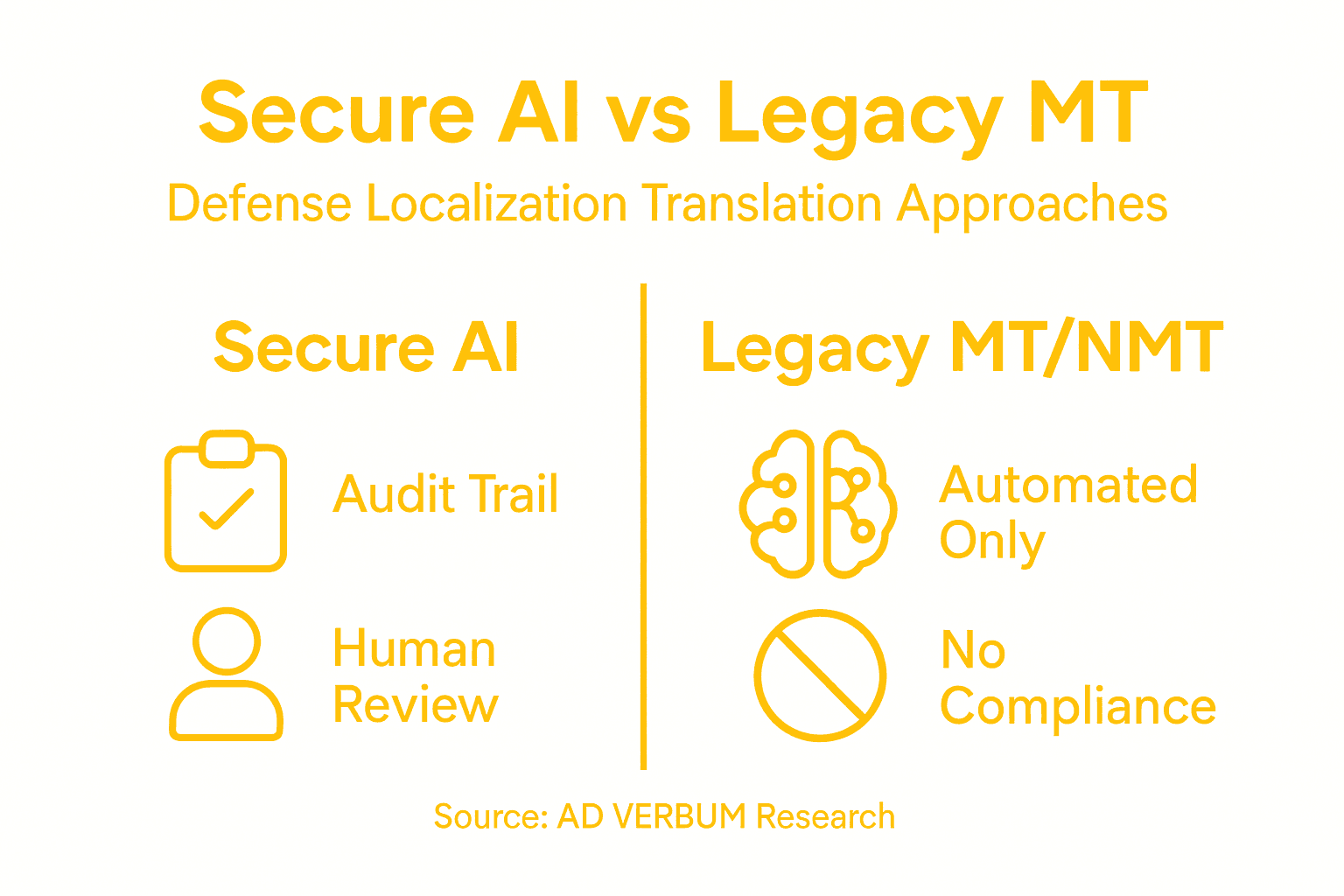
Below is a quick reference comparing secure AI translation and legacy technologies:
Capability | Secure AI Translation | MT / NMT (Legacy) |
Data Security | Integrated encryption | Basic or absent encryption |
Compliance Integration | Built-in audit features | Minimal regulatory controls |
Terminology Management | Real-time validation | Static or limited accuracy |
Error Detection | Automated oversight | Heavier manual review needed |
Secure AI translation transforms linguistic conversion from a mechanical process into a strategic, compliance-driven communication framework.
Pro tip: Implement comprehensive validation protocols that systematically compare AI translation outputs against domain-specific terminology repositories to ensure maximum linguistic and technical accuracy.
Elevate Your Defense Localization with Secure AI and Expert Human Oversight
Securing defense localization demands precision, strict compliance, and unwavering data protection. This article highlights key challenges such as terminology governance, regulatory frameworks like ITAR and EAR, and the inherent risks in AI translation technologies. At AD VERBUM, we understand these pain points and offer a proprietary AI-powered hybrid translation solution designed for highly regulated sectors, including defense.
Our Specialized AI Translation leverages a proprietary Language Operations System hosted on secure EU servers ensuring full data sovereignty and compliance with ISO 27001 and GDPR standards. By integrating your Translation Memories and Term Bases, our LLM-driven platform works seamlessly with certified subject-matter experts to provide the contextual accuracy and audit-ready quality essential for defense documentation. Whether navigating complex security regulations or demanding exact terminology control, AD VERBUM offers a 3x to 5x faster workflow that never compromises on compliance or security.
Secure your defense projects with AD VERBUM’s trusted AI+HUMAN hybrid translation approach that aligns with rigorous industry standards such as ISO 17100 and ISO 18587. Discover how our expert linguists and secure technology together mitigate translation risks and guarantee regulatory adherence. Visit https://adverbum.com today and take the next step toward resilient, precise defense localization.
Frequently Asked Questions
What is defense localization in SMEs?
Defense localization in small and medium-sized enterprises (SMEs) refers to the process of adapting defense technology development and communication to comply with regulatory standards while ensuring specialized solutions tailored to defense needs.
How does AI translation differ from legacy translation methods like MT and NMT?
AI translation utilizes advanced algorithms that offer contextual understanding and compliance integration, whereas legacy methods such as Machine Translation (MT) and Neural Machine Translation (NMT) primarily rely on rule-based or statistical approaches, resulting in limited contextual accuracy and higher error rates.
What are the security risks associated with AI translation in defense?
Security risks include potential breaches of data confidentiality, inaccurate translations of technical terminology, unintended bias, and inadequate cultural interpretation that could compromise operational security.
Why is human oversight critical in the translation process for defense sectors?
Human oversight is essential to ensure the precision of technical translations, validate compliance with regulations, and address contextual nuances that AI translation alone may not adequately capture, thereby maintaining operational integrity.
Recommended

