


Translation Technology Trends 2025: Why LLM Surpasses NMT

Most businesses face a growing challenge as translation technologies evolve at lightning speed. The move from basic systems to advanced Large Language Models brings both opportunity and complexity. Understanding what sets modern solutions apart can help you navigate the risks and rewards in this rapidly changing landscape.
Table of Contents
Key Takeaways
Point | Details |
Transformation to LLMs | Large Language Models (LLMs) are revolutionizing translation by providing enhanced contextual understanding and generative capabilities compared to traditional Neural Machine Translation (NMT). |
Precision in Specialized Fields | LLMs offer increased accuracy in legal, medical, and technical translations, enabling better comprehension of specialized terminology and nuanced meanings. |
Data Security Enhancements | LLMs utilize robust security protocols that ensure data protection and regulatory compliance, particularly important in sensitive industries like healthcare and finance. |
Mitigating NMT Risks | The AI+HUMAN workflow integrates human expert verification to address potential translation artifacts and inaccuracies inherent in NMT systems. |
Defining Translation Technologies in 2025
Translation technologies have undergone radical transformation, evolving from basic machine translation to sophisticated language models that promise unprecedented precision. The landscape of translation technologies in 2025 represents a critical inflection point where Large Language Models (LLMs) are fundamentally challenging traditional Neural Machine Translation (NMT) approaches.
At the core of this technological shift are fundamental differences in computational linguistics. Neural Machine Translation relies on statistical pattern matching between language pairs, while Large Language Models leverage deep contextual understanding and generative capabilities. Research indicates that LLMs can comprehend nuanced linguistic contexts far beyond NMT’s capabilities, enabling more accurate, contextually appropriate translations. As detailed in comparative linguistic studies, LLMs demonstrate superior performance across multiple dimensions:
Contextual Comprehension: Understanding semantic subtleties and cultural nuances
Generative Flexibility: Adapting translation style and tone dynamically
Cross-Linguistic Inference: Bridging conceptual gaps between languages more effectively
The implications for specialized industries are profound. In high-stakes sectors like legal, medical, and technical translation, LLMs offer unprecedented precision. AD VERBUM’s AI+HUMAN workflow leverages these technological advancements, ensuring translations that maintain not just literal meaning, but comprehensive communicative intent. By integrating subject matter expert verification with cutting-edge language models, the company transforms translation from a mechanical process into a nuanced, intelligent communication strategy.
LLM-Based AI Versus Traditional NMT
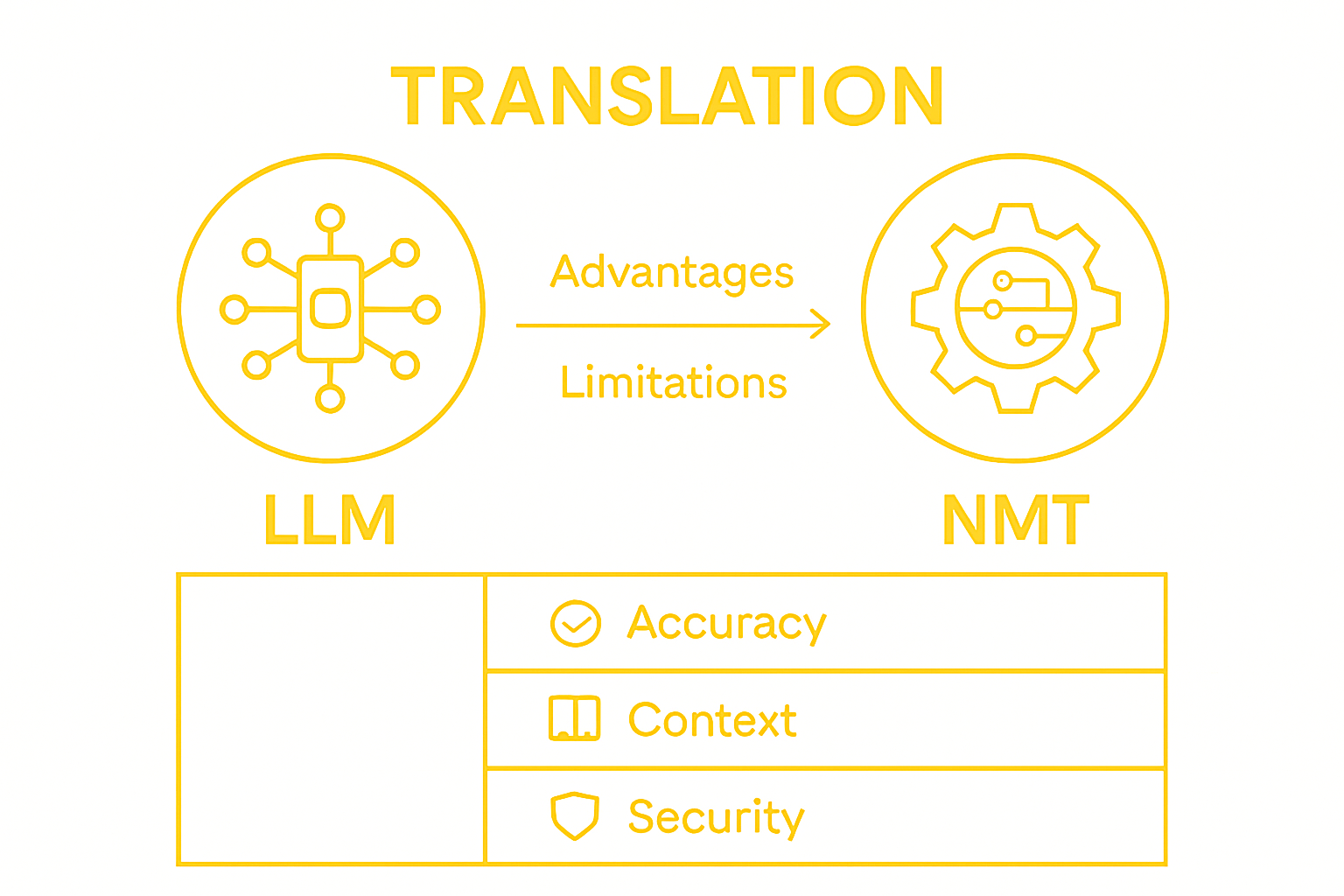
The translation technology landscape is experiencing a fundamental transformation, with Large Language Models (LLMs) challenging the traditional paradigms of Neural Machine Translation (NMT). Comparative linguistic research reveals critical distinctions between these two technological approaches, highlighting the emerging superiority of LLM-based systems in addressing complex translation challenges.
Traditional Neural Machine Translation operates through statistical pattern recognition, mapping direct linguistic equivalences between language pairs. In contrast, Large Language Models leverage deep contextual understanding, enabling more nuanced and contextually sophisticated translations. The key differentiators emerge in several critical domains:
Contextual Understanding: LLMs comprehend semantic subtleties beyond literal word-for-word translation
Generative Capabilities: Ability to reconstruct meaning rather than merely translating surface-level text
Adaptive Learning: Dynamic adjustment to linguistic and cultural nuances
Hybrid translation methodologies are emerging as a promising approach, combining the strengths of NMT and LLM technologies. AD VERBUM’s AI+HUMAN workflow exemplifies this advanced strategy, integrating cutting-edge language models with expert human verification. This approach transforms translation from a mechanical process to an intelligent, context-aware communication strategy, particularly crucial in specialized fields like legal, medical, and technical documentation where precision is paramount.
Ensuring Terminology and Contextual Precision
Precision in translation is not just about converting words, but capturing the intricate nuances of language and specialized domain knowledge. Recent linguistic research underscores the critical importance of maintaining precise terminology and contextual integrity across different translation technologies.

Terminology Management represents the core challenge in advanced translation systems. Traditional Neural Machine Translation (NMT) often struggles with domain-specific terminology, producing translations that lack technical accuracy. Large Language Models (LLMs), by contrast, demonstrate superior capabilities in understanding and preserving specialized vocabulary. This is particularly evident in technical and academic domains, where multilingual scientific translation requires extraordinary linguistic precision.
The key challenges in ensuring terminology accuracy involve multiple complex factors:
Domain-Specific Vocabulary: Maintaining precise technical terms
Contextual Semantic Mapping: Understanding nuanced meanings beyond literal translation
Cultural and Linguistic Adaptation: Preserving conceptual integrity across language barriers
AD VERBUM’s AI+HUMAN workflow addresses these challenges through a sophisticated approach that combines advanced LLM technology with human expert verification. By integrating subject matter experts who can validate and refine machine-generated translations, the company ensures that every translation maintains not just linguistic accuracy, but the precise conceptual and technical intent of the original document.
Data Security and Regulatory Compliance Impacts
In the rapidly evolving landscape of translation technologies, data security and regulatory compliance have emerged as critical considerations that fundamentally distinguish Large Language Models (LLMs) from traditional Neural Machine Translation (NMT) systems. Language technology research highlights the intricate challenges surrounding data protection and regulatory adherence in modern translation workflows.
Data Security represents a paramount concern for organizations operating in regulated industries such as healthcare, finance, and legal services. Traditional NMT systems often rely on public cloud infrastructures that introduce significant data vulnerability risks. In contrast, Large Language Models developed with rigorous security protocols offer a more robust approach to protecting sensitive information. Comparative analysis of machine translation technologies reveals several critical distinctions:
Data Sovereignty: Closed ecosystem preventing unauthorized data transmission
Compliance Frameworks: Strict adherence to GDPR, HIPAA, and industry-specific regulations
Controlled Access: Granular permission management for sensitive document handling
AD VERBUM’s AI+HUMAN workflow exemplifies advanced security standards by hosting translation technologies exclusively on private EU servers, ensuring maximum data protection. This approach not only mitigates potential compliance risks but also provides clients in highly regulated sectors with a translation solution that meets the most stringent international security requirements.
Industry Risks: Hidden Dangers of NMT
Neural Machine Translation (NMT) technologies harbor significant hidden risks that can compromise critical communication processes across industries. Comprehensive translation artifact analysis reveals systematic vulnerabilities that pose substantial challenges for organizations relying on traditional translation methodologies.
Translation Artifacts represent one of the most dangerous yet often overlooked risks in NMT systems. These technological glitches can fundamentally alter meaning, introducing subtle but catastrophic errors that may go unnoticed. Unlike Large Language Models (LLMs) which demonstrate contextual understanding, NMT frequently produces translations that contain:
Semantic Distortions: Unintended meaning shifts
Contextual Hallucinations: Fabricated information without source correlation
Terminological Inconsistencies: Unpredictable technical term translations
Emerging research on technological integration suggests that the fundamental architectural limitations of NMT create inherent risks impossible to fully mitigate. AD VERBUM’s AI+HUMAN workflow addresses these challenges by implementing rigorous human verification protocols, ensuring that every translation undergoes expert scrutiny to eliminate potential systemic errors that could compromise organizational communication integrity.
Elevate Your Translations with AD VERBUM’s Proven LLM Advantage
The article “Translation Technology Trends 2025: Why LLM Surpasses NMT” highlights the critical challenges companies face with traditional Neural Machine Translation including semantic distortions, terminology inconsistencies, and serious data security risks. When precision matters as much as compliance, relying on legacy NMT or public Machine Translation can put your legal, medical, or technical content at unacceptable risk. AD VERBUM’s proprietary LLM-based AI addresses these pain points head-on by combining advanced contextual language understanding with strict enforcement of terminology and zero data leakage through our secure EU-based infrastructure.
By deploying our unique AI+HUMAN workflow, AD VERBUM ensures every translation maintains regulatory compliance, protects sensitive data under GDPR and HIPAA, and is reviewed by over 3,500 subject matter experts. This integrated approach goes beyond basic AI or traditional NMT to deliver the highest level of accuracy and security available in today’s market.
Discover how your organization can eliminate translation risks and achieve unparalleled precision by partnering with AD VERBUM. Learn more about our specialized AI translation services and take the first step toward smarter, safer translations designed for regulated industries. Act now to safeguard your vital communication with technology built for tomorrow’s compliance challenges.
Frequently Asked Questions
What are the main differences between Large Language Models (LLMs) and Neural Machine Translation (NMT)?
Large Language Models (LLMs) provide deep contextual understanding and generative capabilities, allowing for more nuanced translations, while Neural Machine Translation (NMT) relies on statistical pattern matching and often struggles with semantic subtleties.
How do LLMs improve contextual comprehension in translation?
LLMs excel at understanding semantic nuances and cultural contexts, allowing them to produce translations that are not just literal, but also contextually appropriate and culturally relevant.
What advantages does the AI+HUMAN workflow offer in translation?
The AI+HUMAN workflow combines advanced LLM technology with expert human verification, ensuring translations that maintain linguistic accuracy as well as the precise conceptual intent of the original text, particularly in specialized fields.
Why is data security more robust in LLM-based systems compared to traditional NMT?
LLM-based systems often implement rigorous security protocols and operate within closed ecosystems, minimizing data vulnerability and ensuring compliance with industry regulations like GDPR and HIPAA, unlike traditional NMT which may rely on public cloud infrastructures.
Recommended
