


Clinical evaluation report translation: key scrutiny points by notified bodies 2026

Treating clinical evaluation report translation as a simple linguistic task is a costly mistake that jeopardizes both patient safety and regulatory approval. Translation errors in clinical endpoints, risk-benefit analyses, and device nomenclature create grounds for Major Non-Conformity findings during notified body reviews. Under EU Medical Device Regulation 2026, technical reviewers scrutinize translated clinical claims with the same rigor applied to original documentation, and imprecise language in these high-stakes documents directly impacts market clearance timelines and compliance outcomes.
Table of Contents
Key takeaways
Point | Details |
Certified translations mandatory | Certified translations are essential for CE marking to ensure compliance with EU safety directives under MDR 2026. |
Notified bodies assess accuracy | Technical reviewers evaluate linguistic precision, clinical data integrity, and consistency between original and translated reports. |
QMS integration required | Translation management processes and certified provider qualifications are scrutinized during audits. |
Language requirements vary | Each EU member state mandates specific official languages for clinical documentation and labeling materials. |
Translation errors drive non-compliance | Mistranslations contribute to approximately 10% of device-related errors in hospitals, impacting patient safety and regulatory outcomes. |
Why certified translations are essential for clinical evaluation reports
The Medical Device Regulation mandates translations of labels, instructions for use, and clinical documentation into official EU languages where devices are marketed. This requirement extends beyond administrative compliance to patient safety and clinical decision-making integrity. A certified translation includes a formal declaration certifying accuracy and completeness, creating legal accountability that generic translation lacks.
Accurate translation mitigates the risk of patient harm from device misuse caused by ambiguous instructions or misinterpreted safety warnings. When clinical evaluation reports contain imprecise translations of contraindications, adverse event data, or performance claims, healthcare professionals may make uninformed decisions that compromise patient outcomes. Regulatory authorities recognize this connection, which is why certified medical translations are required for CE marking under MDR.
Misunderstanding translation as purely linguistic neglects its regulatory and safety stakes. Clinical evaluation reports synthesize literature reviews, clinical trial data, and post-market surveillance findings to demonstrate device safety and performance. Each data point, clinical endpoint, and risk assessment must maintain identical meaning across languages to support valid conformity assessment. Translation errors in these sections create discrepancies that notified bodies flag as potential evidence manipulation or data integrity issues.
Certified translations support legal compliance and market access by meeting specific medical translation requirements that vary across jurisdictions. Without proper certification, manufacturers face market entry delays, repeat submissions, and increased scrutiny during subsequent audits. The certification process documents translator qualifications, quality assurance steps, and traceability, creating an audit trail that demonstrates due diligence.
Pro Tip: Plan translation workflows during technical documentation development, not after finalizing English versions. Early integration prevents market entry delays and allows terminology consistency across all regulatory submissions.
What notified bodies scrutinize in clinical evaluation report translations
Notified bodies focus on linguistic accuracy and technical correctness of medical terminology when reviewing translated clinical evaluation reports. Notified Bodies scrutinize translations to ensure accuracy, completeness, and consistency with the original language, focusing on impact on safety and performance. Technical reviewers compare translated clinical claims against source documents to identify meaning shifts, ambiguous phrasing, or terminology inconsistencies that could affect clinical interpretation.
Consistency between original and translated reports is critical for clinical data integrity. When a clinical endpoint appears as “device-related adverse events” in English but translates inconsistently across French, German, and Spanish versions, reviewers question whether the data represents identical patient populations and outcomes. This scrutiny extends to statistical analyses, where mistranslated confidence intervals or p-values can misrepresent clinical significance.
Verification that translations support informed clinical decisions and patient safety drives notified body assessment priorities. Notified Bodies assess translation quality to ensure patient safety and regulatory compliance, focusing on accuracy of instructions for use, labeling, and marketing materials. Reviewers evaluate whether translated safety warnings maintain the urgency and clarity of source text, and whether contraindications are rendered with precision that prevents misinterpretation.
Assessment of translation management in your Quality Management System reveals whether you treat translation as a controlled process or an outsourced task. Auditors examine documented translator qualifications, quality assurance procedures, and change control processes for translated documents. Companies without formal translation procedures in their QMS face findings related to inadequate process control, even when translations are technically accurate.

Requirement for documented translator qualifications and quality assurance processes creates accountability similar to other regulated activities. Notified bodies expect evidence that translators possess subject matter expertise in medical devices, not just linguistic competence. This includes certifications like ISO 17100 for translation services and ISO 13485 for medical device quality management, demonstrating that translation providers understand regulatory context.
Common pitfalls include:
Mistranslation of safety information that dilutes warning severity or creates ambiguous contraindications
Lack of adaptation to target audience reading levels and clinical practice norms in different markets
Document inconsistencies between clinical evaluation reports and related technical documentation like risk management files
Missing or incomplete translation certificates that fail to document translator credentials and project metadata
Pro Tip: Maintain translation certificates with detailed metadata including translator qualifications, quality assurance steps, and version control information. This documentation becomes critical evidence during notified body audits and demonstrates systematic process control.
Understanding MDR technical documentation translation requirements and compliance requirements for medical translation helps manufacturers anticipate scrutiny areas and build robust processes that withstand audit review.
Navigating language requirements across EU member states
Each EU country mandates different official languages for labeling and clinical documents, creating a complex compliance landscape that manufacturers must navigate strategically. The European Commission published Revision 3 summarizing language requirements, clarifying Romania and Portugal specifics that often confuse manufacturers planning market entry.
Romania permits English only with prior authorization from national authorities, a nuance that catches manufacturers off guard when they assume English suffices across all EU markets. This authorization process adds time to market entry timelines and requires advance planning to avoid delays. Without understanding this requirement, companies may submit documentation that regulatory authorities reject for language non-compliance.
Portugal mandates Portuguese but allows English for professional-only documents, creating a two-tier approach based on end user type. Devices intended for home use require full Portuguese translation of all patient-facing materials, while professional-use devices may maintain English technical documentation with Portuguese labeling. Misclassifying device user type leads to incomplete translation scope and compliance gaps.
Failure to meet local language mandates can delay market entry or cause non-compliance findings that trigger corrective action requests. These delays carry financial consequences beyond translation costs, including lost revenue during market exclusion periods and competitive disadvantage when rivals enter markets first. Regulatory authorities view language non-compliance as a failure to meet basic safety requirements, not a minor administrative oversight.
Country | Official Language(s) | Clinical Document Requirement | Special Conditions |
Germany | German | Full translation required | Technical documentation may include English with German summary |
France | French | Full translation required | No exceptions for professional devices |
Spain | Spanish | Full translation required | Regional languages may apply in specific territories |
Romania | Romanian | Full translation or prior authorization for English | Authorization process adds 30-60 days to timeline |
Portugal | Portuguese | Full translation for consumer devices | Professional-use devices may use English technical docs |
Early and specific language planning is essential to meet all member state requirements without redundant translation efforts. Manufacturers should map target markets against language requirements during product development, not after technical documentation is finalized. This forward planning allows terminology standardization across languages and prevents costly rework when translations reveal inconsistencies in source documentation.
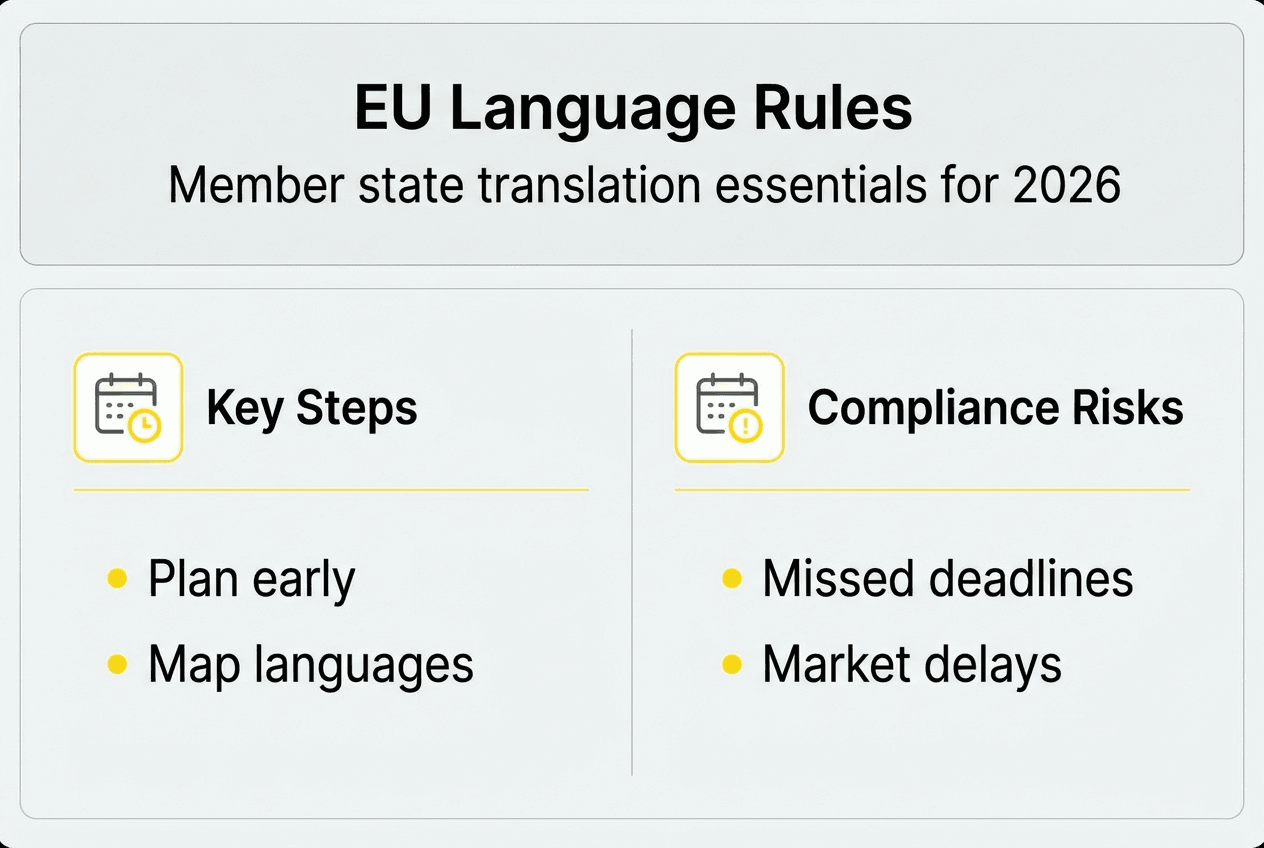
Translation timelines should align with regulatory deadlines to avoid blocking device sales in key markets. A phased approach that prioritizes high-value markets while preparing translations for secondary markets maintains momentum and revenue generation. Understanding EU MDR EUDAMED 2026 compliance timelines helps synchronize translation delivery with submission windows.
Best practices to ensure translation compliance and pass notified body scrutiny
Use qualified translators with certifications like ISO 17100 and ISO 13485 to demonstrate competence in both translation methodology and medical device regulatory requirements. These certifications signal that translators understand quality management principles and apply systematic approaches to terminology control, not just linguistic conversion. External professional translation services with recognized certifications are favored by notified bodies during audit reviews.
Integrate detailed translation procedures in your Quality Management System to establish translation as a controlled process subject to the same rigor as design controls or risk management. Document translator selection criteria, quality assurance steps, terminology management protocols, and change control processes for translated documents. This integration demonstrates that translation receives appropriate oversight and resources.
Obtain and keep translation certificates detailing translator information and project metadata for every translated document. These certificates should include translator qualifications, language pairs, quality assurance methods, completion dates, and version control references. During audits, this documentation proves that translations were executed by competent personnel using controlled processes.
Choose certified translation providers experienced in medical device regulations who understand the clinical and technical context of your documentation. Generic translation agencies lack the subject matter expertise to recognize when terminology choices affect clinical meaning or regulatory interpretation. Specialized providers bring medical professionals, engineers, and regulatory experts into translation teams, ensuring technical accuracy alongside linguistic precision.
Regularly audit translated documents for consistency and accuracy across all language versions and related technical documentation. Spot-check translations against source documents, verify terminology alignment with approved term bases, and confirm that updates to source documents trigger corresponding translation updates. Over 60% of regulatory failures in EU pharma trace back to unclear translation requirements and data security issues.
Certification | What It Certifies | Relevance to Clinical Evaluation Reports |
ISO 17100 | Translation service quality management | Systematic translation processes and qualified personnel |
ISO 13485 | Medical device quality management | Understanding of regulatory context and device-specific requirements |
ISO 18587 | Post-editing of machine translation output | Quality control when AI translation tools are used |
ISO 27001 | Information security management | Data protection for confidential clinical and technical information |
Pro Tip: Train internal staff to detect common translation errors and flag inconsistencies early in review cycles. Quality assurance professionals who understand basic translation quality indicators can identify issues before submissions reach notified bodies, reducing costly revision cycles.
Recognize translation as strategic risk mitigation, not just a linguistic task. Translation quality directly affects patient safety, regulatory compliance, and market access timelines. Companies that integrate translation into their risk management processes identify translation-related hazards and implement controls that prevent errors from reaching patients or regulators.
Implementing translation compliance best practices and following a regulated document translation workflow creates systematic approaches that scale across product portfolios and geographic markets.
Partner with expert medical translation services for MDR compliance
Navigating clinical evaluation report translation requirements demands specialized expertise that combines medical knowledge, regulatory understanding, and linguistic precision. Professional certified translation services reduce compliance risk by applying systematic quality controls and subject matter expert review to every translation project. These specialists understand which clinical evaluation report sections generate the highest translation risk and how technical reviewers identify ambiguity in regulatory submissions.
Leveraging specialists familiar with EU MDR translation requirements accelerates market entry by avoiding common pitfalls that trigger non-conformity findings. These providers maintain networks of medical professionals, regulatory affairs experts, and certified linguists who bring domain expertise to translation projects. Their familiarity with notified body expectations ensures translations meet scrutiny standards from initial submission.
Benefit from comprehensive localization and multilingual SEO capabilities that extend beyond clinical evaluation reports to all market-facing content. Consistent terminology across regulatory submissions, marketing materials, and digital presence strengthens brand credibility and supports cohesive market positioning. Streamline audit readiness with traceable and certified translation services that document every quality control step and maintain version control across language variants.
FAQ
What languages must clinical evaluation reports be translated into under EU MDR?
Translation languages depend on target EU member states where you intend to market the device. Manufacturers must provide documentation in official languages required by each EU member state where the device is sold. Refer to the European Commission Revision 3 tables for specific country guidance, noting special conditions for Romania and Portugal. Plan translations during product development to align with market entry timelines.
How do notified bodies verify translation quality during audits?
Notified bodies review documentation consistency between original and translated versions, looking for meaning shifts or terminology inconsistencies. They evaluate translation management integration in your company Quality Management System, including documented procedures and change controls. Notified bodies assess translation quality focusing on accuracy, completeness, and QMS integration including translator qualifications and certifications. Verification includes examining translation certificates for translator credentials and project metadata.
What are the risks of poorly translated clinical evaluation reports?
Poorly translated reports increase the risk of device misuse and patient harm when healthcare professionals misinterpret safety warnings or contraindications. They create higher likelihood of non-conformity findings and regulatory rejection during notified body reviews. Mistranslations contribute to approximately 10% of device-related errors in hospitals, impacting patient safety and regulatory compliance. Financial consequences include market entry delays, repeat submission costs, and potential penalties for non-compliance.
What qualifications should translators of clinical evaluation reports possess?
Translators should hold certifications like ISO 17100 for translation services and demonstrate subject matter expertise in medical devices or clinical research. Medical professional backgrounds, such as physicians, nurses, or clinical researchers with translation training, provide ideal combinations of clinical knowledge and linguistic skill. Certification in ISO 13485 medical device quality management indicates understanding of regulatory context. Verify that translation providers maintain documented translator qualification records available for audit review.
How can manufacturers streamline translation workflows for multiple EU markets?
Establish centralized terminology management using translation memories and term bases that enforce consistent terminology across all language pairs. Plan translations during technical documentation development rather than after English finalization to identify and resolve inconsistencies early. Prioritize high-value markets for initial translation while preparing secondary market translations in parallel. Implement change control processes that automatically trigger translation updates when source documents are revised, maintaining version alignment across languages.
Recommended