


How to prepare a multilingual bid for an EU defense tender
- 7 hours ago
- 9 min read
Preparing a multilingual bid for an EU defense tender is one of the most procedurally demanding tasks in international procurement. You are not simply translating documents. You are producing a legally binding, technically precise package that must satisfy national language mandates, Directive 2009/81/EC, dual-use export controls, and classified data handling requirements, all while keeping terminology consistent across consortium partners and meeting submission deadlines. Most EU defense tenders require bids in the official national language of the contracting member state, and every section, from executive summary to technical annex, must hold up to scrutiny.
Table of Contents
Preparing multilingual documentation: managing legal, technical, and consortium translations
Ensuring compliance with EU Dual-Use Regulation and classified data handling
Common mistakes, risk mitigation, and quality assurance in multilingual EU defense bids
Why AI+HUMAN hybrid translation with certified providers is non-negotiable
How AD VERBUM supports your multilingual EU defense tender preparation
Key Takeaways
Point | Details |
National language compliance | EU defense bids must be submitted in the official national language due to procurement document restrictions. |
Professional translation required | Machine translation alone is inadequate; AI+HUMAN hybrid or professional human translation ensures legal and technical accuracy. |
Strict dual-use compliance | Regulation 2021/821 enforces export licenses and controls on technical data throughout bid processes. |
Security clearances essential | Personnel and facility security clearances are required to handle classified bid information in defense tenders. |
Certified translation provider benefits | Providers with ISO 17100 and ISO 27001 certifications help manage compliance, quality, and data security risks effectively. |
How do you prepare a multilingual bid for an EU defense tender: understanding language requirements and regulatory context
The legal foundation matters before a single document goes to translation. EU defense procurement operates under Directive 2009/81/EC, which governs the award of contracts in the fields of defense and security. Unlike standard commercial tenders, defense tenders frequently use restricted procedures, meaning your bid must meet formal pre-qualification criteria before you are even invited to submit. Security requirements, including facility clearances and personnel vetting, can apply from the pre-qualification stage onward.
On language specifically, the rule is simple and unforgiving: bids must be submitted in the official national language of the member state running the tender. The Tenders Electronic Daily (TED) portal publishes summary notices in multiple EU languages, which can give a false sense that the full documentation is similarly multilingual. It is not. The full solicitation, technical specifications, evaluation criteria, and contractual terms appear only in the national language. If your team is reading a translated summary to understand scope, you are already one degree removed from the authoritative source.
A few practical realities to map before you start:
Germany, France, Poland, Italy, Spain: Full bid submission in the national language, no exceptions for the formal record.
Netherlands, Sweden, Finland: Greater tolerance for English alongside the national language in some technical annexes, but never as a replacement for the primary submission.
NATO framework contracts: English or French are common working languages, which reduces the translation burden for initial pre-qualification but not for final award documentation.
Understanding jurisdiction-specific translation compliance in the target country should be the first task on your bid kickoff checklist, not an afterthought handled the week before submission.
Pro Tip: Request the full procurement dossier in the original national language immediately when the tender notice appears. Do not wait for a translated summary. Every day of delay compresses your translation timeline.
Preparing multilingual documentation: managing legal, technical, and consortium translations
With the regulatory and language foundations clarified, the documentation preparation phase is where most bids are won or lost. A defense bid package typically includes legal and corporate qualification documents, financial statements, technical proposals, declarations of conformity, and certifications. Each category carries different translation risks.
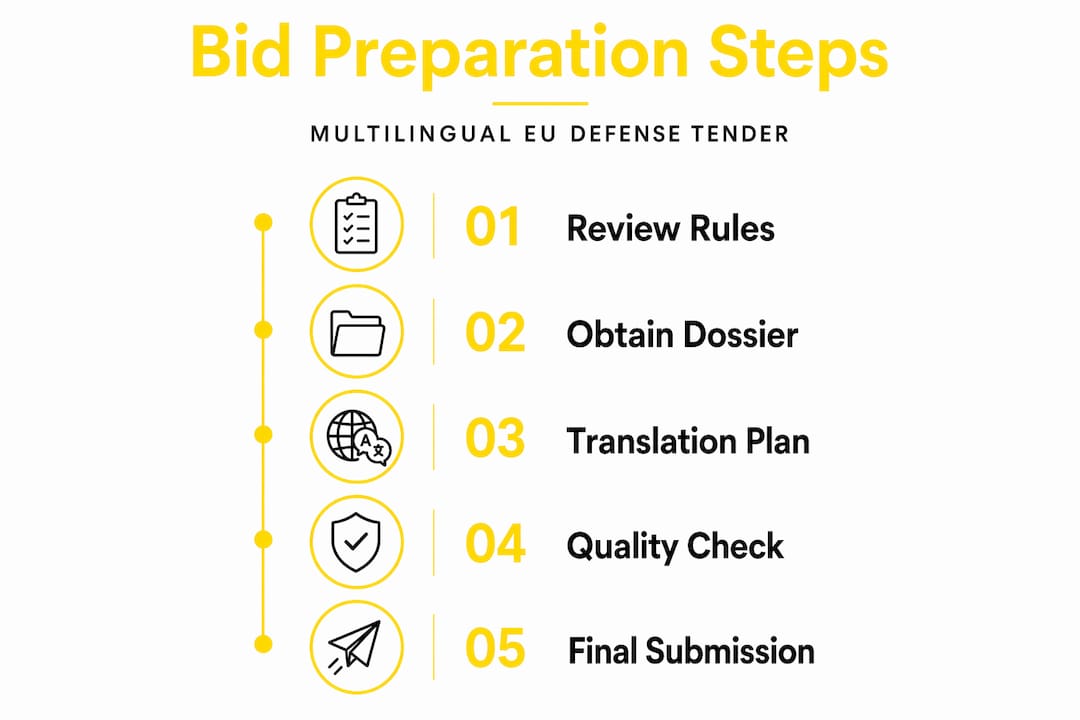
The recommended workflow for a compliant multilingual bid package:
Audit your source documents. List every document required by the solicitation and identify the original language of each. Certificates issued in your home jurisdiction will need certified translation and, in some cases, an apostille.
Establish a master glossary. Before any translation begins, compile a term base (TB) covering all program-specific terminology, acronyms, and system names. In a consortium, this is non-negotiable. A term translated differently by two partners in the same bid becomes an evaluation risk.
Assign document categories. Separate legal and commercial documents from highly technical sections such as system architecture descriptions, interface control documents, or maintenance specifications. Each category requires different translator expertise.
Commission translations with appropriate subject-matter expertise. Professional human translation is essential for EU defense bids. A linguist who handles general commercial contracts cannot reliably translate a radar system specification or a software requirements document for a command and control platform.
Reconcile consortium contributions. If three partners are each translating their own sections, terminology drift is nearly inevitable without a shared TB and a single quality review pass over the complete package.
Country-specific certification requirements add another layer. For example, Italian tenders above €150,000 require equivalent certifications under Legislative Decree No. 36/2023, such as Italy’s SOA qualification system, with translated documentation proving equivalence. You cannot simply submit your home country certification and expect it to be accepted at face value.
Translation approach | Terminology control | Defense suitability | Data governance |
Legacy machine translation (MT) | None | Not suitable | Uncontrolled |
Neural machine translation (NMT, public SaaS) | Inconsistent | High risk | Variable |
AI+HUMAN hybrid (proprietary LLM + SME review) | Enforced via TB | Suitable with ISO QA | EU-hosted, auditable |

Before selecting a translation partner, work through a structured translation vendor checklist and consult resources specifically focused on best translation partners for NATO and EU defense documentation.
Pro Tip: Build the term base before you brief your translators, not after. Retroactively fixing terminology inconsistencies across a 300-page bid package is an order of magnitude more expensive than preventing them.
Ensuring compliance with EU Dual-Use Regulation and classified data handling
Documentation preparation and regulatory compliance with data handling are not separate workstreams. They must run in parallel.
Regulation (EU) 2021/821 requires export licenses for dual-use goods and technology, imposing strict obligations on any transfer of controlled technical information, including to translation service providers.
This is the part of multilingual bid preparation that many teams underestimate. The moment you hand a technical specification covering a dual-use system to a translation vendor, you may be executing a deemed export. If that vendor processes the document outside the EU, uses cloud infrastructure in a non-authorized jurisdiction, or lacks the appropriate security controls, you could be in violation of export control obligations before your bid is even submitted.
Key compliance requirements in this phase:
Verify security clearances early. Security clearances for personnel and facilities are mandatory before classified defense contract award. If your translation provider or consortium partner lacks the required Personnel Security Clearance (PSC) or Facility Security Clearance (FSC), they cannot legally access classified technical content.
Map your data flows. Document exactly where bid data travels: which systems process it, in which country, under what governance framework.
Implement access controls. Use role-based access on all shared document repositories. Limit classified annex access to cleared personnel only, including on your own team.
Require written confidentiality and security agreements from all translation vendors. This is a minimum. For classified content, contractual controls alone are not sufficient without technical controls.
Audit trails matter. Maintain logs of who accessed which document version and when. This is not bureaucratic overhead; it is your defense if a compliance question arises during contract award or audit.
For a detailed view of the risks involved in sharing controlled technical data with language service providers, the EU technical data compliance framework and guidance on sharing defense data with LSPs under EU export law are essential references for bid managers.
Common mistakes, risk mitigation, and quality assurance in multilingual EU defense bids
Understanding where bids fail is as useful as knowing how to build them correctly. The most common failure points are not exotic. They are predictable and preventable.
Translation-related disqualification triggers:
Submitting a machine-translated bid without professional review. Evaluators in procurement-experienced member states flag this immediately, often before the technical evaluation begins.
Inconsistent terminology between sections written by different consortium partners, which signals poor coordination and undermines evaluator confidence.
Missing certified translations for corporate qualification documents, which creates a formal grounds for rejection.
Using translated versions of the tender specification as your working reference instead of the authoritative original.
Security and compliance failures:
Sending controlled technical annexes to translation providers without verifying their data handling posture and applicable clearances.
Version control failures that result in submitting an earlier draft of a translated section.
No audit trail for document access during bid preparation, which becomes a problem if a compliance review is triggered.
Compliance failures can lead to contract termination, financial penalties, and lasting reputational damage. In defense markets, where relationships and track records carry significant weight, a compliance-related disqualification can affect your ability to bid on future contracts with the same contracting authority.
Mitigation practices that consistently reduce risk:
Vet every translator and translation vendor before engagement, using a formal process that covers subject-matter expertise, security posture, and confidentiality controls. A structured approach to vetting linguists for compliance should be a standard part of your supplier onboarding.
Implement a final quality review pass over the complete translated package, not just individual sections.
Use version management on all documents from day one, with clear naming conventions that include language, version number, and date.
Train your bid team on the specific regulatory and language requirements of the target jurisdiction. A proposal coordinator who understands why Italy’s SOA equivalence rules apply will catch a missing document before it becomes a rejection reason.
Pro Tip: Run a pre-submission compliance checklist at least five business days before the deadline. This gives you time to fix errors that a last-minute check would surface too late to address. Document this check as part of your bid process audit trail.
For a repeatable framework, the translation compliance best practices guide covers quality control structures applicable to defense bid workflows.
Why AI+HUMAN hybrid translation with certified providers is non-negotiable
Here is an opinion grounded in 25 years of working with regulated, high-stakes documentation: the debate about whether AI can replace human translators in defense procurement is already over, and the answer is not what either side expected.
Pure machine translation, whether legacy MT or consumer-grade neural machine translation tools, fails in this context not because AI is inherently unreliable, but because those tools were not built for the governance requirements of EU defense procurement. They cannot enforce your term base. They cannot hold document-level context across a 200-page technical proposal. Most critically, they process data in ways that create real export control exposure when your content is controlled under Regulation 2021/821.
But equally, the assumption that maximum human involvement equals maximum quality is wrong. A human translator working without terminology governance, without document-level context tools, and under a three-week deadline on a 400-page bid package will produce inconsistencies. Volume and complexity defeat even experienced translators working in isolation.
The answer is an AI+HUMAN hybrid workflow built specifically for regulated content. In practice, this means ingesting client Translation Memories and Term Bases before a single word is translated, using a proprietary LLM-based system to produce terminology-constrained output, having a certified subject-matter expert review for technical accuracy and regulatory compliance, and completing a final QA pass aligned to ISO 17100 and ISO 18587. That sequence produces consistency that neither pure MT nor unassisted human translation can match at bid scale.
ISO 17100 certification is the quality baseline for professional translation. ISO 27001 certification is the security baseline for handling sensitive and controlled data. AQAP 2110, which governs quality management systems for defense suppliers, is the defense-sector-specific framework that aligns translation quality assurance with the broader defense industry standard. A provider holding or working toward all three is not just a vendor; they are a compliance partner.
If you are building a compliance-grade translation RFP for your defense bid program, those three certifications should appear as mandatory requirements, not evaluation bonus points.
How AD VERBUM supports your multilingual EU defense tender preparation
Multilingual EU defense bids demand more than translation capacity. They require a partner who understands procurement law, export controls, and consortium terminology governance in the same conversation.
AD VERBUM’s AI+HUMAN hybrid translation workflow is built for exactly this environment. Documents are processed through a proprietary LangOps System hosted on EU servers, with no reliance on public cloud infrastructure for core processing. ISO 27001 certification and AQAP 2110 alignment mean your data handling meets the security and quality baseline that defense procurement demands. With 3,500+ subject-matter expert linguists covering 150+ languages, including engineers and legal specialists with defense sector experience, AD VERBUM handles the full bid package: legal qualification documents, technical proposals, certification equivalence packages, and consortium terminology management. Explore AD VERBUM’s localization services and the full range of AD VERBUM services to find the right fit for your next EU defense bid.
Frequently asked questions
What languages must be used for submitting EU defense tender bids?
Bids generally must be submitted in the official national language of the member state running the tender, since full procurement documents are published only in that language. TED portal summaries appear in other EU languages but carry no official submission weight.
Can machine translation be used alone for EU defense bids?
No. Machine translation alone is insufficient for the legal and technical accuracy these bids require. An AI+HUMAN hybrid approach with certified subject-matter expert review is the appropriate standard for defense procurement documentation.
What security clearances are required for classified defense tenders?
Personnel Security Clearances and Facility Security Clearances are both mandatory before classified defense contracts can be awarded. These requirements extend to any partner or service provider who will access classified bid content, including translation vendors.
How does EU Dual-Use Regulation affect bid preparation?
Regulation (EU) 2021/821 requires export licenses for dual-use goods and technology, which means sharing controlled technical documentation with a translation provider can constitute a regulated transfer. Translation partners must operate within an EU-hosted, access-controlled environment to remain compliant.
Recommended