


How EU defense tendering works: a guide for bid managers

EU defense procurement is one of the most opaque markets in the world. If you have searched for open defense tenders in the EU and found almost nothing on the Tenders Electronic Daily (TED) portal, that is not a glitch. Only about 10% of EU defense procurement is published there, with the rest awarded through national channels, direct negotiations, or classified procedures that never see a public portal. For bid managers and business development professionals entering this space for the first time, understanding how defense tendering actually works in the EU means learning a multi-layer system of legal frameworks, national exemptions, and collaborative programs that operates very differently from civilian public procurement.
Table of Contents
How does defense tendering actually work in the EU: the legal foundation
Typical stages of bidding and procedural rules under Directive 2009/81/EC
Navigating national vs. multinational tenders: EDA, OCCAR, EDF, and PESCO roles
Multilingual and cross-border collaboration challenges in EU defense bids
The often overlooked challenges and strategic implications of EU defense tendering
Key Takeaways
Point | Details |
EU defense procurement complexity | A mix of EU directives, national exemptions, and collaborative programs governs defense tendering, making entry challenging for newcomers. |
Tender visibility is limited | Only about 10% of EU defense procurement is published on TED due to exemptions for sensitive contracts and national security concerns. |
Restricted procedures dominate | Pre-qualification and restricted tender processes with long timelines are standard, requiring early and thorough preparation. |
Security clearances are crucial | Facility and personnel security clearances, taking up to 18 months, must be obtained with sponsorship prior to classified contract awards. |
Collaborative programs expand opportunities | EDA, OCCAR, EDF, and PESCO provide frameworks for joint procurement and R&D funding, facilitating cross-border and multinational contracts. |
How does defense tendering actually work in the EU: the legal foundation
The starting point is Directive 2009/81/EC, the EU’s dedicated legal framework for defense and security procurement. It sets rules that differ substantially from the standard public procurement directive. The core difference is that defense procurement acknowledges security interests explicitly, which means contracting authorities have more flexibility to restrict competition, impose security requirements, and limit publication.
On top of that, Article 346 of the Treaty on the Functioning of the European Union (TFEU) allows any member state to exempt a contract entirely from EU procurement rules if it considers disclosure would harm its essential security interests. In practice, this exemption is used frequently, which is why the TED portal shows only a fraction of actual defense spending.
Beyond national frameworks, several EU-level institutions shape how defense contracts are structured and awarded:
European Defence Agency (EDA): Coordinates collaborative procurement programs across member states and manages capability development initiatives.
European Defence Fund (EDF): Funds research and development consortia, with an €8 billion budget for 2021 to 2027, creating follow-on procurement opportunities.
Organisation for Joint Armament Cooperation (OCCAR): Manages specific multinational acquisition programs like the A400M transport aircraft and TIGER helicopter.
Permanent Structured Cooperation (PESCO): Enables a group of committed member states to jointly develop and procure defense capabilities.
Understanding this EU defense procurement legal framework is not optional. It determines which procedure applies to a given contract, what documentation you need, and whether a tender will appear on a public portal at all.
Who buys and where to find defense tenders in the EU
The primary buyers in EU defense procurement are national defense ministries and their specialized acquisition agencies. Germany’s Federal Office of Bundeswehr Equipment, Information Technology and In-Service Support (BAAINBw), France’s Direction Générale de l’Armement (DGA), and Italy’s Segretariato Generale della Difesa are examples of the agencies that award multimillion-euro projects, often without TED publication.
For tenders that do appear publicly, the main sources are:
TED (Tenders Electronic Daily): The EU’s official portal for above-threshold public contracts. Use the CPV (Common Procurement Vocabulary) codes in the 35000000 range to filter for defense-related notices.
National procurement portals: Each member state runs its own portal. France uses PLACE, Germany uses DTVP and the Vergabemarktplatz, and Poland uses the Public Procurement Bulletin. These portals often carry defense notices that never reach TED.
EDA tender portal: Lists calls for proposals under EDA-managed collaborative programs.
EDF calls for proposals: Published by the European Commission, these fund research and development consortia.
OCCAR program offices: Publish tender notices for specific joint programs directly.
The hard truth is that only about 10% of defense procurement reaches TED. Relying on a single portal will cause you to miss the overwhelming majority of opportunities. You need a monitoring strategy that covers national portals, agency websites, and EU-level program offices simultaneously.
Pro Tip: Set up automated alerts on TED using CPV codes 35100000 to 35999000 (defense equipment and systems) and 72000000 (IT services, relevant for defense IT contracts). Combine this with direct subscriptions to the EDA and EDF newsletter feeds to catch collaborative program calls early.
Understanding where EU defense tender publication portals fit into your opportunity pipeline is the difference between a reactive and a proactive market entry strategy.
Typical stages of bidding and procedural rules under Directive 2009/81/EC
The EU defense bidding process under Directive 2009/81/EC uses the restricted procedure as its default, not the open procedure common in civilian procurement. This is a critical distinction for newcomers.
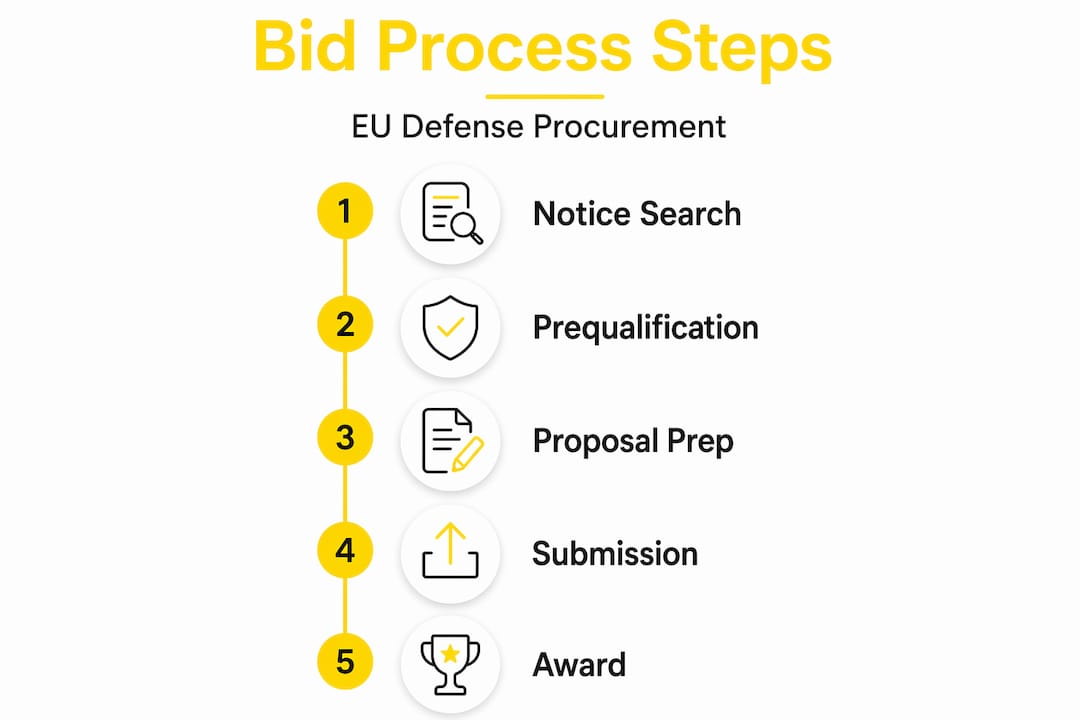
Here is how the typical bid sequence unfolds:
Prior Information Notice (PIN) or Contract Notice: The contracting authority announces the upcoming procurement. This is your earliest signal and often the best moment to start preparing.
Pre-qualification questionnaire (PQQ): Suppliers submit company credentials, financial standing, technical capacity, and security clearance status. The authority shortlists a minimum of five suppliers.
Invitation to Tender (ITT) or Request for Proposal (RFP): Shortlisted suppliers receive the full specification and are invited to submit a formal bid.
Evaluation and clarification: The authority evaluates bids against published award criteria, which typically include technical merit, price, and security compliance. Clarification rounds may follow.
Contract award and standstill period: The authority notifies all bidders of the outcome. A mandatory standstill period (usually 15 days) allows unsuccessful bidders to challenge the decision before the contract is signed.
Contract execution and reporting: Performance, quality, and security obligations continue throughout the contract lifecycle, often with NATO or EU audit rights.
Restricted procedures with a pre-qualified shortlist of at least five suppliers and a total timeline of 6 to 12 months are standard. Plan your resource allocation accordingly. A bid submitted six months into a process you discovered at step three is rarely competitive.
Classified contracts add another layer entirely. These require a Facility Security Clearance (FSC) for your company and Personnel Security Clearances (PSC) for individuals who will access classified information. Security clearances take 3 to 18 months and must be sponsored by the contracting authority, not self-initiated.
A clearance cannot be obtained speculatively. If a classified tender appears and you do not already hold an FSC, you are effectively disqualified before you start. The clearance process must begin well before a specific contract opportunity arises.
Pro Tip: Contact the relevant national security authority (NSA) in your country early. In Germany this is the BSI, in France the SGDSN. Ask about the FSC application process even before a specific contract is in scope. The security clearance process for EU defense bids is a long-lead item that cannot be compressed once a tender deadline is set.
Navigating national vs. multinational tenders: EDA, OCCAR, EDF, and PESCO roles
Not all EU defense procurement works the same way. The channel you pursue shapes your bid strategy, consortium requirements, and documentation obligations significantly.
Framework | Who manages it | Typical contract type | Cross-border requirement | Budget scale |
National MoD tender | National ministry or agency | Platform, service, or support | No | Variable |
EDA collaborative program | European Defence Agency | Capability development | Yes (member states) | Medium to large |
OCCAR program | OCCAR program office | Major platform acquisition | Yes (participating nations) | Large |
EDF call for proposals | European Commission | R&D consortia | Yes (min. 3 EU states) | Up to €100M per call |
PESCO project | Lead member state | Joint capability development | Yes (PESCO members) | Variable |
Key points about each channel:
National tenders account for the majority of defense spending but carry high domestic award rates. Entering as a subcontractor to a national prime is often a more realistic first step than bidding as a prime contractor.
EDA acts as a coordinator for collaborative projects, with a target of increasing collaborative spending to 40% by 2030. EDA programs are more open to non-domestic suppliers than national tenders.
OCCAR runs specific long-term programs. Entry points are limited but subcontracting opportunities exist throughout the program lifecycle.
EDF funds R&D consortia with an €8 billion budget for 2021 to 2027. EDF grants require at least three entities from at least three different EU member states. Winning an EDF grant positions your consortium well for follow-on procurement.
PESCO projects are jointly developed by participating member states, with industrial participation typically tied to those nations.
For newcomers, EDF calls and EDA collaborative programs are often the most accessible entry points because they explicitly require cross-border participation, which levels the domestic preference playing field. More detail on multinational EU defense programs is worth reviewing before you decide which channel to prioritize.
Multilingual and cross-border collaboration challenges in EU defense bids
Cross-border consortia are not just a legal structure. They are an operational reality that creates immediate documentation and communication challenges. When a French prime, a Polish subcontractor, and a Spanish SME form a consortium for an EDF call, every technical specification, compliance declaration, quality plan, and contractual document must be accurate across multiple languages and jurisdictions.
The compliance baseline for defense documentation is not the same as for commercial translation. Cross-border consortia must manage multilingual documentation and comply with ISO 17100 and AQAP 2110 standards to meet security and quality requirements.
What this means in practice:
ISO 17100 governs the translation process itself, requiring qualified translators, revision by a second linguist, and documented quality controls. A contracting authority can and does reject documentation that cannot demonstrate ISO 17100-compliant production.
AQAP 2110 (Allied Quality Assurance Publication) is the NATO standard for quality management in defense supply chains. It applies to documentation produced as part of a defense contract, not just to physical products.
Terminology consistency across all bid documents is a legal and technical requirement, not a style preference. A mistranslated specification or an inconsistent use of a technical term in a safety-critical document can constitute a material error that invalidates a bid.
Data sovereignty matters for classified or sensitive documents. Routing defense documentation through public cloud translation tools creates governance and security risks that contracting authorities will scrutinize.
Pro Tip: Establish a project-specific Term Base (TB) and Translation Memory ™ before the first document goes to translation. These assets enforce terminology consistency across all languages and all documents throughout the bid lifecycle, and they carry forward into contract execution if you win.
AD VERBUM’s AI+HUMAN hybrid translation workflow addresses these requirements directly. The process starts with ingesting your existing TM and TB assets, then applies the proprietary LLM-based LangOps System to generate target language output constrained by your terminology and style guidance. A certified subject-matter expert then reviews for technical accuracy and regulatory compliance, followed by QA aligned to ISO 17100 and ISO 18587. All processing runs on EU-hosted private infrastructure with ISO 27001 certification, which satisfies the data sovereignty requirements that defense contracts impose. For multilingual challenges in EU defense bids, this is the standard of control that regulated documentation demands.
The often overlooked challenges and strategic implications of EU defense tendering
Here is what the official guides do not tell you: Directive 2009/81/EC exists to create a more open EU defense market, but 75% of contracts are still awarded to domestic firms due to national security exemptions and entrenched procurement relationships. The directive sets the rules. It does not change the culture.
This means that a technically superior bid from a foreign supplier can lose to a domestic incumbent not because the evaluation was corrupt, but because the contracting authority has a decade of working relationship with the incumbent, an established security clearance framework in place, and a political preference for domestic industrial capability. That is the reality of EU defense procurement, and pretending otherwise wastes your time and budget.
The practical implication is that market entry strategy matters as much as bid quality. Starting with unclassified contracts to build relationships and enabling security clearance sponsorship is the recognized path to breaking into classified procurement. Winning a small, unclassified services contract with a national ministry or a subcontract role under a domestic prime gives you three things: a reference, a relationship, and a sponsor for your clearance application.
Compliance and documentation quality are also consistently undervalued by first-time bidders. Companies spend months on technical proposals and then submit documentation that fails basic quality standards. A bid rejected at the administrative compliance stage costs the same as a bid that was never submitted. The risks of non-compliant documentation in defense bids are not theoretical. They are a routine cause of disqualification.
The companies that succeed in EU defense procurement over time treat it as a market entry program, not a single bid event. They build clearances before they need them, establish relationships before tenders open, and invest in documentation quality as a competitive differentiator, not an afterthought.
How AD VERBUM supports your EU defense tender success
Navigating EU defense procurement requires more than understanding the rules. It requires documentation that meets the compliance standards contracting authorities actually enforce.
AD VERBUM provides AI+HUMAN hybrid translation and localization services certified to ISO 17100 and aligned with AQAP 2110 requirements for defense bid documentation. With 3,500+ subject-matter expert linguists covering 150+ languages, EU-hosted infrastructure under ISO 27001 certification, and a proprietary LangOps System that enforces terminology governance across every document, AD VERBUM is built for the compliance demands of cross-border defense bids. Whether you need pre-qualification documentation, technical specifications, or consortium-level multilingual content across multiple jurisdictions, the AI+HUMAN hybrid workflow delivers accuracy at 3x to 5x the speed of traditional translation without compromising the audit trail your bid requires. For consortium meetings and negotiations, AD VERBUM also provides interpretation services to support cross-border collaboration at every stage.
Frequently asked questions
What is Directive 2009/81/EC and why does it matter for defense tenders in the EU?
Directive 2009/81/EC sets the EU’s dedicated legal framework for defense and security procurement, creating rules that differ from civilian tenders to balance competition with security interests. It defines which procedures apply, what documentation is required, and when national security exemptions can override standard publication obligations.
Why are so few EU defense contracts published on TED?
Only around 10% of EU defense contracts appear on TED because many are exempted under Article 346 TFEU national security provisions and awarded directly by governments or agencies without public notice. Effective opportunity monitoring requires tracking national portals and agency websites alongside TED.
How long does it take to obtain security clearances needed for classified defense contracts?
Security clearances take 3 to 18 months and must be sponsored by the contracting authority, meaning you cannot self-initiate the process for a specific contract. Starting the Facility Security Clearance application well before any classified tender appears is the only way to avoid disqualification by default.
What advantages do collaborative EU programs like EDA and EDF offer to bidders?
EDA and EDF programs explicitly require cross-border participation, which reduces the domestic preference advantage that dominates national tenders. EDA targets 40% collaborative spending by 2030, while EDF’s €8 billion budget for 2021 to 2027 creates R&D funding opportunities that position winning consortia for follow-on procurement contracts.
Recommended

