


MiFID II disclosure translation: ensuring terminology consistency for compliance 2026
- Mar 16
- 9 min read

Investment firms operating across European Union member states confront a critical yet frequently overlooked compliance vulnerability: inconsistent terminology in translated MiFID II disclosures. When Key Information Documents, suitability reports, and pre-contractual materials are localized without rigorous terminology governance, firms expose themselves to regulatory sanctions, investor protection failures, and supervisory scrutiny from national competent authorities. This guide equips compliance officers and localization managers with a practical framework for ensuring precise, regulation-aligned translations that satisfy MiFID II disclosure standards while protecting both investor interests and firm reputation.
Table of Contents
Understanding The Problem: Terminology Inconsistencies In Mifid Ii Disclosures
Preparing For Compliant Mifid Ii Disclosure Translation: Key Requirements And Prerequisites
Executing Accurate Mifid Ii Disclosure Translations: Step-By-Step Process
Verifying And Maintaining Mifid Ii Disclosure Translation Compliance
Ensure Flawless Mifid Ii Translation Compliance With Ad Verbum
Key takeaways
Point | Details |
Regulatory mandate | MiFID II requires consistent terminology across all language versions to ensure investor protection and market transparency. |
Compliance risks | Inconsistent translations lead to regulatory breaches and potential legal challenges from investors. |
Technical solution | Specialized translation workflows with terminology enforcement and subject-matter expert review maintain accuracy. |
Process requirements | Notification procedures, secure data handling, and format preservation align with MiFID II passporting and disclosure rules. |
Digital communication | FCA electronic communication defaults require careful localization of digital client materials. |
Understanding the problem: terminology inconsistencies in MiFID II disclosures
MiFID II requires consistent terminology across languages in financial disclosures to ensure investor protection and market transparency. When investment firms translate client communications, product documentation, or risk warnings into multiple European languages, even subtle terminology variations create regulatory exposure. A risk disclosure that reads “moderate volatility” in English but translates to a term implying “high uncertainty” in German fundamentally alters the investor’s understanding of product characteristics.
The regulatory framework leaves no ambiguity about professional standards. MiFID II requires investment firms to act fairly, honestly, and professionally, always in the best interests of their clients. Terminology discrepancies across language versions directly undermine this obligation by creating information asymmetry between investors accessing different language versions of identical disclosure documents. National competent authorities increasingly scrutinize translated materials during supervisory reviews, comparing source and target versions for semantic alignment.
Inconsistent terminology across languages in MiFID II disclosures can lead to regulatory breaches and legal challenges. Firms face multiple consequence layers when translation errors surface. Regulatory sanctions range from formal warnings to fines, depending on severity and investor impact. Investor confusion stemming from contradictory disclosures creates legal liability exposure, particularly when retail clients make investment decisions based on misleading translated content.
Practical consequences manifest quickly:
Delayed product approvals when regulators identify terminology conflicts during filing reviews
Mandatory document withdrawals and costly retranslation projects
Reputational damage when investors discover discrepancies between language versions
Increased supervisory attention triggering broader compliance audits
Investment firms distributing cross-border products cannot treat translation as a purely linguistic exercise. Avoiding terminology errors in cross-border contracts requires the same precision mindset applied to MiFID II disclosures. Every financial term carries regulatory weight. Every risk descriptor shapes investor perception. Every procedural instruction must translate with absolute fidelity to ensure consistent client experience regardless of language preference.
Translation errors in MiFID II disclosures do not simply create communication problems. They generate compliance failures with measurable regulatory and financial consequences.
Preparing for compliant MiFID II disclosure translation: key requirements and prerequisites
Before initiating any translation project involving MiFID II disclosures, compliance officers must establish regulatory and operational foundations. Investment Firms must notify the MFSA of their intention to passport services to other EU/EEA member states under MiFID II. This notification obligation extends beyond initial registration. Firms must update regulators when material changes occur in service delivery, including significant modifications to client communications or disclosure documentation.
Terminology management forms the cornerstone of compliant translation preparation. Build comprehensive glossaries mapping every financial term, risk descriptor, and regulatory phrase to approved equivalents in each target language. These glossaries must capture nuance beyond dictionary definitions. A term like “execution only” service requires precise translation that conveys the absence of investment advice without implying inferior service quality. Choosing translation providers for banking and fintech applications demands verification that vendors maintain robust terminology databases and enforce consistent usage across all projects.
Secure data handling protocols protect sensitive client information throughout translation workflows. Financial services firms processing personal data must comply with GDPR data processor obligations, including signed Data Processing Agreements and documentation requirements. Translation vendors accessing client names, account details, or transaction information qualify as data processors under GDPR Article 28. Firms must verify vendor compliance through:
Signed Data Processing Agreements specifying security measures and breach notification procedures
Evidence of technical and organizational safeguards protecting data confidentiality
Documented participation in Records of Processing Activities
Regular security audits and penetration testing results
Format preservation prevents regulatory rejection of translated documents. Financial firms risk costly delays and regulatory rejection when translated compliance documents suffer from broken formatting, such as scrambled tables and incorrect legal numbering. MiFID II disclosures frequently contain complex tables comparing fund performance, fee structures, or risk scenarios. Translation processes must maintain table integrity, preserve legal clause numbering, and retain visual hierarchy that guides investor comprehension.
Pro Tip: Create a 7-step data security checklist specifically for translation projects involving client data or regulatory filings. Include vendor security certifications, encryption protocols, access controls, and audit trail requirements as mandatory verification points before releasing any documents for translation.
Regulatory notification timelines vary by jurisdiction and service type. Firms must map notification requirements for each target market, accounting for competent authority processing times and potential information requests. Build translation project timelines that accommodate regulatory approval periods, allowing buffer time for terminology clarification or format adjustments requested during supervisory review.
Executing accurate MiFID II disclosure translations: step-by-step process
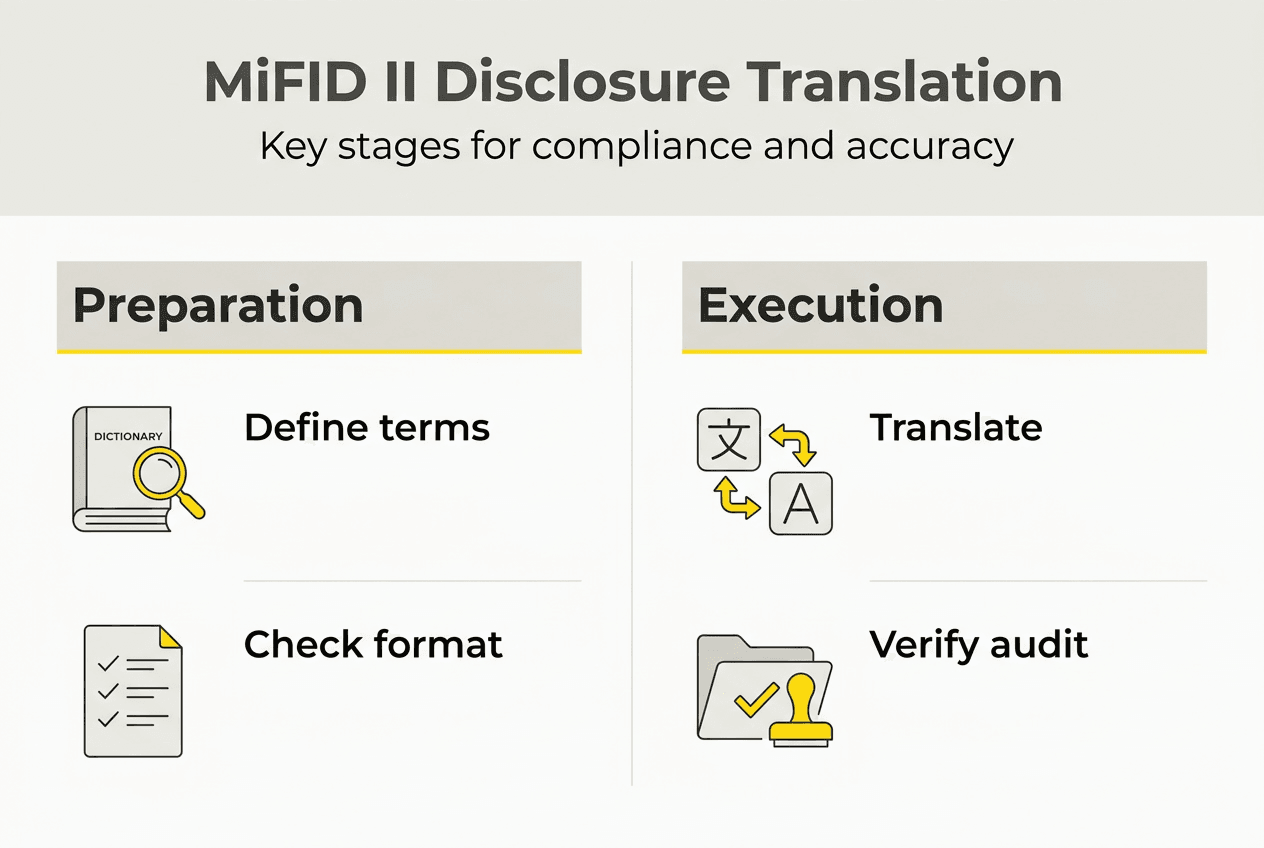
Successful MiFID II disclosure translation follows a structured sequence prioritizing terminology accuracy and regulatory alignment. Start by defining uniform terminology glossaries for every target language. These glossaries must extend beyond simple word-pair mappings to capture contextual usage rules. Document whether specific terms require capitalization, how compound financial concepts should be rendered, and which phrases must remain untranslated to preserve legal precision.

Deploy specialized translation tools maintaining legal and formatting requirements. Generic translation tools often fail to maintain structural integrity required for MiFID II filings, risking compliance failures. Consumer-grade machine translation engines lack the governance controls necessary for regulated content. They cannot enforce terminology consistency across document sets, preserve legal clause numbering, or maintain audit trails documenting translator decisions.
Implement secure workflows ensuring GDPR-compliant data handling throughout every project phase:
Asset integration: Ingest client Translation Memories and Term Bases containing previously approved translations and firm-specific terminology
Controlled translation: Use platforms with role-based access controls, encryption at rest and in transit, and comprehensive activity logging
Version management: Maintain clear version histories linking each translation iteration to specific reviewer comments and approval decisions
Secure delivery: Transfer completed translations through encrypted channels with recipient authentication
Multi-stage quality reviews catch errors before disclosure distribution. Consistency in terminology is crucial for avoiding misinterpretations across different language versions of MiFID II disclosures. Structure review workflows to separate linguistic accuracy verification from regulatory compliance assessment:
Linguistic review: Native-speaker translators with financial expertise verify grammar, style, and terminology usage
Compliance review: Regulatory specialists confirm alignment with MiFID II obligations and local competent authority expectations
Format verification: Technical reviewers validate that tables, numbering, and visual elements match source documents
Final approval: Senior compliance officers sign off after confirming all review stages completed successfully
Pro Tip: Examine terminology enforcement examples to understand how leading firms implement automated checks preventing unapproved term usage. Configure translation platforms to flag any deviation from approved glossaries, requiring explicit justification before proceeding.
Marketing communication under MiFID II must be fair, clear, and not misleading to investors, especially retail clients. This obligation intensifies for translated materials where linguistic nuance can inadvertently introduce bias. Review every promotional claim, performance comparison, and risk warning to ensure translated versions convey identical meaning without amplification or dilution of key messages.
Translation Stage | Primary Focus | Key Output |
Terminology definition | Financial term accuracy | Approved multilingual glossary |
Initial translation | Linguistic quality | Draft target language version |
Compliance review | Regulatory alignment | Annotated compliance assessment |
Format verification | Structural integrity | Layout-validated document |
Final approval | Overall quality | Signed release authorization |
Consult the comprehensive translation compliance guide for detailed protocols addressing audit documentation, reviewer qualification requirements, and ongoing quality monitoring frameworks applicable to regulated financial content.
Verifying and maintaining MiFID II disclosure translation compliance
Verification begins with systematic final quality checks covering terminology, formatting, and regulatory alignment. Create detailed checklists documenting every verification step, from glossary compliance confirmation to cross-reference accuracy between language versions. Assign specific team members responsibility for each verification dimension, ensuring no single reviewer attempts to validate all quality aspects simultaneously.
Comprehensive audit trails document every decision point throughout translation projects. Maintain records showing:
Initial source document versions with timestamps and approval signatures
Translator credentials and subject-matter expertise qualifications
Terminology decisions with justifications for any glossary deviations
Review comments from each quality assurance stage
Final approval authorizations with compliance officer sign-off
These audit trails prove invaluable during regulatory inspections when competent authorities request evidence demonstrating translation quality controls and governance processes.
Adapt workflows to accommodate evolving regulatory requirements. The FCA updates include making electronic communications the default mode with retail clients, impacting translation requirements. Digital delivery channels introduce new localization challenges beyond document translation. Email templates, mobile app interfaces, and online portal content require the same terminology rigor applied to formal disclosure documents.
Monitor regulatory developments affecting translation obligations across all jurisdictions where your firm operates. The MiFID II / MiFIR Review 2024 revised transparency rules requiring harmonized disclosures. Regulatory amendments frequently introduce new terminology, modify disclosure formats, or establish additional language requirements. Establish monitoring processes tracking competent authority guidance updates, industry working group recommendations, and peer firm practices.
Pro Tip: Understanding machine translation risks helps compliance teams identify when automated tools create unacceptable exposure. Reserve machine translation for internal reference materials only, never for client-facing MiFID II disclosures requiring regulatory precision.
Comparison tables track terminology evolution and ensure consistency across document updates:
Document Element | Version 1.0 Term | Version 2.0 Term | Change Rationale |
Risk classification | Moderate volatility | Medium volatility | Regulator feedback alignment |
Fee structure | Management charge | Management fee | Industry standard terminology |
Execution method | Best execution | Optimal execution | Client comprehension improvement |
Regular content updates reflect MiFID II and MiFIR amendments, market practice evolution, and lessons learned from translation quality incidents. Schedule quarterly reviews of all active disclosure documents, comparing current versions against regulatory guidance and identifying terminology refinements needed to maintain compliance. Implement version control protocols preventing outdated translations from inadvertent distribution.
Security considerations extend beyond initial translation to ongoing document management. Review legal translation data security practices ensuring archived translations, terminology databases, and project documentation receive the same protection as active client files. Establish retention schedules aligned with regulatory record-keeping obligations while implementing secure deletion protocols for materials exceeding required retention periods.
Ensure flawless MiFID II translation compliance with AD VERBUM
Navigating MiFID II disclosure translation requirements demands specialized expertise combining financial knowledge, regulatory understanding, and linguistic precision. AD VERBUM delivers comprehensive localization services purpose-built for regulated sectors including finance and legal industries. Our proprietary AI ecosystem operates on EU-hosted servers, ensuring data sovereignty aligned with GDPR processor obligations while our network of 3,500+ subject-matter expert linguists includes financial professionals who understand the regulatory nuance behind every term.

Our professional translation services implement the AI+HUMAN hybrid workflow essential for MiFID II compliance: terminology enforcement through Translation Memories and Term Bases, LLM-based translation constrained by your approved glossaries, and certified expert review ensuring regulatory alignment. ISO 27001 certification and ISO 17100 quality standards provide the governance framework competent authorities expect. Explore our finance and legal industry expertise to discover how AD VERBUM streamlines multilingual disclosure compliance while reducing regulatory risk.
Frequently asked questions
What is MiFID II and why does terminology consistency matter in disclosures?
MiFID II is the Markets in Financial Instruments Directive, a European Union regulatory framework governing investment services and financial markets. Terminology consistency across language versions ensures every investor receives identical information regardless of their language preference, preventing misunderstandings that could lead to unsuitable investment decisions. National competent authorities assess whether translated disclosures accurately convey the same risk profile, product characteristics, and client obligations as source documents.
What risks arise from inconsistent translation of MiFID II disclosures?
Inconsistent translations create multiple risk layers including regulatory sanctions from competent authorities, legal liability when investors claim they received misleading information, and reputational damage when discrepancies surface publicly. Firms may face mandatory document withdrawals, delayed product approvals, and increased supervisory scrutiny triggering broader compliance audits. Investor trust erodes quickly when clients discover contradictory information between language versions of supposedly identical disclosures.
How can firms ensure their MiFID II disclosures meet translation compliance requirements?
Implement robust terminology management systems with approved multilingual glossaries, deploy secure GDPR-compliant translation platforms with audit trail capabilities, and establish multi-stage review processes separating linguistic quality from regulatory compliance verification. Engage subject-matter experts with financial industry knowledge to review translations for technical accuracy and regulatory alignment. Consult translation compliance best practices for detailed protocols covering vendor selection, quality assurance frameworks, and ongoing monitoring requirements.
How have recent FCA rules on electronic communications affected MiFID II translation obligations?
The FCA now defaults to electronic communications with retail clients, expanding translation requirements beyond traditional documents to digital channels including email templates, mobile applications, and online portals. Every client touchpoint requires the same terminology rigor and regulatory precision previously applied only to formal disclosure documents. Firms must localize user interfaces, error messages, and interactive content while maintaining consistent financial terminology across all digital platforms and language versions.
Recommended

