


Master the AI+human translation workflow process in 2026

A single mistranslated term in a clinical trial protocol can delay drug approval by months and cost millions. In regulated industries like life sciences and legal sectors, translation precision directly impacts compliance, safety, and business continuity. Traditional machine translation lacks the contextual understanding and terminology control these fields demand, while purely manual workflows cannot match modern speed requirements. The solution lies in structured AI+human translation workflows that combine neural machine translation efficiency with subject matter expert oversight, delivering both accuracy and velocity for mission-critical documentation.
Table of Contents
Key takeaways
Point | Details |
Terminology governance | Specialized management systems and translation memories reduce terminology errors by up to 80 percent in regulated content |
Neural translation limits | NMT provides fluency gains but requires expert human review to catch domain-specific errors and compliance issues |
Augmented tools | AI-powered translation assistance enhances linguist productivity while maintaining human control over critical decisions |
Structured workflow | Multi-stage processes with defined checkpoints prevent errors and create audit trails for regulatory documentation |
Verification rigor | Combined automated QA and expert validation ensures both linguistic quality and compliance before delivery |
Understanding the unique challenges in regulated industry translations
Regulated sectors operate under constraints that make translation fundamentally different from general content localization. Life sciences documentation must maintain absolute terminological precision across languages because a single ambiguous phrase in a package insert can create patient safety risks. Legal translations carry binding contractual weight, where mistranslated obligations expose organizations to liability. Financial disclosures require exact numerical correspondence and regulatory terminology alignment across jurisdictions.
The stakes become clear in the numbers. Terminology management systems reduce errors up to 80 percent when properly implemented, a critical improvement when regulatory submissions face rejection for inconsistent term usage. Translation memories similarly transform efficiency by ensuring that previously approved translations of standard phrases appear identically across all documents, eliminating the variation that triggers compliance questions.
Beyond accuracy, regulated translations require complete traceability. Audit trails must document who translated each segment, which terminology resources guided decisions, and what review steps occurred before approval. This documentation burden makes ad hoc translation approaches unworkable at scale. Organizations need systematic workflows that capture this metadata automatically while linguists focus on the actual translation work.
Compliance mandates add another layer of complexity. Medical device translations must align with MDR requirements for technical documentation. Pharmaceutical submissions follow ICH guidelines that specify terminology standards across regions. Legal translations often require sworn translator certification in target markets. Each regulatory framework imposes specific quality standards that generic translation processes cannot address without explicit design.
Cultural and contextual precision matters as much as literal accuracy in these domains. A clinical trial consent form must convey informed consent concepts that vary across legal systems. Marketing materials for regulated products face advertising restrictions that differ by country, requiring translators who understand both linguistic nuance and regulatory boundaries. Standard machine translation engines lack this specialized knowledge, making human expertise non-negotiable even as AI tools accelerate initial drafting.
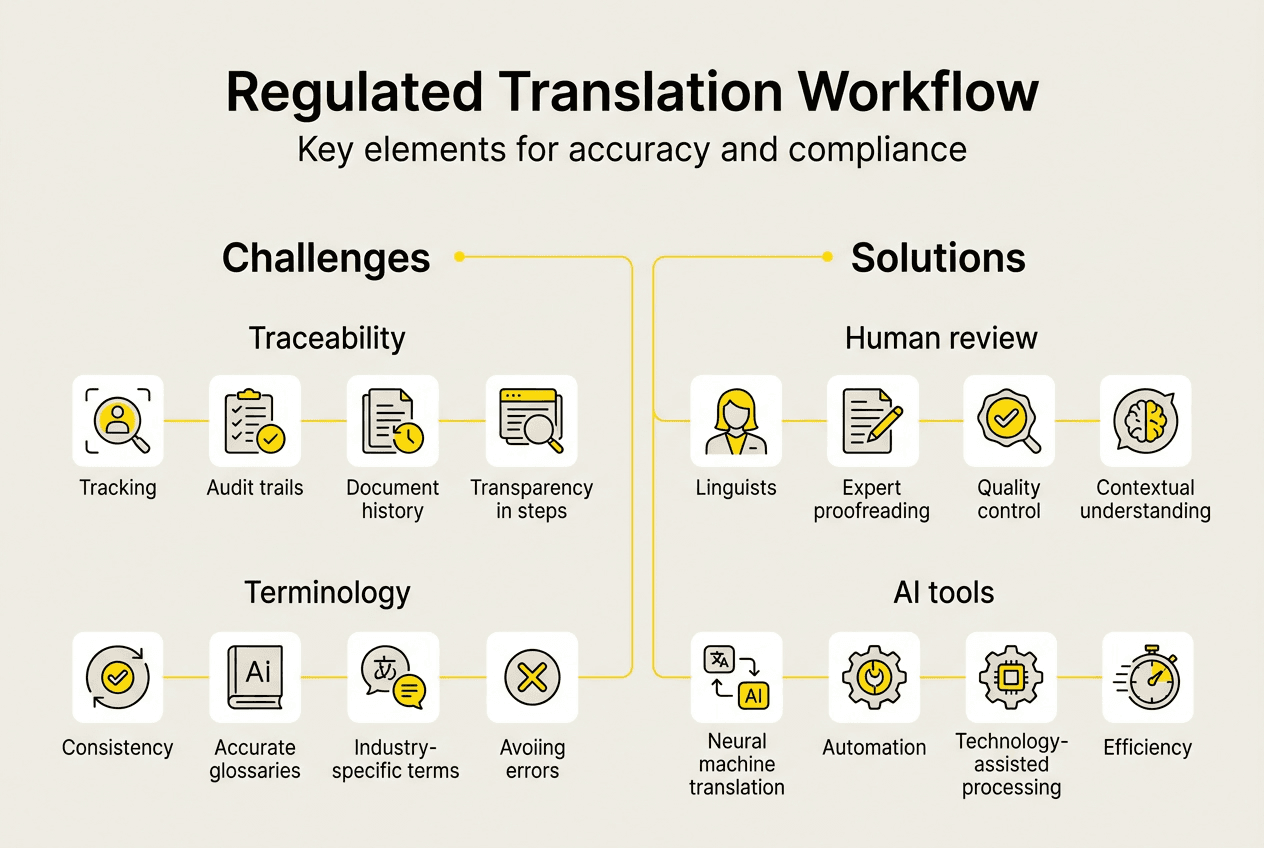
The challenge intensifies with volume. Large organizations manage thousands of pages of technical documentation, regulatory submissions, and legal contracts simultaneously across dozens of languages. Manual translation cannot scale to meet these demands within required timelines. Pure machine translation introduces unacceptable error rates. The solution requires a structured workflow that systematically combines AI speed with human judgment, using terminology enforcement as the foundation for consistency.
Preparing your AI+human translation workflow: tools and prerequisites
Successful AI+human workflows begin with deliberate tool selection and infrastructure setup before any translation work starts. The foundation consists of three integrated systems: neural machine translation engines, terminology management platforms, and translation memory databases. Each component serves a specific function in the workflow, and their integration determines overall effectiveness.
Neural machine translation selection requires domain-specific evaluation. Generic NMT engines trained on broad web content perform poorly on specialized terminology and document structures common in regulated industries. NMT and transformer models significantly improved fluency compared to earlier statistical approaches, but this fluency can mask terminology errors that human reviewers must catch. Evaluate engines based on their ability to handle technical vocabulary, maintain consistent terminology across long documents, and preserve formatting in complex layouts like tables and numbered lists.
Terminology management systems form the quality control backbone. These platforms store approved translations for domain-specific terms, enforce consistent usage across all projects, and flag deviations for human review. Implementation requires upfront investment in building comprehensive term bases that cover your specific regulatory domain, product lines, and corporate style preferences. The payoff comes through dramatically reduced error rates and faster review cycles as translators work from pre-approved terminology rather than making individual decisions on critical terms.
Translation memory integration accelerates consistency for repetitive content. Regulatory documents contain substantial boilerplate text that appears across multiple submissions with minor variations. Translation memories capture these previously translated segments and suggest them automatically when similar source text appears, ensuring identical translations for identical content. This consistency matters enormously in regulatory review, where unexplained variation triggers questions and delays.
Pro Tip: Structure your term bases hierarchically with corporate-wide terms at the top level, domain-specific terminology in the middle tier, and project-specific terms at the bottom. This architecture prevents terminology conflicts while allowing appropriate flexibility across different document types.
Augmented translation tools represent the practical interface where human linguists interact with AI assistance. These platforms present machine translation output alongside terminology suggestions, translation memory matches, and contextual reference materials. The goal is cognitive support, not automation. Translators maintain full control over final output while AI handles lookup tasks, consistency checking, and initial drafting of straightforward segments.
Workflow tool comparison:
Tool category | Primary function | Human oversight level | Best for |
Pure NMT | Fast initial translation | Post-editing required | High-volume, lower-risk content |
Augmented translation | AI-assisted human translation | Real-time human control | Regulated, compliance-critical content |
Translation memory | Consistency enforcement | Approval on suggestions | Repetitive documentation |
Terminology management | Term standardization | Expert validation of entries | Technical and legal precision |
User role definition completes the preparation phase. Effective AI+human processes require clear assignment of responsibilities across project managers, subject matter expert translators, terminology specialists, and quality reviewers. Document who approves terminology additions, who validates technical accuracy, and who performs final compliance checks. This role clarity prevents bottlenecks and ensures accountability in audit situations.
Executing the AI+human translation workflow step-by-step
The execution phase transforms preparation into delivered translations through a systematic sequence that balances speed with control. Each step includes specific checkpoints where human judgment overrides AI output when necessary, creating the precision regulated industries require.
Asset integration and preprocessing. Begin every project by loading client-specific translation memories and term bases into the workflow platform. This step constrains AI output to approved terminology from the start rather than correcting errors later. Preprocessing also includes document analysis to identify formatting complexity, extract reference materials, and flag segments requiring specialized subject matter expertise.
AI-powered initial translation. Neural machine translation generates the first-pass translation using the loaded terminology constraints and translation memory matches. Augmented translation tools provide intelligent suggestions that help linguists by offering context-aware alternatives and highlighting terminology that requires validation. The AI handles straightforward segments efficiently while flagging complex passages for human attention.
Subject matter expert review. Certified linguists with domain expertise review every segment, focusing cognitive effort where it matters most. They validate technical accuracy, assess regulatory compliance implications, and refine contextual nuance that AI cannot capture. This review is not proofreading but active translation decision-making informed by AI suggestions rather than starting from blank pages.
Terminology validation checkpoint. Automated tools scan completed translations against approved term bases, flagging any deviations for explicit review. Linguists either correct the deviation or document justification for the alternative choice. This checkpoint catches inconsistencies before they reach quality assurance, reducing rework cycles.
Contextual coherence review. Human reviewers assess document-level flow, checking that translations maintain logical connections across sections, preserve intended emphasis, and adapt cultural references appropriately. AI excels at segment-level translation but struggles with these broader coherence patterns that matter in regulatory submissions.
Pro Tip: Configure your workflow platform to automatically route segments containing negation, conditional statements, or numerical data to senior reviewers. These linguistic patterns commonly trip up NMT systems and carry high risk in regulated content.
Workflow stage comparison:
Stage | AI contribution | Human contribution | Quality impact |
Initial translation | 80-90% of draft content | Terminology validation, complexity flagging | Speed, consistency baseline |
Expert review | Terminology suggestions, memory matches | Technical accuracy, compliance assessment | Domain precision, regulatory alignment |
Coherence check | Consistency scanning | Document flow, cultural adaptation | Professional quality, contextual appropriateness |
Final validation | Automated QA checks | Approval decision, audit documentation | Compliance assurance, delivery confidence |
The optimized AI+human process maintains continuous feedback loops where human corrections improve AI performance over time. When translators override machine suggestions, those decisions feed back into translation memories and inform future NMT output. This learning cycle gradually reduces the human effort required on routine content while preserving expert oversight on critical decisions.

Verifying quality and ensuring compliance in AI-assisted translation
Verification transforms completed translations into compliant deliverables through systematic quality checks that combine automated scanning with expert judgment. This final phase catches errors that slipped through earlier stages and provides the documentation trail regulators expect.
Automated QA tools perform rapid consistency checks across multiple dimensions. They verify that all approved terms appear with correct translations, confirm that numerical values match between source and target, and flag formatting inconsistencies that could indicate translation errors. These tools scan entire documents in seconds, identifying issues that would take human reviewers hours to find manually. However, automated checks cannot assess contextual appropriateness or regulatory compliance, making them a complement to human review rather than a replacement.
Expert validation focuses on high-risk elements that require domain knowledge to evaluate properly. Subject matter experts review technical passages to confirm accurate representation of scientific concepts, legal obligations, or safety instructions. They assess whether translations will be interpreted correctly by target audience professionals familiar with local regulatory frameworks and industry conventions. This expertise-driven review catches subtle errors that both AI systems and general linguists might miss.
Quality verification checklist:
Terminology consistency verified against approved term bases
Numerical accuracy confirmed through automated comparison
Regulatory terminology aligned with target market requirements
Cultural appropriateness assessed for target professional audience
Formatting preserved for tables, lists, and document structure
Compliance documentation completed for audit trail
Compliance verification examines whether translations meet specific regulatory standards applicable to the content type and target market. Medical device translations require verification against MDR technical documentation standards. Pharmaceutical submissions need ICH terminology alignment checks. Legal contracts may require sworn translator certification or notarization depending on jurisdiction. Each regulatory framework imposes specific validation requirements that must be explicitly addressed and documented.
“MT should be viewed as a complement to, rather than a replacement for, human translators, especially in high-stakes scenarios.”
This principle guides the entire verification approach. AI-powered QA tools dramatically improve efficiency and consistency checking, but final approval authority must rest with qualified human experts who understand regulatory implications and can exercise professional judgment on edge cases.
Final validation workflow:
Verification type | Method | Performed by | Documentation output |
Terminology consistency | Automated term base comparison | QA software with human review of flags | Terminology compliance report |
Technical accuracy | Expert content review | Subject matter specialist | Technical validation certificate |
Regulatory alignment | Standards checklist | Compliance reviewer | Regulatory compliance statement |
Cultural appropriateness | Professional assessment | Native expert linguist | Localization quality report |
The verification phase produces formal documentation that demonstrates due diligence in translation quality management. This documentation serves two purposes: internal quality assurance and external regulatory compliance. Organizations need evidence that translations underwent appropriate review processes, particularly when regulatory authorities question submission content or when legal disputes arise over contract interpretation.
Implementing systematic quality assurance with compliance-focused checklists transforms verification from subjective review into a repeatable process with measurable quality metrics. Track error rates by category, measure terminology consistency scores, and monitor review cycle times to identify process improvements. This data-driven approach to quality management provides the objective evidence regulators expect and helps organizations optimize their workflows over time.
Discover professional localization solutions with AD VERBUM
Implementing the AI+human translation workflows described in this guide requires specialized expertise and purpose-built technology infrastructure. AD VERBUM delivers precision localization services for regulated industries through a proprietary Language Operations System that combines advanced AI with a network of 3,500+ subject matter expert linguists. Our approach integrates client-specific translation memories and term bases from project initiation, ensuring terminology governance and compliance alignment from the first segment.
With 25+ years serving life sciences, legal, and other high-stakes sectors, AD VERBUM maintains ISO 17100, ISO 18587, and ISO 27001 certifications while delivering turnaround speeds 3x to 5x faster than traditional workflows. Our EU-hosted infrastructure provides the data sovereignty and security controls regulated organizations require. Explore our comprehensive translation services to discover how AI+human hybrid workflows can transform your localization operations while maintaining the precision and compliance your industry demands.
FAQ
What is the main advantage of combining AI with human translation in regulated industries?
The primary benefit is achieving both speed and precision simultaneously. Neural machine translation handles routine content efficiently, reducing turnaround time by 3x to 5x compared to purely manual workflows. Subject matter experts then focus their expertise on technical accuracy, regulatory compliance, and contextual nuance that AI cannot reliably assess. This combination delivers the velocity modern business requires without compromising the quality regulated industries demand.
How do terminology management systems improve translation workflows?
Terminology management systems enforce approved term translations automatically, reducing terminology errors by up to 80 percent in regulated content. They flag deviations for human review rather than allowing inconsistent usage to reach final deliverables. These systems also accelerate translator decision-making by providing instant access to validated terminology rather than requiring research or subjective judgment on critical terms. The result is both higher quality and faster throughput.
What are best practices for ensuring compliance in AI-assisted translations?
Implement multi-stage human review with defined checkpoints where subject matter experts validate technical accuracy and regulatory alignment. Use automated QA tools to scan for terminology consistency and formatting errors, but reserve final approval authority for qualified human reviewers. Maintain detailed documentation of all review stages, terminology decisions, and quality checks to create the audit trail regulators expect. Never rely on AI output alone for compliance-critical content regardless of confidence scores.
Why is subject matter expertise essential in regulated translation workflows?
Regulated industries use specialized terminology with precise meanings that general linguists and AI systems may misinterpret. Medical translators need clinical knowledge to distinguish between similar terms with different safety implications. Legal translators require understanding of jurisdictional differences in contractual concepts. Subject matter experts catch subtle errors that would pass linguistic quality checks but create compliance or safety risks. Their domain knowledge is irreplaceable in high-stakes translation scenarios.
How do translation memories differ from terminology management in workflow impact?
Translation memories store previously translated sentences and paragraphs, suggesting exact matches when identical source text appears again. They ensure consistency for repetitive content like regulatory boilerplate. Terminology management systems focus specifically on individual terms and phrases, enforcing approved translations at the word level across all content regardless of surrounding context. Both tools are complementary: translation memories handle segment-level consistency while terminology systems ensure term-level precision. Effective workflows integrate both capabilities.
Recommended

