


Translating UCITS KIID and PRIIPs KID for Multi-Market Distribution

Translating UCITS KIID and PRIIPs KID for multi-market distribution is defined as the process of rendering Key Information Documents into each host member state’s required language while preserving regulatory terminology, document structure, and investor comprehension standards mandated by EU law. Since 1 January 2023, UCITS no longer benefit from the PRIIPs exemption, meaning every retail-facing fund now requires a compliant PRIIPs KID in every distribution language. The translation workflow is not a formatting exercise. It is a compliance obligation with direct audit exposure, NCA submission deadlines, and terminology governance requirements that span BaFin, AMF, and CSSF jurisdictions simultaneously.
How do you translate UCITS KIID and PRIIPs KID for multi-market distribution?
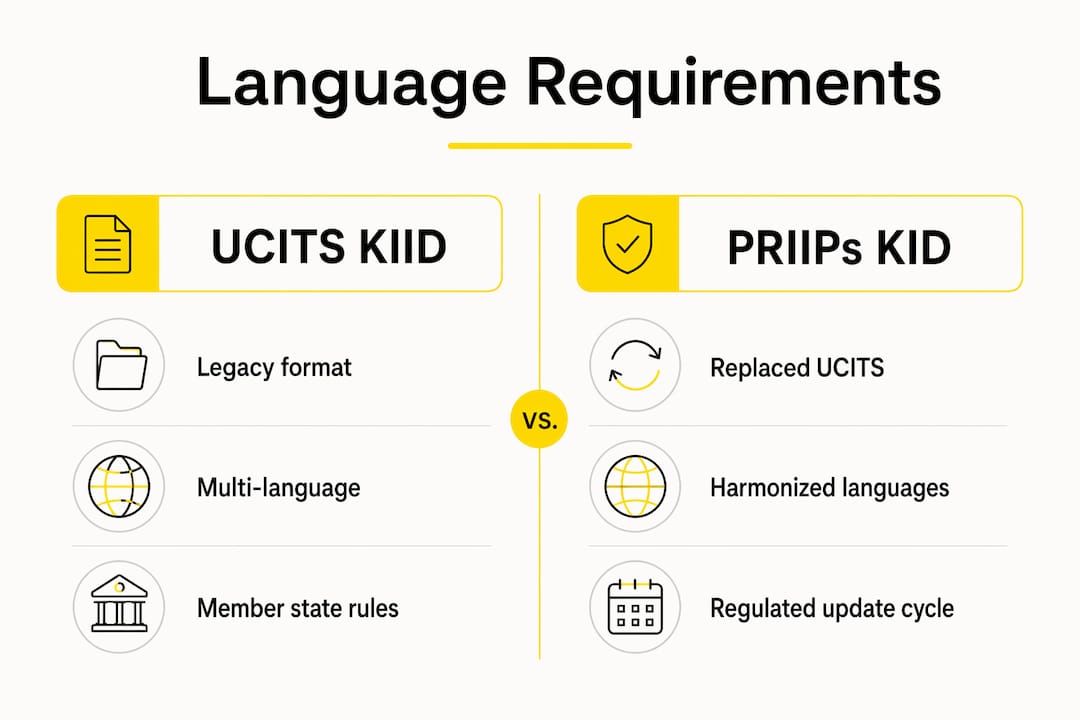
Translating these documents correctly starts with understanding that the PRIIPs KID and the legacy UCITS KIID are structurally and legally distinct, even though both serve retail investor disclosure purposes. The KIID operated under Directive 2009/65/EC and required two pages covering objectives, risk, charges, and past performance. The PRIIPs KID, governed by Regulation (EU) No 1286/2014, introduces a Summary Risk Indicator (SRI) replacing the Synthetic Risk and Reward Indicator (SRRI), adds performance scenarios, and restructures cost disclosures under a Reduction in Yield format.
The regulatory shift matters for translation because the SRI and SRRI are not interchangeable terms. Using SRRI language in a PRIIPs KID translation, or vice versa, creates a direct compliance error that NCAs can flag during document review. The AMF has confirmed that UCITS must comply with KID regulations for retail clients from 2023 onward, which means your translation workflow must be rebuilt around PRIIPs KID structure, not adapted from legacy KIID templates.

The CSSF adds a further constraint: the KID must be brief and clear, functioning as a condensed summary rather than a verbatim extraction from the prospectus. This directly shapes translation quality standards. A translator who defaults to prospectus-level language density produces a document that fails the investor comprehension test, regardless of linguistic accuracy.
Key regulatory distinctions that affect translation scope:
Document structure: PRIIPs KID uses seven mandatory sections with fixed headings; translations must preserve heading labels exactly as defined in the regulation’s official language versions.
Risk terminology: SRI (PRIIPs) and SRRI (UCITS KIID) must not be conflated. Each requires jurisdiction-consistent phrasing in the target language.
Performance scenarios: PRIIPs KID includes stress, unfavorable, moderate, and favorable scenarios. These scenario labels must match the official translated terminology used in each member state’s regulatory publications.
Update obligations: CSSF requires annual review and resubmission. Translated versions must be updated within the same cycle, not treated as static assets.
What are the language requirements for each distribution jurisdiction?
Multi-market distribution requires adherence to a Member State language matrix that specifies both the required language and the ex ante notification format for each jurisdiction. PwC Plus publishes a detailed table derived from JC 2024 44 that maps these requirements by country. This is the operational starting point for any compliance team building a distribution language plan.
The table below illustrates how requirements vary across four major EU distribution markets:
Member State | Required language(s) | Submission authority | Ex ante notification |
Germany | German | BaFin | Required before marketing |
France | French | AMF | Required before marketing |
Luxembourg | French, German, or English | CSSF | Required before marketing |
Netherlands | Dutch or English (retail) | AFM | Required before marketing |
Article 82 of Directive 2009/65/EC defines host member state obligations, confirming that language obligations follow the jurisdiction where units are marketed, not where the fund is domiciled. This means a Luxembourg-domiciled UCITS distributed in Germany requires a German-language KID submitted to BaFin, regardless of the fund’s home regulator being the CSSF.
ESMA’s 2026 report on cross-border fund distribution reinforces that harmonized translated disclosures must align with marketing communications and prospectus content across jurisdictions. A German KID that describes investment policy differently from the German marketing materials creates a consistency failure that ESMA specifically flags as a compliance risk. Your translation workflow must include a cross-reference check between the KID, the prospectus, and any marketing communications in each language.
What is the step-by-step workflow for translating KIDs with regulatory compliance?
A compliant translation workflow for PRIIPs KID and UCITS KIID covers six sequential stages. Each stage has a defined output and a compliance checkpoint.
Map investor type and distribution jurisdiction. Before any translation begins, confirm which investor categories receive the document in each market and which NCA governs submission. This mapping determines document version requirements and language obligations. Transitioning from KIID to KID is both a compliance and portfolio configuration issue requiring versioning by investor type and jurisdiction.
Build and ingest terminology assets. Compile a Term Base (TB) covering SRI/SRRI labels, performance scenario names, cost disclosure terms, and investment policy vocabulary in each target language. These assets must reflect official regulatory language from ESMA publications and NCA guidance, not generic financial dictionaries. Translation Memories ™ from prior KID versions should be ingested at this stage to enforce consistency with previously approved language.
Select certified financial SME translators. ISO 17100 governs translation service quality management. ISO 18587 governs post-editing of machine-translated output. Both standards require that translators hold subject-matter competence in the relevant domain. For PRIIPs KID translation, this means translators with demonstrated financial regulatory expertise, not general legal or financial translators. Certified financial SME translators following ISO 17100, ISO 18587, and ISO 27001 standards produce translations that meet both quality and security requirements for regulated documents.
Translate with terminology enforcement. The translation output must be constrained by the TB and TM assets from step two. Generic neural machine translation engines do not enforce terminology governance at the document level, which creates inconsistency risk across multi-language KID sets. Context-sensitive generation with explicit terminology constraints is the correct technical approach for regulated financial content.
Conduct SME review for regulatory accuracy. A certified subject-matter expert reviews the translated output for technical accuracy, regulatory compliance, and contextual nuance. This review specifically checks that SRI/SRRI terminology is correctly applied, that performance scenario labels match NCA-approved language, and that the document reads as a clear summary rather than a prospectus extract.
Establish version control and audit trail. Each translated KID version must be linked to the underlying official submission and the calculation basis used for SRI and cost figures. CSSF emphasizes version control to confirm that each language version corresponds accurately to the submitted risk profile. Annual updates must be completed within 35 business days after year-end, and all language versions must be updated in the same cycle.
Pro Tip: Build your jurisdiction language matrix before the annual review cycle begins. Compliance teams that map NCA submission deadlines and language requirements in Q4 avoid the bottleneck of simultaneous multi-language updates in January and February.
What common pitfalls occur in translating KIDs for multi-market distribution?
Translation errors in PRIIPs KID and UCITS KIID documents fall into five recurring categories. Each carries a distinct compliance risk profile.
Prospectus-level language density. Translators without KID-specific briefing default to prospectus register, producing documents that are accurate but fail the CSSF’s clarity and brevity standard. The KID must read as a condensed summary for retail investors, not as a legal disclosure.
Inconsistent risk terminology across languages. SRI descriptions that vary between the German and French versions of the same fund’s KID create a direct compliance inconsistency. Terminology governance for SRI and investment policy terms must be enforced at the TB level, not left to individual translator judgment.
Missing or incomplete audit trails. Multi-version governance that lacks a document-level audit trail cannot demonstrate to BaFin or AMF that each language version reflects the same underlying calculation. This is a recurring finding in NCA inspections of cross-border fund documentation. Deficient version control is the most common multi-market governance failure.
Ignoring jurisdiction-specific formatting requirements. BaFin and AMF have different submission portal formats and metadata requirements. A KID that is linguistically correct but submitted in the wrong format or without required ex ante notification is non-compliant regardless of translation quality.
Static treatment of translated assets. Treating translated KIDs as one-time deliverables rather than living documents that require annual review creates compounding compliance risk. Each year’s performance scenario recalculation and cost update must propagate to every language version simultaneously.
Mitigation requires four controls: a living regulatory glossary updated with each ESMA and NCA publication cycle, a cross-functional review process that includes legal, product, and compliance sign-off on each language version, an automated audit trail system linking each translated version to its source calculation, and a certified translation partner with documented financial SME competence.
For a parallel example of how SFDR translation errors create downstream regulatory exposure, the pattern of inconsistent terminology across language versions is identical to what occurs in KID translation failures.
How do ISO standards and certified translation services support compliant KID translation?
ISO 17100, ISO 18587, and ISO 27001 are the three standards that define a compliant translation workflow for regulated financial documents. ISO 17100 sets requirements for translation service quality, including translator competence verification and process controls. ISO 18587 governs the post-editing of machine-translated content, defining the human review steps required before a machine-assisted translation is considered final. ISO 27001 addresses information security management, which is directly relevant when KID documents contain fund-specific data that must not be processed through unsecured public cloud infrastructure.
The distinction between legacy machine translation, consumer neural machine translation, and a proprietary LLM-based system matters here. Legacy MT produces literal output with weak context handling, creating meaning errors in risk descriptions and cost disclosures. Consumer NMT engines offer better fluency but lack terminology governance controls and present data sovereignty risks for regulated content. An AI+HUMAN hybrid translation approach, where a proprietary LLM generates output constrained by client Term Bases and Translation Memories, then a certified SME reviews for regulatory accuracy, addresses all three failure modes. Advanced workflows integrating certified SME translators with regulatory language glossaries and automated audit trail systems represent the current standard for multi-language KID compliance.
Maintaining terminology consistency across MiFID II disclosures follows the same governance logic as KID translation. The investment in a shared Term Base across fund disclosure document types reduces per-document review time and improves cross-document consistency during NCA inspections.
Pro Tip: Request that your translation provider supply a terminology report alongside each KID delivery. This report should list every SRI, cost, and policy term used in each language version, mapped to the approved TB entry. It becomes part of your audit trail and demonstrates terminology governance to regulators.
Key takeaways
Compliant PRIIPs KID translation for multi-market distribution requires jurisdiction-mapped language assets, certified SME review, and a living audit trail that updates with every annual recalculation cycle.
Point | Details |
UCITS KIID replaced by PRIIPs KID | Since January 2023, all UCITS must produce a PRIIPs KID for retail clients, not a legacy KIID. |
Jurisdiction language matrix is mandatory | Each EU member state specifies required languages and NCA submission formats; map these before translation begins. |
Terminology governance prevents compliance errors | SRI and SRRI are not interchangeable; enforce consistent risk and cost terms via a certified Term Base in every language. |
Audit trail links versions to calculations | Every translated KID must be traceable to the underlying SRI calculation and annual review submission. |
ISO-certified SME review is the quality standard | ISO 17100 and ISO 18587 define the human review requirements that separate compliant translation from generic output. |
What I’ve learned from watching KID translation programs fail
The most consistent failure pattern I observe in multi-market KID translation is not a language error. It is a process error. Compliance teams treat the translation as the final step in the KID production cycle, when it should be embedded from the moment the source document is drafted. By the time a German or French KID reaches a translator, the source English document has already locked in terminology choices, sentence structures, and section lengths that may be difficult to render clearly in the target language without exceeding the document’s brevity requirements.
The second failure is organizational. Product teams own the KID calculation. Legal teams own the prospectus. Compliance teams own the submission. Nobody owns the translated KID as a distinct compliance asset. This means version control breaks down at the translation layer, and annual updates to the source document do not automatically trigger updates to all language versions. CSSF and AMF inspections increasingly focus on this gap.
My practical recommendation is to treat each language version of a KID as a separate regulatory filing with its own owner, deadline, and audit trail. The translation workflow should be governed by the same change management process that governs the source document. When the SRI changes, every language version changes simultaneously, not sequentially over weeks.
The firms that get this right are the ones that invest in a shared terminology infrastructure before they need it, not after a compliance finding forces the issue. A certified translation partner with documented financial SME competence and ISO-aligned QA is not an overhead cost. It is the control that makes multi-market distribution auditable.
How AD VERBUM supports compliant multi-market KID translation
AD VERBUM’s AI+HUMAN hybrid translation workflow is built for exactly the compliance requirements that PRIIPs KID and UCITS KIID translation demands. The workflow begins with ingesting your existing Translation Memories and Term Bases, then applies AD VERBUM’s proprietary LLM-based LangOps System to generate target language output constrained by your approved terminology. A certified financial SME then reviews for regulatory accuracy, contextual nuance, and KID-specific clarity standards. QA is aligned to ISO 17100 and ISO 18587 throughout. All processing runs on EU-hosted private infrastructure under ISO 27001 certification, with no reliance on public cloud tooling for core document handling. AD VERBUM supports 150+ languages and delivers at three to five times the speed of traditional translation workflows. For compliance teams managing annual KID review cycles across multiple distribution markets, explore AD VERBUM’s financial translation services and localization solutions built for regulated content.
FAQ
What replaced the UCITS KIID for retail investors?
The PRIIPs KID replaced the UCITS KIID for retail clients as of 1 January 2023, when the AMF confirmed that UCITS no longer benefit from the PRIIPs exemption and must comply with KID regulations.
Which languages are required for PRIIPs KID distribution in the EU?
Each EU member state specifies its own language requirements. Germany requires German, France requires French, and Luxembourg accepts French, German, or English. The PwC Plus Member State language matrix derived from JC 2024 44 is the reference document for mapping these obligations.
How often must translated KIDs be updated?
KIDs require annual review, with updates reflecting current SRI calculations and cost disclosures. CSSF guidance indicates that all language versions must be updated within the same review cycle, with 35 business days after year-end as the standard practice for completion.
What ISO standards apply to PRIIPs KID translation?
ISO 17100 governs translation service quality and translator competence. ISO 18587 governs post-editing of machine-translated content. ISO 27001 governs information security for the document handling process. All three apply to compliant KID translation workflows.
What is the most common compliance failure in multi-language KID programs?
Deficient version control is the most common failure, where translated language versions are not updated simultaneously with the source document’s annual recalculation, creating inconsistencies that NCAs identify during cross-border fund distribution inspections.
Recommended