


PESCO and Multilingual Documentation: A Coordinator's Guide

PESCO, the EU’s Permanent Structured Cooperation framework, is defined as a legally binding defense cooperation mechanism among 26 EU member states, designed to develop shared military capabilities through coordinated, multi-national projects. What makes PESCO operationally demanding for project coordinators is not just its technical scope. It is the multilingual documentation obligation that runs through every governance layer, from Council Decisions and project annexes to National Implementation Plans and cross-institutional reporting. Understanding what PESCO requires in terms of multilingual documentation is the first step toward managing it without compliance risk.
What is PESCO and how are its projects structured?
PESCO enhances operational readiness and improves citizens’ security through legally binding commitments that distinguish it from voluntary EU cooperation formats. Member states sign binding agreements to meet quantitative and qualitative defense targets, and they must demonstrate compliance annually through National Implementation Plans and political letters. That audit trail starts with documentation, and documentation starts with language.
As of 2025, PESCO includes 74 projects with nearly half in active execution phase, positioning the framework for continuation from 2026 to 2030. This scale matters for consortium leads because each project carries its own governance structure, participant list, and deliverable set. Managing documentation across that volume requires a system, not a workaround.

Each PESCO project is governed by a Council Decision that defines the project list and participating members in formal annexes. Annex I and II contain member lists for individual projects such as ESSOR (European Secure Software defined Radio), specifying roles for coordinators, full participants, and observers. These are not narrative descriptions. They are controlled data fields that must remain consistent across every language version of the official record.
Project roles within PESCO follow a defined structure:
Coordinator: The member state or entity leading the project, responsible for reporting to EU institutions.
Participants: Member states with full project involvement and binding commitments.
Observers: Member states or third parties with limited, non-binding involvement.
Secretariat support: Provided jointly by the European Defence Agency (EDA), the European External Action Service (EEAS), and the EU Military Staff.
Pro Tip: Map your project’s full participant and observer list against the Council Decision annex before any translation work begins. Discrepancies between the working document and the official annex are the most common source of rework in multilingual PESCO submissions.
Why does PESCO require multilingual documentation?
PESCO’s multilingual documentation needs arise directly from its multi-national legal structure. When 26 member states operate under a single binding framework, every governance document must be accurate and consistent across the working languages of all participating institutions. A mistranslated role designation or an inconsistent project title across language versions is not a formatting error. It is a compliance failure.
Multiple EU bodies including the EDA, EEAS, and EU Military Staff facilitate PESCO secretariat functions, which means documentation flows across institutions with different working language norms and review processes. Consortium leads who submit documents in a single language, or who rely on informal translations for cross-institutional review, create gaps that surface during validation or audit.
The legal basis reinforces this. PESCO commitments include legally binding targets requiring detailed, auditable documentation across multiple languages. Member states cannot satisfy their annual reporting obligations with documents that exist only in one language, particularly when those documents reference shared project deliverables, capability descriptions, or financial commitments tied to European Defence Fund co-funding.
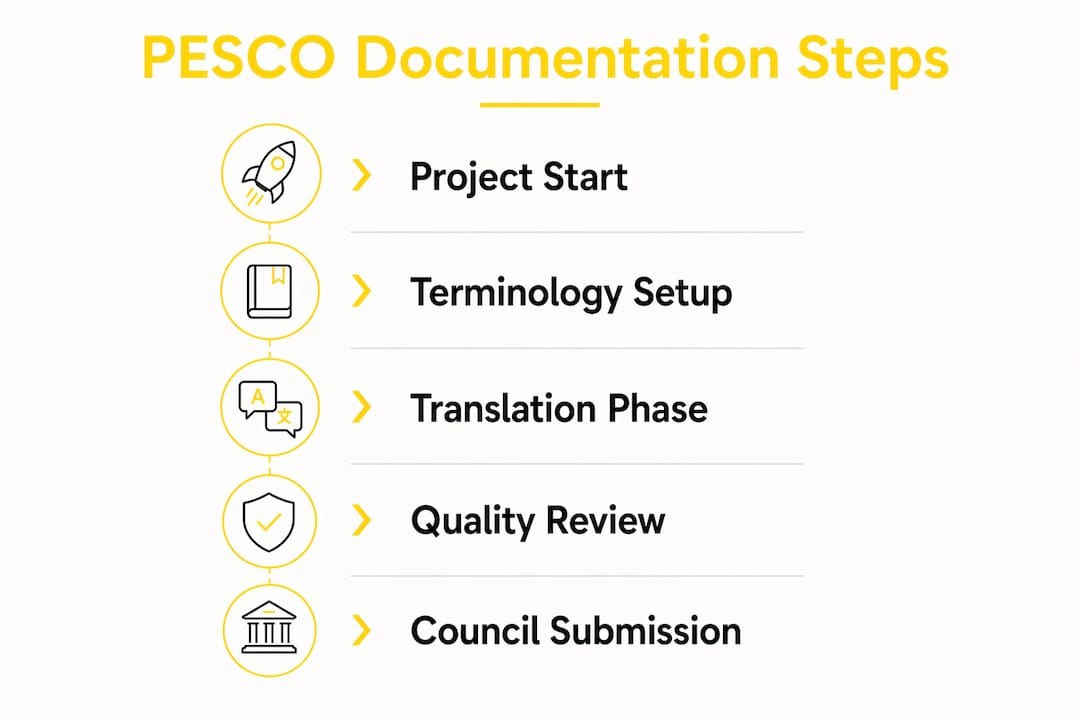
Consider the documentation scope a single PESCO project generates across its lifecycle:
Project proposal and description: Submitted in the coordinator’s working language and translated for Council review.
Council Decision annexes: Formally published in all EU official languages, requiring controlled translation of member lists, project titles, and role designations.
National Implementation Plans: Submitted annually by each member state, requiring consistent terminology alignment with the project’s master documentation.
Progress reports: Reviewed by EDA and shared across institutions, requiring terminology consistency with prior submissions.
EDF co-funding applications: Where applicable, EDF co-funding eligibility introduces additional documentation requirements that must align with both PESCO and EDF frameworks simultaneously.
The importance of multilingual documentation in this context is not administrative formality. It is the mechanism by which 26 governments and multiple EU institutions maintain a shared, auditable record of what was agreed, who committed to what, and what has been delivered.
What are the key challenges in managing PESCO multilingual documentation?
The timeline problem
The administrative timeline from project proposal to Council validation is approximately 9 months. That window sounds generous until you account for the sequential nature of the process: drafting, internal review, legal clearance, translation, institutional review, and Council adoption. Translation is rarely treated as a parallel workstream. It is typically scheduled last, which compresses it into the highest-pressure phase of the cycle.
Treating translation as a late-stage task is the single most common planning failure in PESCO project administration. Coordinators who build translation timelines into the project schedule from the proposal stage avoid the cascading delays that come from late-stage terminology disputes and rework.
Terminology governance and document masters
Locking terminology and approved document masters before translation begins is a non-negotiable practice for any project with multiple language versions. When source documents change after translation has started, every translated version must be updated in parallel. In a project with six participating member states and four working languages, a single late change to a capability description can generate 24 separate revision tasks.
The table below compares translation approaches by their suitability for PESCO documentation:
Approach | Terminology control | Audit trail | SME review | PESCO suitability |
Legacy MT (Machine Translation) | None | None | None | Not suitable for legal or technical content |
NMT via public SaaS engines | Inconsistent | Limited | None | High risk for regulated annexes and binding commitments |
AI+HUMAN hybrid translation | Enforced via TM and TB | Full | Certified SME | Suitable for all PESCO document types |
Annex data as controlled fields
Small translation discrepancies in names, roles, and annex tables risk breaking internal consistency in official reporting to EU bodies and partners. Project coordinators should instruct translation teams to treat annex data as controlled fields, not narrative text. A country name, a project code, or a role designation must be identical across all language versions of a document, not translated contextually.
Pro Tip: Create a project-specific Term Base before any translation begins. Include all project titles, role designations, capability terms, and annex field labels. Share it with every translator and reviewer working on the project. This single step eliminates the majority of consistency errors in multilingual PESCO submissions.
Technical and legal content in defense projects requires subject-matter expert review rather than solely automated output. A capability description for a joint surveillance system carries technical precision requirements that a general-purpose translation engine cannot reliably satisfy. The risk is not just inaccuracy. It is the introduction of ambiguity into a legally binding document. For guidance on managing EU technical data risks in defense translation, the exposure from unvetted translators handling controlled content is a documented compliance liability.
How does AD VERBUM support PESCO multilingual documentation compliance?
AD VERBUM’s position in PESCO documentation workflows is defined by its certification baseline and its AI+HUMAN hybrid translation methodology. ISO 17100 and ISO 27001 certification, combined with AQAP 2110 pending alignment, establish the quality and security controls that defense consortia require for auditable translation workflows.
The AI+HUMAN hybrid translation process AD VERBUM applies to PESCO documentation follows a fixed sequence:
Asset integration: Client Translation Memories ™ and Term Bases (TB) are ingested before any translation begins, enforcing project-specific terminology from the first output.
LLM generation: AD VERBUM’s proprietary LLM-based LangOps System produces target language output constrained by the client’s terminology and style guidance, operating on EU-hosted private infrastructure with no reliance on public cloud tooling for core processing.
SME review: A certified subject-matter expert reviews output for technical accuracy, regulatory compliance, and contextual nuance. For PESCO projects, this means linguists with defense, legal, or engineering backgrounds, drawn from AD VERBUM’s network of 3,500+ expert linguists.
Quality assurance: QA is aligned to ISO 17100 and ISO 18587, with sector-specific checks applied where relevant.
For consortium leads managing multilingual bids for EU defense tenders, this workflow delivers three specific operational benefits. First, terminology is enforced at the generation stage, not corrected after the fact. Second, the audit trail is complete from asset ingestion through final QA, satisfying the traceability requirements of both PESCO governance and EDF co-funding frameworks. Third, turnaround is three to five times faster than traditional translation workflows, which matters when Council Decision timelines leave limited space for documentation cycles.
AD VERBUM supports 150+ languages including regional variants, which covers the full range of EU member state working languages active in current PESCO projects.
Key takeaways
PESCO’s multilingual documentation requirements are a compliance obligation, not an administrative preference, and managing them without a structured translation workflow creates audit risk across every project phase.
Point | Details |
PESCO is legally binding | 26 member states hold binding commitments requiring auditable, multilingual documentation at every governance level. |
74 active projects, growing scope | Nearly half of PESCO’s 74 projects are in execution phase, each generating multi-language documentation across Council annexes, progress reports, and NIP submissions. |
9-month timeline demands early planning | The proposal-to-validation cycle leaves no room for last-minute translation; build it as a parallel workstream from day one. |
Annex data requires controlled translation | Project titles, role designations, and member lists must be treated as controlled fields, not narrative text, to preserve cross-institutional consistency. |
AI+HUMAN hybrid is the compliance-aligned approach | Terminology enforcement, SME review, and ISO-aligned QA distinguish certified translation workflows from general-purpose MT or NMT tools. |
Why documentation is where PESCO projects actually succeed or fail
I have reviewed enough cross-border defense project submissions to say with confidence that the administrative failures in PESCO are almost never strategic. They are terminological. A project coordinator who has spent months negotiating capability scope and participant commitments submits a Council Decision annex where the project title appears in three slightly different forms across language versions. The institutional reviewer flags it. The correction cycle adds weeks. The Council validation window closes.
The uncomfortable reality is that multilingual documentation in PESCO is treated as a support function when it is actually a governance function. The document is the agreement. If the document is inconsistent across languages, the agreement is inconsistent. That is not a translation problem. It is a project management problem that translation exposes.
What I recommend to consortium leads is simple: assign documentation ownership the same way you assign technical workstream ownership. One person is responsible for the document master. One person owns the Term Base. Translation is scheduled in the project plan, not added when everything else is done. And the translation provider is briefed on the project’s governance structure, not just handed a file.
The EU defense cooperation environment is expanding. PESCO’s continuation from 2026 to 2030 means more projects, more participants, and more documentation cycles. The coordinators who build translation governance into their project architecture now will not be the ones explaining delays to the Council later.
How AD VERBUM supports PESCO documentation compliance
AD VERBUM delivers certified AI+HUMAN hybrid translation for defense consortia operating under PESCO, EDF, and related EU frameworks. ISO 17100 and ISO 27001 certification, combined with AQAP 2110 pending alignment, provide the quality and security baseline that regulated defense documentation requires. AD VERBUM’s proprietary LangOps System enforces project terminology from the first output, and every translation is reviewed by a certified subject-matter expert before QA sign-off. For consortium leads managing multi-language submissions across Council annexes, progress reports, and co-funding applications, AD VERBUM’s defense translation services provide the audit trail and terminology control that PESCO governance demands. Contact AD VERBUM to discuss your project’s documentation requirements.
FAQ
What is PESCO in simple terms?
PESCO (Permanent Structured Cooperation) is an EU defense framework in which 26 member states make legally binding commitments to develop shared military capabilities through collaborative projects, governed by Council Decisions and overseen by the EDA, EEAS, and EU Military Staff.
Why does PESCO require translation into multiple languages?
PESCO projects involve participants from multiple EU member states and are formally governed by Council Decisions published in all EU official languages, making consistent multilingual documentation a legal and governance requirement rather than an optional practice.
How many PESCO projects are currently active?
As of the 2025 EDA progress report, PESCO includes 74 projects with nearly half in active execution phase, with the framework scheduled to continue from 2026 to 2030.
What is the biggest risk in PESCO multilingual documentation?
Inconsistent terminology across language versions of Council Decision annexes and project descriptions is the primary risk, as discrepancies in names, roles, and controlled data fields can break internal consistency in official EU reporting and trigger validation delays.
What translation standard applies to PESCO documentation?
ISO 17100 is the recognized quality standard for translation services applied to legal and technical content in regulated environments. For defense projects, ISO 27001 for information security and AQAP 2110 for defense quality management are the additional compliance references that translation providers should meet or be working toward.
Recommended

