


Source Content Quality: Its Impact on Translation Outcomes

Poor source content is the single largest controllable variable in translation quality. Before any machine translation (MT) engine processes a segment, before any subject-matter expert reviews a draft, the source text has already determined the ceiling for what the output can achieve. Ambiguous phrasing, inconsistent terminology, and convoluted sentence structure do not disappear in translation. They compound.
The source content quality impact on translation operates across four dimensions:
Clarity: Unambiguous sentences reduce the risk of mistranslation by both MT systems and human reviewers.
Consistency: Uniform terminology across a document enables translation memory ™ leverage and term base (TB) matching.
Cultural relevance: Source text written for a global audience avoids idioms, date formats, and locale-specific references that break down across languages.
Structural simplicity: Complex sentence length, polysemy, and structural complexity have been shown to negatively impact machine translation quality negatively correlate with MT quality, affecting accuracy, naturalness, and terminology consistency.
The downstream consequences of poor source quality are concrete: elevated post-editing costs, delayed release cycles, and mistranslations that carry legal or safety risk in regulated sectors. AD VERBUM’s AI+HUMAN hybrid translation approach addresses this directly by integrating source asset analysis, TM and TB ingestion, and certified subject-matter expert (SME) review before any output reaches a client.
How translation quality is measured and why source content drives the scores
Translation quality is not a single metric. Practitioners use a layered set of measures, each sensitive to different aspects of source content quality.
Core quality dimensions:
Adequacy: Does the translation convey the full meaning of the source? Gaps here trace directly to source ambiguity or omission.
Fluency: Does the output read naturally in the target language? Structural complexity in the source degrades fluency scores.
Terminology consistency: Are domain-specific terms rendered uniformly? Inconsistent source terminology produces inconsistent target terminology.
Naturalness: Does the translation sound like it was written by a native speaker? Overly literal source phrasing forces literal MT output.
Evaluation frameworks in use in 2026:
Metric / Framework | Type | What it measures | Source content sensitivity |
BLEU | Automated | N-gram overlap with reference | Moderate |
COMET | AI-assisted | Semantic quality vs. reference | High |
BERTScore | AI-assisted | Contextual embedding similarity | High |
MQM (Multidimensional Quality Metrics) | Human-centric | Error categorization by type and severity | Very high |
ISO 17100 | Certification standard | Process compliance for translation services | High |
ISO 18587 | Certification standard | Post-editing of MT output | High |
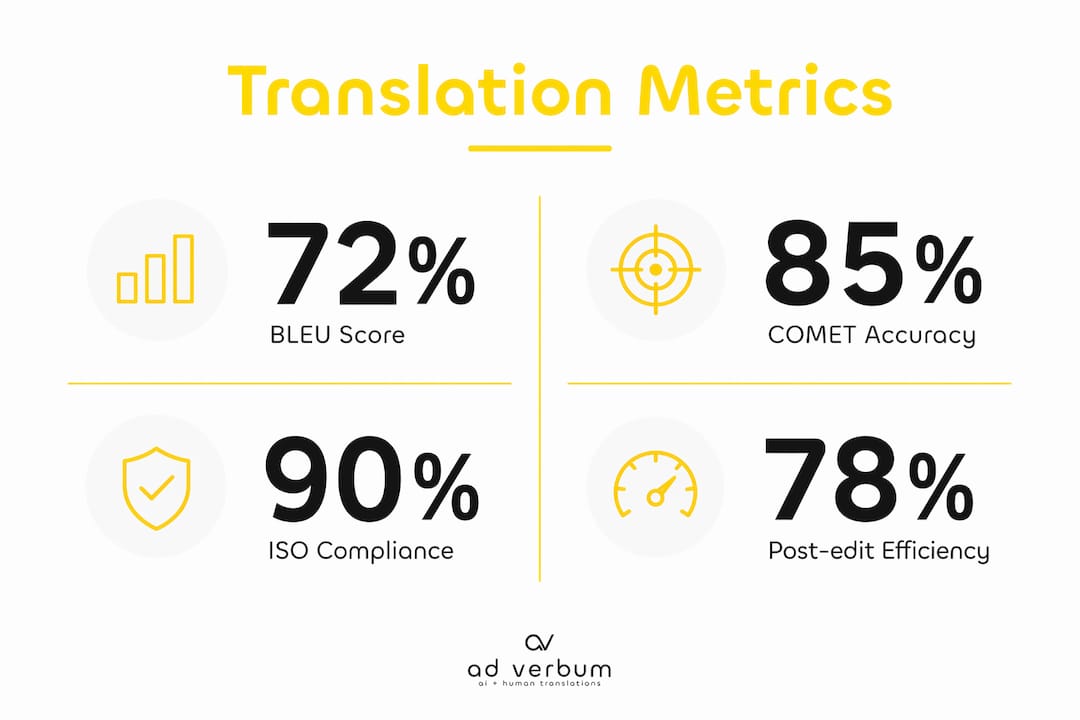
ISO 17100 and ISO 18587 set the process baseline for professional translation and post-editing respectively. Compliance with both requires documented QA steps, qualified reviewers, and traceable revision cycles. Neither standard can compensate for a source text that was never fit for translation in the first place.
AI-assisted metrics like COMET and BERTScore are now standard in enterprise workflows because they correlate better with human judgment than BLEU alone. Research shows that MT quality prediction from source text achieves Root Mean Square Error values in a low range and Pearson’s correlation up to 0.688, meaning source text features alone can forecast translation quality before a single word is translated with reasonable accuracy. That capability enables automated routing: clean source segments go to MT, borderline segments to MT with post-editing, and high-complexity or regulated segments to full human translation.
Continuous feedback loops close the quality cycle. When post-editors flag recurring error patterns, those patterns trace back to specific source content issues, which then inform author guidance and style guide updates.
How to prepare source content that actually improves translation quality
Pre-editing source texts to improve clarity, consistency, and simplification reduces translation errors, accelerates workflows, and is especially valuable in multilingual pipelines. The principles are straightforward; the discipline to apply them consistently is not.
Source content optimization steps:
Simplify sentence structure. Keep sentences to one idea. Subordinate clauses, nested conditionals, and passive constructions all increase translation difficulty.
Control terminology at the source. Define approved terms before writing begins. A corporate terminology database, enforced by authoring tools, prevents variant forms from entering the source.
Eliminate ambiguity. Pronouns with unclear antecedents, polysemous words used without context, and idiomatic phrases all create interpretation risk for MT engines and human translators alike.
Write for a global audience. Avoid locale-specific references: holidays, currency formats, legal citations, and culturally-bound humor do not translate cleanly.
Reduce word volume. AI translation engines produce better results when source text volume is reduced and simplified. Fewer words, written consistently, produce faster and higher-quality multilingual output.
Reuse approved content. Sentences already in the TM carry verified translations. Reusing them at the source eliminates translation cost and consistency risk simultaneously.
Apply a style guide. A documented style guide enforces sentence length limits, approved phrasing patterns, and punctuation conventions that MT engines handle predictably.
Workflow integration matters as much as the rules themselves. Author training, information quality management systems, and iterative review cycles keep source quality from degrading over time. Technology tools that flag non-compliant terminology in real time, integrated into authoring environments, catch problems before they reach the translation pipeline.
Pro Tip: Run a terminology audit on your source content before submitting it for translation. Identify every variant form of a key product or regulatory term and consolidate to a single approved form. That single step reduces post-editing time and TM fragmentation across all target languages.

High-quality source content reduces translation costs by minimizing errors, improving consistency, and speeding review cycles across languages. The cost of fixing a terminology error at the source is a fraction of the cost of correcting it after translation into ten languages.
Why AI+HUMAN hybrid translation outperforms standalone MT for variable source content
Standalone MT, whether legacy rule-based systems or publicly available Neural Machine Translation (NMT) engines, handles clean, simple source content reasonably well. The problem is that real-world source content is rarely clean or simple. Regulated documentation, legal contracts, and life sciences submissions contain domain-specific terminology, complex conditional structures, and compliance-critical phrasing that NMT engines handle inconsistently.
The distinction matters:
Legacy MT produces literal output with weak context handling. In safety-critical or regulated text, that produces a higher likelihood of critical meaning errors.
NMT (public SaaS engines) shows inconsistent terminology control, variable handling of negation and domain nuance, and governance limitations for regulated documentation.
AI+HUMAN hybrid translation combines context-sensitive LLM generation with explicit terminology governance and mandatory SME review, producing output that accounts for document function, regulatory context, and client-specific terminology.
Contextual awareness, including understanding source function (legal, instructional, aesthetic), is essential to prevent misinterpretation by both AI and human translators. A legal indemnity clause and a product description may use identical words with entirely different legal weight. An MT engine without document-level context handling cannot make that distinction reliably.
Error tolerance also varies by domain. Viewers tolerate minor MT errors in audiovisual content when visual and acoustic channels compensate, but that tolerance collapses in technical or regulated texts requiring precision. A subtitle error that viewers work around is categorically different from a mistranslated dosage instruction or a misrendered contract clause.
Benefits of the AI+HUMAN hybrid model for variable source content:
SMEs catch terminology errors that LLMs generate when source context is thin.
Document-level context handling prevents segment-level translation from losing cross-paragraph coherence.
Compliance review catches regulatory phrasing that must match approved language exactly.
Turnaround stays faster than traditional human-only workflows because the LLM handles volume; SMEs handle judgment.
For legal document translation, this combination is not optional. Source function awareness and SME review are the controls that prevent a compliant source text from producing a non-compliant translation.
Quality assurance processes that hold when source content varies
QA in translation is not a final proofreading step. It is a set of process controls that run throughout the workflow, designed to catch errors introduced at every stage, including those originating in the source.

ISO 17100 and ISO 18587 define the process requirements for professional translation and post-editing. ISO 17100 requires qualified translators, revision by a second linguist, and documented QA steps. ISO 18587 adds specific requirements for post-editing MT output, including competency standards for post-editors and defined quality levels (full post-editing vs. light post-editing). Both standards require that source content issues be flagged and resolved before or during translation, not after delivery.
Terminology governance is the QA control most directly tied to source content quality. A term base enforced at the source prevents variant forms from entering the pipeline. Enforced at the translation stage, it catches MT output that deviates from approved terminology. Without a term base, QA reviewers spend time on terminology decisions that should have been made once and applied consistently.
Process controls that reduce source-induced quality risk:
Quality gates at project intake that flag source content below defined readability or consistency thresholds.
Real-time analytics on TM match rates, which drop when source content is inconsistent.
Feedback loops from post-editors to authors, identifying recurring source patterns that generate translation errors.
Data sovereignty controls ensuring that sensitive source content is processed only within compliant infrastructure.
Contextual factors significantly impact translation quality, and ignoring context leads to errors that are especially problematic with AI translation tools. QA processes that treat translation as a purely linguistic task, without accounting for document function and regulatory context, miss the errors that matter most in high-stakes content.
For regulated sectors, QA alignment extends beyond ISO standards to sector-specific requirements: MDR for medical devices, HIPAA for protected health information, and AQAP2110 for defense documentation. Each adds requirements that trace back to source content accuracy and auditability.
How AD VERBUM’s LangOps System handles source content quality in practice
AD VERBUM’s AI+HUMAN hybrid translation workflow is built around the recognition that source content quality is a variable, not a given. The LangOps System, hosted on private EU servers, processes source content through a defined sequence designed to contain quality risk at each stage.
The workflow sequence:
Asset integration. Client TMs and TBs are ingested first, establishing the terminology and style baseline before any translation begins.
LLM generation. The proprietary LLM-based system produces target language output constrained by client terminology and style guidance, with document-level context handling.
SME review. Certified subject-matter experts review for technical accuracy, regulatory compliance, and contextual nuance. In Life Sciences and Legal, this step is mandatory regardless of source content quality.
QA alignment. Final QA is aligned to ISO 17100 and ISO 18587, with sector-specific requirements applied where relevant.
AD VERBUM’s metrics-driven approach applies this principle operationally. Source text features are assessed at intake to predict translation suitability and route segments accordingly, reducing post-editing volume on segments where MT output would require near-complete rewriting.
In Life Sciences, where a mistranslated instruction for use can trigger a regulatory submission failure, the combination of controlled source content, LLM-based generation with terminology enforcement, and mandatory SME review provides the audit trail that regulatory bodies require. In Legal, where cross-border contract terminology must be rendered with exact equivalence, the TB-constrained LLM generation and SME review prevent the terminology drift that standalone MT produces.
AD VERBUM holds ISO 9001, ISO 17100, ISO 18587, ISO 13485, ISO 27001, ISO 42001, ISO 14001, and AQAP2110 certifications, all independently audited by Bureau Veritas. For clients in regulated sectors, those certifications are the documented evidence that QA processes meet the standards their own compliance teams require.
The continuous improvement loop runs in both directions: post-editor feedback informs LLM fine-tuning, and source quality reports go back to client authors, reducing the volume of problematic source content in subsequent projects.
Why terminology and style standardization are non-negotiable upstream controls
Terminology standardization is the highest-leverage intervention available before translation begins. A single approved term, consistently applied across a source document, produces consistent TM matches, consistent TB hits, and consistent MT output. Every variant form of that term, whether a synonym, an abbreviation, or a regional spelling, breaks that chain.
Style standardization operates at the sentence level. A style guide that enforces sentence length limits, approved sentence structures, and punctuation conventions gives MT engines predictable input. Predictable input produces predictable output. That predictability is what makes TM leverage possible: a sentence written the same way as a previously translated sentence retrieves the existing translation rather than generating a new one.
The terminology enforcement guide for technical translation covers the mechanics of building and maintaining a term base that survives personnel changes and product updates. The core principle is that terminology decisions are made once, documented, and enforced by tooling, not left to individual author judgment on each document.
For organizations translating into multiple languages simultaneously, style standardization at the source multiplies in value. A sentence restructured for clarity in English produces cleaner output in all target languages, not just one. The investment in source quality is amortized across every language pair in the project.
What poor source content actually costs in practice
The failure modes from poor source content are predictable, and they follow a consistent pattern across sectors.
Terminology inconsistency is the most common source-induced quality problem. When a source document uses three different terms for the same product component, the translation produces three different target-language terms, none of which may match the approved term in the client’s existing documentation. Post-editors must then decide which term is correct, often without access to the client’s TB, producing inconsistent output that requires a second review cycle.
Structural complexity drives MT quality down measurably. Research confirms that sentence length, polysemy, and structural complexity negatively correlate with MT quality across eleven language pairs. A 40-word sentence with three subordinate clauses and two polysemous terms is not a translation challenge. It is a translation failure waiting to happen.
Ambiguous pronoun reference is a specific failure mode that MT engines handle poorly. When “it” or “they” could refer to multiple antecedents in the source, the MT engine makes a choice. That choice is often wrong, and the error is often invisible to a post-editor who did not read the surrounding paragraphs.
Culturally-bound phrasing produces translation that is technically accurate but locally inappropriate. A legal disclaimer written for a US audience may reference specific federal statutes that have no equivalent in the target jurisdiction. A product description using American idioms may produce target-language text that reads as awkward or unprofessional.
Cascading cost structure is the financial consequence. An error introduced in the source and not caught before translation is corrected once in the source and once in every target language. In a 20-language project, a single source error generates 20 correction tasks. For organizations working with AI legal tools in document preparation, catching these errors before translation is the point where the cost curve bends.
What the evidence shows: source quality in regulated and technical translation
The clearest evidence for source content quality impact on translation comes from regulated sectors, where the cost of a mistranslation is not a quality score but a compliance failure.
In Life Sciences, a medical device instruction for use translated from a poorly structured source has produced regulatory submission rejections where the target-language text was technically accurate but failed to meet the clarity requirements of the target market’s regulatory authority. The source was the problem. The translation was faithful to a source that was not fit for purpose.
In Legal, corporate transactions involving cross-border documentation require that defined terms in the source carry exactly the same meaning in every target-language version. When source documents use defined terms inconsistently, or define them in one section and use variants elsewhere, the translation produces target-language documents where the defined term and its variants appear as separate concepts. That is a contract drafting error introduced at the source and amplified by translation. Legal counsel working on corporate transactions increasingly require source document review as a pre-translation step for this reason.
In technical documentation, a software user guide with inconsistent UI element names produces translations where the same button is referred to by three different names across chapters. Users cannot follow the instructions. The source was the failure point.
The pattern across all three examples is the same: source content quality determines the ceiling for translation quality, and no post-editing process, however thorough, fully compensates for a source that was not prepared for translation.
How AD VERBUM’s translation services address source quality at scale
AD VERBUM’s translation services are built for organizations where source content quality is variable and the cost of translation failure is high. The LangOps System handles 150+ languages, including regional variants, with 3,500+ subject-matter expert linguists covering Life Sciences, Legal, Finance, Defense, and Manufacturing.
For project managers and localization specialists who need predictable quality at scale, AD VERBUM’s AI+HUMAN hybrid translation delivers turnaround substantially faster than traditional workflows, with ISO 17100 and ISO 18587 aligned QA, private EU-hosted infrastructure, and mandatory SME review for regulated content. The LangOps System’s source quality assessment at intake means that routing decisions, post-editing scope, and QA requirements are defined before translation begins, not discovered during review.
Contact AD VERBUM to assess your source content quality and define the right workflow for your next multilingual project.
Key Takeaways
Source content quality sets the ceiling for translation quality in every workflow, and no post-editing process fully compensates for a source that was not prepared for translation.
Point | Details |
Source quality determines output ceiling | Ambiguity, inconsistency, and structural complexity in source text degrade MT and human translation quality before any translator begins. |
MT suitability is predictable | Models can predict MT quality from source text alone, with Pearson’s correlation reaching moderate levels, enabling automated workflow routing before translation starts. |
Pre-editing reduces downstream cost | Simplifying source sentences, controlling terminology, and eliminating ambiguity reduces post-editing volume and error correction across all target languages. |
ISO 17100 and ISO 18587 set the QA baseline | Both standards require documented QA steps and qualified reviewers; neither compensates for source content that was not fit for translation. |
AI+HUMAN hybrid translation handles variability | Combining LLM-based generation with SME review and TB enforcement manages source content variability in regulated and high-stakes translation. |
Recommended