


Avoid 20–40% Delays: Multilingual DTP for Regulated Medical Teams

Multilingual DTP for medical content turns translated text into regulatory-ready, visually consistent documents in every target language, matching source layout, pagination, and typography before final release. Commission it after translation export and before printing or publishing. Teams releasing IFUs, labels, SmPCs, or clinical trial materials across markets need this step to catch layout breaks, missing fonts, and script errors that translation alone won’t reveal, and to ensure seamless integration with medical practice management systems.
Table of Contents
What Is Multilingual DTP in a Regulated Context?
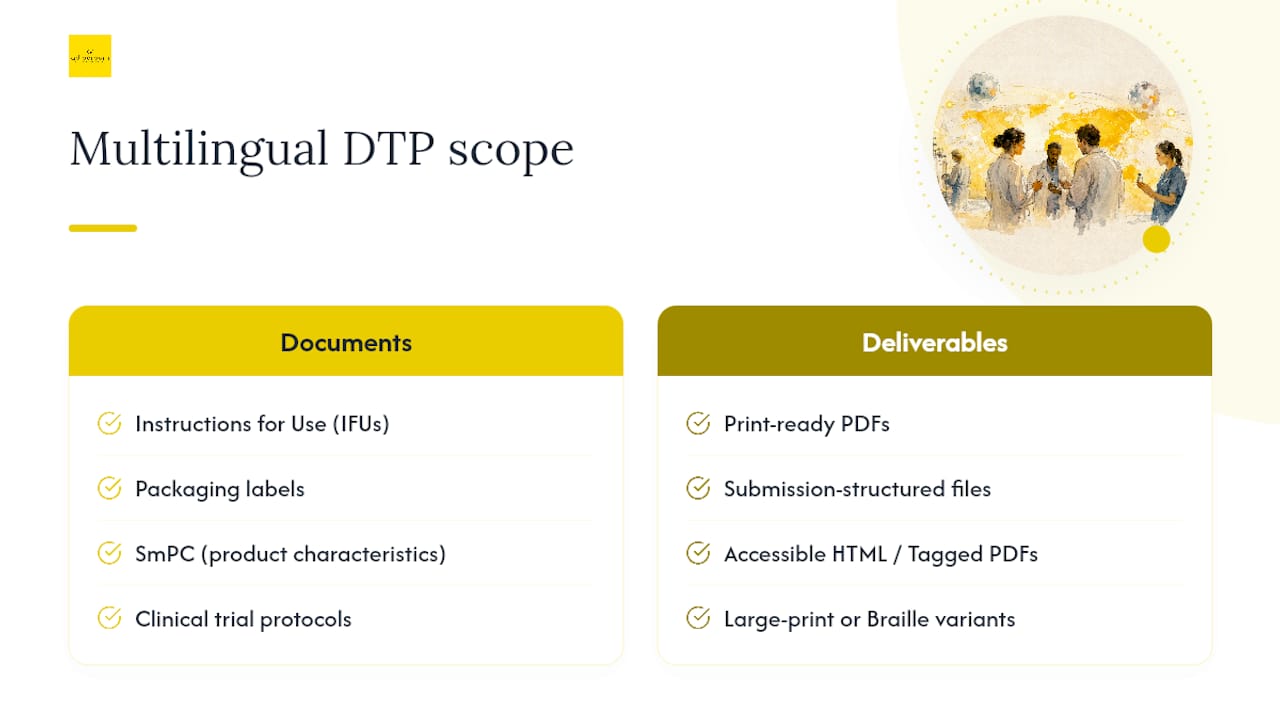
Multilingual DTP is the layout and formatting stage that takes translated text and rebuilds it inside the original document structure, in every target language, so the final file reads correctly and matches the approved source design. In medical and life-sciences work, that means instructions for use (IFUs), packaging labels, Summary of Product Characteristics (SmPC) documents, clinical trial protocols, and patient-facing marketing materials.
Deliverable formats typically include print-ready PDFs, structured files for regulatory submission, accessible HTML or tagged PDFs for e-labeling, and sometimes large-print or Braille-ready variants for patient accessibility requirements. Scope shifts depending on the target: a submission-ready SmPC has different pagination and cross-reference rules than a consumer IFU insert, and procurement teams should define which category applies before quoting the work.
The Three-Phase DTP Workflow
Medical multilingual DTP follows a three-phase structure that vendor guides and risk-checking resources consistently describe: preparation, layout, and sign-off.
Pre-translation file preparation. Package source files, embed fonts, integrate the client’s translation memory ™ and term base (TB), and document style notes so translators and DTP specialists work from the same reference.
Layout and DTP. Import finished translations into the native file, re-typeset text, and adjust layout for expansion, contraction, right-to-left (RTL) mirroring, or CJK (Chinese, Japanese, Korean) character spacing.
Final technical and linguistic QA (DTP sign-off). Bilingual reviewers check the typeset output against source content, confirm pagination and numbering survived the layout pass, and issue preflight approval before delivery.
Each phase needs a clear gate. Skipping phase one is the single most common cause of rework later, because a poorly packaged source file forces the DTP team to reconstruct formatting from scratch instead of adapting it.
A File-Preparation Checklist Worth Putting in Your SOW
Poor source file preparation can add roughly 20 to 40 percent to localization timelines and costs, according to a DTP Labs analysis of project data. That range is large enough that a procurement team should treat file prep as a contractual gate, not a courtesy.
Pro Tip: Attach a file-preparation checklist directly to your statement of work. Vendors quote more accurately, and rework disputes have a written standard to point back to.
Require the following before translation even starts:
Embed all fonts and package linked assets (images, graphics, style sheets) with the native file.
Provide editable source files (InDesign, FrameMaker, Word) rather than flattened PDFs.
Use paragraph and character styles consistently instead of manual formatting overrides.
Tag non-translatable text (trademarks, code numbers, unit symbols) so it’s excluded automatically.
Supply existing TM and TB assets so terminology stays consistent across the document set.
Include metadata (product codes, market destinations, revision history) and a reference output sample.
Specify accessibility requirements upfront if the deliverable needs tagged PDF or HTML output.
Which File Formats and Tools Actually Work
Packaged InDesign files with linked IDML, and structured FrameMaker documents with consistent style tagging, are the safest formats to accept for medical DTP work. Both preserve style definitions and asset links, which means the layout phase adapts existing structure instead of rebuilding it.
Scanned or flattened PDFs are the opposite case: there’s no editable text layer, no font data, and no style hierarchy, so the DTP team has to reconstruct the document before translation can even begin. That reconstruction work is often quoted separately, and it’s the fastest way for a project timeline to slip.
A few tool-specific notes matter for regulated content:
InDesign’s World-Ready Composer handles Middle Eastern and South Asian scripts correctly; standard composition mode does not.
FrameMaker remains the standard for long structured documents like clinical protocols and technical manuals with heavy cross-referencing.
Target outputs should be specified explicitly: print-ready PDF/X for packaging, accessible tagged PDF or HTML5 for e-labeling, and large-print or Braille-adjacent layouts where regulatory or market requirements call for them.
What DTP Linguistic Sign-Off Has to Check
DTP sign-off is where layout and regulatory risk actually get caught, and it needs a specific set of deliverables to do that reliably. Community DTP guidance on linguistic sign-off lays out the standard checks:
Layout integrity. Hyphenation, line breaks, numbering sequences, pagination, and cross-references all have to survive the language swap intact.
Regulatory formatting. Symbols, unit conventions, and labeling layout constraints need review against applicable EMA expectations or, where relevant, MDR and IVDR labeling rules.
Acceptance artifacts. The reviewer should receive a bilingual comparison PDF, an annotated comment log, and the final approved output file as a package, not as separate loose deliverables.
Pro Tip: Never accept “final” files without the bilingual comparison PDF attached. Without it, there’s no audit trail proving the linguist actually checked the typeset output against the approved source text.
Even a technically correct translation can fail sign-off if pagination shifts a warning statement onto the wrong page or breaks a required cross-reference. That’s a layout defect, not a translation error, and it needs the same scrutiny either way.
Common Failure Modes and How to Contract Around Them
Most multilingual DTP problems trace back to four recurring issues, all of which are predictable and all of which can be written into a contract before they happen.
Text expansion or contraction. German and Finnish translations often run 20 to 30 percent longer than English source text, while CJK languages tend to contract. Build flexible templates with adjustable type sizes instead of fixed text boxes.
Missing fonts. Require font package delivery or written licensing confirmation for every target language font before layout work starts, and define a fallback font policy in the SOW.
Locked or flattened PDFs. Specify editable source files as a delivery requirement, or define reconstruction fees and turnaround SLAs upfront so cost isn’t a surprise later.
RTL and CJK handling. Mandate script-aware DTP resources and require native-speaker proofing for right-to-left languages, since full layout mirroring (page flow, table order, image placement) is a different skill set than left-to-right typesetting.
Following a structured preflight checklist at intake catches most of these before they become billable change orders.
When an AI+HUMAN Hybrid Provider Fits This Work
Select a provider built for regulated content when three conditions apply: the document needs an audit trail, terminology has to stay locked across every language and every revision, and the underlying workflow needs to satisfy ISO 17100, ISO 18587, ISO 13485, or HIPAA alignment for medical data handling.
A qualified provider runs an AI+HUMAN hybrid workflow built around that requirement set: client TM and TB assets are ingested first, a proprietary LLM-based system generates target-language output constrained by that terminology, a subject-matter expert linguist reviews for technical accuracy and regulatory nuance, and QA runs aligned to ISO 17100 and ISO 18587 standards. That structure holds for two common scenarios. A medical device manufacturer releasing an IFU across 15 markets needs the same terminology enforced in every language simultaneously, with a documented SME review trail for each one. A multi-national clinical trial sponsor localizing a patient consent packet needs pagination, numbering, and cross-references to survive translation into every trial-site language without a single formatting deviation that a notified body could flag. Both cases call for the same discipline: structured medical translation compliance checks married to a DTP process that treats layout as a regulatory control, not a cosmetic pass.

Procurement Priorities That Actually Move the Needle
File preparation, TM and TB integration, and a documented DTP sign-off decide more of a regulated multilingual project’s outcome than any single vendor choice. Skip the preflight gate and you inherit someone else’s formatting mess three languages deep into the project. Skip the bilingual sign-off and you’re trusting that pagination didn’t quietly break a required warning statement.
Require a DTP preflight check and a bilingual sign-off deliverable in every statement of work before the project starts, not as an optional add-on after delivery.
— Eric Brown
Get a Quote for Multilingual DTP and ISO-Aligned QA
AD VERBUM is the practical alternative to piecing together translation, layout, and compliance QA across separate vendors: one AI+HUMAN hybrid workflow handles all three, on EU-hosted infrastructure aligned to ISO 17100, ISO 18587, and HIPAA.
The core services map directly to the checklist above: AI+HUMAN hybrid translation, multilingual localization and DTP, ISO-aligned linguistic QA, and TM/TB integration from your existing terminology assets. When you request a quote, include your source files, target languages, required regulatory outputs (print PDF, tagged PDF, e-labeling), and delivery deadline. That’s enough for an accurate scope and turnaround estimate without a back-and-forth. Visit the services overview to see the full offering or start a quote request directly.
Sources
Check the file-preparation checklist and risk checker before scoping any project. Review EMA guidance for labeling expectations, W3C internationalization notes for script handling, and community DTP sign-off instructions for acceptance criteria.
FAQ
What Is Multilingual DTP?
Multilingual DTP is the process of laying out and typesetting translated content across multiple languages so the final document matches the source design in pagination, fonts, and formatting. In medical work, it happens after translation and before final delivery, and it includes a dedicated linguistic sign-off step.
What Does DTP Mean in Translation?
DTP stands for desktop publishing, referring to the layout and formatting work that turns translated text into a finished, print-ready or digital-ready document. It’s distinct from translation itself, since a document can be translated correctly but still fail DTP if pagination, numbering, or symbols break during typesetting.
What Are the Main Uses of DTP in Medical Localization?
DTP in medical localization typically covers instructions for use (IFUs), product labeling, SmPC documents, clinical trial materials, and patient-facing marketing content. Each document type carries different regulatory formatting expectations, from MDR labeling rules to accessible e-labeling standards.
How Much Extra Time Should I Budget for DTP on a Multilingual Medical Project?
Budget depends heavily on file readiness. Poorly prepared source files can add 20 to 40 percent to project timelines and costs, so a clean, packaged native file with embedded fonts and TM/TB integration is the single biggest lever for keeping DTP on schedule.
Does AD VERBUM Offer Multilingual DTP for Regulated Documents?
AD VERBUM’s localization services include DTP work integrated with AI+HUMAN hybrid translation, TM/TB asset management, and QA aligned to ISO 17100 and ISO 18587. Pricing is scoped per project through a quote request, since costs vary by language count, file complexity, and regulatory output requirements.
Recommended