


Why EU Defense Tenders Require Vetted Translators

EU defense tenders require vetted translators because sharing controlled technical data with an unvetted linguist constitutes an unlicensed export under EU Dual-Use Regulation 2021/821, Article 2(2)(b). This is not a procurement preference. It is a legal obligation enforced by National Competent Authorities including Bafa in Germany, DGA in France, and UAMA in Italy. Procurement and compliance officers who overlook translator vetting expose their organizations to regulatory penalties, contract disqualification, and reputational damage that no NDA can undo. The formal industry term for this requirement is “controlled technical data access compliance,” and it applies the moment a classified or dual-use document leaves your organization’s access-controlled environment.
Why EU defense tenders require vetted translators: the legal foundation
The core legal trigger is the concept of “deemed transfer” defined in EU Dual-Use Regulation 2021/821, Article 2(2)(b). A deemed transfer occurs when controlled technical data is made accessible to a person outside the authorized control boundary, regardless of whether that person is physically located in another country. Handing a defense tender document to an unvetted freelance translator satisfies this definition. The transfer is deemed to have occurred the moment access is granted.
This matters because EU dual-use export controls were designed to prevent sensitive technology from reaching unauthorized parties. Translation is not exempt from this logic. The content of the document, not the act of translating it, determines whether export controls apply.
National Competent Authorities enforce these rules with real consequences:
Bafa (Germany) administers dual-use licensing and conducts compliance audits under the Federal Office for Economic Affairs and Export Control framework.
DGA (France) oversees defense procurement and export authorization, including oversight of subcontractors handling controlled data.
UAMA (Italy) enforces Law 185/1990 alongside EU Regulation 2021/821, with authority to investigate and penalize unlicensed transfers.
Penalties for unlicensed transfers include criminal prosecution, substantial fines, and permanent exclusion from future defense procurement. For companies actively bidding on EU defense contracts, a single compliance failure can close access to an entire market segment.
How facility and personnel security clearances apply to translators
The vetting process for translators operates on two levels: organizational and individual. Both must be in place before any controlled document changes hands.

A Facility Security Clearance (FSC) is issued to an organization, not an individual. It certifies that the company has the physical infrastructure, document handling procedures, and internal controls required to process classified information. FSC is a prerequisite for any organization handling NATO, EU, or ESA classified material. Without it, no employee of that organization can legally receive a Personnel Security Clearance (PSC).
A Personnel Security Clearance (PSC) is issued to individuals. It involves rigorous background checks covering criminal history, financial stability, foreign contacts, and loyalty assessments. PSC is granted only when the employing organization already holds FSC. This structural dependency is intentional. It creates a layered security model where individual access is only possible within a verified organizational framework.
The practical steps for a language service provider to achieve clearance eligibility follow a defined sequence:
Apply for FSC. The organization submits to a security audit conducted by national security services such as AIVD (Netherlands) or MIVD (Dutch Military Intelligence). The audit procedures verify secure physical environments, document handling processes, IT security controls, and personnel management practices.
Receive FSC certification. Upon successful audit, the organization is certified to handle classified material at the specified level.
Nominate individual translators for PSC. Each translator who will access controlled content undergoes a personal background investigation.
Receive PSC for each nominated individual. Only cleared individuals may then access classified tender documents.
Pro Tip: When evaluating a language service provider for defense work, request documentary evidence of both FSC and PSC for the specific linguists assigned to your project. A provider with FSC but uncleared individual translators is still non-compliant for classified document access.
Contractual NDAs do not substitute for this process. NDAs alone cannot ensure compliance when classified data is involved. An NDA is a civil instrument. FSC and PSC are legal prerequisites under public law. Treating them as equivalent is one of the most common and costly compliance errors in defense procurement.
How nationality vetting and contractual obligations shape the compliance chain
Beyond security clearances, nationality vetting restricts access to controlled technical data based on the translator’s citizenship and residency profile. This is not discrimination. It is a risk control mechanism built into EU and NATO security frameworks. Only translators from permitted nationalities with appropriate clearances may legally translate defense tender content.
Defense prime contractors carry the primary compliance responsibility. When they subcontract translation to a language service provider, they pass that responsibility down through contractual clauses. These clauses typically specify:
Mandatory FSC and PSC verification before document access is granted.
Nationality restrictions aligned with the classification level of the content.
Audit rights allowing the prime to inspect the LSP’s compliance records.
Incident reporting obligations if a security breach or unauthorized access occurs.
Termination rights if the LSP fails to maintain required clearance status.
Failure modes in this chain are well documented. An LSP that subcontracts to a freelancer without verifying that freelancer’s clearance status breaks the chain of custody. The prime contractor remains liable. A translator who holds PSC but whose employing organization has lost FSC is no longer legally authorized to access classified material, even if the individual’s personal clearance has not expired. Linguist vetting must align both individual and organizational clearances simultaneously. Misalignment at either level invalidates the entire compliance posture.
The procurement consequence is direct. Tender evaluators at contracting authorities check compliance documentation as part of bid assessment. A bid that cannot demonstrate vetted translation handling for its technical annexes is a bid at risk of disqualification, regardless of the quality of the underlying proposal.
Vetted vs. unvetted translators: what the difference means for your bid
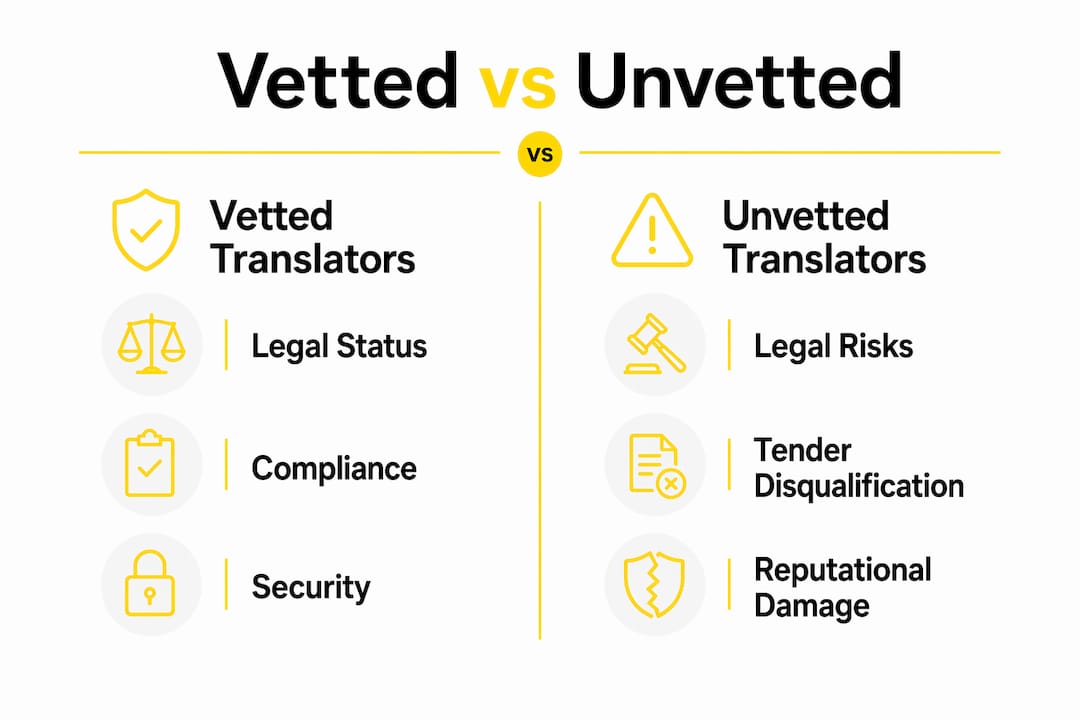
The table below maps the practical differences between vetted and unvetted translation approaches across the dimensions that matter most to procurement and compliance officers.
Dimension | Vetted translators | Unvetted translators |
Legal status under Regulation 2021/821 | Compliant: authorized access to controlled data | Non-compliant: access constitutes deemed transfer |
Security clearance | FSC at organizational level, PSC at individual level | None required or verified |
Nationality vetting | Verified against permitted nationality lists | Not assessed |
Auditability | Full documentation trail for compliance review | No audit trail |
Tender eligibility | Maintains bid compliance | Risks disqualification |
NCA enforcement exposure | Minimal when clearances are current | High: subject to penalties from Bafa, DGA, UAMA |
Terminology governance | Enforced through controlled glossaries and TM assets | Inconsistent, no governance framework |
Using unvetted translators risks legal violations, tender disqualification, and reputational damage. The risk is not theoretical. NCAs conduct post-award audits and can investigate translation subcontractors as part of export control enforcement.
AD VERBUM operates under ISO 17100 for translation quality management, ISO 27001 for information security, and is aligned with AQAP 2110 defense quality standards. These certifications provide the compliance baseline that defense tender evaluators expect to see in an LSP’s qualification documentation.
Pro Tip: Ask your LSP to provide its ISO 27001 certificate and a summary of its FSC status before contract signature. If the provider cannot produce both documents, the translation workflow is not compliant for classified defense content.
Practical steps to build a compliant translation workflow for EU defense tenders
Compliance does not happen by default. It requires deliberate process design at each stage of the tender preparation workflow. The following sequence gives procurement and compliance officers a structured path to defensible compliance.
Classify your documents before translation begins. Identify which annexes, specifications, and technical data sheets contain controlled content under EU Dual-Use Regulation 2021/821. Not every document in a defense tender requires the same level of control.
Verify LSP clearance status. Confirm that the language service provider holds current FSC. Request the certificate and check its validity date and scope. Review the 5 best translation partners for NATO and EU defense work as a reference benchmark.
Confirm individual PSC for assigned translators. FSC at the organizational level is necessary but not sufficient. Each translator working on controlled content must hold a current PSC. Request the names and clearance references for all assigned linguists.
Verify nationality compliance. Cross-reference translator nationalities against the permitted nationality requirements for your specific contract classification level.
Execute compliant contractual documentation. Include audit rights, nationality restrictions, incident reporting obligations, and termination clauses in your LSP agreement. Review your multilingual bid preparation process to confirm these clauses are standard in your template.
Implement secure document handling. Use encrypted transfer channels, access-controlled repositories, and version-controlled document management. A data security checklist for regulated sector translations provides a practical starting point.
Conduct a pre-submission compliance review. Before filing the tender, verify that all translation documentation, clearance records, and contractual instruments are complete and current. Gaps identified at this stage are recoverable. Gaps identified by an NCA auditor after award are not.
AD VERBUM’s AI+HUMAN hybrid translation workflow integrates these controls directly into the production process. Asset integration ingests client Translation Memories and Term Bases first, establishing terminology governance before any output is generated. The proprietary LLM-based LangOps System then produces target language output constrained by client terminology and style guidance. A certified subject-matter expert reviews for technical accuracy, regulatory compliance, and contextual nuance. QA is aligned to ISO 17100 and ISO 18587. The entire process runs on EU-hosted private infrastructure with no reliance on public cloud tooling, which directly supports data sovereignty requirements in defense contracts.
Key takeaways
EU defense tenders require vetted translators because sharing controlled technical data with an uncleared linguist is an unlicensed export under EU Dual-Use Regulation 2021/821, enforceable by Bafa, DGA, and UAMA with penalties including bid disqualification and criminal prosecution.
Point | Details |
Deemed transfer rule | Granting document access to an unvetted translator triggers Article 2(2)(b) of Regulation 2021/821. |
FSC before PSC | Organizations must hold Facility Security Clearance before any individual translator can receive Personnel Security Clearance. |
NDAs are insufficient | Contractual NDAs do not substitute for FSC and PSC under public law; relying on them alone is a compliance failure. |
Nationality vetting is mandatory | Only translators from permitted nationalities with current clearances may legally access controlled defense content. |
Certification baseline | ISO 17100, ISO 27001, and AQAP 2110 alignment are the minimum standards to look for when qualifying an LSP for defense work. |
The compliance gap most bidders discover too late
I have reviewed enough defense tender post-mortems to identify a consistent pattern. Companies that lose bids on translation compliance grounds almost never failed because they used bad translators. They failed because they used good translators who lacked the right clearances. The linguistic quality was fine. The legal authorization was absent.
The misunderstanding runs deep. Many procurement teams treat translation as a document production task and apply the same vendor selection logic they use for printing or formatting services. They check price, turnaround, and language pairs. They do not check FSC status, PSC records, or nationality compliance. By the time the contracting authority’s compliance team flags the gap, the bid is already compromised.
EU enforcement is tightening. The 2021 recast of the dual-use regulation expanded the definition of technology transfer and gave NCAs broader audit authority. Bafa, DGA, and UAMA are not passive observers. They conduct proactive compliance reviews, and translation subcontractors are within scope. The companies that treat vetting as a checkbox exercise are the ones that generate enforcement cases.
My advice is to build vetting into your LSP qualification process the same way you build it into your security subcontractor selection. Require FSC documentation as a pass/fail criterion. Require PSC records for named translators before document access is granted. Treat any LSP that cannot produce both as ineligible for controlled content, regardless of their other qualifications.
How AD VERBUM supports compliant tranEU defense tenders
AD VERBUM is a language service provider with 25 years of experience in regulated sectors including defense, life sciences, and legal. Its ISO 27001 certified infrastructure runs on EU-hosted private servers, with no public cloud exposure for core processing. ISO 17100 governs translation quality management, and AQAP 2110 alignment is in progress for defense-specific quality assurance. The AI+HUMAN hybrid translation model combines proprietary LLM-based generation with certified subject-matter expert review, delivering output that meets both linguistic and regulatory standards. AD VERBUM’s network of 3,500+ expert linguists includes engineers and legal scholars with domain-specific credentials. For defense tender translation that holds up to NCA scrutiny, explore AD VERBUM’s approach to compliance-aligned language services.
FAQ
What is a “deemed transfer” under EU Regulation 2021/821?
A deemed transfer occurs when controlled technical data is made accessible to an unauthorized person, regardless of physical location. Sharing a defense document with an unvetted translator satisfies this definition and constitutes an unlicensed export.
Why are NDAs not enough for defense translation compliance?
NDAs are civil contracts and do not satisfy the public law requirements for classified data access. Facility Security Clearance and Personnel Security Clearance are legal prerequisites that NDAs cannot replace.
Which authorities enforce translator vetting requirements in EU defense tenders?
Bafa in Germany, DGA in France, and UAMA in Italy are the primary National Competent Authorities that enforce dual-use export controls, including compliance audits covering translation subcontractors.
What certifications should an LSP hold for EU defense translation work?
ISO 17100 for translation quality management, ISO 27001 for information security, and AQAP 2110 for defense-specific quality assurance are the baseline certifications to verify when qualifying a language service provider for controlled defense content.
Can a translator with PSC work for any organization on defense content?
No. A Personnel Security Clearance is valid only within the context of an organization that holds a current Facility Security Clearance. If the employing organization loses FSC, the individual’s PSC no longer authorizes access to classified material.
Recommended

