


EUDAMED Multilingual Notified Body Certificates: 2026 Guide
- Jun 4
- 8 min read

EUDAMED’s Notified Bodies and Certificates module is defined as the mandatory EU database mechanism through which Notified Bodies upload certificate scope, conditions, validity, and language of issuance for all medical devices regulated under MDR and IVDR. As of 28 May 2026, this module became compulsory for all new certificates, with legacy certificates required in the system by 28 May 2027. For regulatory affairs managers, understanding how EUDAMED handles multilingual notified body certificates is not optional. Misaligned scope text, mistranslated fixed identifiers, or incomplete submissions cause validation failures that block device market entry across the EU.
How does EUDAMED handle multilingual notified body certificates?
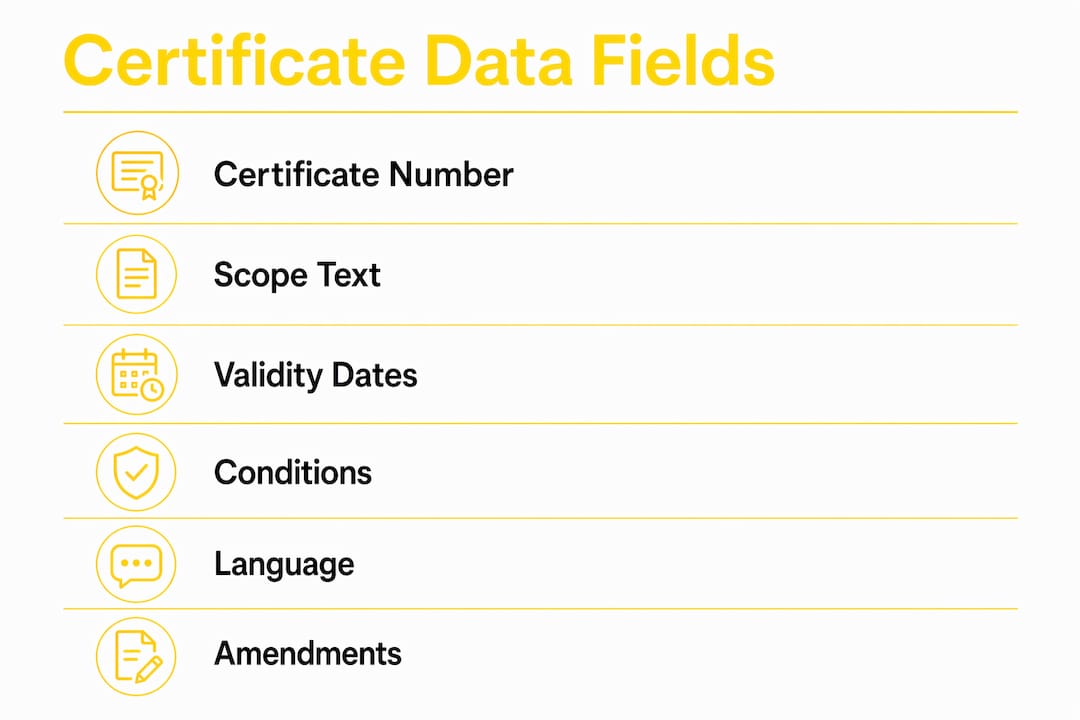
EUDAMED records certificate data through structured fields, not free-text documents. Notified Bodies enter the certificate number, scope text, validity dates, conditions, and the language or languages in which the certificate was issued. The EUDAMED user interface supports all official EU languages, but free-text fields linked to certificates require careful management to prevent translation errors that trigger validation failures.
The module does not automatically translate certificate scope text. Each language version of a scope statement must be entered with precision, matching the exact phrasing used in the manufacturer’s technical documentation and device registration data. This is where most multilingual certificate management problems originate: a scope statement translated loosely into German or French will not match the controlled terminology in the manufacturer’s Instructions for Use (IFU) or technical file, and EUDAMED’s validation logic will flag the discrepancy.
What certificate data fields are captured
The following data elements are recorded in EUDAMED for each notified body certificate:
Certificate number and issuing Notified Body identifier
Certificate scope text in the language of issuance, with exact phrasing required
Validity period, including start date, expiry, and any suspension or withdrawal status
Certificate conditions and any restrictions on intended purpose
Language(s) of issuance, entered explicitly to support traceability across EU member states
Amendment history, with each version requiring a separate structured entry
The Basic UDI-DI functions as the anchor referencing Notified Body certificates, not the reverse. This directional logic matters: a change to certificate data can trigger a required update to the Basic UDI-DI record, which in turn affects device registration visibility. Regulatory experts confirm that misunderstanding this relationship is one of the most common causes of data management errors and delayed market entry.
Pro Tip: Never treat the Basic UDI-DI as a static identifier. Map its dependencies to certificate fields before any certificate amendment, and verify that scope text changes propagate correctly through device registration records.
Certificate field | Multilingual management requirement |
Scope text | Exact phrasing must match IFU, labels, and technical file in each language |
Language of issuance | Entered explicitly; supports cross-border traceability |
Certificate conditions | Translated conditions must preserve legal meaning without paraphrase |
Amendment records | Each version requires a separate, language-consistent entry |
How does EUDAMED certificate translation align with technical documentation?
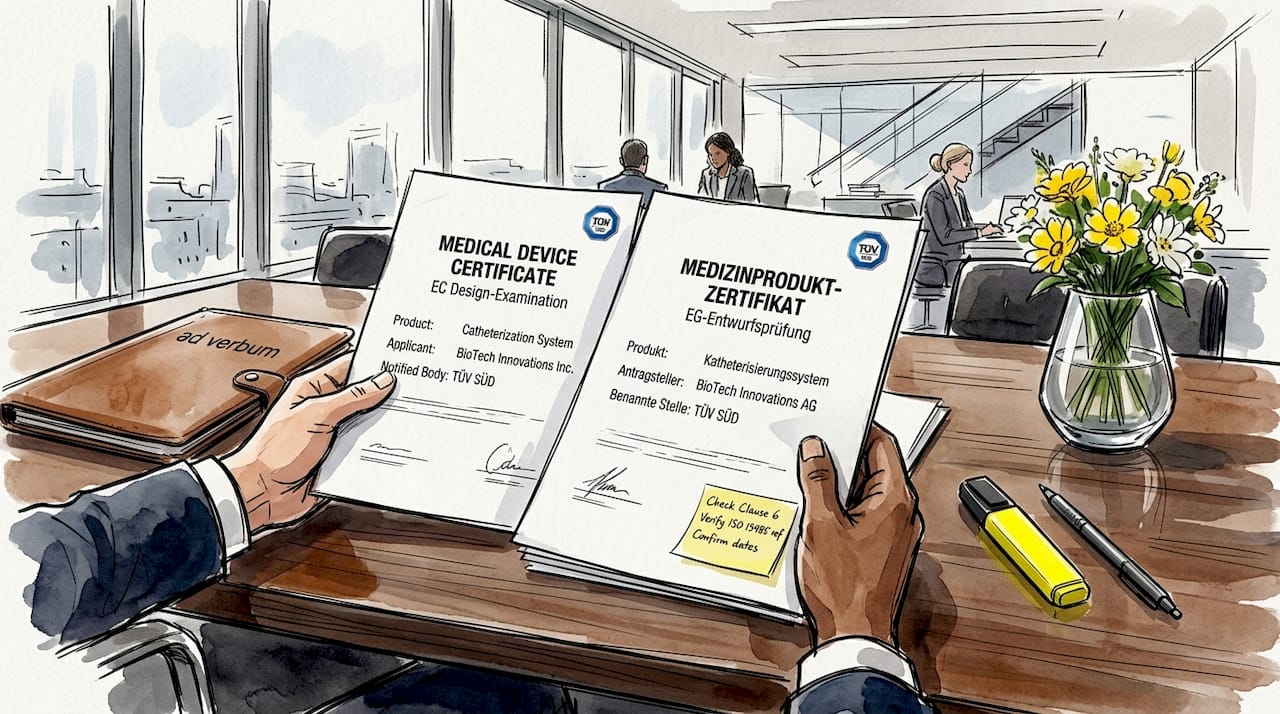
Treating multilingual certificate data as governed data rather than a simple translation task is the baseline requirement for EUDAMED compliance. The distinction matters because ad hoc translation introduces uncontrolled terminology variation. When a Notified Body enters a scope statement in English and the manufacturer’s French IFU uses a different term for the same device component, EUDAMED’s validation logic identifies a mismatch. The result is a stalled registration, not a minor administrative correction.
The standards that define EUDAMED-grade translation quality are ISO 17100 (translation service requirements), ISO 13485 (quality management for medical devices), and ISO 27001 (information security management). Using translation services certified to these standards is the documented baseline for consistent, compliant multilingual certificate entries. This is not a recommendation. It is the control framework that auditors and Notified Bodies reference when reviewing documentation quality.
Terminology governance requires three specific controls:
Controlled glossaries. Every device-specific term used in certificate scope text must have an approved translation in each required EU language. Glossaries must be version-controlled and shared between the manufacturer and the Notified Body before certificate submission.
Do-not-translate lists. Codes, identifiers, product reference numbers, and fixed regulatory terms must not be translated. EUDAMED treats these as fixed values. Translating them introduces data mismatches that fail automated validation.
Harmonization across document sets. The scope language in the EUDAMED certificate must match the IFU, device labels, and technical documentation in every language. A single divergent term across these documents creates an audit finding.
Pro Tip: Build your do-not-translate list before the first certificate submission, not after the first validation error. Include all UDI-related codes, Notified Body reference numbers, and any regulatory classification terms that appear verbatim in EUDAMED fixed-value fields.
The EUDAMED registration guide published by Adverbum covers the procedural steps for aligning certificate and device data in detail, including the specific fields where terminology mismatches most frequently occur.
What are the practical steps for managing multilingual certificates in EUDAMED?
Effective multilingual certificate management in EUDAMED requires coordination between the manufacturer and the Notified Body before any data entry begins. The following sequence reflects current best practice for regulatory affairs teams managing this process.
Align on certificate identifiers and scope text early. Before the Notified Body uploads any certificate data, the manufacturer and NB must agree on the exact phrasing of scope text in every required language. This agreement should be documented in a formal quality agreement or technical protocol.
Submit complete technical documentation. 65% of MDR technical files submitted to Notified Bodies are incomplete, which directly delays certificate issuance and EUDAMED registration. Incomplete submissions are the single largest controllable cause of registration delays.
Register legacy certificates before 28 May 2027. Certificates issued before the mandatory use date must be entered into EUDAMED by this deadline. Manufacturers should audit all active certificates now and prioritize those with complex multilingual scope statements.
Establish a formal amendment protocol. Certificate renewals and amendments require updated EUDAMED entries. Each update must go through the same terminology governance process as the original submission, including glossary verification and scope text harmonization.
Confirm device registration status after NB upload. Manufacturer device registration remains in “Submitted” status until the Notified Body validates the certificate link. Build a monitoring step into your registration workflow to catch misalignments before they delay market access.
The EUDAMED mandatory use changes that took effect in May 2026 also shifted accountability. Notified Bodies must now enter certificate and decision information into EUDAMED before devices can be publicly visible or marketed. This means the manufacturer’s market access timeline is directly dependent on the accuracy of the NB’s multilingual data entry.
Assign a named regulatory affairs contact responsible for EUDAMED certificate data coordination with each Notified Body.
Maintain a certificate registry that tracks EUDAMED entry status, language versions, and amendment history.
Schedule quarterly reviews of all active certificates to identify upcoming renewals and scope changes requiring multilingual updates.
Pro Tip: Request a draft copy of the certificate scope text from your Notified Body before they upload it to EUDAMED. Cross-check it against your IFU and technical file in every required language. Catching a terminology mismatch at this stage costs hours. Catching it after a validation failure costs weeks.
What are the common failure modes in multilingual certificate registration?
The most frequent causes of EUDAMED validation errors in multilingual certificate submissions fall into five categories. Each has a documented mitigation.
Scope text discrepancies. Discrepancies between certificate scope text in EUDAMED and manufacturer documentation cause validation errors and registration delays. The mitigation is exact phrasing alignment, verified before submission, not after.
Translation of fixed identifiers. Translating UDI codes, product reference numbers, or classification codes into a target language breaks EUDAMED’s validation logic. These values must appear verbatim in every language version.
Incomplete device or certificate data. Missing fields in either the certificate record or the linked device registration prevent the system from completing the validation chain. Team-NB data confirms that incomplete submissions are a systemic problem across the industry.
Over-reliance on machine translation. Legacy machine translation (MT) produces literal output with weak context handling. Neural machine translation (NMT) tools available as consumer SaaS products offer inconsistent terminology control and limited governance for regulated documentation. Neither approach meets the audit requirements for EUDAMED-grade certificate translation without certified human review.
No audit trail for translation decisions. Regulatory inspectors require evidence that translation choices were deliberate and controlled. Ad hoc translation with no version history, no glossary, and no reviewer sign-off fails this requirement.
“Managing multilingual regulatory data requires governed workflows with controlled glossaries and do-not-translate lists rather than ad hoc translation efforts. Using ISO 17100, ISO 13485, and ISO 27001 certified translation services supports consistent, compliant multilingual certificate entries.” Source: Multilingual compliance translation systems cut regulatory errors
The regulatory risks from improper translation in technical documentation extend directly to certificate scope text. A mistranslated intended purpose or device classification in a certificate can constitute a material misrepresentation under MDR, with consequences beyond a delayed registration.
Key takeaways
EUDAMED multilingual certificate compliance requires exact scope text alignment, governed terminology, and certified translation across every language of issuance before Notified Body upload.
Point | Details |
Mandatory use from May 2026 | All new certificates must be uploaded immediately; legacy certificates due by 28 May 2027. |
Scope text must match exactly | Certificate scope language in EUDAMED must mirror IFU, labels, and technical file in every required language. |
Fixed identifiers are never translated | UDI codes and classification references must appear verbatim; translating them causes validation failures. |
Basic UDI-DI is the anchor | Certificate changes can trigger UDI-DI updates; map dependencies before any amendment. |
Certified translation is the control baseline | ISO 17100, ISO 13485, and ISO 27001 certified services provide the audit-defensible quality standard. |
Why multilingual certificate governance is the compliance gap most teams underestimate
I have reviewed EUDAMED readiness assessments across multiple device manufacturers, and the pattern is consistent. Teams invest heavily in getting the technical file right and then treat the multilingual certificate entry as an administrative task. It is not. The certificate scope text is a regulatory assertion. Every word in every language version carries legal weight, and EUDAMED’s validation logic enforces exact matching without tolerance for paraphrase.
The manufacturers who avoid registration delays are the ones who formalize the relationship between their regulatory affairs team and their Notified Body around terminology governance, not just submission timelines. They share glossaries. They agree on scope text phrasing before the NB touches the EUDAMED interface. They treat the do-not-translate list as a controlled document, not a sticky note.
The other pattern I see is an over-confidence in NMT tools for certificate translation. Consumer-grade neural machine translation is adequate for internal drafts. It is not adequate for EUDAMED submissions where the output becomes a public regulatory record. The absence of an audit trail, the inconsistent handling of negation in safety-critical text, and the lack of SME review create a compliance exposure that no regulatory affairs manager should accept. Certified AI+HUMAN hybrid translation with documented QA is the only approach that holds up under inspection.
The EU MDR EUDAMED 2026 compliance requirements are not going to become more lenient. The direction is toward greater data transparency and stricter validation. Building the governance infrastructure now, before a validation failure forces the issue, is the only rational approach.
How AD VERBUM supports EUDAMED multilingual certificate compliance
AD VERBUM provides certified regulatory localization for medical device manufacturers preparing multilingual certificate submissions for EUDAMED. The AI+HUMAN hybrid translation workflow begins with ingesting client Translation Memories and Term Bases, then applies AD VERBUM’s proprietary LLM-based LangOps System to produce terminology-governed output. Certified subject-matter experts with medical device domain knowledge review every output for technical accuracy and regulatory compliance. QA is aligned to ISO 17100, ISO 18587, and ISO 13485, with information security governed under ISO 27001 on private EU-hosted infrastructure. For regulatory affairs teams managing multilingual certificate scope text, IFU harmonization, and EUDAMED data governance, AD VERBUM delivers audit-defensible translation at three to five times the speed of traditional workflows.
FAQ
What does EUDAMED capture for multilingual notified body certificates?
EUDAMED records certificate number, scope text, validity dates, conditions, language of issuance, and amendment history. Free-text fields require exact phrasing alignment with the manufacturer’s technical documentation in every required EU language.
When did EUDAMED certificate registration become mandatory?
Mandatory use of the Notified Bodies and Certificates module began on 28 May 2026 for all new certificates. Legacy certificates must be registered in EUDAMED by 28 May 2027.
Can machine translation be used for EUDAMED certificate scope text?
Legacy MT and consumer NMT tools do not meet the terminology governance and audit trail requirements for EUDAMED-grade certificate translation. ISO 17100 and ISO 13485 certified AI+HUMAN hybrid translation with documented QA is the compliant standard.
What causes the most common EUDAMED multilingual validation errors?
Discrepancies between certificate scope text in EUDAMED and manufacturer documentation are the leading cause of validation failures. Translating fixed identifiers such as UDI codes is the second most frequent error.
How does the Basic UDI-DI relate to notified body certificates in EUDAMED?
The Basic UDI-DI references the notified body certificate, not the reverse. Changes to certificate data can require updates to the Basic UDI-DI record, which affects device registration status and public visibility in EUDAMED.
Recommended
