


International Customer Support Localization: 2026 Playbook

Effective international customer support localization requires an AI+HUMAN hybrid translation pipeline combined with modular multi-agent orchestration, per-jurisdiction data controls, and knowledge-base transcreation completed by days 15–21 of deployment. That combination lets regulated organizations reach 24/7 multilingual coverage by day 30 without sacrificing audit-grade quality or compliance posture.
The six core elements every program needs:
Modular training: market-specific onboarding modules for each regional team, not a single global script
Knowledge-base transcreation: cultural adaptation of KB articles, not word-for-word translation
Per-region data residency: jurisdiction-aware storage and model selection from day one
Channel mapping: platform selection aligned to local preferences before any content is localized
Translation Memory and Term Base integration: centralized TM/TB feeding every channel and workflow
Per-locale quality benchmarks: CSAT, first-contact resolution, and deflection tracked separately by language
Bottom line: AI+HUMAN hybrid localization with structured TM/TB governance and jurisdiction-aware data controls is the only approach that scales past 15 markets without exponential effort growth.
Table of Contents
What does international customer support localization actually mean?
Localization is not translation. Translation converts words. Localization adapts language, tone, cultural references, channel format, and workflow alignment so that a customer in São Paulo and a customer in Seoul both receive support that feels native, not foreign. The industry term for the deepest layer of this work is transcreation: rewriting content so the meaning, emotional register, and cultural logic land correctly, even when the literal words change entirely.
Scope for a regulated deployment covers:
Knowledge-base articles and FAQs — versioned, TM/TB-integrated, QA’d under ISO 17100 and ISO 18587
In-product messages and chat templates — transcreated for tone and local etiquette, not machine-translated
Escalation workflows — routing rules, escalation language, and agent handoff scripts adapted per region
Reporting and analytics — per-locale metrics tracked separately from global aggregates
Compliance documentation — localized under sector-specific frameworks (HIPAA for U.S. health data, GDPR for EU-resident data, ISO 13485 for medical devices)
Localization functions as strategic trust-building; English-only support signals secondary treatment to international customers. For regulated industries, the compliance boundary matters as much as the linguistic one. ISO 27001 governs information security across the pipeline; ISO 17100 and ISO 18587 set the QA standard for translation and post-editing output. AD VERBUM holds all three, independently audited by Bureau Veritas.
How do you deploy localized support in 30 days?
Structured, AI-integrated platforms reduce multi-region deployment to weeks, not months. The timeline below reflects that operational reality.

Phase | Days | Key Milestones | Owner |
Audit and priorities | D1–D7 | Linguistic gap analysis, channel audit, data residency mapping | Program Manager, Privacy Owner |
Team assembly | — | SME reviewer onboarding, brand immersion, TM/TB ingestion | Localization Lead, Engineering Owner |
KB transcreation | D15–D21 | Knowledge-base articles localized, versioned, QA’d | Localization Lead, SME Reviewers |
Follow-the-sun activation | D22–D30 | 24/7 routing live, per-locale metrics baseline set | Ops Owner, Program Manager |
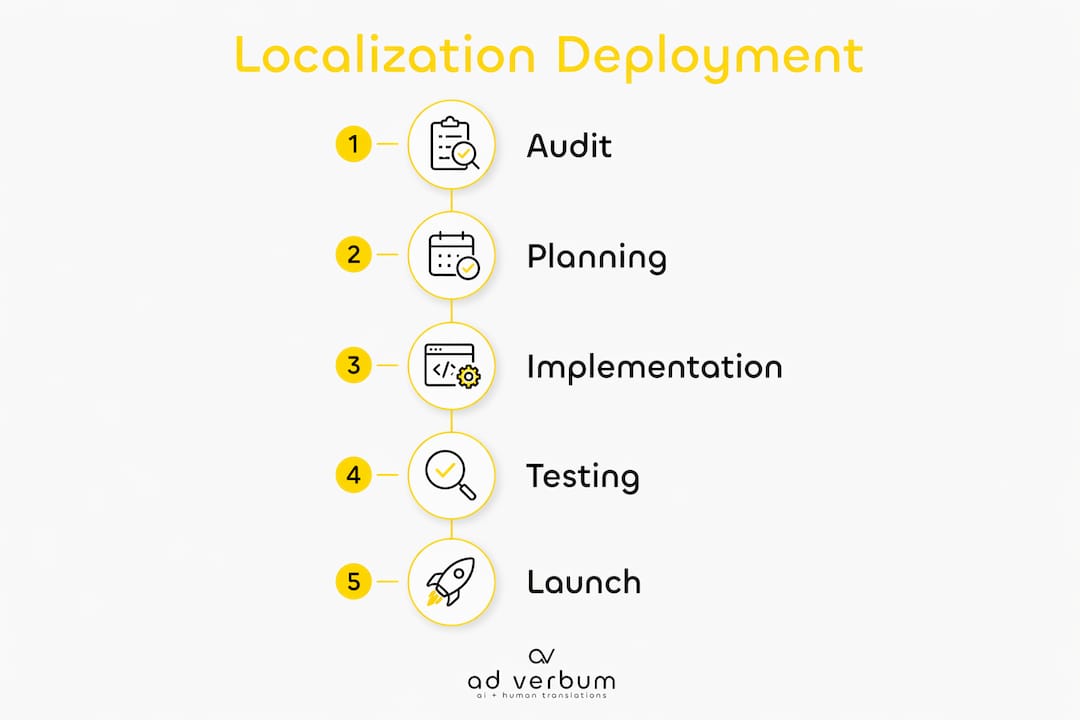
KB localization runs days 15–21; full 24/7 activation targets day 30. Those windows are tight, which is why TM/TB ingestion must happen in week two, not week three.
Roles and artifacts every program needs:
Program Manager: owns timeline, escalation path, and signoff gates
Localization Lead: manages TM/TB, vendor SLAs, and KB versioning
SME Reviewers: validate technical accuracy and regulatory compliance per locale
Privacy/Compliance Owner: confirms data residency and jurisdictional controls before go-live
Engineering Integration Owner: connects helpdesk to TM/TB, LLM prompts, and analytics pipeline
Ops Owner: manages follow-the-sun scheduling and incident response
Rollback triggers should be defined before day 22: a per-locale CSAT drop below threshold, a spike in escalation rate, or a failed QA audit on a KB batch all warrant pausing that locale’s activation.
Pro Tip: Run parallel soft-launch testing on one locale for 48 hours before activating the full follow-the-sun schedule. Catch integration failures and routing errors in a contained environment rather than during a global go-live.
What criteria matter for regulated U.S. deployments?
Enterprise-grade deployments require four non-negotiables: data residency controls, per-jurisdiction LLM flexibility, audit trails with jurisdictional tagging, and deterministic accuracy for regulated content. Regulatory fragmentation intensified in 2025–2026, with GDPR, LGPD, and sovereign AI frameworks all requiring separate model and data controls.
Criterion | Must-Have | Nice-to-Have |
AI+HUMAN hybrid translation with SME review | ✓ Regulated sectors | — |
ISO 17100 and ISO 18587 QA alignment | ✓ All deployments | — |
ISO 27001 information security certification | ✓ All deployments | — |
Per-jurisdiction data residency | ✓ HIPAA/GDPR scope | — |
Audit logs with jurisdictional tagging | ✓ Regulated sectors | — |
Model-switch capability per jurisdiction | ✓ Multi-region AI | — |
ISO 13485 for medical device content | ✓ Life Sciences | — |
AQAP2110 for defense content | ✓ Defense | — |
Bureau Veritas independent audit evidence | ✓ Procurement | — |
Dedicated regional teams vs. pooled | Dedicated when >15 markets or high-risk locale | Pooled for early-stage |
For vendor selection in legal and compliance contexts, require vendors to supply ISO certificates, Bureau Veritas audit reports, and a written data processing agreement that names the jurisdiction of processing. SLA items should specify turnaround benchmarks and incident response windows, not just word counts. AI governance frameworks like ISO 42001 are now a meaningful differentiator for programs using LLM-based translation at scale.
Which channels should you localize first?
Platform preferences are region-specific and critical to culturally nuanced customer experience. Language alone is insufficient; the channel and UI context, including symbols, tone, and message length, matter equally.
Region | Primary Channel | Localization Priority |
Brazil | Chat templates, escalation scripts | |
China | In-app messages, KB summaries | |
Thailand | Line | Notifications, FAQ snippets |
U.S. (Spanish-speaking segments) | SMS and voice | IVR scripts, email templates |
Europe (GDPR scope) | Email and web chat | KB articles, GDPR consent language |
Integration is where implementations fail most often. The connective tissue between helpdesk, TM/TB, LLM prompts, and analytics is not a configuration task; it is an engineering project that needs an owner and acceptance criteria.
Integration checklist:
Helpdesk → TM/TB sync confirmed with webhook or API test
Real-time language detection active and routing to correct regional agent configuration
In-product copy transcreation reviewed by SME before channel activation
Per-locale telemetry pipeline live: CSAT, first-contact resolution, deflection rate tracked separately
What do regulated rollouts look like in practice?
Life Sciences support rollout: A medical device manufacturer localizing customer support for EU and U.S. markets versions every KB article in a TM/TB-integrated system, routes all content through ISO 13485-aligned QA, and requires SME clinical reviewer signoff before any article goes live. The LLM operates under deterministic constraints: no generative output on drug interactions or device indications without SME approval. EU-hosted TM ensures GDPR compliance for all EU-resident data processed during support interactions.
Fintech support rollout: A payments platform expanding to Brazil and the EU maps data residency requirements before selecting LLM configurations. Brazilian customer data stays within LGPD scope; EU data within GDPR. KYC escalation rules are localized with stronger language triggers for fraud-adjacent queries, and every escalation is logged with jurisdictional tagging for audit. Rollback scenarios are pre-defined: if a locale’s first-contact resolution rate drops more than 10 percentage points from baseline within the first two weeks, that locale reverts to human-only routing until root cause is identified.
KPIs to track across both scenarios:
CSAT by locale (not global average)
First-contact resolution rate by language
KB deflection rate per locale
Escalation rate and time-to-resolution for non-native language interactions
Churn rate correlated with language interaction quality
Where do localized support programs most often fail?
Ad-hoc localization becomes operationally unsustainable beyond approximately 10–15 markets without a modular operating model. The failure modes below are the most common, and each has a concrete control.
Failure Mode | Root Cause | Mitigation |
Literal translation of KB articles | No TM/TB, no SME review | Enforce TM/TB integration; require SME signoff on all KB content |
Siloed translation memories per team | No central TM governance | Centralize TM/TB; single source of truth for all locales |
Wrong channel choice for region | Channel audit skipped | Complete channel matrix before any content localization begins |
Legal noncompliance in localized content | No jurisdiction-aware data controls | Per-jurisdiction data residency and model selection from day one |
LLM hallucination in regulated content | No deterministic constraints | Constrain LLM output to approved terminology; require SME review before deployment |
Support content managed as a core localization project, versioned and QA’d under the same ISO frameworks used enterprise-wide, is the structural control that prevents most of these failures. Monitoring should include automated smoke tests on KB changes and per-locale metric regression alerts: a sudden drop in first-contact resolution for a single language is a signal, not noise.
For defense and high-security contexts, access controls and audit logs are not optional governance additions; they are procurement requirements.
When does AD VERBUM fit your localization program?
AD VERBUM is the right specification when the deployment involves regulated content, audit requirements, sensitive data constraints, or SME oversight needs that generic NMT engines cannot meet.
AD VERBUM Capability | Maps to Deployment Requirement |
AI+HUMAN hybrid translation | Must-have for regulated sectors (Life Sciences, Finance, Defense) |
3,500+ SME linguists (medical, legal, engineering) | SME review requirement in procurement SLA |
ISO 17100, ISO 18587 QA alignment | QA standard requirement in RFP |
ISO 27001, ISO 42001 certified | Information security and AI governance requirement |
ISO 13485 | Medical device content requirement |
AQAP2110 | NATO/defense content requirement |
EU-hosted LangOps System, no public cloud | Data residency and sovereignty requirement |
Bureau Veritas independent audit | Third-party audit evidence requirement |
150+ languages including regional variants | Multi-market coverage requirement |
3x–5x faster than traditional workflows | Turnaround SLA requirement |
The AI+HUMAN hybrid translation workflow follows this exact sequence: TM/TB ingestion first, then LLM-constrained generation using the proprietary LangOps System, then certified SME review for technical accuracy and regulatory compliance, then QA aligned to ISO 17100 and ISO 18587. That sequence is what separates it from legacy MT or public NMT engines, where terminology governance and SME oversight are absent or optional.
Contract language should specify: EU data residency confirmed in writing, Bureau Veritas audit evidence supplied at contract signature, ISO 17100/18587 QA applied to all deliverables, and SME reviewer credentials available for audit on request. For AI governance, require ISO 42001 certification and a written description of how the LLM is constrained for regulated content. Guidance on AI governance in compliance programs reinforces why these contractual controls matter as sovereign AI frameworks expand.
Key Takeaways
Effective international customer support localization requires an AI+HUMAN hybrid pipeline, per-jurisdiction data controls, and KB transcreation completed by days 15–21 to reach audit-grade 24/7 coverage by day 30.
Point | Details |
AI+HUMAN hybrid is non-negotiable for regulated content | SME review and ISO-aligned QA prevent terminology errors and compliance failures in Life Sciences, Finance, and Defense. |
KB transcreation must finish by days 15–21 | The 30-day deployment timeline targets full follow-the-sun activation by day 30; KB localization in days 15–21 is the critical path. |
Channel mapping precedes content localization | Platform preferences vary by region; localizing content before confirming the right channel wastes resources and misses customers. |
Modular operating model required past 15 markets | Ad-hoc localization becomes unsustainable beyond approximately 10–15 markets without market-specific training and centralized TM/TB governance. |
AD VERBUM for audit-grade regulated deployments | AD VERBUM’s LangOps System, 3,500+ SME linguists, and Bureau Veritas-audited ISO certifications map directly to regulated procurement requirements. |
The compliance gap most programs ignore
The most common governance failure in international support localization is not a technology problem. It is a sequencing problem. Programs select a translation vendor, configure a helpdesk, and then discover that their data processing agreements do not cover the jurisdictions they are operating in, or that their LLM vendor cannot demonstrate deterministic output for regulated content. By that point, the program is already live.
The right sequence is the reverse: establish data residency and model governance first, then build the content pipeline on top of that foundation. This is especially true for U.S.-regulated industries where HIPAA applies to any support interaction involving protected health information, regardless of where the customer is located. A localized chat template that routes PHI through a non-compliant processing environment is a liability, not a feature.
Staged rollouts with explicit rollback criteria are not a sign of program weakness. They are the correct governance posture for any regulated deployment. A 30-day timeline is achievable, but only if the compliance architecture is locked before day one of content work, not after.
AD VERBUM delivers audit-grade localization for regulated support programs
For support leaders who need a partner that can meet regulated procurement requirements from day one, AD VERBUM offers AI+HUMAN hybrid translation with full ISO certification, EU-hosted data sovereignty, and a network of 3,500+ subject-matter expert linguists covering 150+ languages.
The LangOps System integrates your existing Translation Memories and Term Bases, applies LLM-constrained generation, routes every output through certified SME review, and delivers QA aligned to ISO 17100 and ISO 18587. Turnaround runs 3x–5x faster than traditional workflows, with Bureau Veritas-audited certifications available at contract signature. For Life Sciences, Finance, Defense, and Manufacturing programs where audit trails and data residency are procurement requirements, not preferences, AD VERBUM is built for that specification.
Request a scoped engagement or compliance review at AD VERBUM Localization.
Standards, sources, and procurement references
ISO 17100 — Translation services quality standard; governs QA requirements for professional translation workflows
ISO 18587 — Post-editing of machine translation output; sets the standard for AI+HUMAN hybrid QA
ISO 27001 — Information security management; required for data-sensitive localization pipelines
ISO 13485 — Medical devices quality management; applies to Life Sciences support content localization
ISO 42001 — AI management systems; governs LLM use and safety in regulated translation workflows
AQAP2110 — NATO quality assurance standard for defense sector localization
Multilingual Customer Support: The Hidden Driver of International Growth — transcreation, TM/TB governance, integration failure patterns
Global AI Customer Service Deployment Playbook 2026 — multi-region deployment speed, regulated architecture requirements, regulatory fragmentation
Multilingual Customer Support: 2026 Global Scaling Guide — KB localization days 15–21, 24/7 activation day 30 timeline
Strategies for providing hyper-localized and culturally nuanced global support — channel mapping, platform-first localization
How global brands localize support at scale — modular operating model, 10–15 market scaling threshold
Recommended