Secure Technical Translation Process for Regulated Sectors

Managing translations of regulated pharmaceutical documentation across Northern Europe can expose organizations to risks most standard workflows overlook. For compliance managers, protecting sensitive data and meeting strict legal requirements is non-negotiable. This guide outlines secure translation solutions that combine ISO 27001-aligned cybersecurity, advanced AI-powered tools, rigorous human oversight, and robust quality assurance to ensure regulatory confidence and operational precision.
Table of Contents
Quick Summary
Key Point | Explanation |
1. Securely integrate translation assets | Protect sensitive linguistic resources with strong cybersecurity and access control measures. |
2. Utilize AI for context-sensitive drafts | Leverage advanced AI tools to generate accurate translations by incorporating industry-specific terminology. |
3. Collaborate with subject-matter experts | Engage experts to refine AI-generated drafts and ensure compliance with regulatory requirements through precise evaluations. |
4. Implement rigorous quality assurance | Establish comprehensive verification protocols to validate translations against regulatory standards and maintain accuracy. |
Step 1: Integrate client translation assets securely
Successful translation asset integration requires strategic data management and robust cybersecurity protocols. Organizations must implement systematic approaches to protect sensitive linguistic resources while maintaining accessibility for authorized translation workflows.
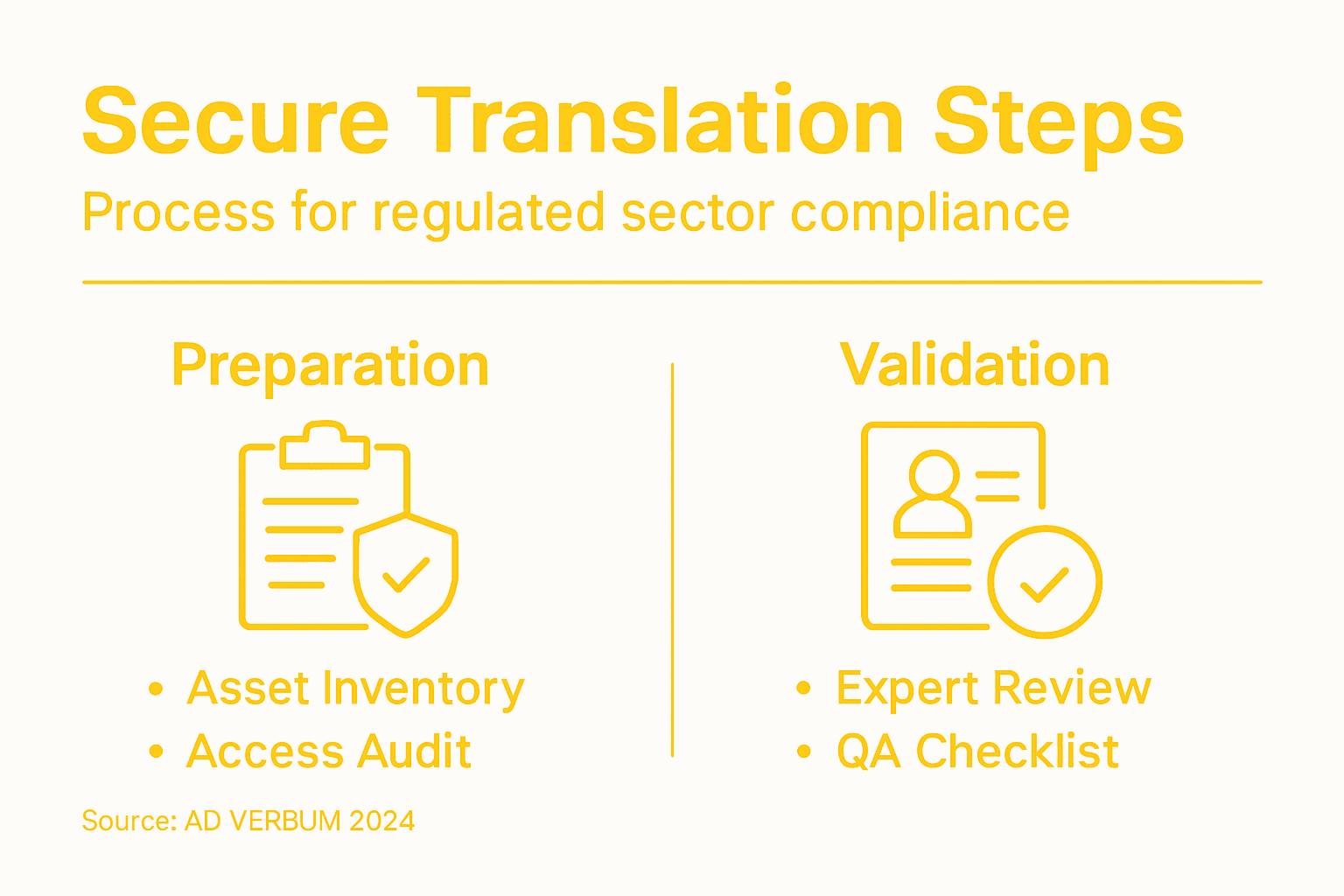
The initial phase involves creating a comprehensive asset inventory that documents all existing translation memories, glossaries, and terminology databases. Organizations should follow systematic processes to control system access and establish clear governance frameworks. Key steps include:
Identifying all existing translation assets
Classifying assets by sensitivity level
Determining appropriate access permissions
Creating role-based authentication protocols
Establishing encryption standards for data at rest and in transit
Secure asset integration demands meticulous attention to data sovereignty and compliance requirements. Translation assets must be processed through controlled channels that maintain strict confidentiality and prevent unauthorized access or potential data leakage.
Regulated sectors require translation asset management that goes beyond standard information security practices, demanding specialized handling and comprehensive risk mitigation strategies.
Effective implementation requires collaboration between linguistic teams, cybersecurity professionals, and compliance officers to develop a holistic approach that balances accessibility with robust protection mechanisms.

Pro tip: Conduct periodic access audits and maintain detailed logs of all translation asset interactions to ensure continuous compliance and rapid incident response.
Step 2: Generate context-sensitive draft translations with AI
Generating precise context-sensitive translations requires advanced AI technologies that understand specialized terminology and industry-specific nuances. Organizations need strategic approaches to leverage machine learning capabilities while maintaining rigorous quality control standards.
The draft translation process leverages neural machine translation systems trained on domain-specific corpora. Large language models trained on specialized content enable generation of technically accurate initial drafts across complex regulated sectors. Key implementation strategies include:
Training AI models on industry-specific terminology databases
Configuring language models with precise domain constraints
Establishing clear parameters for technical accuracy
Defining acceptable variation ranges for technical terminology
Implementing multi-layered verification protocols
Successful AI draft generation demands sophisticated technological infrastructure that balances machine efficiency with human expertise. Translation workflows must integrate intelligent systems capable of understanding contextual subtleties while preventing potential misinterpretations.
Regulated industries require translation technologies that provide more than literal text conversion - they need systems that comprehend complex technical and legal contexts with precision.
Careful configuration of AI translation tools involves continuous refinement, where machine learning models progressively improve through expert human feedback and systematic quality assessment mechanisms.
Pro tip: Develop comprehensive terminology repositories and maintain strict linguistic governance frameworks to enhance AI translation model performance and accuracy.
Step 3: Refine translations with subject-matter experts
Translation refinement requires a strategic collaboration between AI-generated drafts and human linguistic expertise. Organizations must implement robust expert review protocols that leverage specialized knowledge to ensure technical accuracy and regulatory compliance.
Technical translation success depends on selecting subject-matter experts who possess deep domain understanding and linguistic precision. The refinement process involves critical evaluation across multiple dimensions:
Verifying scientific and technical terminology accuracy
Ensuring regulatory compliance language standards
Identifying potential contextual misinterpretations
Validating industry-specific terminology nuances
Maintaining consistent specialized vocabulary
Subject-matter experts serve as critical quality control checkpoints, applying their specialized knowledge to validate and enhance machine-generated translations. Their role goes beyond linguistic correction - they provide contextual validation that ensures the translated content meets strict industry requirements.
Expert-driven refinement transforms translation from a mechanical process into a sophisticated, precision-driven methodology that protects critical communication integrity.
Successful refinement requires establishing clear review workflows, defining explicit quality metrics, and creating structured feedback mechanisms that enable continuous improvement of both human and AI translation capabilities.
Pro tip: Develop a structured expert evaluation framework with clear scoring criteria to standardize and optimize the translation refinement process.
Step 4: Verify compliance through rigorous quality assurance
Quality assurance represents the critical final checkpoint in ensuring translation accuracy, regulatory adherence, and legal defensibility. Organizations must implement comprehensive verification protocols that systematically validate every aspect of the translated documentation.
Compliance processes in translation demand multi-layered review mechanisms that go beyond traditional linguistic checks. The verification workflow encompasses several strategic evaluation dimensions:
Cross-referencing translations against regulatory standards
Conducting detailed terminology consistency audits
Performing comparative source-target language analysis
Documenting each verification step for potential regulatory review
Maintaining comprehensive audit trails of translation modifications
Successful quality assurance integrates both technological validation tools and expert human oversight. This hybrid approach ensures that translations meet not just linguistic accuracy requirements, but also complex regulatory and industry-specific compliance standards.
Rigorous quality assurance transforms translation from a potential risk point into a strategic compliance asset that protects organizational integrity.
Effective verification requires establishing clear assessment criteria, implementing standardized review checklists, and creating robust feedback mechanisms that continuously improve translation quality and compliance accuracy.
Pro tip: Develop a weighted scoring matrix that quantifies translation quality across multiple compliance dimensions to enable objective and systematic verification.
The following table contrasts the focus areas across each translation workflow phase for regulated sectors:
Phase | Primary Focus | Key Stakeholder | Core Risk Addressed |
Asset Integration | Data security | Cybersecurity team | Unauthorized asset access |
AI Draft Generation | Contextual accuracy | AI engineers | Terminology misinterpretation |
Expert Refinement | Technical precision | Subject-matter experts | Compliance inconsistencies |
Quality Assurance | Regulatory verification | Compliance officers | Audit and legal deficiencies |
Secure Your Regulated Sector Translations with AD VERBUM
The article highlights key challenges in managing sensitive translation assets securely and ensuring compliance in regulated sectors. If you are seeking precise technical translation solutions that safeguard your translation memories and terminologies while meeting rigorous quality assurance standards, AD VERBUM offers a tailored answer. Our AI+HUMAN hybrid translation workflow matches the article’s four-step process: secure asset integration, context-sensitive AI draft generation using proprietary LLM technology, expert subject-matter review, and ISO-aligned quality assurance.
AD VERBUM stands apart because of our unique position as a Northern European language service provider with over 25 years of experience in Life Sciences, Legal, and Medical domains. We combine strict data sovereignty hosted on EU servers with the specialized expertise of 3,500+ subject-matter experts to mitigate the risks of unauthorized access, misinterpretation, and compliance failures. Our proprietary AI ecosystem enforces terminology governance and contextual accuracy—critical for regulated industries—while ensuring your data stays secure under ISO 27001, GDPR, and HIPAA standards.
Elevate your translation process and safeguard your critical communications today. Visit AD VERBUM to explore how our Specialized AI Translation solutions can transform your regulated documentation efforts with precision and security. Make the next step to a trusted partnership that understands the complexities of your sector and delivers reliable, compliant translations right when you need them.
Secure your translation projects now. Discover how AD VERBUM’s combined expertise and proprietary AI technology ensure your regulated content meets every compliance requirement without compromise. Visit AD VERBUM to get started.
Frequently Asked Questions
What steps are involved in securing translation assets for regulated sectors?
Successful integration of translation assets requires creating a comprehensive asset inventory, classifying assets by sensitivity, and setting access control protocols. Start by documenting all translation memories, glossaries, and terminology databases to ensure proper management.
How can I generate context-sensitive draft translations using AI?
To generate precise draft translations, train AI models using domain-specific terminology databases and configure them to understand technical nuances. Implement clear parameters and verification protocols to enhance accuracy and relevance.
What role do subject-matter experts play in the translation process?
Subject-matter experts review AI-generated translations to ensure technical precision and regulatory compliance. Engage these experts to validate industry-specific terminology and contextual nuances during the refinement process.
How can I verify compliance in translated documents?
Compliance verification involves systematic reviews that check translations against regulatory standards and conduct terminology consistency audits. Create a detailed checklist for each verification step to maintain thorough documentation.
What are effective quality assurance measures for translation accuracy?
Effective quality assurance includes cross-referencing translations against original documents and maintaining comprehensive audit trails. Standardize your review process by developing a weighted scoring matrix to objectively assess quality across multiple compliance dimensions.
How often should I conduct access audits for translation assets?
Conduct access audits on a regular basis—ideally every 3 to 6 months—to ensure compliance and prevent unauthorized access to translation assets. Document findings and adjust access protocols as necessary to maintain security.
Recommended