


Medical Translation Compliance Process: A Regulated Industry Guide
- 6 hours ago
- 8 min read

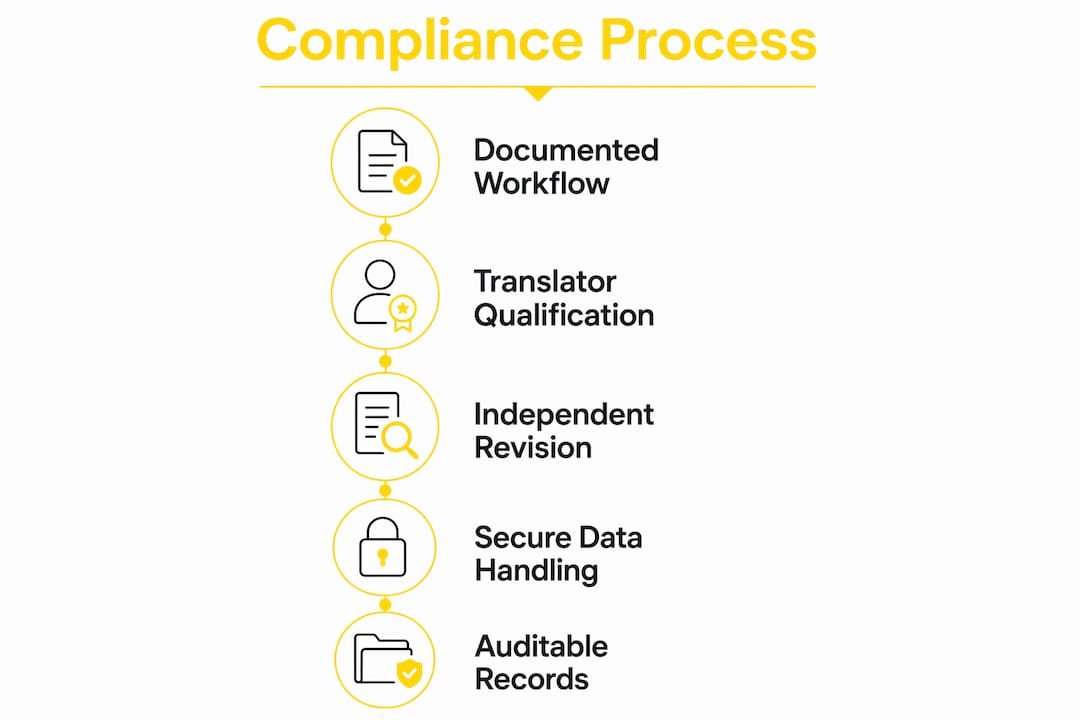
The medical translation compliance process is a structured, documented workflow that ensures translated healthcare and pharmaceutical documents meet regulatory accuracy, security, and traceability requirements. It is not simply a quality check. It is a controlled production system governed by frameworks including ISO 17100, FDA translator qualification guidelines, and HIPAA data security requirements. For professionals in life sciences, medical devices, and clinical research, understanding each step of this process is the difference between audit readiness and regulatory exposure.
What are the key steps in the medical translation compliance process?
The compliance workflow begins before a single word is translated. Project intake defines the regulatory context, target markets, applicable standards, and document type. A clinical trial informed consent form triggers different requirements than a product label, and the workflow must reflect that distinction from day one.
The five core steps are:
Project intake and scoping. Define the regulatory framework, language pairs, document classification, and required certifications before assigning resources.
Translator qualification and selection. FDA guidelines specify that translators must have education, training, or experience in both the source and target language relevant to the medical content. Matching the linguist to the subject matter is a regulatory requirement, not a preference.
Independent revision. ISO 17100 mandates a two-stage production process: a qualified translator produces the translation, and a separate qualified reviser reviews it independently. This step is not optional under ISO 17100. Skipping it voids compliance.
Terminology governance. Approved term bases and style guides constrain both the translator and the reviser. Controlled terminology prevents meaning drift across document versions and language variants.
Final verification and project documentation. Every project closes with a documented record of who translated, who revised, what terminology version was used, and what approval was granted. This record is the audit trail.
Pro Tip: Build your project documentation template before the project starts, not after. Auditors verify process evidence at the job level, and retroactive documentation is a red flag.
The revision step deserves particular emphasis. Audit-readiness depends on objective evidence of process steps, not policy statements. A provider that claims ISO 17100 compliance but cannot produce revision records for a specific project file is not compliant in practice.
Which standards and regulations govern medical translation compliance?
Five frameworks define the compliance floor for medical document translation. Each addresses a different dimension of risk.

Standard or Regulation | Scope | Key Requirement |
ISO 17100:2015 | Translation service quality | Mandatory independent revision; documented translator and reviser competence per project |
ISO 18587 | Post-editing of machine translation | Formal competence and documented review steps for AI-assisted workflows |
FDA Translation Guidelines | US market medical content | Translator qualification in the specific language pair and medical subject area |
HIPAA | US patient data in translation workflows | Secure data handling, controlled access, and encryption for protected health information |
EU MDR | Medical devices and IVDs in the EU | Controlled, versioned multilingual informed consent forms and IFUs with approval tracking |
ISO 17100:2015 is the foundational standard for translation quality assurance across regulated industries. It defines minimum competence requirements for translators and revisers, mandates the two-stage production process, and sets documentation expectations that map directly to audit requirements.
ISO 18587 addresses the growing use of AI-assisted translation. Post-editing under ISO 18587 is treated as a controlled, auditable process with its own competence and workflow documentation requirements. This standard makes AI-assistance viable in regulated contexts when combined with qualified human revision.
HIPAA compliance demands secure data policies, controlled access, and encryption throughout translation workflows. Any provider handling protected health information must demonstrate these controls, not just assert them. EU MDR adds a layer specific to medical devices: each translated document version must link back to the approved source master, with change control records showing what changed and when.
How to ensure auditability and traceability in medical translation projects?
Auditability is built into the workflow, not added at the end. The following controls are the minimum required for a defensible audit trail.
Translator and reviser qualification records. Maintain CV files, credentials, and subject-matter competence documentation for every linguist assigned to a project. Auditors verify personnel competence at the job level.
Per-project revision records. Document the revision step separately from the translation step. The record must show who revised, what version they reviewed, and what outcome was recorded.
Locked term bases and version control. Terminology governance is the critical factor that prevents regulatory risks from multilingual content drift. Lock the approved term base at project start and link it to the source document version.
Change control records. When source documents are amended, the translation workflow must capture what changed, which language versions are affected, and what re-translation or re-revision was triggered.
Sampled project evidence for audits. Prepare a project evidence package that includes the source file, target file, revision record, terminology version, and approval sign-off. Auditors sample projects; each sample must stand alone as complete evidence.
Pro Tip: Assign a unique project identifier that links the source document version, the translation memory snapshot, and the term base version used. This single control resolves most traceability gaps during audits.
The table below maps documentation controls to the audit questions they answer.
Audit Question | Required Evidence |
Was the translator qualified? | CV, credentials, subject-matter competence record |
Was independent revision performed? | Revision record with reviser ID and approval date |
Was approved terminology used? | Term base version log linked to project ID |
Were source amendments tracked? | Change control record with affected language list |
Is the final file traceable to the source? | Version-linked project package with approval sign-off |
What common failure modes occur in medical translation compliance?
Compliance failures in medical translation follow predictable patterns. Recognizing them is the first step toward preventing them.
Terminology drift. Approved glossaries are updated in one language but not propagated across all target languages. The result is inconsistent terminology across document versions, which creates regulatory discrepancies in multilingual submissions.
Skipping independent revision. Providers under time or cost pressure sometimes use the same person to translate and review. This directly violates ISO 17100 and produces an unverifiable output.
Informal or undocumented workflows. A translation produced through email chains and informal handoffs generates no audit trail. Auditors require objective evidence of each process step, and informal workflows cannot produce it.
Uncontrolled AI translation. Legacy machine translation (MT) produces literal output with weak context handling. Neural machine translation (NMT) tools available as consumer SaaS products carry inconsistent terminology control and governance limitations for regulated documentation. Neither is appropriate for regulated medical content without formal controls.
Unqualified revisers. Assigning a bilingual employee with no medical subject-matter expertise to revise a clinical document does not satisfy ISO 17100 or FDA qualification requirements.
Controlled AI+HUMAN hybrid methods are recommended for clinical outcome assessment translations where lack of published AI recommendations prompts caution about uncontrolled AI use.
The mitigation for most of these failures is the same: a documented, auditable workflow with qualified personnel at every stage. Terminology governance tools, locked term bases, and change control mechanisms linked to source master document versions address drift. Mandatory revision records address the skipped-revision risk. ISO 18587-aligned post-editing protocols address AI use in regulated workflows.
How AD VERBUM supports the medical translation compliance process
AD VERBUM’s compliance-aligned translation services are built around the same frameworks that regulators audit. The workflow follows a defined four-stage sequence.
Asset integration. Client Translation Memories ™ and Term Bases (TB) are ingested first, constraining all output to approved terminology from the start.
LLM generation. AD VERBUM’s proprietary LLM-based LangOps System produces target language output with explicit terminology governance and document-level context handling. This is not legacy MT or consumer NMT. It is a private, EU-hosted system with no reliance on outsourced public cloud tooling.
Certified subject-matter expert review. Every output is reviewed by a qualified linguist with domain expertise, covering technical accuracy, regulatory compliance, and contextual nuance. AD VERBUM’s network includes 3,500+ subject-matter expert linguists, including medical professionals.
QA aligned to ISO 17100 and ISO 18587. Where MDR or other sector requirements apply, QA steps are adjusted accordingly.
AD VERBUM holds ISO 17100, ISO 18587, ISO 9001, ISO 13485, and ISO 27001 certifications. HIPAA and GDPR alignment governs data handling throughout. Turnaround runs 3x to 5x faster than traditional workflows, according to AD VERBUM. The system supports 150+ languages, including regional variants relevant to EU MDR multilingual submissions.
Key Takeaways
The medical translation compliance process requires documented, auditable workflows with qualified translators, mandatory independent revision, and controlled terminology governance at every stage.
Point | Details |
Independent revision is non-negotiable | ISO 17100 requires a separate qualified reviser; skipping this step voids compliance. |
Terminology governance prevents drift | Lock approved term bases at project start and link them to the source document version. |
Auditability requires per-project evidence | Maintain translator credentials, revision records, and version logs for every project file. |
AI use requires formal controls | ISO 18587 makes AI-assisted translation viable only when combined with documented human revision. |
Regulatory scope varies by market | FDA, HIPAA, EU MDR, and ISO 17100 each address different dimensions of compliance risk. |
The revision step is where compliance actually lives
Professionals procuring medical translation services tend to focus on translator credentials. That focus is understandable but incomplete. In my experience reviewing compliance workflows across life sciences and pharmaceutical clients, the single most common audit finding is not a credential gap. It is a missing or informal revision record.
ISO 17100’s independent revision requirement exists because translation errors in medical documents carry direct patient safety consequences. A qualified translator can still miss a negation error, a dosage unit, or a contraindication nuance. An independent reviser with the same subject-matter expertise catches what the translator normalized. That second set of eyes is the control. Without a documented record of it, the control did not happen as far as an auditor is concerned.
The other pattern I see consistently is terminology drift in multilingual projects. A sponsor updates a master glossary in English but does not propagate the change to the French, German, and Japanese term bases. Six months later, the same device is described with three different terms across three regulatory submissions. Regulators notice. The fix is not complicated. It requires a change control process that links every term base update to the source master and triggers a review of affected translations. Most providers do not have this in place by default. Ask for it explicitly before you sign a contract.
The future of this field will involve more AI-assisted translation, not less. The question is not whether AI belongs in regulated workflows. The question is whether the AI system operates under formal controls: terminology governance, document-level context handling, ISO 18587-aligned post-editing, and a qualified human reviser at the end of the chain. Providers that conflate consumer NMT tools with controlled AI+HUMAN hybrid translation are the ones to avoid.
— Eric Brown
AD VERBUM’s medical translation and localization services
Medical content that crosses borders requires more than accurate translation. It requires compliant localization that holds up under regulatory review in every target market.
AD VERBUM delivers ISO 17100 and ISO 18587 certified AI+HUMAN hybrid translation for healthcare and pharmaceutical clients, with full audit trail documentation, locked terminology governance, and HIPAA and GDPR-aligned data handling. The LangOps System runs on private EU-hosted infrastructure with no public cloud exposure. For organizations managing multilingual submissions across FDA, EU MDR, or clinical trial requirements, AD VERBUM also supports multilingual content reach alongside compliance workflows. Contact AD VERBUM to discuss your regulatory translation requirements.
FAQ
What is the medical translation compliance process?
The medical translation compliance process is a documented workflow that governs how healthcare and pharmaceutical documents are translated, revised, and approved to meet regulatory standards including ISO 17100, FDA guidelines, HIPAA, and EU MDR.
Why is independent revision required under ISO 17100?
ISO 17100 requires a separate qualified reviser to review every translation independently. This two-stage process creates a verifiable audit trail and reduces the risk of undetected errors in safety-critical content.
How does HIPAA apply to medical translation workflows?
HIPAA requires that any provider handling protected health information during translation must implement secure data policies, controlled access, and encryption. Providers must demonstrate these controls through documented risk assessments and data processing agreements.
What makes AI translation compliant in regulated medical contexts?
AI-assisted translation is compliant when it follows ISO 18587 requirements: formal post-editor competence, documented review steps, and a qualified human reviser at the end of the workflow. Consumer NMT tools without these controls do not meet regulated documentation standards.
What documentation do auditors request for medical translation projects?
Auditors typically request translator and reviser qualification records, per-project revision logs, the term base version used, change control records for any source amendments, and a version-linked project package showing final approval. Each project file must stand alone as complete evidence.
Recommended