


GDPR in Language Services: 2026 Compliance Guide

GDPR in language services is defined as the application of EU Regulation 2016/679 to the processing of personal data during translation, localization, and related linguistic workflows. Any language service provider (LSP) that handles personal data on behalf of a client operates as a data processor under Article 4(8), while the client remains the data controller. This distinction carries direct legal consequences: processors must sign a Data Processing Agreement (DPA), implement technical and organizational security measures, and support the controller’s obligations toward data subjects. For legal, compliance, and marketing professionals in regulated industries, understanding these obligations is not optional. Mistranslated DPAs or insecure translation workflows can trigger Article 83 fines and audit failures.
What are GDPR compliance requirements for language service providers?
GDPR compliance in translation services centers on Article 28, which governs the processor relationship. An LSP processing personal data must meet the following obligations:
Lawful basis and purpose limitation. Processing must be limited to the specific purpose defined in the DPA. An LSP engaged to translate clinical trial consent forms cannot repurpose that data for any other use.
Data Processing Agreements. The DPA must specify the subject matter, duration, nature, and purpose of processing, the type of personal data involved, and the categories of data subjects. DPA substance must reflect actual workflows; a generic template that does not match the LSP’s real processes provides no legal protection.
Access control and confidentiality. Only authorized personnel may access personal data. Linguists, project managers, and QA reviewers must operate under binding confidentiality obligations.
Subprocessor transparency. The LSP must disclose all third parties involved in processing, including cloud infrastructure providers. Subprocessors such as AWS, Azure, and Google Cloud must be listed, and the controller must be notified before any new subprocessor is added.
Data minimization and retention limits. The LSP must process only the data strictly necessary for the task and delete or return all personal data upon completion. Vague or extended retention policies are a primary non-compliance risk.
Audit rights. The DPA must grant the controller the right to audit the LSP’s compliance, either directly or through an independent third party.
Data subject rights support. The LSP must assist the controller in responding to access, rectification, and erasure requests within statutory timeframes.
Pro Tip: Before signing any LSP contract, request a copy of the provider’s subprocessor list and their deletion confirmation procedure. If either is absent or vague, treat it as a red flag.
Consumer-grade or free-tier translation tools present a specific risk. These tools often lack valid Article 28 contracts and enterprise governance controls. Using them for documents containing personal data exposes the controller to direct regulatory liability.

How do international data transfer rules affect GDPR compliance in language services?
Chapter V of GDPR prohibits transferring personal data outside the European Economic Area (EEA) without adequate safeguards. This rule applies directly when an LSP routes translation work to linguists, subprocessors, or technology platforms located in third countries.
The primary transfer mechanism is Standard Contractual Clauses (SCCs). The European Commission issued updated SCCs on june 4, 2021, replacing earlier versions and introducing a modular structure covering controller-to-processor and processor-to-processor transfers. These updated SCCs are now the baseline requirement for most cross-border translation workflows.
The Schrems II ruling by the Court of Justice of the EU added a critical layer. SCCs alone are no longer sufficient. Controllers must conduct a Transfer Impact Assessment (TIA) before relying on SCCs, evaluating whether the destination country’s laws allow authorities to access transferred data in ways that would undermine the SCC protections.
The practical steps for managing international transfers in language services are:
Identify all transfer destinations. Map where translation work, TM storage, and QA review occur geographically.
Execute updated SCCs. Use the 2021 modular SCCs for each controller-to-processor and processor-to-subprocessor relationship outside the EEA.
Conduct and document a TIA. Assess the destination country’s surveillance laws, legal remedies available to data subjects, and any government access rights.
Apply supplementary measures if needed. When a TIA finds that destination laws limit SCC effectiveness, add technical measures such as end-to-end encryption, pseudonymization, or access restrictions before transfer.
Monitor adequacy decisions. The EU-US Data Privacy Framework, adopted in 2023, provides an adequacy mechanism for certified US organizations. Monitor its status, as legal challenges remain possible.
Maintain fallback plans. If a transfer mechanism is invalidated, you need a documented contingency, such as rerouting work to EEA-based resources.
Transfer mechanism | Scope | Key requirement |
Adequacy decision | Countries with equivalent protection | No additional steps required |
Standard Contractual Clauses (SCCs) | Third countries without adequacy | TIA + supplementary measures if needed |
EU-US Data Privacy Framework | Certified US organizations | Verify certification before transfer |
Binding Corporate Rules (BCRs) | Intra-group transfers | DPA supervisory authority approval |
For guidance on translating SCCs accurately, the linguistic precision of the SCC text itself is a compliance variable. A mistranslated clause can alter the legal meaning and void the protection the SCC is meant to provide.
What are the risks of non-compliant translation tools and workflows?
The most underestimated risk in GDPR compliance for language services comes from the translation technology layer, not the contract layer. Many organizations invest in DPA negotiations but then route sensitive documents through consumer NMT engines or SaaS translation platforms with inadequate governance.
The specific risks are:
AI model training on customer data. Tools that use submitted content to train or fine-tune AI models create a compliance failure that cannot be remedied. Deletion requests cannot remove data already incorporated into model weights. This makes the right to erasure under Article 17 practically unenforceable.
Uncontrolled data retention. Many SaaS translation platforms retain uploaded files for extended periods under vague terms. This violates the data minimization and storage limitation principles of Article 5.
Missing or inadequate DPAs. Free-tier tools typically offer no DPA at all. Paid tiers may offer a standard DPA that does not reflect the actual data flows or subprocessor chain.
Subprocessor opacity. Multi-cloud environments involving AWS, Azure, and Google Cloud create layered subprocessor relationships. If the LSP cannot provide a current, complete subprocessor list, the controller cannot fulfill its own transparency obligations.
Mistranslated compliance documents. Errors in translated DPAs, privacy notices, or consent forms can create legal exposure under both GDPR and sector-specific regulations. The risks of mistranslated DPAs extend to Article 83 administrative fines.
Pro Tip: When vetting an LSP, ask three specific questions: Where is your processing infrastructure hosted? Do you use customer data to train or improve AI models? Can you provide your current subprocessor list with data residency details? Inability to answer any of these clearly disqualifies the provider for regulated use cases.
Legacy machine translation (MT) systems carry the highest risk of meaning errors in regulated text due to literal output and weak context handling. Consumer NMT engines offer better fluency but inconsistent terminology control and variable handling of negation, which is critical in safety or legal documents. Neither category is appropriate for GDPR-sensitive content without enterprise-grade governance controls layered on top.
How to implement GDPR-compliant processes in language services workflows
Implementing GDPR compliance in translation workflows requires documented controls at every stage of the project lifecycle, not just at contract signing.
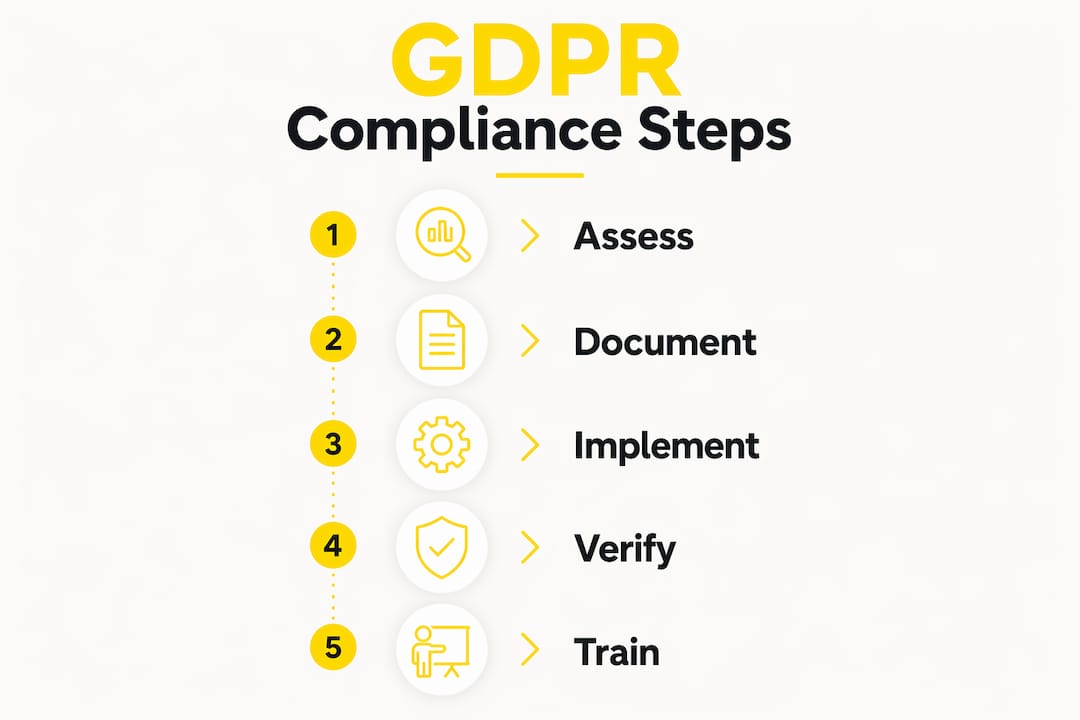
Conduct a data audit. Before any translation project begins, identify whether the source documents contain personal data. Categories to check include names, contact details, health data, financial records, and any data that could identify a natural person directly or indirectly.
Negotiate a detailed DPA. The DPA must name all subprocessors, specify data residency, define retention periods, and include a deletion confirmation procedure. Generic DPAs that do not reflect the actual workflow provide no legal certainty.
Select tools with verifiable data residency. Use only platforms that can confirm where data is stored and processed. EU-hosted infrastructure eliminates the need for SCCs on the processing side. AD VERBUM’s LangOps System operates on private EU-hosted servers with no reliance on outsourced public cloud tooling for core processing.
Implement access restrictions and encryption. Apply role-based access controls so that only the linguists and reviewers assigned to a project can access its files. Require encrypted file transfer for all upload and delivery steps. Secure translation workflows involve encrypted delivery, role-based access, and explicit deletion schedules.
Conduct and document Transfer Impact Assessments. For any workflow involving resources outside the EEA, complete a TIA before the transfer occurs. Document the assessment, the outcome, and any supplementary measures applied.
Train staff on GDPR obligations. Project managers, account managers, and linguists who handle personal data must understand data minimization, confidentiality requirements, and the procedure for responding to data subject rights requests.
Schedule periodic compliance reviews. GDPR enforcement priorities and transfer mechanisms evolve. Review your DPAs, subprocessor lists, and TIAs at least annually, and after any significant change to your toolchain or workflow.
Pro Tip: Build a compliance checklist into your project intake process. Before a file is uploaded to any translation platform, confirm that the tool is covered by a current DPA, that data residency is documented, and that the project scope matches the processing purpose stated in the DPA.
For a detailed view of compliance best practices for translation across regulated sectors, the controls above apply equally to legal, life sciences, and financial services workflows.
Key Takeaways
GDPR compliance in language services requires documented processor agreements, verified data residency, controlled retention, and Transfer Impact Assessments for every cross-border workflow.
Point | Details |
Article 28 DPA is mandatory | The DPA must reflect actual workflows, name subprocessors, and include deletion procedures. |
SCCs require a TIA | Updated 2021 SCCs must be paired with a documented Transfer Impact Assessment for all EEA transfers. |
AI model training creates erasure risk | Tools that train on customer data make Article 17 deletion rights practically unenforceable. |
EU-hosted infrastructure reduces transfer risk | Processing on EU servers eliminates the need for SCCs on the core processing side. |
Periodic audits are required | DPAs, subprocessor lists, and TIAs must be reviewed at least annually and after toolchain changes. |
What compliance professionals get wrong about GDPR in language services
The most common mistake I see in regulated organizations is treating the DPA as the finish line. A signed DPA creates a legal framework, but it does not verify that the LSP’s actual systems match what the contract describes. I have reviewed DPAs from well-known translation platforms that listed data residency as “EU” while their subprocessor schedules disclosed infrastructure in the US and Singapore. The contract said one thing. The data flow said another.
The Schrems II decision changed the compliance calculus permanently. Organizations that relied on the old Privacy Shield framework learned that adequacy decisions can be invalidated overnight. The lesson is that cross-border transfer compliance requires ongoing monitoring, not a one-time SCC execution. TIAs are living documents, not checkbox exercises.
The emerging risk I watch most closely is AI model training. Consumer NMT platforms and some enterprise SaaS tools use submitted content to improve their models. Once personal data enters a model’s training set, the right to erasure becomes theoretical. This is not a hypothetical risk. It is a documented compliance gap that supervisory authorities are beginning to examine more closely.
The organizations that handle this well share one characteristic: they treat their LSP as a compliance partner, not just a vendor. That means requiring audit rights, exercising them, and updating DPAs when the LSP’s subprocessor chain changes. The risks of unvetted translation workflows are real and measurable. The controls exist. The gap is almost always in implementation.
— Eric Brown
AD VERBUM’s approach to GDPR-compliant language services
AD VERBUM operates a private EU-hosted LangOps System that processes translation work without routing data through outsourced public cloud infrastructure. This architecture directly addresses the data residency and subprocessor transparency requirements that regulated clients face most often.
AD VERBUM’s AI+HUMAN hybrid translation workflow integrates client Translation Memories and Term Bases before any LLM generation occurs, ensuring terminology governance from the first output. Every project receives certified subject-matter expert review and QA aligned to ISO 17100 and ISO 18587. AD VERBUM holds ISO 27001 certification for information security and maintains compliance alignment with GDPR, HIPAA, and MDR. For organizations in Life Sciences, Legal, Finance, or Defense, AD VERBUM’s GDPR-compliant localization services provide the audit trail, DPA substance, and data residency controls that regulated workflows require.
FAQ
What is GDPR in translation services?
GDPR in translation services refers to the obligations that apply when a language service provider processes personal data on behalf of a client. The LSP acts as a data processor under Article 28 and must sign a DPA, implement security controls, and support data subject rights.
What must a GDPR-compliant DPA for translation include?
A compliant DPA must specify the processing scope, data types, subprocessors, security measures, retention periods, deletion procedures, and audit rights. A generic DPA that does not reflect the LSP’s actual workflows does not satisfy Article 28.
When are Standard Contractual Clauses required in language services?
SCCs are required whenever personal data is transferred to a translation provider, linguist, or subprocessor located outside the EEA in a country without an EU adequacy decision. The 2021 updated SCCs must be used, paired with a documented Transfer Impact Assessment.
Can free translation tools be used for GDPR-regulated content?
Free-tier translation tools generally cannot be used for GDPR-regulated content. They typically lack valid Article 28 DPAs, have uncontrolled data retention, and may use submitted content to train AI models, making erasure rights unenforceable.
What is a Transfer Impact Assessment in the context of language services?
A Transfer Impact Assessment is a documented evaluation of whether the destination country’s laws allow government access to transferred personal data in ways that would undermine SCC protections. It is required before any cross-border transfer of personal data to a translation provider outside the EEA.
Recommended
