


Translation Cost per Word: A Practical Budgeting Guide

Professional human translation in the United States typically runs $0.08–$0.30 per word, depending on language pair, subject matter, and turnaround. For machine translation with post-editing (MTPE), per-word rates drop to $0.03–$0.10. The standard budgeting formula is:
Estimated cost = word count × base rate × language multiplier × urgency multiplier
Two quick examples using that formula:
Small job (500 words, English to Spanish, standard turnaround): calculated cost totals about $50, but many vendors apply a minimum fee that often exceeds this.
Medium job (5,000 words, English to Japanese, expedited): calculated cost totals over a thousand dollars, depending on multipliers applied.
Regulated content — medical, legal, certified — typically sits at the upper end of the base range or above it. Factor that in before you request quotes.
Key Takeaways
Professional translation in the U.S. runs $0.08–$0.35 per word for human work, with AI+HUMAN hybrid workflows delivering compliant output at $0.05–$0.10 per word for regulated content when full SME review and ISO-aligned QA are included.
Point | Details |
Core budgeting formula | Estimated cost = word count × base rate × language multiplier × urgency multiplier. |
Human translation range | Professional U.S. rates run $0.08–$0.35/word; regulated content (legal, medical) sits at the upper end. |
Hybrid cost advantage | AI+HUMAN hybrid workflows typically offer cost savings while maintaining an audit trail comparable to fully human translation. |
Top cost drivers | Language pair, subject-matter complexity, turnaround, and TM leverage are the four primary rate variables. |
AD VERBUM for regulated projects | AD VERBUM’s LangOps System delivers ISO 17100/18587-aligned QA, SME review, and 3x–5x faster turnaround for regulated content. |
Table of Contents
What does translation cost per word by service type?
Per-word pricing varies significantly by what you are actually buying. Document translation, subtitle work, and live interpreting each carry different rate structures, and knowing which benchmark applies to your project prevents you from comparing quotes that are not measuring the same thing.
Ranges sourced from NLLB Translation Cost Estimator and VerboLabs 2026 market guide.
When per-minute or per-hour pricing applies. Subtitles and captions are billed per finished minute of audio because word density varies by speaker. One minute of spoken content averages roughly 130–150 words, so a $10/minute subtitle rate converts to approximately $0.067–$0.077 per word — cheaper than most document rates, but the time-coding and formatting labor is built in. Live interpreting (simultaneous or consecutive) is billed per hour because the interpreter’s cognitive load, not word count, drives the fee. Wordly, which provides AI-driven real-time interpretation and captioning across mobile and web platforms, uses per-minute and per-session pricing for live events.
Short pricing examples:
1,000-word general document (English to French): 1,000 × $0.12 = $120
1-minute subtitle file (English to Spanish): 1 × $8 = $8 (roughly $0.055/word equivalent)
10-minute interpreting block: At $100/hour, that is approximately $16.67 for the block — though most interpreters charge a half-day or full-day minimum
What factors raise or lower your per-word rate?
Language pair supply and demand
Common European pairs — English to Spanish, French, German — attract the most translators, which keeps rates near the lower end of the professional range. The ATA client guidance identifies language pair as one of the primary pricing drivers, alongside subject matter and turnaround.
Subject-matter complexity
A general marketing brochure and a cardiac device instructions-for-use (IFU) are not the same job. Technical, legal, and medical content requires translators with domain credentials, which narrows the available pool and raises rates.
File format and DTP
Clean, editable source files (Word, plain text) cost less to process than locked PDFs, InDesign files, or XML with embedded tags. Desktop publishing (DTP) work — reformatting translated text to fit the original layout — is typically billed separately at $50–$150/hour or as a flat project add-on.
Translation Memory ™ leverage
When a vendor runs your source file against an existing TM, repeated or similar segments get discounted.
Turnaround multipliers
Pro Tip: Before requesting a rush quote, run a word count and check whether splitting the job across two translators at standard rates is cheaper than a single-translator rush. It often is — and the section on timelines below explains how to price in the added project management overhead.
How do translation billing models work?
Understanding the billing model on a quote lets you convert any fee structure into a per-word equivalent for comparison.
Per-word is the dominant model for document translation. Vendors count source words (the language you are translating from) because that is fixed and auditable.
Per-page is common for certified translations of official documents (birth certificates, diplomas, contracts). A standard page is typically defined as 250–300 words. At $0.15/word, a 275-word page costs $41.25 — so a quoted $50/page rate is roughly $0.18/word equivalent.
Per-hour applies to interpreting, DTP, transcription, and consulting. Converting to a per-word equivalent requires knowing the interpreter’s output rate. A skilled simultaneous interpreter handles roughly 100–150 words per minute, so a $150/hour rate converts to approximately $0.017–$0.025 per word — but that comparison is misleading because interpreting and translation are different cognitive tasks with different risk profiles.
Per-minute is standard for subtitles, voice-over, and AI-driven live captioning products like Wordly.
Flat project fees appear on small, well-scoped jobs or recurring retainer arrangements. They are convenient but make scope creep expensive — any revision or added language triggers a change order.
Minimum fees are nearly universal. Most professional translators and agencies apply a $30–$100 minimum per project. For a 200-word certificate, the minimum fee, not the per-word rate, is what you will actually pay. Factor minimums into your per-unit cost when batching small documents.
Sample cost and timeline calculations
Small project: 500 words, English to Spanish, general content
Rate is calculated by multiplying per-word rate by language and urgency multipliers, resulting in an approximate total cost for the project size.
Minimum fee likely applies; budget $75–$100
Timeline: one translator, half a day
Medium project: 5,000 words, English to German, technical manual
Rate depends on per-word base and complexity multipliers, yielding an approximate project cost.
Timeline: a professional translator produces roughly 2,000–3,000 words per day. At 2,500 words/day, this is a 2-day translation task plus 1 day for review and QA — 3 business days total at standard turnaround.
Large project: 50,000 words, English to Japanese, regulated technical content
Rate includes base per-word price and linguistic multipliers, leading to a multi-thousand-dollar project estimate.
Single-translator timeline: 50,000 ÷ 2,500 = 20 translation days, plus QA — roughly 4–5 calendar weeks
Parallelized across 4 translators: translation phase drops to 5 days, but adds project management, style harmonization, and QA overhead — budget an additional 10–15% for PM and consistency review, bringing the total to approximately $15,730–$16,445 and a realistic delivery of 8–10 business days
Parallelization works well for modular content (separate chapters, independent product sheets). It creates risk on continuous narrative text or highly interdependent regulatory documents where terminology consistency across translators requires a dedicated terminology manager and a final harmonization pass.
AD VERBUM’s LangOps System integrates client Translation Memories and Term Bases at the start of every project, which constrains all translators to the same approved terminology from the first segment — reducing harmonization overhead on large regulated projects where consistency failures carry compliance risk.
How does AI+HUMAN hybrid translation change cost and turnaround?
AI+HUMAN hybrid translation is a workflow in which a proprietary LLM generates the initial translation output, constrained by client terminology and style guidance, and a certified subject-matter expert then reviews for technical accuracy, regulatory compliance, and contextual nuance. This is distinct from legacy machine translation (MT), which produces literal output with weak context handling, and from public neural machine translation (NMT) engines, which offer inconsistent terminology control and limited governance for regulated documentation.
Cost bands by automation level, per NLLB’s estimator:
The VerboLabs market guide notes that MT and AI pricing is appropriate for high-volume, low-risk content — internal communications, product descriptions, knowledge-base articles — where a terminology error carries no regulatory consequence.
Decision criteria for regulated content:
Use human-only or AI+HUMAN hybrid with full SME review when the document is a regulated deliverable: IFU, clinical study report, legal contract, financial disclosure, or defense specification. Errors in these documents carry liability, recall, or compliance risk.
AI + light post-editing is appropriate for lower-risk regulated-adjacent content: internal SOPs, training materials, non-promotional product descriptions — where a qualified reviewer checks output but the stakes of a missed nuance are lower.
AI-only output is not appropriate for any content that will be submitted to a regulatory body, used in litigation, or relied on for patient or operator safety decisions.
Example scenario: medical device IFU, 10,000 words, English to French
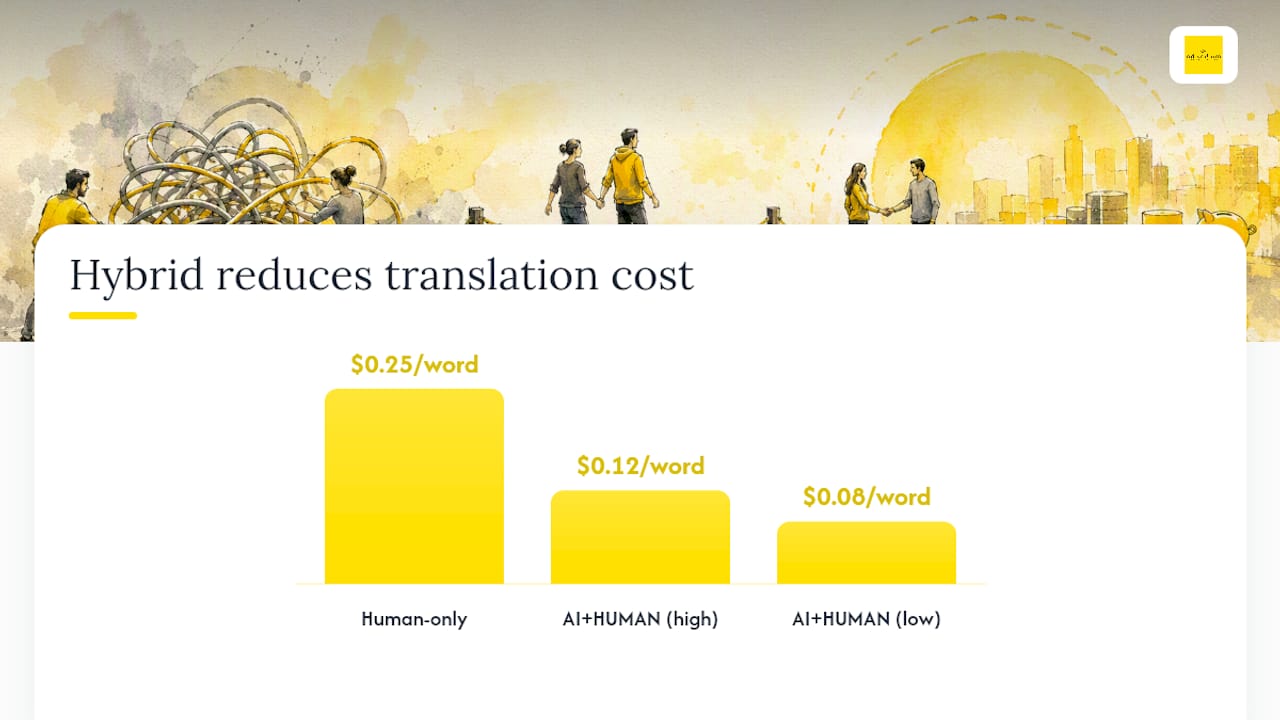
Human-only at $0.25/word: $2,500, estimated 4–5 business days
AI+HUMAN hybrid (full post-editing, SME review, ISO 17100/18587 QA): approximately $0.08–$0.12/word = $800–$1,200, with AD VERBUM’s stated 3x–5x turnaround improvement putting delivery at 1–2 business days
The cost difference is real. So is the compliance posture: the hybrid workflow still includes a certified SME reviewer and QA aligned to ISO 17100 and ISO 18587, which means the audit trail is equivalent to a human-only process.
Pro Tip: When requesting a hybrid quote for regulated content, ask the vendor to confirm that the AI system is terminology-governed (not a public NMT engine), that SME reviewer credentials are documented, and that QA reports are deliverable artifacts — not internal-only records.
Certified and regulated translation: what costs more and why
Certified translation adds a signed statement from the translator or agency attesting to the accuracy and completeness of the translation. Notarization adds a notary’s seal to that statement. Neither certification nor notarization guarantees quality — they attest to the translator’s identity and professional standing, not to the linguistic accuracy of the output.
Common regulated-sector add-ons and approximate uplifts:
Certified statement: $25–$75 flat fee per document, or included in a higher per-word rate ($0.20–$0.40+)
Notarization: $15–$50 per document (notary fee, varies by state)
SME reviewer (medical, legal, engineering): 15–30% uplift on base translation rate
Traceable QA and audit logs: typically included in ISO 17100-aligned workflows; ask whether QA reports are a deliverable
Apostille or consular legalization: government fees vary; not a translation cost but a procurement line item
ISO 17100 sets the process and competency requirements for professional translation services. ISO 18587 covers post-editing of machine translation output. Both are relevant quality standards for procurement: an ISO 17100-certified vendor has documented workflows, qualified translators, and a revision step. ISO 18587 certification means the vendor’s MTPE process meets a defined standard — relevant when buying hybrid or post-edited output for regulated use.
Procurement checklist for regulated projects:
SME reviewer credentials documented (degree, domain, language pair)
QA report delivered as a project artifact, not internal-only
TM retention policy stated (who owns the TM, how long it is retained, under what access controls)
Data-hosting assurances confirmed (GDPR, HIPAA, ISO 27001 as applicable)
Certification type specified (translator-signed, agency-signed, notarized)
Change control process defined before work begins
For court-certified or litigation-support translation, the requirements differ by jurisdiction — confirm the specific court or registry requirement before ordering.
How to get an accurate translation quote
Vague RFQs produce vague quotes. Vendors who cannot see your files, word count, or QA requirements will pad their estimates or exclude line items that later surface as change orders.
RFQ checklist — include all of these:
Source files in their native format (Word, PDF, InDesign, XML)
Exact word count from a CAT tool or the vendor’s own count tool
Source and target language(s), including regional variants (e.g., Brazilian Portuguese vs. European Portuguese)
File type and any DTP requirements
Existing TM and glossary files, or confirmation that none exist
Style guide or reference translations
Required deliverables: translated file, QA report, certified statement, TM update
QA level required: ISO 17100, ISO 18587, sector-specific (MDR, FDA, etc.)
Certification or notarization requirements
Desired turnaround and hard deadline
Questions to ask every vendor:
What is included in the per-word rate — translation only, or revision and QA?
What minimum fee applies, and how is it triggered?
How is TM leverage calculated and reported in the quote?
Who reviews the output, and what are their credentials for this subject matter?
Where is data processed and stored, and what security certifications apply?
What is the change control process if scope expands?
Are QA reports and TM updates delivered as project artifacts?
The ATA recommends requesting detailed QA and certification documentation for regulated translations — not just a price per word.
One-paragraph RFQ template:
Practical ways to reduce per-word costs
Cost reduction in translation is mostly about reducing rework and maximizing asset reuse. The strategies below apply to most projects; the exceptions for regulated content are noted.
Build and share a TM before the first paid batch. Even a small reference corpus of previously translated content creates leverage on the first real project. Vendors apply TM discounts on full and fuzzy matches — 10–70% off the base rate depending on match quality.
Consolidate batches. Sending 10 small jobs separately triggers 10 minimum fees. Batching them into one submission eliminates nine minimums and often qualifies for volume pricing.
Pre-edit the source. Plain-language source text with short sentences, consistent terminology, and no ambiguous pronouns translates faster and with fewer revision cycles. A 10% reduction in source complexity can reduce translation time and cost by a similar margin.
Supply a glossary and style guide. Approved terminology reduces translator research time and post-editing cycles. On a 20,000-word technical project, a 500-term glossary can save 2–4 hours of translator time.
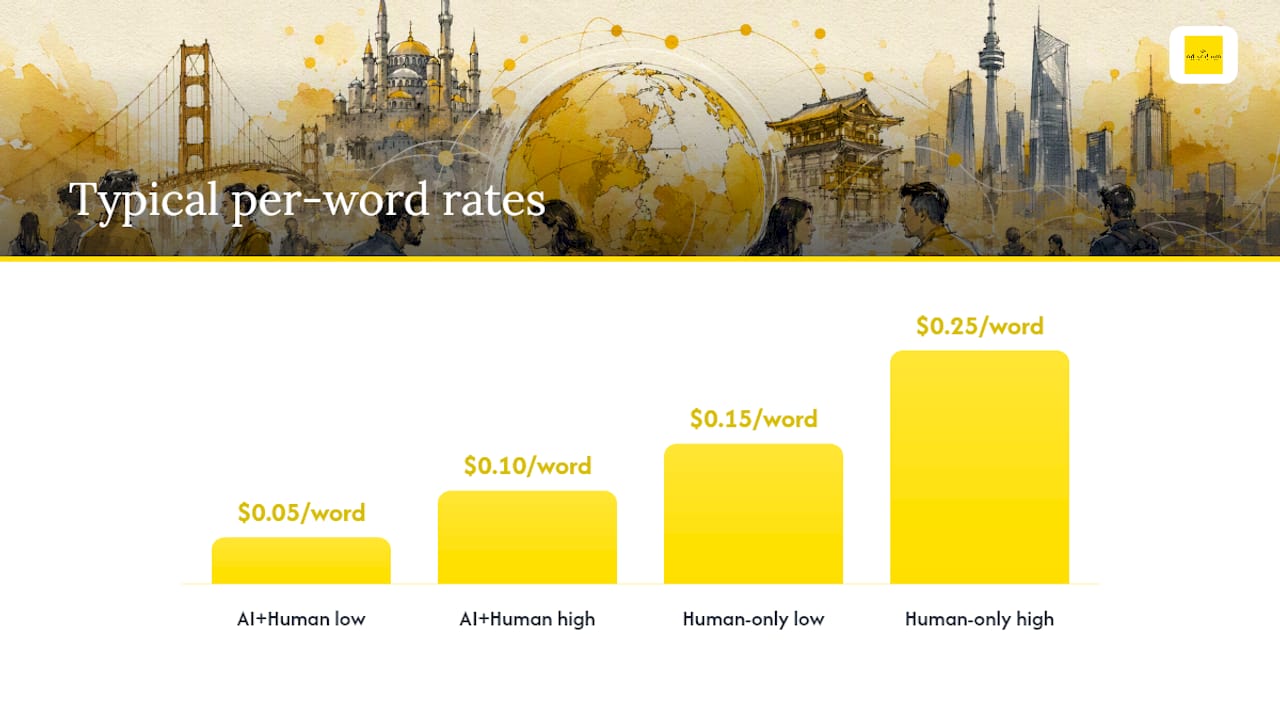
Choose AI+HUMAN hybrid for non-safety content. Internal communications, training materials, and marketing copy for non-regulated markets are good candidates for hybrid workflows at $0.05–$0.10/word rather than $0.15–$0.25/word for human-only.
Negotiate minimums for recurring work. If you send regular volume to a vendor, a standing agreement with a waived or reduced minimum fee and a volume discount tier is standard practice.
Avoid emergency turnarounds. A 2x–3x urgency multiplier on a 10,000-word job adds $1,500–$3,000 over the standard rate. Building a 5-day buffer into project timelines costs nothing.
When cost-saving moves are inappropriate: do not apply hybrid-only or AI-only workflows to regulated deliverables (IFUs, clinical data, legal filings, defense specifications) without a documented SME review step and ISO-aligned QA. The cost savings are real; so is the compliance exposure if the review step is removed.
Pro Tip: *Set up your TM and term base before the first paid project, not after. The setup cost is typically a one-time fee of $200–$500.
What buyers consistently get wrong about translation pricing
The most expensive mistake in translation procurement is not paying too much per word. It is scoping the project incorrectly and discovering the gap after delivery.
Three patterns repeat across regulated-sector projects. First, buyers submit source files without a TM or glossary, then dispute the output because terminology does not match their internal standards — a problem that a $300 glossary setup would have prevented. Second, buyers request a per-word quote without specifying QA level, receive a translation-only price, and then pay a separate revision and certification fee that was never in the original scope. Third, buyers set unrealistic turnarounds, pay the rush multiplier, and then request revisions that push the final delivery past the original deadline anyway.
The compliance dimension compounds these mistakes. For regulated content, a terminology error is not just a quality issue — it is a potential regulatory nonconformance. AD VERBUM enforces traceable QA, documented SME review, and data sovereignty controls (ISO 27001, GDPR, HIPAA alignment) on every regulated project precisely because the audit trail is part of the deliverable, not an optional add-on.
Per-word rates are a starting point. The freelance market guide puts professional U.S. rates at $0.10–$0.30/word. What that range does not capture is the cost of a missed certification requirement, a terminology inconsistency across a 50,000-word submission, or a data-handling breach on a HIPAA-covered document. Scope and compliance controls are where the real budget risk lives.
AD VERBUM handles regulated translation projects with full audit trails
Regulated and technical buyers face a specific problem: per-word rates from general providers do not include the SME review, ISO-aligned QA, or data-sovereignty controls that compliance teams require. AD VERBUM’s AI+HUMAN hybrid translation workflow addresses that gap directly — the LangOps System ingests your TM and term base first, generates output constrained by your approved terminology, routes every segment through a certified subject-matter expert, and delivers QA reports aligned to ISO 17100 and ISO 18587 as project artifacts.
AD VERBUM holds ISO 9001, ISO 17100, ISO 18587, ISO 13485, ISO 27001, and ISO 42001 certifications, independently audited by Bureau Veritas, and aligns to GDPR, HIPAA, and MDR. It supports 150+ languages across regulated industries including life sciences, legal, finance, defense, and manufacturing.
To get a firm quote, send: source files, exact word count, target languages, required QA or certification level, and your deadline. Contact AD VERBUM directly to start.
Sources
The pricing ranges, standards references, and workflow claims in this article draw from the following sources:
Recommended

