


Subject Matter Expertise in Translation: A 2026 Guide

Subject matter expertise in translation is defined as a translator’s in-depth knowledge of the specific field they are translating, enabling accurate terminology use and contextually appropriate renditions beyond basic language conversion. This expertise is the critical differentiator between a translation that reads correctly and one that holds up under regulatory scrutiny, legal review, or clinical use. Subject matter expertise is essential in regulated and technical fields where a single mistranslated term can trigger compliance violations or patient harm. AD VERBUM’s network of 3,500+ subject-matter expert linguists, including medical professionals, engineers, and legal scholars, reflects how seriously the industry now treats this requirement.
What is subject matter expertise in translation?
Subject matter expertise in translation refers to the translator’s command of a field’s concepts, terminology, workflows, and compliance standards, not just its language. A linguist fluent in German and English can translate a pharmaceutical label. A subject matter expert (SME) in pharmacology can translate it correctly, using the precise International Nonproprietary Names, dosage conventions, and regulatory phrasing required by the European Medicines Agency or the FDA.
The distinction matters across every specialized domain. Legal translation requires knowledge of jurisdiction-specific doctrine, not just legal vocabulary. Medical device translation requires familiarity with ISO 13485 and the EU Medical Device Regulation. Financial translation demands understanding of IFRS or GAAP reporting conventions. Academic translation requires command of citation norms and discipline-specific argumentation styles.

Subject matter experts provide industry vocabulary, compliance insights, and cultural nuance that are essential for localization success in complex domains such as legal and medical. Their role bridges linguistic skill and domain knowledge in a way that neither a generalist translator nor an unreviewed machine translation system can replicate.
The scope of SME involvement also extends to localization projects. Localization adapts content for a specific market, which means an SME must understand not only the terminology but also the regulatory environment, cultural expectations, and local usage conventions of the target market. A software interface localized for the Japanese healthcare market requires a translator who understands both Japanese and Japanese clinical practice norms.
Pro Tip: When scoping a translation project, classify content by risk level first. Regulatory submissions, clinical trial documents, and legal contracts require certified SMEs. Marketing copy and internal communications can tolerate a lower SME threshold. Matching expertise level to content risk reduces cost without sacrificing quality where it counts.
Legal: Contract law, court procedure, jurisdiction-specific terminology
Medical and life sciences: Clinical terminology, pharmacology, ISO 13485, MDR compliance
Technical and engineering: CAD documentation, safety standards, AQAP 2110
Financial: IFRS, GAAP, audit reporting, securities regulation
Academic: Discipline-specific methodology, citation standards, peer review conventions
Why subject matter expertise matters for accuracy and compliance
SME involvement ensures the highest level of translation quality, especially where specialized knowledge is necessary to avoid costly errors. That claim is not abstract. In regulated industries, a mistranslated contraindication in a drug package insert can expose a manufacturer to product liability. A mistranslated clause in a cross-border contract can void an agreement. A mistranslated safety instruction in a defense procurement document can create operational risk.
SME supervision is a critical safeguard in regulated sectors, where errors can lead to compliance violations or legal liability. The cost of correcting a post-publication error in a regulated document is orders of magnitude higher than the cost of SME review at the translation stage. That asymmetry is the core business case for investing in subject matter expertise.
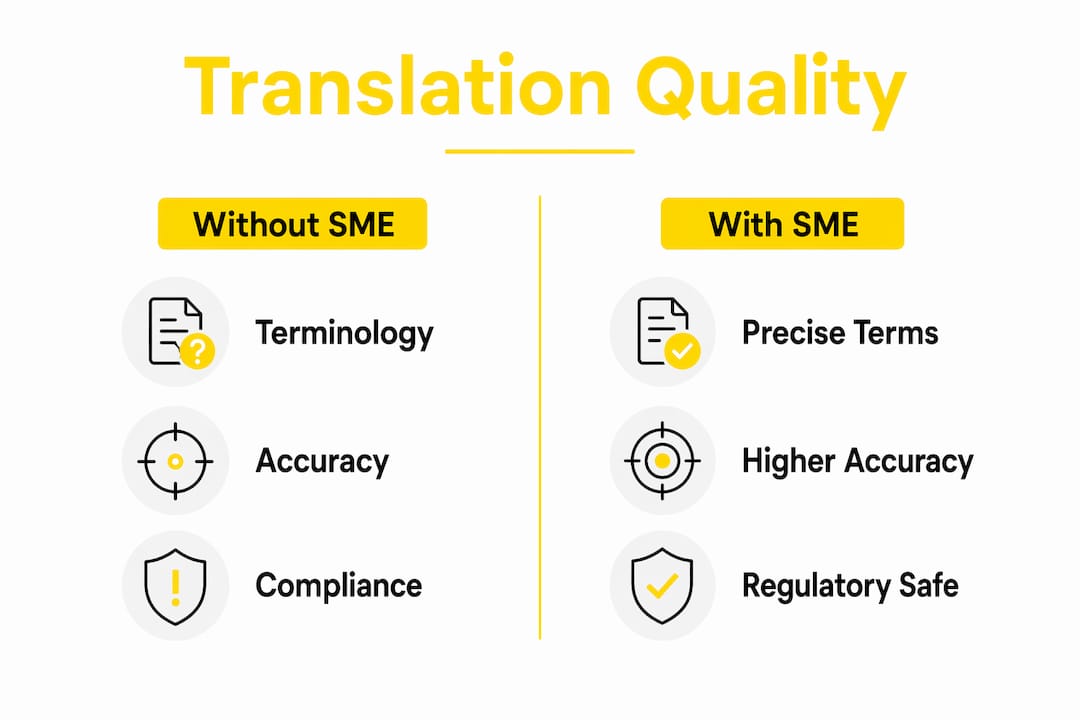
Beyond compliance, SMEs protect brand voice and contextual appropriateness. A medical device company that uses inconsistent terminology across its Instructions for Use, its labeling, and its training materials creates confusion for clinicians and auditors alike. An SME enforces terminology consistency across the full document set, which is something a generalist translator working without a Term Base cannot reliably do.
Without SMEs, translations risk inaccuracies, misused terms, and loss of brand voice, especially in regulated and technical content. The downstream consequences include reputational damage and legal exposure. The risks cluster around four failure modes:
Terminology errors: Using a near-synonym that carries a different legal or clinical meaning
Compliance gaps: Missing jurisdiction-specific phrasing required by a regulator
Cultural misalignment: Rendering a concept accurately in language but inappropriately for the target market
Consistency failures: Using different terms for the same concept across a document set, creating audit risk
How subject matter experts integrate with AI+HUMAN hybrid translation workflows
AI+HUMAN hybrid translation workflows depend on SME input at multiple stages, not just at final review. SMEs help define what “good” means in context for AI outputs, distinguishing harmless stylistic variations from errors that erode trust or create compliance risk. Without that upstream guidance, an AI system optimizes for fluency rather than accuracy in the domain-specific sense that regulated content requires.
Localization SMEs train and guide AI systems to produce outputs that feel natural, reliable, and tailored to local markets, not generic or misaligned. This is the structural difference between a consumer-grade Neural Machine Translation engine and a purpose-built AI+HUMAN hybrid translation system. The former produces fluent output. The latter produces defensible output.
AI+HUMAN hybrid translation workflows rely on continuous SME feedback to tune terminology, annotation, and quality scoring frameworks. SMEs improve both pre-translation datasets and post-translation evaluation. AD VERBUM’s LangOps System follows a four-step sequence that embeds SME review as a mandatory control, not an optional add-on:
Asset integration. Client Translation Memories ™ and Term Bases (TB) are ingested first, constraining the AI’s output space to approved terminology from the start.
LLM generation. AD VERBUM’s proprietary LLM-based system produces target language output governed by client terminology and style guidance.
SME review. A certified subject-matter expert reviews the output for technical accuracy, regulatory compliance, and contextual nuance.
Quality assurance. QA is aligned to ISO 17100 and ISO 18587 and, where relevant, to sector requirements such as MDR.
This sequence matters because legacy Machine Translation (MT) produces literal output with weak context handling, creating a high likelihood of meaning errors in safety-critical text. Standard Neural Machine Translation engines offer better fluency but inconsistent terminology control and governance limitations for regulated documentation. AD VERBUM’s LLM-based approach adds terminology enforcement, document-level context handling, EU-hosted data sovereignty, and mandatory SME review.
Pro Tip: When evaluating an AI translation vendor for regulated content, ask specifically whether SME review is embedded in the workflow or offered as an optional upgrade. A workflow where SME review is optional is a workflow where it will be skipped under deadline pressure.
Translation quality with and without subject matter expertise
The quality gap between SME-reviewed and non-SME-reviewed translations is most visible across four dimensions: accuracy, terminology consistency, compliance alignment, and style appropriateness.
Quality dimension | Without SME | With SME |
Terminology accuracy | Near-synonyms used interchangeably; domain errors likely | Approved terms enforced; domain errors caught before publication |
Compliance alignment | Jurisdiction-specific phrasing may be absent or incorrect | Regulatory phrasing verified against applicable standards |
Consistency across documents | Variable; depends on individual translator memory | Enforced via Term Base and SME cross-document review |
Cultural and contextual fit | Linguistically correct but potentially inappropriate for target market | Adapted for local regulatory environment and usage conventions |
Error consequence | Potentially costly: legal liability, regulatory rejection, patient harm | Mitigated: errors caught at review stage before distribution |
The table above reflects a pattern that holds across legal, medical, and technical translation. A generalist translator working without SME oversight will produce output that passes a surface-level linguistic review. That output will fail a domain expert’s review, a regulatory audit, or a legal challenge. The failure mode is not obvious until it is expensive.
Best practices for leveraging subject matter expertise in translation projects
Selecting the right SME involves validating domain knowledge, linguistic skills, and experience with localization workflows. SMEs often collaborate closely with translators for the best outcomes. The selection process should treat domain credentials and localization experience as equally weighted criteria.
Effective SME integration follows a set of practices that translation managers can apply regardless of project size:
Validate credentials before assignment. A medical SME should hold relevant clinical or scientific qualifications. A legal SME should have jurisdiction-specific training. Linguistic fluency alone does not qualify someone as a subject matter expert.
Build and maintain Term Bases collaboratively. SMEs should contribute to Term Base development at project start, not just review output at the end. Early terminology alignment prevents downstream rework.
Define quality criteria explicitly. SMEs should document what constitutes an acceptable translation for each content type. This creates a reviewable standard that survives staff changes and scales across large document sets.
Integrate SMEs into AI feedback loops. In AI+HUMAN hybrid translation workflows, SMEs should annotate errors, flag terminology gaps, and contribute to quality scoring. That feedback improves subsequent AI outputs on the same account.
Align SME review scope with content risk. Regulatory submissions and clinical documents require full SME review. Lower-risk content may require only spot-check review. Calibrating scope to risk controls cost without reducing quality where it matters.
Document SME decisions for audit trails. In regulated sectors, the ability to demonstrate that a qualified expert reviewed a translation is as important as the translation itself. ISO 17100 and ISO 18587 both require documented human review steps.
Key takeaways
Subject matter expertise in translation is the non-negotiable control that separates defensible, compliant translations from fluent but legally or clinically unreliable ones.
Point | Details |
SME definition | A subject matter expert holds deep domain knowledge, not just linguistic skill, enabling accurate terminology and compliance alignment. |
Compliance protection | SME oversight prevents terminology errors and compliance gaps that can trigger regulatory rejection or legal liability. |
AI workflow integration | SMEs define quality criteria, review AI outputs, and feed terminology governance into AI+HUMAN hybrid translation systems. |
Quality dimensions | SME involvement improves accuracy, terminology consistency, compliance alignment, and cultural fit across all content types. |
Selection and validation | Effective SME use requires credential validation, Term Base collaboration, and documented review for audit purposes. |
The case for treating SMEs as infrastructure, not reviewers
The translation industry has spent a decade debating whether AI will replace human translators. That debate misses the more consequential question: who defines what the AI is trying to achieve?
Working with regulated-sector clients across Life Sciences, Legal, and Defense, I have seen the same failure pattern repeat. An organization adopts a translation technology, reduces its SME headcount to cut costs, and then spends more on remediation than it saved. The problem is never the AI. The problem is that no one told the AI what “correct” means in a pharmacovigilance report or a defense procurement contract.
SMEs are not a quality gate at the end of a translation workflow. They are the source of the quality criteria that the entire workflow is trying to meet. That reframing changes how you staff a translation program. You do not hire SMEs to check translations. You hire SMEs to define what a correct translation looks like, build the Term Bases and style guides that encode that definition, and then verify that the output meets the standard they set.
The organizations that get this right treat SME knowledge as infrastructure. They invest in Term Bases, annotated review records, and SME-led quality frameworks that persist across projects and vendors. The organizations that get it wrong treat SMEs as an optional line item that gets cut when budgets tighten. The regulatory consequences of that choice are well documented.
— Eric Brown
How AD VERBUM delivers SME-backed translation for regulated industries
AD VERBUM’s AI+HUMAN hybrid translation model places subject matter experts at the center of every regulated translation project, not at the periphery.
AD VERBUM operates a network of 3,500+ subject-matter expert linguists, including medical professionals, engineers, and legal scholars, embedded in a four-step workflow governed by ISO 17100, ISO 18587, ISO 13485, and ISO 27001. The proprietary LangOps System runs on EU-hosted infrastructure with no reliance on public cloud tooling for core processing, meeting GDPR, HIPAA, and MDR alignment requirements. AD VERBUM’s localization services cover 150+ languages and deliver turnarounds 3x to 5x faster than traditional workflows, without removing the SME review step that regulated content requires. Contact AD VERBUM to discuss your project’s compliance and terminology requirements.
FAQ
What is a subject matter expert in translation?
A subject matter expert in translation is a professional with deep knowledge of a specific field, such as medicine, law, or engineering, who ensures that translated content uses accurate terminology and meets domain-specific compliance standards.
Why is subject matter expertise important in localization?
Subject matter expertise is critical in localization because it prevents terminology errors, compliance gaps, and cultural misalignment that generalist translators cannot reliably catch, particularly in regulated industries such as Life Sciences and Legal.
How do SMEs contribute to AI+HUMAN hybrid translation workflows?
SMEs define quality criteria for AI outputs, review generated translations for technical accuracy and regulatory compliance, and contribute terminology and annotation data that improve subsequent AI outputs on the same account.
What are the risks of translating regulated content without an SME?
Without SME oversight, regulated translations risk inaccurate terminology, missing jurisdiction-specific phrasing, and consistency failures across document sets, which can result in regulatory rejection, legal liability, or patient harm.
How do you select a qualified subject matter expert for a translation project?
Selecting a qualified SME requires validating domain credentials, linguistic proficiency, and experience with localization workflows. For regulated content, SMEs should also have documented experience with the applicable compliance framework, such as MDR, HIPAA, or AQAP 2110.
Recommended