


Why Compliance Matters in Translation for Regulated Industries

Compliance in translation is defined as adherence to legal, regulatory, and industry-specific standards that govern how multilingual content is produced, reviewed, and documented in regulated sectors. For compliance officers managing legal contracts, medical device instructions, or financial disclosures, a mistranslation is not a quality inconvenience. It is a regulatory event. Inaccuracies in medical and financial documents expose organizations to regulatory fines and reputational damage that can take years to recover from. Understanding why compliance matters in translation starts with recognizing that every translated document in a regulated context carries the same legal weight as its source.
Why compliance matters in translation workflows
Translation compliance is the practice of aligning every step of a multilingual content workflow with documented procedures, quality controls, and applicable regulatory frameworks. The industry term for this discipline is translation quality assurance, and it operates within standards such as ISO 17100 (translation services), ISO 18587 (post-editing of machine translation output), and ISO 13485 (quality management for medical devices). These standards define not just output quality but process integrity: who reviews what, when, and with what evidence.
The core components of a compliant translation workflow are:
Documented procedures. Every translation task must follow a written process that matches actual project execution. Organizations that align procedures with actual workflow achieve better audit outcomes and stronger risk control.
Terminology governance. Controlled vocabularies and terminology assets reduce mistranslation risk in regulated content by enforcing consistent linguistic choices across all documents.
Review and validation steps. ISO 17100 requires translation, revision, and proofreading as distinct steps. Collapsing these into a single pass is a documented compliance gap.
Audit trails. Every decision, revision, and approval must be traceable. Without records, compliance cannot be demonstrated to an auditor.
Pro Tip: Map your current translation workflow against ISO 17100 step by step before your next audit. Gaps between your documented process and actual practice are the most common audit failure point.
ISO 18587 adds a specific layer for organizations using machine translation output: it requires that post-editing by a qualified human linguist be documented and verifiable. This matters because not all AI translation tools produce output that meets this standard by default.

What are the compliance risks of poor translation quality?
Non-compliance in regulated translation produces three categories of risk: legal, financial, and operational. Each carries a distinct audit implication.
Legal penalties. Regulatory bodies in the European Union, the United States Food and Drug Administration, and financial regulators such as the Securities and Exchange Commission require that translated documents meet the same accuracy standard as source documents. A mistranslated contraindication in a medical device manual or an error in a cross-border financial disclosure can trigger enforcement action.
Reputational damage. Non-compliance in regulated translation causes reputational damage that compounds over time. A single publicized translation error in a clinical trial document or a product recall notice can affect market access across multiple jurisdictions.
Audit failure. Fragmented traceability across multiple systems makes it difficult to demonstrate compliance during audits. Auditors look for evidence that documented systems match actual project execution. When records are incomplete or spread across disconnected tools, the audit finding is non-conformance, regardless of translation quality.
“Strong compliance is not about the complexity of documented procedures but consistency between documents and real project execution.” — Translation Standards
A concrete example: a pharmaceutical company translating patient information leaflets into 12 languages for EU market authorization must demonstrate, for each language version, that a qualified translator and a qualified reviser worked independently on the text. If the vendor cannot produce evidence of that two-step process, the submission is at risk. The translation quality may be excellent. The compliance record is what fails.
Compliance gaps vs. best practices: a comparison
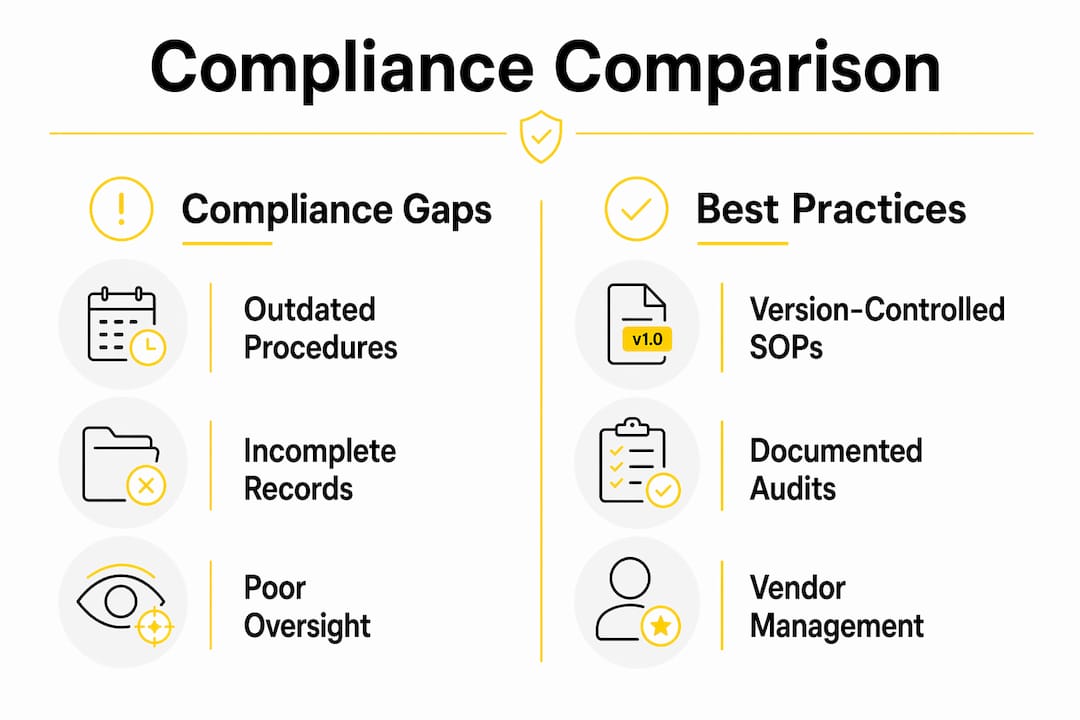
Many translation companies fail audits not because of dramatic errors but because of recurring documentation and process alignment gaps. The table below maps the most common compliance issues against the corresponding best practice control.
Compliance gap | Best practice control |
Outdated or unapproved procedures | Version-controlled SOPs reviewed and approved on a defined schedule |
Incomplete vendor qualification records | Documented vendor assessment, including linguist credentials and ISO certification status |
Fragmented traceability across tools | Centralized project management with linked translation memory and audit log |
No evidence of two-step review | Separate revision records per ISO 17100, with named reviser and timestamp |
Terminology inconsistency across projects | Active term base (TB) enforced at the translation stage, not corrected at review |
Missing post-editing documentation | ISO 18587-aligned post-editing records when machine translation output is used |
Pro Tip: Run a live project sample during internal audits, not just a document review. Audit strategies that sample live projects surface gaps that procedure reviews miss entirely.
Technology supports compliance when it is governed correctly. Translation Memory ™ systems enforce consistency across document versions and reduce the risk of contradictory terminology appearing in updated regulatory submissions. Term bases enforce approved vocabulary at the point of generation. Automated QA tools flag missing segments, formatting errors, and terminology deviations before human review. None of these tools replace procedural controls. They make procedural controls auditable.
For organizations operating under GDPR or HIPAA, the compliance picture extends to data handling. Translation vendors who process personal data in source documents must operate under a data processing agreement and demonstrate that data is handled within approved jurisdictions. Vendors using public cloud-based translation engines without enterprise data controls introduce a data sovereignty risk that is separate from, and in addition to, translation quality risk.
How to maintain compliance in translation projects
Maintaining translation compliance across a regulated organization requires a structured approach. The following steps apply whether you manage translation in-house, through a single vendor, or across a panel of language service providers.
Define your compliance policy. Specify which regulatory frameworks apply to your translated content. For medical devices, this includes MDR and ISO 13485. For financial documents, it includes applicable securities regulations. For any document containing personal data, GDPR or HIPAA applies. Your policy must name the standards, not just reference “quality.”
Qualify your vendors. Vendor qualification is a compliance control, not a procurement step. Require ISO 17100 certification as a baseline. For medical content, require demonstrated experience with MDR-aligned workflows. Ask for evidence of linguist credentials, not just a vendor statement.
Document your workflow. Write a procedure that describes every step from source document receipt to final delivery. The procedure must match what actually happens. Effective compliance requires verifiable evidence that documented systems match actual project implementation.
Enforce terminology governance. Provide vendors with an approved term base before translation begins. Require that the term base is loaded into the translation environment and that deviations are flagged, not silently corrected. Consistent linguistic assets reduce errors and improve quality assurance in regulated content.
Integrate AI+HUMAN hybrid translation under governance. AI+HUMAN hybrid translation models can be compliant when integrated with documented workflows and quality controls. The key requirement is that AI-generated output is reviewed by a certified subject-matter expert and that the review is recorded. Generic neural machine translation (NMT) engines without enterprise controls do not meet this requirement by default.
Train your teams. Translating compliance training into native languages improves understanding and reduces operational risk. Training records in the target language are themselves a compliance artifact.
Monitor and audit continuously. Schedule internal audits that sample live projects. Review vendor performance against documented KPIs. Update procedures when regulatory requirements change. Compliance is a continuous state, not a certification event.
For organizations operating across multiple jurisdictions, the 2026 compliance best practices guide provides a current reference for aligning translation workflows with evolving regulatory requirements.
Key takeaways
Translation compliance in regulated industries requires documented procedures, terminology governance, and verifiable audit trails at every stage of the multilingual content workflow.
Point | Details |
Compliance is process, not just quality | ISO 17100 and ISO 18587 govern workflow steps, not only output accuracy. |
Audit failures come from gaps, not errors | Fragmented records and misaligned procedures cause most compliance findings. |
Terminology governance is a control | Enforcing approved term bases at the translation stage prevents downstream regulatory risk. |
AI translation requires documented oversight | AI+HUMAN hybrid models are compliant only when review and QA steps are recorded and traceable. |
Data handling is part of compliance | Vendors processing regulated content must operate under GDPR or HIPAA-aligned data controls. |
The compliance gap nobody talks about
The most persistent compliance problem I see in regulated translation is not a technology failure or a linguist error. It is the gap between what the procedure document says and what actually happens on a project. Organizations invest in ISO certification, vendor panels, and QA tools. Then a project runs under deadline pressure, the two-step review gets compressed into one, and the record reflects the procedure rather than the reality.
Auditors who sample live projects find this gap immediately. Auditors who only review documents miss it entirely. The Swiss legal compliance framework makes this point clearly: systemic compliance problems in legal translation workflows are almost always execution gaps, not design gaps.
The second thing I would push back on is the assumption that AI translation is inherently a compliance risk. Legacy machine translation (MT) carries real risk because its literal output and weak context handling produce meaning errors in safety-critical text. Public NMT engines carry governance risk because terminology control and data sovereignty are inconsistent without enterprise controls. But a properly governed AI+HUMAN hybrid model, with terminology enforcement, SME review, and ISO-aligned QA, is not a compliance risk. It is a compliance asset. The distinction matters because compliance officers who ban AI translation outright are often accepting slower, more expensive workflows without actually reducing risk. The question is not whether AI is involved. The question is whether the workflow is documented, the output is reviewed, and the evidence is traceable.
How AD VERBUM supports compliance in regulated translation
AD VERBUM’s AI+HUMAN hybrid translation workflow is built for regulated content from the ground up. Every project begins with asset integration: client Translation Memories and Term Bases are loaded before any output is generated. The proprietary LangOps System then produces target language output constrained by client terminology. A certified subject-matter expert, drawn from AD VERBUM’s network of 3,500+ linguists including medical professionals and legal scholars, reviews for technical accuracy and regulatory compliance. QA is aligned to ISO 17100 and ISO 18587, with sector-specific controls for MDR and HIPAA where applicable.
AD VERBUM’s infrastructure is ISO 27001 certified and hosted on private EU servers, with no reliance on public cloud tooling for core processing. For compliance officers managing localization across regulated markets, AD VERBUM delivers audit-ready workflows with full traceability across 150+ languages. Contact AD VERBUM to assess whether your current translation workflow meets the documentation and evidence standards your next audit will require.
FAQ
What is compliance in translation?
Compliance in translation is adherence to legal, regulatory, and industry standards governing how multilingual content is produced, reviewed, and documented. Standards such as ISO 17100, ISO 18587, HIPAA, and GDPR define the procedural and data handling requirements for regulated translation workflows.
What are the most common compliance issues in translation?
The most common compliance issues are fragmented recordkeeping, outdated procedures, incomplete vendor oversight, and missing evidence of two-step review. These recurring gaps cause most audit failures, not translation quality errors.
How does compliance affect translation quality and risk?
Compliance controls such as terminology governance, documented review steps, and audit trails directly reduce the risk of mistranslation and regulatory breach. Organizations that align their procedures with actual workflow have measurably better audit outcomes and risk control.
Is AI translation compliant with ISO 17100?
AI translation output is compliant with ISO 17100 when it is reviewed and revised by a qualified human linguist and that review is documented. Generic NMT engines without enterprise controls do not meet this standard by default. AI+HUMAN hybrid models with documented QA steps can satisfy ISO 17100 and ISO 18587 requirements.
What documentation is required for compliant medical translation?
Compliant medical translation requires documented translator and reviser credentials, a traceable two-step review process, an approved term base, and records demonstrating alignment with MDR and ISO 13485 where applicable. Medical translation compliance also requires HIPAA-aligned data handling for documents containing patient information.
Recommended