


Machine Translation Risks Explained for Regulated Sectors

Most American companies face higher stakes when it comes to translation accuracy, especially in regulated sectors where even a single error can carry severe consequences. With over 60 percent of global businesses now integrating advanced language technology, the gulf between traditional machine translation and AI-powered translation has never been wider. Understanding how these systems differ is vital for anyone responsible for compliance, data privacy, or communication in fast-moving industries.
Table of Contents
Key Takeaways
Point | Details |
Advancements in Translation | AI translation surpasses traditional machine translation by understanding context and nuances, enhancing accuracy and meaning. |
Risks of Machine Translation | Relying solely on machine translation in regulated sectors can lead to critical errors and legal liabilities due to terminology precision failures. |
Data Privacy Concerns | Machine translation poses significant data security risks, including data exposure and compliance violations in sensitive industries. |
AI+HUMAN Workflow Benefits | Combining AI with human expertise in the translation process significantly mitigates risks and ensures accuracy tailored to industry-specific requirements. |
Machine Translation vs AI Translation Explained
The landscape of translation technology has dramatically transformed, moving far beyond traditional machine translation (MT) methods. While standard MT tools attempt basic word-for-word conversion, AI translation represents a sophisticated leap forward in linguistic precision and contextual understanding. Researchers examining translation technologies highlight critical distinctions between autonomous machine translation and more nuanced translation approaches.
Machine Translation (MT) operates through algorithmic substitution, essentially replacing words from one language with their direct counterparts. This approach frequently produces awkward, mechanically literal translations that miss crucial contextual subtleties. Traditional MT systems rely on predefined rule sets and statistical models, which struggle with complex linguistic structures, idiomatic expressions, and sector-specific terminology.
In contrast, AI translation - particularly AD VERBUM’s proprietary approach - employs Large Language Models (LLMs) that comprehend language holistically. These advanced systems don’t merely translate words but interpret entire contextual frameworks. Key differences include:
Context Awareness: AI translation understands semantic nuances
Terminology Precision: Ability to maintain industry-specific vocabulary
Contextual Integrity: Preserves original document’s intended meaning
Security: Closed-loop systems preventing data leakage
The AI+HUMAN workflow at AD VERBUM represents the pinnacle of translation technology, combining machine learning’s speed with human expertise’s critical refinement. Unlike generic MT tools, this approach ensures absolute accuracy for high-stakes industries like pharmaceuticals, legal services, and technical documentation.
Common Machine Translation Risks in Regulated Industries
In highly regulated sectors like legal services, pharmaceuticals, and medical manufacturing, machine translation (MT) poses significant and potentially catastrophic risks. Legal documentation translation carries profound risks when relying solely on automated systems, with potential consequences ranging from miscommunication to substantial legal liability.
Terminology Precision Failures represent a critical vulnerability in machine translation. Regulated industries demand absolute linguistic accuracy, where even minor translation errors can trigger serious repercussions. MT systems frequently misinterpret complex technical terminology, legal language, and industry-specific jargon, potentially creating dangerous misunderstandings in critical documents such as medical device instructions, pharmaceutical research protocols, or legal contracts.
The primary risks of machine translation in regulated sectors include:
Contextual Misinterpretation: MT lacks nuanced understanding of specialized language contexts
Regulatory Non-Compliance: Inaccurate translations can violate industry-specific documentation requirements
Legal Liability: Mistranslated documents might expose organizations to significant legal risks
Technical Inaccuracy: Critical technical specifications can be fundamentally misrepresented
AD VERBUM’s AI+HUMAN workflow represents the definitive solution to these translation challenges. By combining advanced Large Language Models with human subject matter expert verification, the process ensures not just linguistic accuracy, but comprehensive contextual understanding that meets the stringent requirements of regulated industries.
Data Privacy, Security, and Compliance Failures
Machine translation technologies introduce substantial data privacy and security vulnerabilities that can devastate organizations operating in regulated industries. Research on neural machine translation systems reveals critical security vulnerabilities through potential data manipulation techniques that compromise entire translation infrastructures.

Data Exposure Risks represent a profound concern for enterprises using public machine translation platforms. When sensitive documents are processed through generic translation tools, confidential information becomes vulnerable to unauthorized access, potential data breaches, and systemic compromise. These risks are particularly acute in industries like healthcare, finance, and legal services, where regulatory compliance demands absolute data protection.
The primary data privacy and security failures associated with machine translation include:
Uncontrolled Data Transmission: Sensitive information potentially exposed through public cloud systems
Compliance Violations: Potential breaches of GDPR, HIPAA, and industry-specific data protection regulations
Intellectual Property Leakage: Confidential documents potentially archived or accessed by third-party translation services
Unauthorized Data Mining: Risk of translation platforms harvesting and analyzing proprietary content
AD VERBUM’s AI+HUMAN workflow provides a definitive solution to these critical security challenges. By utilizing a closed-loop, ISO 27001 certified translation ecosystem hosted exclusively on secure European servers, the company ensures that sensitive information remains completely protected throughout the translation process.
Terminology Enforcement: LLM vs MT/NMT Accuracy
Comparative linguistic research examining translation technologies reveals profound differences in terminology accuracy between traditional machine translation (MT) systems and advanced Large Language Models (LLMs). The critical distinction lies in the ability to consistently and contextually enforce precise technical terminology across complex documentation.
Terminology Enforcement represents a fundamental challenge in translation technologies. Neural Machine Translation (NMT) systems typically rely on statistical pattern matching, which frequently results in inconsistent and contextually inappropriate terminology. These systems struggle to maintain industry-specific vocabulary, often producing translations that deviate significantly from required technical standards. The linguistic variations can introduce critical misunderstandings, especially in high-stakes sectors like medical manufacturing, pharmaceutical research, and legal documentation.
Key differences in terminology accuracy include:
Contextual Understanding: LLMs comprehend nuanced context beyond literal word replacement
Consistent Terminology: Ability to enforce strict glossary adherence across entire documents
Domain-Specific Precision: Advanced comprehension of technical and industry-specific language
Adaptive Learning: Capability to integrate client-specific terminology guidelines
AD VERBUM’s AI+HUMAN workflow represents the pinnacle of terminology enforcement. By combining proprietary Large Language Model technology with human subject matter expert verification, the process ensures absolute linguistic precision that traditional MT and NMT systems cannot achieve. This approach guarantees not just translation, but comprehensive linguistic and technical accuracy tailored to each client’s specific regulatory and communication requirements.
Mitigating Risks With AI+HUMAN Translation Workflows
Strategies for mitigating translation risks through integrated human expertise have become critical for organizations operating in high-stakes regulatory environments. The AI+HUMAN workflow represents a comprehensive approach to translation that addresses the fundamental limitations of traditional machine translation technologies.
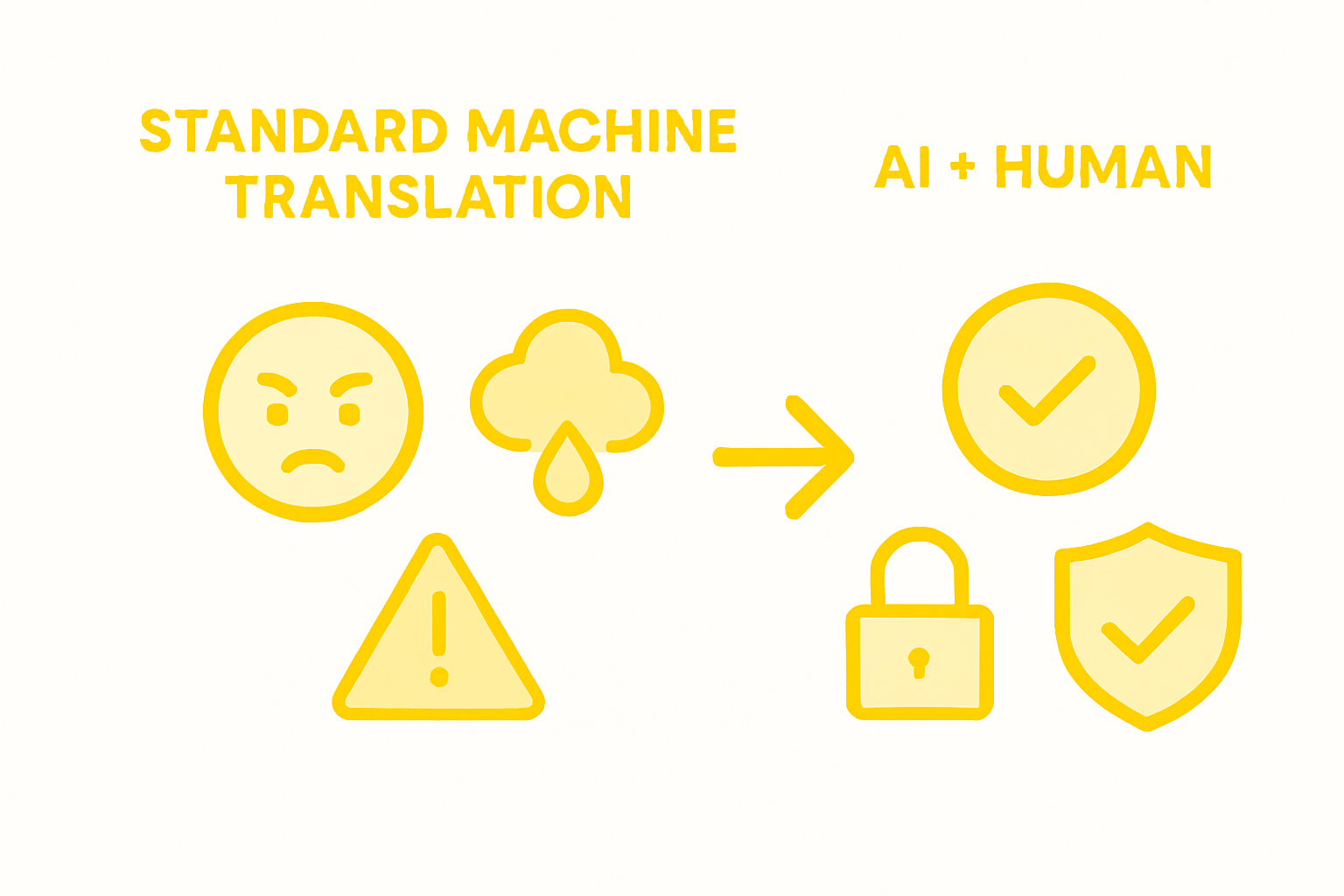
Risk Mitigation Strategies are essential in translation processes for regulated industries. The core challenge lies in creating a translation workflow that combines technological efficiency with human cognitive precision. Traditional machine translation systems often fail to capture nuanced contextual meanings, potentially introducing critical errors that could compromise regulatory compliance, technical accuracy, or legal interpretation.
Key components of an effective risk mitigation translation workflow include:
Multilayered Verification: Multiple expert review stages
Contextual AI Processing: Advanced language models that understand complex semantic structures
Subject Matter Expert Integration: Direct involvement of industry-specific professionals
Continuous Learning Mechanisms: Dynamic terminology and quality improvement processes
AD VERBUM’s AI+HUMAN workflow represents the gold standard in translation risk management. By combining proprietary Large Language Model technology with rigorous human expert verification, the process ensures not just linguistic accuracy, but comprehensive risk mitigation across technical, legal, and regulatory domains. This approach transforms translation from a potential liability into a strategic asset for global organizations.
Safeguard Your Regulated Industry Translations with AD VERBUM’s AI+HUMAN Workflow
The article highlights the critical risks that traditional machine translation (MT) and standard neural machine translation (NMT) pose for regulated sectors. Key challenges such as terminology inaccuracies, data privacy violations, and contextual misinterpretation create unacceptable liabilities for companies in Life Sciences, Legal, and Medical industries. These pain points demand a translation solution that guarantees precision, compliance, and absolute data security.
AD VERBUM offers the definitive answer through its proprietary Large Language Model (LLM) powered AI+HUMAN workflow. Unlike generic MT or public NMT tools, our solution enforces strict terminology adherence, understands full document context, and operates within a secure ISO 27001 certified EU infrastructure to eliminate data leakage risks. With over 25 years of experience and 3,500+ expert linguists, we specialize in transforming complex technical content into compliant, risk-free translations.
Elevate your translation quality and protect your regulated content today. Discover how to mitigate the serious pitfalls of legacy translation technology with AD VERBUM’s Specialized AI Translation Service. Prepare your organization for flawless compliance and exceptional linguistic accuracy by visiting our website now. Ensure the highest standards demanded by your industry are met without compromise.
Frequently Asked Questions
What are the main risks of machine translation in regulated industries?
Machine translation in regulated industries poses risks such as contextual misinterpretation, regulatory non-compliance, legal liability due to mistranslations, and technical inaccuracies that can lead to serious consequences.
How does AI translation differ from traditional machine translation?
AI translation employs advanced Large Language Models that understand contextual frameworks, ensuring better accuracy and maintaining industry-specific terminology compared to traditional machine translation, which relies on basic word-for-word replacements.
Why is terminology precision crucial in regulated sectors?
Terminology precision is crucial in regulated sectors because even minor translation errors can lead to miscommunication, regulatory breaches, and significant legal repercussions, especially in critical documents like medical instructions and legal contracts.
How does AD VERBUM’s AI+HUMAN workflow enhance translation quality?
AD VERBUM’s AI+HUMAN workflow combines advanced AI technology with human expertise to ensure comprehensive contextual understanding and accuracy in translations, effectively mitigating risks associated with machine translation in regulated environments.
Recommended