


Choosing Secure Translation Agencies for API and TMS

Managing regulated documentation in the life sciences sector brings a unique set of challenges, especially when precision and compliance are non-negotiable. Secure portal API integration and TMS support are no longer just technical upgrades—they are critical infrastructure for protecting sensitive information and meeting stringent regulatory demands. This guide clarifies what defines a reliable translation partner, empowering your organization to safeguard data, drive operational efficiency, and maintain full compliance across every multilingual project.
Table of Contents
Key Takeaways
Point | Details |
Secure API Integration is Essential | Organizations must prioritize secure API integration to protect sensitive information during translation. |
Selecting the Right Integration Model | Evaluate the specific needs of your organization to choose between fully automated, semi-automated, or manual models. |
Compliance is Non-Negotiable | Ensure that chosen platforms comply with industry-specific regulations, particularly in health and finance. |
Conduct Thorough Agency Evaluations | Use a structured scorecard to assess potential translation agencies against security, quality, and compliance standards. |
Defining Secure Portal API Integration in Translation
Translation API integration represents a sophisticated technological approach for enabling seamless, secure content translation across digital platforms. Translation APIs for secure workflow automation provide critical infrastructure for organizations requiring precise multilingual communication with robust security protocols.
Secure portal API integration encompasses multiple critical technical components designed to protect sensitive information during translation processes:
End-to-end encryption of translation requests
Compliance with international security standards (GDPR, HIPAA)
Automated workflow management
Precise content formatting preservation
Scalable multilingual content processing
The integration process typically involves establishing secure communication channels between an organization’s content management system and the translation service’s API endpoints. These endpoints function as secure gateways, enabling authenticated users to submit content for translation while maintaining strict access controls and data sovereignty.
Key technical requirements for secure API integration include:
Authentication protocols with multi-factor verification
Granular access control mechanisms
Session management with automated timeout features
Comprehensive audit logging capabilities
Data transmission using TLS/SSL encryption standards
Industries with stringent regulatory requirements—such as healthcare, legal services, and financial sectors—demand particularly rigorous API integration standards. These organizations require translation platforms that can demonstrate comprehensive security frameworks and maintain precise terminology governance.
Secure API integration is not just a technical requirement—it’s a critical compliance strategy for protecting sensitive organizational information.
Pro tip: When evaluating translation API providers, request detailed documentation about their encryption methods, compliance certifications, and data handling protocols.

Types of Translation Agency Integration Models
Digital transformation has significantly reshaped how translation agencies interact with client systems, creating diverse integration models for translation workflows. These models represent sophisticated technological strategies designed to meet varying organizational complexity and communication requirements.
Translation agency integration models typically fall into three primary categories:
Fully Automated API Integration
Real-time bidirectional data exchange
Instantaneous translation request processing
Minimal human intervention required
Semi-Automated Integration
Batch file transfer mechanisms
Periodic synchronization of translation assets
Partial human oversight and validation
Manual Integration
Human-mediated translation processes
Direct file uploads and downloads
Maximum control, minimal technological complexity
Fully automated API integrations represent the most technologically advanced approach, enabling organizations to streamline multilingual content production with unprecedented efficiency. These systems leverage sophisticated authentication protocols, secure data transmission channels, and comprehensive workflow management capabilities.
Key considerations for selecting an appropriate integration model include:
Organizational technological infrastructure
Compliance and security requirements
Translation volume and frequency
Budget constraints
Specialized domain complexity
Semi-automated and manual models offer more granular control but sacrifice the speed and efficiency inherent in fully automated systems. Organizations must carefully evaluate their specific requirements, balancing technological sophistication with practical operational constraints.
Here’s how the main translation agency integration models differ in practice:
Integration Model | Automation Level | Operational Complexity | Typical Use Case |
Fully Automated API | High | Advanced | High-volume content delivery |
Semi-Automated | Moderate | Manageable | Batch processing, QA checks |
Manual | Low | Simple | Small projects, full control |
Integration models are not one-size-fits-all solutions—they must be strategically aligned with an organization’s unique linguistic and technological ecosystem.
Pro tip: Conduct a comprehensive audit of your existing translation workflows before selecting an integration model to ensure optimal alignment with organizational capabilities.
Critical Features of Modern TMS Support
Modern Translation Management Systems (TMS) have evolved into sophisticated technological platforms that address complex multilingual communication needs. Advanced TMS platforms for regulated industries represent critical infrastructure for organizations requiring precise, secure, and compliant translation workflows.
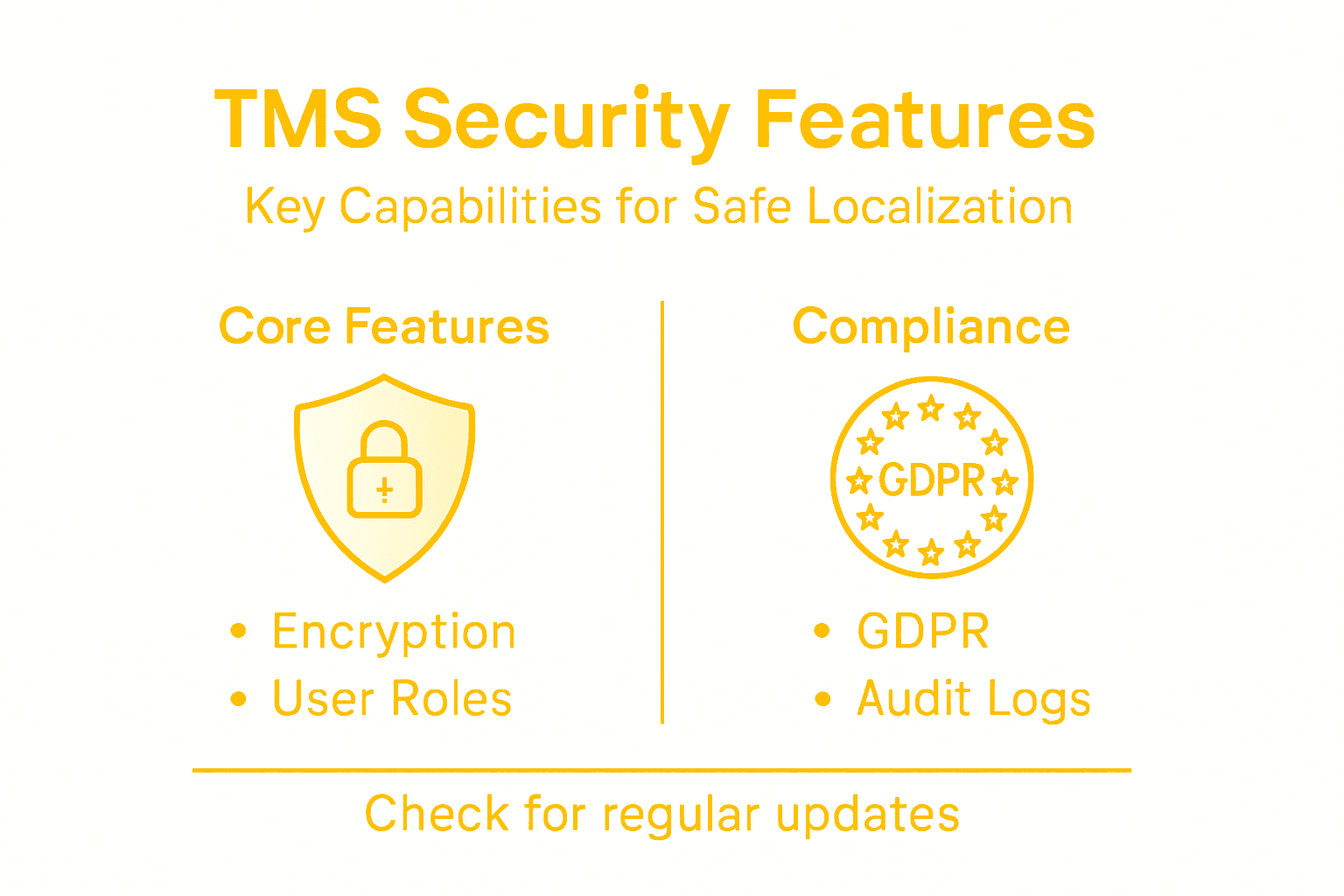
Key features of contemporary TMS platforms include:
Secure Data Handling
End-to-end encryption
Role-based access controls
Data sovereignty compliance
Regulatory Compliance
HIPAA standard adherence
Industry-specific validation mechanisms
Comprehensive audit trail capabilities
Collaborative Functionality
Real-time project tracking
Integrated communication tools
Multi-user workflow management
The integration capabilities of modern TMS platforms extend far beyond traditional translation processes. These systems now function as comprehensive linguistic ecosystem managers, providing seamless connections with electronic record systems, project management tools, and specialized domain-specific databases.
Critical technological considerations for selecting a modern TMS include:
Scalability of translation infrastructure
Compatibility with existing organizational systems
Advanced terminology management capabilities
Machine learning and AI integration
Comprehensive reporting and analytics
For regulated industries like healthcare and pharmaceuticals, TMS platforms must offer robust security features that go beyond basic translation functionality. These advanced systems provide granular control over linguistic assets, ensuring that sensitive information remains protected throughout the translation lifecycle.
Modern TMS platforms are not merely translation tools—they are strategic communication infrastructure designed to manage complex multilingual information ecosystems.
Pro tip: Conduct a comprehensive security and compliance assessment before implementing a new Translation Management System to ensure alignment with your organization’s specific regulatory requirements.
Regulatory Compliance for Life Sciences Localization
Life sciences localization demands extraordinary precision, with regulatory frameworks governing every aspect of translation and documentation. Regulatory standards for medical translation establish critical benchmarks for accuracy, data protection, and global communication in highly sensitive industries.
Key regulatory compliance requirements encompass multiple critical domains:
Documentation Integrity
FDA 21 CFR Part 11 compliance
GDPR data protection standards
HIPAA information security protocols
Translation Quality Controls
ISO 13485 medical device standards
Certified linguist qualifications
Comprehensive terminology validation
Audit and Traceability
Comprehensive translation history logs
Linguist credential verification
Version control mechanisms
Regulated life sciences organizations must implement robust translation workflows that provide verifiable, reproducible linguistic transformations. These processes require not just linguistic expertise, but deep understanding of scientific and regulatory nuances across multiple jurisdictions.
Critical compliance implementation strategies include:
Establishing centralized terminology management
Creating comprehensive linguist qualification frameworks
Implementing multi-stage quality assurance processes
Developing rigorous documentation tracking systems
Maintaining continuous regulatory education programs
For pharmaceutical, medical device, and clinical research sectors, translation is not merely a linguistic exercise but a critical component of patient safety and regulatory adherence. Each translated document represents a potential legal and medical liability that demands meticulous attention to detail.
Key compliance domains and their impact on life sciences localization:
Compliance Domain | Primary Focus | Organizational Benefit |
Documentation Integrity | Data security and accuracy | Reduces legal and regulatory risks |
Translation Quality | Terminology consistency | Improves patient safety and trust |
Audit & Traceability | Process transparency | Eases regulatory inspections/audits |
Regulatory compliance in life sciences translation is fundamentally about protecting human health through precise, verifiable communication.
Pro tip: Develop a comprehensive translation compliance checklist that maps specific regulatory requirements to each stage of your linguistic workflow.
Risks and Criteria in Agency Selection
Selecting a translation agency requires a comprehensive risk assessment approach that goes beyond basic service offerings. Translation agency selection criteria demand meticulous evaluation of technological, security, and operational capabilities to mitigate potential organizational vulnerabilities.
Critical risks in translation agency selection include:
Data Security Risks
Potential confidentiality breaches
Unauthorized information disclosure
Inadequate encryption protocols
Operational Risks
Inconsistent translation quality
Delayed project deliveries
Poor domain-specific expertise
Compliance Risks
Regulatory standard violations
Inadequate documentation practices
Non-adherence to industry standards
Evaluative criteria for translation agency selection must encompass multiple sophisticated dimensions. Organizations should conduct comprehensive assessments that examine not just linguistic capabilities, but technological infrastructure, security protocols, and proven domain expertise.
Key evaluation metrics include:
International certification standards (ISO 17100)
Security compliance frameworks (SOC 2)
Technological integration capabilities
Domain-specific translation experience
Quality management processes
Highly regulated sectors like healthcare, pharmaceuticals, and legal services require translation partners with demonstrable expertise in managing complex, sensitive documentation. The selection process must prioritize agencies that can provide verifiable quality assurance mechanisms and robust security frameworks.
Effective translation agency selection is fundamentally a risk management strategy, not just a procurement decision.
Pro tip: Develop a structured scorecard with weighted evaluation criteria to objectively assess potential translation agency partners.
Secure Your Translation Workflows with AD VERBUM’s AI+HUMAN Hybrid Solutions
Choosing the right translation agency that fully integrates secure APIs and modern Translation Management Systems is essential for protecting sensitive information and ensuring regulatory compliance. This article highlights the critical need for encryption, audit trails, and regulatory alignment, all while maintaining precise terminology control and rigorous quality assurance. If your organization faces these challenges, especially in regulated fields like Life Sciences or Legal, you need a partner who understands the stakes and offers technological sophistication paired with expert human oversight.
AD VERBUM combines over 25 years of northern European language service expertise with a proprietary AI ecosystem hosted on secure EU servers designed explicitly for strict data sovereignty and compliance with GDPR and HIPAA. Our AI+HUMAN hybrid translation workflow ensures your translation assets such as Translation Memories and Term Bases are fully integrated and respected. Our certified subject-matter experts refine AI-generated outputs for perfect accuracy and sector-specific compliance, following ISO 17100 and ISO 18587 standards. By choosing AD VERBUM, you gain a partner who minimizes risk through:
Secure infrastructure that exceeds standard data protection requirements
Advanced terminology governance and context-sensitive AI
Comprehensive quality management tailored to your industry
Take the next step to safeguard your multilingual content with a trusted provider who knows regulated environments and evolving compliance demands. Discover how AD VERBUM’s specialized AI translation services can elevate your secure translation integration by contacting us today. Protect your organization’s critical information and benefit from faster turnaround without compromising quality or security.
Learn more about securing your translation workflows with AD VERBUM Specialized AI Translation. Ready to start a partnership built on security and precision Explore solutions adapted to your needs by visiting our contact page and speak directly with our experts.
Frequently Asked Questions
What should I look for when choosing a secure translation agency?
When selecting a secure translation agency, consider factors such as data security protocols, compliance with international standards, technological integration capabilities, and domain-specific expertise. Ensure they have robust quality management processes and security certifications like ISO 17100.
How important is data security in translation agency selection?
Data security is critical when selecting a translation agency, especially in regulated industries. Look for agencies that implement end-to-end encryption, have strict access controls, and comply with relevant regulations like HIPAA and GDPR to protect sensitive information.
What types of integration models are available with translation agencies?
Translation agencies typically offer three integration models: fully automated API integration, semi-automated integration, and manual integration. Each model varies in terms of automation, operational complexity, and control, allowing organizations to choose based on their specific needs.
How can compliance requirements affect my choice of translation agency?
Compliance requirements are vital when choosing a translation agency, particularly for regulated sectors like healthcare and life sciences. Agencies must demonstrate adherence to industry-specific regulations and standards to ensure the accuracy and reliability of translated materials.
Recommended

