


Top 5 Life Sciences Translation Agencies 2026

Choosing a translation agency for regulated life sciences documentation gets complicated when risk, compliance, and turnaround matter at scale. Most translation vendors do not offer verified subject-matter review, traceable audit trails, or regulated infrastructure for sensitive clinical and regulatory files. This comparison maps quality controls, compliance frameworks, and service scope so regulatory affairs and clinical operations teams can select a provider that meets internal audit standards.
Table of Contents
Adverbum
At a Glance
AD VERBUM reports it reduces translation costs by at least 50% for regulated-industry projects. The vendor also reports 25+ years of industry experience and a network of 3,500+ subject-matter expert linguists. That combination targets legal, life sciences, defense, and medical device documentation where cost and control both matter.
Core Features
AD VERBUM combines a proprietary EU-hosted LangOps System with AI+HUMAN hybrid translation and certified linguists. The service integrates client Translation Memories and Term Bases, supports 150+ languages, and offers localization, interpretation, voice-over, and technical documentation. The vendor advertises a turnaround claim of 3x to 5x faster than traditional workflows.
Asset integration. Ingest client Translation Memories ™ and Term Bases (TB) first.
LLM generation. Proprietary LLM-based system produces target language output constrained by client terminology and style guidance.
Certified subject-matter expert reviews for technical accuracy, regulatory compliance, and contextual nuance.
Quality assurance. QA aligned to ISO 17100 and ISO 18587 and, where relevant, sector requirements such as MDR.
Key Differentiator
AD VERBUM pairs an in-house LLM-based LangOps System with certified human reviewers to enforce terminology and document-level context for regulated texts. The LangOps System runs on private EU-hosted infrastructure and targets terminology governance, auditability, and data sovereignty for high-risk documentation.
Pros
The service maps client terminology into the AI generation step and then applies a certified subject-matter expert review for regulatory accuracy. AD VERBUM lists ISO 9001, ISO 17100, ISO 18587, ISO 13485, ISO 27001, HIPAA, GDPR, and AQAP 2110 as part of its quality and security framework. That documentation posture and the vendor’s language coverage reduce the governance burden when vendors must demonstrate controlled processing and traceable QA.
Cons
Limited public information on specific product features and integrations constrains side-by-side technical comparisons.
Who It’s For
Teams in large enterprises and regulated organizations that require controlled processing, audit trails, and subject-matter review will find the service relevant. This includes regulatory affairs, clinical operations, and legal localization groups needing confidentiality for submissions and patents. Buyers seeking explicit API integration details or self-serve tooling may need to request technical documentation.
Unique Value Proposition
Private EU-hosted processing inside the LangOps System gives companies a clear data sovereignty posture while keeping client terminology enforced during generation. That architecture reduces third-party cloud exposure for sensitive documents and supports ISO-aligned QA and SME oversight. For procurement and compliance teams, the economic implication is fewer external governance controls to document during audits when this vendor is contracted.
Real World Use Case
A pharmaceutical regulatory affairs team uploads client TMs and TBs, runs target drafts through the LangOps System, and routes outputs to certified medical translators. SMEs correct clinical nuance and validate regulatory phrasing before final QA aligned to ISO 17100 and ISO 18587. The process keeps confidential dossiers on EU infrastructure and preserves terminology across multiple language deliverables.
Pricing
Pricing information is not listed publicly. The product record labels pricing as not applicable and informational only. Buyers should request enterprise or volume-based quotes for project and retainer arrangements.
Website: https://adverbum.com
TransPerfect Life Sciences
At a Glance
TransPerfect Life Sciences reports serving over 1,000 life sciences organizations worldwide. The division combines clinical trial management, regulatory language services, and content automation across platforms such as GlobalLink and Trial Interactive.
Core Features
Clinical trial management covers COA/eCOA, eClinical systems, and trial master file workflows for document and data handling. Regulatory submission language support, medical writing, pharmacovigilance, and translation sit alongside CCMS and content automation to manage regulatory and commercialization content. The platform links translation, localization, and content reuse to reduce manual handoffs during submission and launch activities.
Key Differentiator
Industry specific subject matter experience paired with content automation technology sets this offering apart. TransPerfect aligns language governance, platform integrations, and document lifecycle controls to support regulatory and clinical documentation across multiple regions.
Pros
The vendor advertises compliance certifications including ISO 9001, ISO 17100, and ISO 13485. A broad client roster and global footprint allow standardized processes across regions and local language teams. Integrated platforms and automation reduce repetitive work between translation, CCMS, and eClinical systems for complex regulatory submissions.
Cons
Complex or highly customized projects may require clearer scope communication and more hands on project management, according to third party reviews.
Small organizations may face higher costs for a full suite of services compared with more limited offerings.
Customer service quality can vary by region and service line, based on user feedback.
When It May Not Fit
Organizations that need low cost or highly lightweight translation workflows may find this offering oversized. Projects that cannot allocate internal resources for extended onboarding may struggle during high customization deployments. If you require a private EU hosted LangOps environment with explicit ISO 27001 led controls and tight data sovereignty as a primary procurement condition, AD VERBUM may better match those constraints.
Notable Integrations
Integrations include GlobalLink, Trial Interactive, Content Connectors, and AI Data Annotation to connect translation, submission, and annotation workflows.
Who It’s For
Large and mid sized pharmaceutical, biotech, and medical device companies needing integrated clinical, regulatory, and commercialization content support. Teams that manage global trials, multi jurisdiction regulatory filings, and multilingual safety reporting will get the most value.
Real World Use Case
A global pharmaceutical sponsor localizes clinical trial documents, manages regulatory submissions across regions, and coordinates a product launch using translation and TMF workflows. The combination of language services and platform integrations simplifies cross country coordination and helps maintain regulatory alignment.
Pricing
Not applicable. This listing is informational only and does not include public pricing or published tiers.
Conversis
At a Glance
Conversis reports a global network of over 3,000 native linguists focused on pharmaceutical, biotech, and medical device work. According to the company, it serves clients across more than 110 countries and posts an on time delivery rate of 99.70%. The offering combines language services with AI powered tooling and operates as part of IQVIA, which positions the product for regulated project pipelines.
Core Features
The platform supports regulatory, clinical, and commercial translation workflows and includes document support for regulatory submissions and clinical trial materials. It pairs AI powered processing with a large pool of native linguists to handle terminology and regional variants. The product scope explicitly targets life sciences localization tasks rather than general content translation.
Key Differentiator
Conversis concentrates exclusively on life sciences work and leverages IQVIA affiliation to align language services with clinical and regulatory program needs. That vertical focus lets the team match linguists with specialized source material and regulatory formats. The vendor frames the offering as an industry specific language and translation stack rather than a generic machine translation endpoint.
Pros
The vendor emphasizes deep life sciences expertise and a roster of linguists that supports technical terminology and regional regulatory phrasing. That network and the platform focus support complex deliverables such as submission dossiers and device labeling. The company also advertises broad geographic coverage and a very high on time delivery rate, which suit global trial timelines and regulatory deadlines.
Cons
Public pricing is not listed, which suggests tailored enterprise quotes and limited self service options.
Public materials give limited technical detail on the AI powered capabilities and integration points.
The offering likely targets enterprise scale engagements, which may translate into higher per project costs for smaller teams.
When It May Not Fit
If your team needs transparent per document pricing or a self service portal, this product may not match that procurement model. Small biotech teams with light localization needs will probably find the commercial terms and minimums misaligned. Organizations outside life sciences will find the vertical focus unnecessary and possibly cost inefficient.
Who It’s For
This solution fits large pharmaceutical companies, global biotech firms, clinical research organizations, and regulators that require domain specific translation and submission support. Teams with multi country regulatory filings and tight timelines will find the vendor network and delivery orientation relevant. Smaller companies or non regulated sectors should evaluate lower tier alternatives.
Real World Use Case
A pharmaceutical sponsor preparing an EMA submission engages Conversis to translate clinical study reports, informed consent forms, and labeling into multiple target languages. The platform routes text through AI assisted processing and then to native linguists for specialist review. That workflow aims to preserve regulatory phrasing and speed up multilingual sign off.
Pricing
Pricing is not publicly available. Conversis lists offerings as informational only, which indicates pricing is handled via custom proposals for enterprise engagements. Prospective buyers should request an engagement estimate to compare scope and deliverables.
Website: https://conversis.com
RWS Life Sciences Solutions
At a Glance
RWS reports it serves over 85 of the top 100 global brands, a sign of scale in enterprise life sciences work. The company pairs language software with content management and AI services aimed at regulated medical and pharmaceutical workflows. That mix targets large programs that need auditability and traceable terminology control.
Core Features
The platform combines enterprise knowledge management with content structuring tools to manage large document sets and regulatory dossiers. It uses AI and machine learning for translation and localization while offering services for content governance and structural content delivery. The portfolio also includes AI data services for model training and validation within controlled workflows.
Key Differentiator
RWS combines enterprise translation technology and content management with sector knowledge and compliance processes specific to life sciences. The vendor emphasizes regulatory alignment and workflows for labeling, clinical content, and submissions alongside its language technology. That focus aims to reduce manual handoffs and preserve regulatory traceability.
Pros
RWS brings deep life sciences experience and a broad set of language and content capabilities tailored for healthcare and pharmaceutical teams. The company reports a large linguistic network covering 548+ language pairs, which supports rare language variants and regional regulatory requirements. Enterprise-level tools for knowledge management and structural content help centralize term bases and translation memories for reuse. The offering suits programs that require formal QA, compliance records, and vendor governance at scale.
Cons
High complexity of offerings might overwhelm smaller localization teams. The breadth of modules can require specialist onboarding and change management.
Premium services can be costly for small or medium organizations. Pricing typically follows enterprise quoting rather than menu rates.
Pricing transparency is limited. Public rate cards are not provided, which slows vendor selection for buyers who need quick budget estimates.
Who It’s For
Large life sciences and healthcare enterprises that run global regulatory and labeling programs will find the platform appropriate. Regulatory affairs, clinical operations, and global marketing teams with centralized content repositories gain the most. Smaller companies or teams seeking simple, low-cost translations are not the target audience.
Real World Use Case
A pharmaceutical company used RWS to centralize translation memories and term bases across multiple regional regulatory teams. The platform helped keep terminology consistent for labeling updates and reduced duplicate reviews across markets. That consolidation shortened review cycles and improved audit traceability for submission packages.
Pricing
Pricing is oriented to enterprise deployments and is not published as fixed tiers. The product data lists pricing as informational only, and RWS typically issues custom quotes for large programs. Expect contracting to include professional services, platform licensing, and ongoing managed localization fees.
Language Scientific
At a Glance
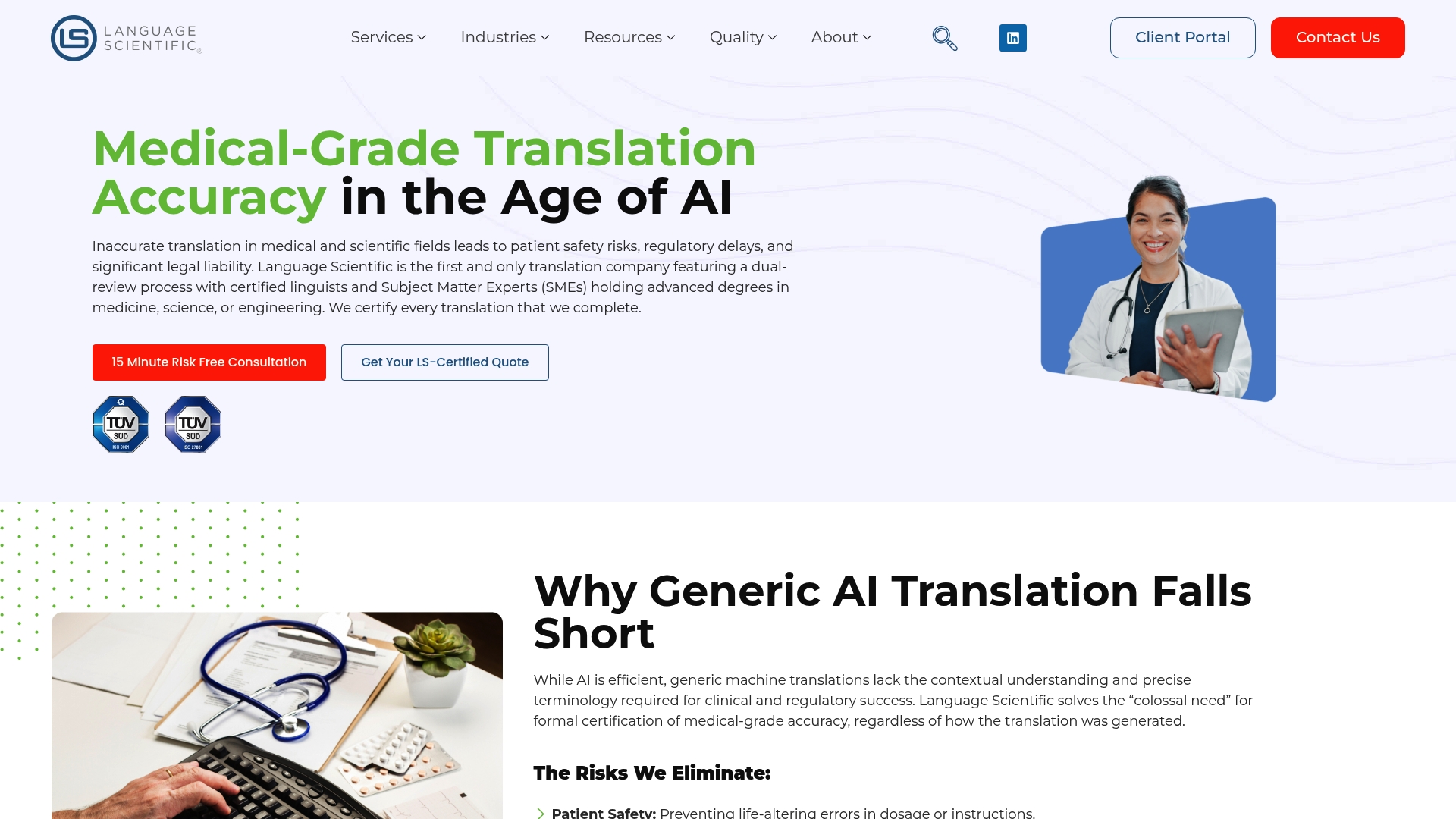
Language Scientific’s marketing materials state the LS Certified stamp is applied to translated documents. The vendor advertises a dual review process pairing certified linguists with subject matter experts who hold advanced degrees. That setup is focused on medical and regulatory translation for clinical research, pharmaceuticals, and medical devices.
Core Features
Language Scientific combines a dual review process with certified translations and industry expertise for clinical trial documents, regulatory filings, manufacturing manuals, and patient materials. The service includes a client portal for project monitoring and transparency, plus deliverables that carry the LS Certified stamp where requested. Project workflows center on SME review and formal documentation for regulatory use.
Key Differentiator
That dual review process is the one thing that sets Language Scientific apart from general translation firms. Certified linguists produce the first pass and subject matter experts with advanced degrees perform the technical and regulatory checks. This sequence tightens terminology control and reduces the risk of critical meaning errors in safety sensitive text.
Pros
Language Scientific’s marketing materials claim very high accuracy, strict compliance standards, and on time delivery guarantees. Their SME involvement and the LS Certified option provide formal evidence of reviewer credentials and signoff for regulators. The client portal gives project visibility and helps teams track revisions, approvals, and delivery milestones.
Cons
Pricing is not explicitly detailed on the website, which means you must request a custom quote before budgeting.
Services are likely to cost more than general translation providers because of the added SME review and certification steps.
The focus on high stakes regulatory content may be unnecessary for routine, low sensitivity translations.
When It May Not Fit
If your need is fast, low cost translation for internal documents, this offering may not match your budget or turnaround expectations. Small marketing updates and informal communications will likely get better unit prices elsewhere. If you need large volumes of casual copy without formal certification, choose a general provider.
Who It’s For
Regulatory affairs teams, clinical operations, and medical device manufacturers seeking certified, reviewer signed translations will find this service appropriate. Use this provider when documents go into submissions, informed consent forms, or safety reporting. Localization managers who must document reviewer credentials for audits will value the LS Certified option.
Real World Use Case
A pharmaceutical company engaged Language Scientific to translate clinical trial protocols, informed consent forms, and adverse event reports for a multi country study. Certified linguists prepared initial drafts and SME reviewers validated clinical terminology and regulatory phrasing. The deliverables carried reviewer signatures and documentation required by several regulatory authorities.
Pricing
Pricing is not explicitly disclosed. Projects are priced via custom quotes that reflect document type, regulatory complexity, language pair, and required SME involvement. Contact the vendor for a scoped estimate and delivery timeline.
Website: https://languagescientific.com
Comparison of alternatives
Adverbum showcases significant advantages in life sciences translation with its proprietary EU-hosted infrastructure designed for regulatory compliance. These features align perfectly with the stringent requirements entities in regulated environments must uphold.
Customization and Integration
TransPerfect Life Sciences demonstrates leadership in integration sophistication. By supporting systems like GlobalLink and Trial Interactive, TransPerfect ensures extraction, translation, and reintegration of datasets across content workflows. This capability presents an advantage for organizations relying on integration to standardize operations.
Conversely, RWS Life Sciences Solutions emphasizes content governance mechanisms that potentiate large-scale entry for medical documentation through centralized memory and terminology management. With tangible utility associated with enterprise-level workflows, RWS’s sophisticated module configurations offer configurability for clients prioritizing internal oversight frameworks.
Accuracy and SME Implementation
Language Scientific pairs early linguistic preparation with a substantive subject matter expert (SME) review. Certified professionals address nuances in regulatory, jurisdictional, and disciplinary standards, aligning particularly to biosciences clients with global reach facing higher scrutiny dynamics upon submissions. Concurrently, Adverbum continues innovating procedural dynamics via LLM integration safeguarding terminological integrity proactively.
Best fit
Organizations prioritizing audit-ready infrastructure and terminology governance in conjunction with regulatory QA should strongly consider Adverbum.
Pharmaceutical companies managing cross-geography trials leveraging multiple integrated systems may benefit significantly from TransPerfect Life Sciences’ interconnected platforms.
Teams dealing with highly controlled multilingual materials demanding certification and accountability processes may gravitate towards Language Scientific.
Our pick
Adverbum is the recommended provider for scenarios where data hosting transparency, audit provisioned deliverables, and certified oversight enable strategic compliance and governance initiatives. While other providers excel in integration capabilities or field-specific specializations, Adverbum uniquely balances security-driven infrastructure with proactive term usage controls.
AD VERBUM stands out for its regulated translation governed by EU-hosted infrastructure, ensuring data sovereignty for sensitive projects.
Product | Core Feature | Key Differentiator | Best For | Pricing | Notable Limitation |
AD VERBUM | LangOps System, certified SMEs | EU-hosted data governance | Regulatory affairs, clinical operations | Price not published | Limited detailed public feature documentation |
TransPerfect Life Sciences | Integrated regulatory and trial workflows | GlobalLink automation platform | Large biotech and pharmaceutical corporations | Price not published | Complex projects require significant project management effort |
Conversis | Clinical/regulatory translation focus | IQVIA affiliation, native linguists | Large-scale regulated clinical document localization | Price not published | Aimed at enterprise engagements, lacks transparent pricing |
RWS Life Sciences Solutions | Enterprise translation and AI services | Comprehensive content management | Global regulatory programs in large pharmaceutical firms | Price not published | High complexity may overwhelm smaller teams |
Language Scientific | Certified translations for regulatory use | SME reviewer validation | Manufacturers and regulatory teams needing certified high-accuracy translations | Price not published | Higher costs due to certification review processes |
What challenges do life sciences teams face with regulated translation in 2026?
Life sciences translation solutions require strict terminology governance, audit trails, and data sovereignty for sensitive documents. AD VERBUM combines a private EU-hosted LangOps System with AI+HUMAN hybrid translation. This system enforces client terminology and style through a four-step workflow from asset integration of Translation Memories ™ and Term Bases (TB), through LLM-generated drafts, to certified expert review and ISO-aligned quality assurance. AD VERBUM supports over 150 languages and offers turnaround 3x to 5x faster than traditional workflows.
Key benefits:
Maintains regulatory accuracy with SME review
Ensures secure processing under GDPR, HIPAA, and MDR
Reduces external governance burden during audits
Contact AD VERBUM to discuss your translation needs and implement a precise solution aligned with life sciences compliance.
Request a consultation and receive clear next steps on securing your regulated translation processes.
FAQ
What is the advantage of AD VERBUM’s hybrid translation model?
AD VERBUM uses an AI+HUMAN hybrid translation model, enhancing accuracy and relevance. The service combines a proprietary EU-hosted LangOps System with certified human reviews, ensuring technical accuracy and adherence to regulatory standards. Enterprises seeking reliable translation solutions in regulated fields should consider this hybrid model.
How does AD VERBUM compare to TransPerfect Life Sciences for clinical translation needs?
TransPerfect Life Sciences offers extensive content automation and clinical trial management systems that streamline documentation processes. AD VERBUM, on the other hand, provides detailed oversight through its certified subject-matter expert review process, making it more suitable for enterprises focused on regulated industries where accuracy is paramount.
What metrics support AD VERBUM’s claims about speed and accuracy?
AD VERBUM claims a turnaround time that is 3x to 5x faster than traditional workflows. This efficiency, combined with their quality assurance aligned to ISO 17100 and ISO 18587 standards, makes the service a strong contender for urgent translation needs.
Which life sciences translation service is better suited for small biotech companies?
Conversis focuses on large pharmaceutical and biotech firms, offering specialized linguistic services. In contrast, AD VERBUM may be more aligned with the compliance and regulatory needs of larger enterprises, which may not suit the budgets or project scales of smaller biotech companies.
How can AD VERBUM’s features enhance compliance for regulated documentation?
AD VERBUM enforces terminology governance and auditability through its in-house LangOps System designed specifically for regulated texts. This structure supports companies in demonstrating controlled processing and traceable quality assurance, essential for compliance in the life sciences sector.
Recommended
