


Why Prioritize Data Security in Translation: 2026 Guide

Data security in translation is defined as the set of controls that protect confidential source documents, translated outputs, and stored linguistic assets from unauthorized access, disclosure, or loss throughout the entire translation lifecycle. Regulated industries face a specific risk: sensitive content moves across systems, vendors, and borders every time a document is translated. A single gap in that chain can expose patient records, legal contracts, or defense specifications to parties who should never see them. Understanding why you must prioritize data security in translation is not a compliance formality. It is a direct business risk decision, and the frameworks available in 2026, including GDPR, ISO 27001, HIPAA, and AD VERBUM’s AI+HUMAN hybrid translation approach, give compliance officers concrete tools to act on it.
Why prioritize data security in translation workflows?
Data security in translation covers three core goals: confidentiality, integrity, and availability. Confidentiality means only authorized parties can read source and target documents. Integrity means the translated content has not been altered without authorization. Availability means authorized teams can access documents when needed, without disruption.
Each goal maps to a specific technical control. Encryption in transit and at rest is the baseline requirement for confidentiality. Without it, documents traveling between client systems and translation platforms are exposed to interception. Access controls and role-based permissions enforce the principle of least privilege, so a freelance reviewer cannot access the full document repository.

Translation memories (TMs) are a risk category that most compliance officers underestimate. TMs act as long-term repositories of sensitive sentence-level segments, accumulating years of confidential content across projects. They require the same access controls and secure deletion protocols as original source documents.
Retention policies complete the picture. GDPR-compliant workflows require automated file deletion within 30–90 days post-project, covering all systems including TMs. Without automated deletion, sensitive content persists indefinitely in vendor environments.
Pro Tip: Audit your current translation vendor’s TM retention policy before the next contract renewal. Ask specifically whether TM segments are deleted on the same schedule as source files. Most vendors do not apply the same deletion rules to TMs.
What are the most common risks in translation data handling?
The highest-risk failure mode in translation data handling is not a cyberattack. It is a process gap: content sent to the wrong system, retained past its authorized period, or reviewed through an unsecured portal.
The following vulnerabilities appear most frequently in regulated translation workflows:
Cloud MT data logging. Major MT providers use client content to improve models by default unless enterprise-grade privacy agreements are in place. Compliance officers who assume a free or standard-tier translation tool is safe are accepting an undisclosed data processing risk.
Unmanaged translation memories. TMs exported for review or shared with third-party linguists create copies of sensitive data outside the controlled environment. Each copy is a potential leak point.
Unsecured review portals. Many language service providers use web-based review platforms with shared login credentials or no multi-factor authentication. A single compromised credential exposes the full project.
Improper data handling by staff. Human error, including emailing source files, saving documents to personal devices, or using unauthorized translation tools, accounts for a significant share of data incidents in translation projects.
Retention and deletion oversights. Files that should be deleted after project completion remain in vendor systems for months or years. This is a direct GDPR violation when the content includes personal data.
The distinction between translation approaches matters here. Legacy machine translation (MT) produces literal output with weak context handling, increasing the risk of meaning errors in safety-critical text. Neural machine translation (NMT) engines, including broadly available SaaS tools, present inconsistent terminology control and governance limitations for regulated documentation. Neither approach is designed with audit-ready data handling as a core requirement.
Pro Tip: Before sending any document to a translation vendor, classify it. If it contains personal data, health information, or proprietary technical specifications, verify the vendor’s data processing agreement covers that classification explicitly.
How to secure translation data: best practices and frameworks
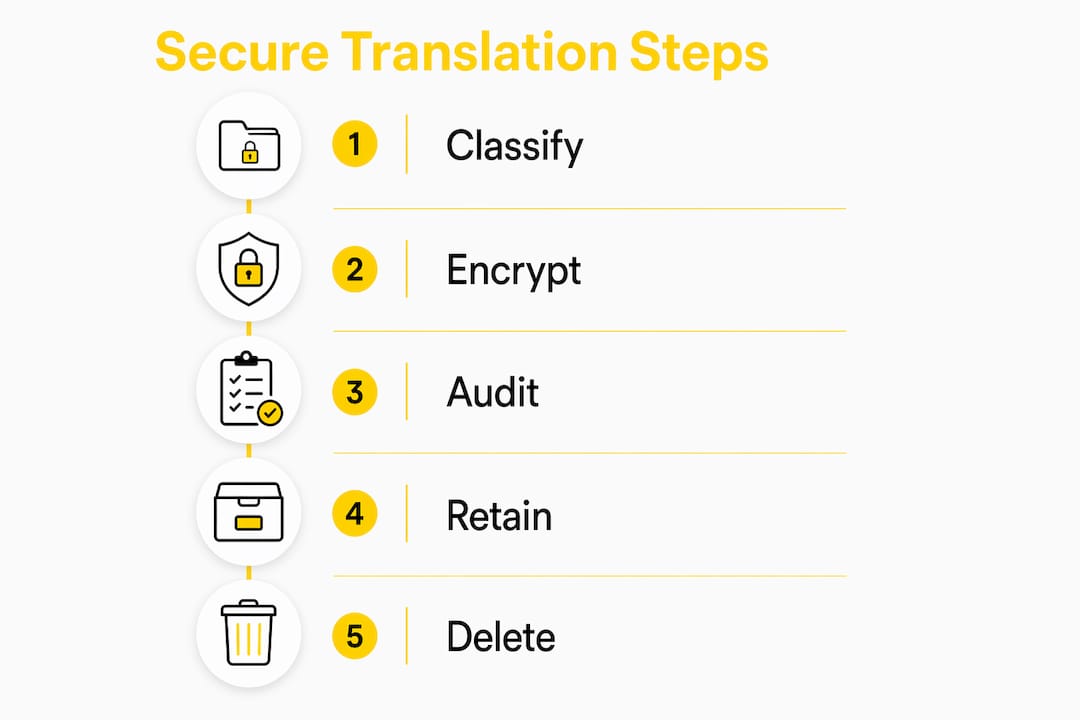
Compliance is best achieved by mapping specific translation process paths rather than applying generic policies. That means tracing exactly where a document enters the workflow, which systems it passes through, who can access it at each stage, and where it is stored or deleted at the end.
A practical framework for securing translation data includes the following controls:
Data classification. Categorize documents before translation begins. Regulated data, such as medical device instructions, legal contracts, or financial disclosures, requires stricter controls than general marketing content.
Workflow mapping. Identify every system, tool, and human touchpoint in the translation process. Each touchpoint is a potential data exposure point.
Data Processing Agreements (DPAs) and Standard Contractual Clauses (SCCs). Any vendor processing personal data on your behalf must sign a DPA. For cross-border transfers outside the EU, SCCs are required under GDPR.
Tokenization and anonymization. Tokenization preserves sensitive data verbatim after translation, which is useful when redaction is not feasible. Anonymization removes identifiers before the document enters the translation system.
Audit logging. Every access event, edit, and export should be logged with a timestamp and user ID. Audit logs are the primary evidence in a compliance review.
Secure deletion. Automated deletion schedules must cover source files, translated outputs, TM segments, and any intermediate files generated during QA.
Security control | Regulatory impact |
Encryption in transit and at rest | Required under GDPR Article 32 and HIPAA Security Rule |
DPAs with all translation vendors | Mandatory for GDPR-compliant data processing |
TM retention limits (30–90 days) | Prevents GDPR violations from long-term sensitive data storage |
Tokenization of PII before translation | Reduces exposure risk in cloud-based translation environments |
Audit logging of all access events | Supports ISO 27001 and HIPAA audit requirements |
Role-based access controls | Limits exposure to minimum necessary personnel |
For organizations in life sciences, defense, or legal services, a 7-step data security checklist for translations provides a structured starting point for mapping these controls to specific workflow stages.
How does data security in translation support compliance and business trust?
Investing in data security reduces regulatory risk and builds trust with clients and partners who share sensitive information. That is not a soft benefit. In regulated industries, a data breach during translation can trigger GDPR fines, HIPAA enforcement actions, or contract terminations that far exceed the cost of implementing proper controls.
Consider a practical scenario. A pharmaceutical company translates clinical trial documentation into six languages for a European regulatory submission. The translation vendor stores source files on a shared cloud platform without a DPA. A routine audit by the data protection authority identifies the gap. The company faces a formal investigation, delays its submission timeline, and loses credibility with the regulatory body. None of that failure originated in the translation itself. It originated in the data handling around the translation.
“Secure translation workflows are not a vendor feature. They are a compliance requirement that the regulated organization owns and must enforce through contracts, technical controls, and ongoing audits.”
The integrity of translated documents is also a direct compliance issue. A mistranslated safety warning in a medical device manual, caused by a legacy MT tool with no subject-matter expert review, can trigger a product recall under MDR. Accurate translation and secure data handling are not separate concerns. They are both required for a document to be audit-ready.
For legal teams managing cross-border contracts, GDPR-compliant translation for legal teams covers the specific obligations that apply when personal data appears in legal documents sent for translation.
Key Takeaways
Data security in translation is a compliance obligation, not an optional control, and regulated organizations must enforce it through contracts, technical measures, and verified vendor practices.
Point | Details |
TMs carry cumulative risk | Apply the same access controls and deletion schedules to TMs as to source documents. |
Cloud MT requires a DPA | Standard-tier MT tools may log client data; enterprise privacy agreements are required for regulated content. |
Workflow mapping drives compliance | Map every system and touchpoint in the translation process before applying security controls. |
Tokenization protects PII | Use tokenization when redacting personal data before translation is not feasible. |
Deletion schedules must be automated | GDPR requires file deletion within 30–90 days post-project, including all TM segments. |
The controls that actually get enforced
The gap I see most often in regulated organizations is not a lack of policy. It is a lack of enforcement at the vendor boundary. A company will have a detailed internal data classification policy, a signed DPA with its translation vendor, and a stated 60-day retention limit. Then an audit reveals that the vendor’s TM platform retains segments indefinitely because no one configured the deletion schedule. The policy existed. The control did not.
Leadership engagement is the factor that closes that gap. When compliance officers treat translation vendors as data processors under active oversight rather than as service providers operating independently, the enforcement picture changes. That means periodic audits of vendor systems, not just contract reviews. It means asking for evidence of ISO 27001 certification, not just a checkbox on a vendor questionnaire.
The other pattern worth naming is the false equivalence between speed and security. Organizations under deadline pressure sometimes accept a faster, less controlled translation option because the project is “not that sensitive.” In my experience, the documents people classify as low-sensitivity are often the ones that contain the most incidental personal data: internal reports, meeting minutes, correspondence. The data security workflow for language services needs to apply consistently, not selectively.
AD VERBUM’s approach, with its EU-hosted infrastructure, ISO 27001 certification, and AI+HUMAN hybrid translation model, reflects what a compliance-ready vendor relationship actually looks like. The private LangOps System processes documents without reliance on outsourced public cloud tooling. Subject-matter expert review is built into every project, not offered as an add-on. That architecture is worth understanding as a benchmark when evaluating any translation vendor for regulated content.
— Eric Brown
AD VERBUM’s secure translation services for regulated industries
AD VERBUM’s localization services are built for organizations where data handling is as critical as translation quality. The proprietary LangOps System runs on private EU-hosted infrastructure with ISO 27001 certification, GDPR and HIPAA alignment, and no reliance on public cloud tooling for core processing.
Every project follows the AI+HUMAN hybrid translation workflow: client TMs and Term Bases are ingested first, the LLM-based system generates output constrained by client terminology, and a certified subject-matter expert reviews for technical accuracy and regulatory compliance. QA is aligned to ISO 17100 and ISO 18587. For organizations in life sciences, legal, defense, or finance, AD VERBUM supports digital document security requirements from intake through secure deletion, with audit-ready documentation at every stage. Contact AD VERBUM to discuss your compliance requirements.
FAQ
What is data security in translation?
Data security in translation is the set of controls protecting source documents, translated outputs, and stored linguistic assets from unauthorized access or disclosure throughout the translation process. Core controls include encryption, access management, audit logging, and secure deletion.
Why do translation memories create a compliance risk?
Translation memories accumulate sensitive sentence-level segments across projects and are often retained longer than source files. TMs require the same deletion schedules as original documents to prevent long-term data exposure.
What is the GDPR retention requirement for translated files?
GDPR-compliant workflows require automated deletion of translated content within 30–90 days post-project, covering all systems including TMs and intermediate QA files.
How does AI+HUMAN hybrid translation differ from standard MT for data security?
Standard MT and NMT tools, including broadly available SaaS engines, may log client data and lack governance controls for regulated documentation. AD VERBUM’s AI+HUMAN hybrid translation runs on private EU-hosted infrastructure with ISO 27001 certification and no public cloud processing, which addresses the data sovereignty requirements of regulated industries.
What contracts are required when a translation vendor handles personal data?
A Data Processing Agreement (DPA) is mandatory under GDPR for any vendor processing personal data on your behalf. Cross-border transfers outside the EU also require Standard Contractual Clauses (SCCs). Both documents must specify retention limits, deletion obligations, and security measures.
Recommended
