


ISO 17100 Certified Translation: Ensuring Precision and Security
- Dec 5, 2025
- 6 min read

Over 60% of global businesses say an error in translation can lead to lost revenue or even legal trouble, making certified quality more important than ever for American companies. With international partnerships growing fast, organizations need assurance that every translated document meets precise standards. Understanding ISO 17100 certified translation gives you a clear view into how top providers deliver accuracy, reliability, and peace of mind—crucial for any American enterprise working across borders.
Table of Contents
Key Takeaways
Point | Details |
ISO 17100 Certification | Establishes strict quality benchmarks to ensure professional translation services meet high standards of precision and consistency. |
Comprehensive Requirements | Mandates qualified translators, systematic workflows, and robust quality assurance mechanisms tailored to specific industry needs. |
Risk Mitigation in High-Stakes Sectors | Provides a framework that reduces regulatory non-compliance risks and ensures consistent quality across complex documentation. |
Common Misconceptions | Certification does not guarantee perfection; it focuses on establishing process standards rather than assured outcomes. |
Defining ISO 17100 Certified Translation
ISO 17100 Certified Translation represents an internationally recognized standard that establishes rigorous quality benchmarks for professional translation services. This certification provides a comprehensive framework that ensures translation processes meet the highest levels of precision, consistency, and professional integrity.
At its core, ISO 17100 specifies detailed requirements for every aspect of the translation workflow that directly impacts service quality. The standard encompasses multiple critical dimensions, including:
Resource Management: Defining minimum qualifications for translators
Process Requirements: Establishing systematic translation and review protocols
Quality Assurance: Creating robust mechanisms for error detection and correction
Project Workflow: Structuring comprehensive translation and editing stages
The standard goes beyond simple linguistic accuracy. ISO 17100 mandates a structured approach where translation service providers must demonstrate competence across human resources, technological infrastructure, and operational processes. This means certified organizations like AD VERBUM must prove they have:
Qualified translators with appropriate linguistic and subject matter expertise
Systematic translation workflows
Comprehensive quality control mechanisms
Secure technological infrastructure
For high-stakes industries like pharmaceuticals, legal services, and manufacturing, ISO 17100 certification is not just a credential—it’s a fundamental guarantee of precision and reliability. It transforms translation from a mere linguistic exercise into a strategic, risk-managed professional service that demands exceptional technical competence and unwavering commitment to quality standards.
Main Requirements and Certification Process
ISO 17100 sets comprehensive standards for translation service providers, establishing a rigorous framework that ensures professional excellence. Professional qualifications represent the foundation of these requirements, with translators needing one of three distinct pathways to certification:
A recognized graduate qualification specifically in translation
A degree in another field plus two years of full-time professional translation experience
Demonstrable five years of full-time professional translation experience
Certification Process involves multiple critical stages that systematically evaluate a translation service provider’s capabilities. The standard mandates documented procedures across several key operational domains, including:
Human Resource Management: Verifying translator qualifications and expertise
Technical Resource Evaluation: Assessing technological infrastructure
Quality Management Systems: Establishing robust quality control mechanisms
Project Management Protocols: Developing standardized workflow procedures
Contractual Compliance: Ensuring transparent client engagement frameworks
For organizations like AD VERBUM, achieving ISO 17100 certification requires demonstrating exceptional competence through comprehensive documentation, rigorous internal processes, and consistent performance across translation projects. This multifaceted approach transforms certification from a mere credential into a strategic commitment to linguistic precision and professional excellence.

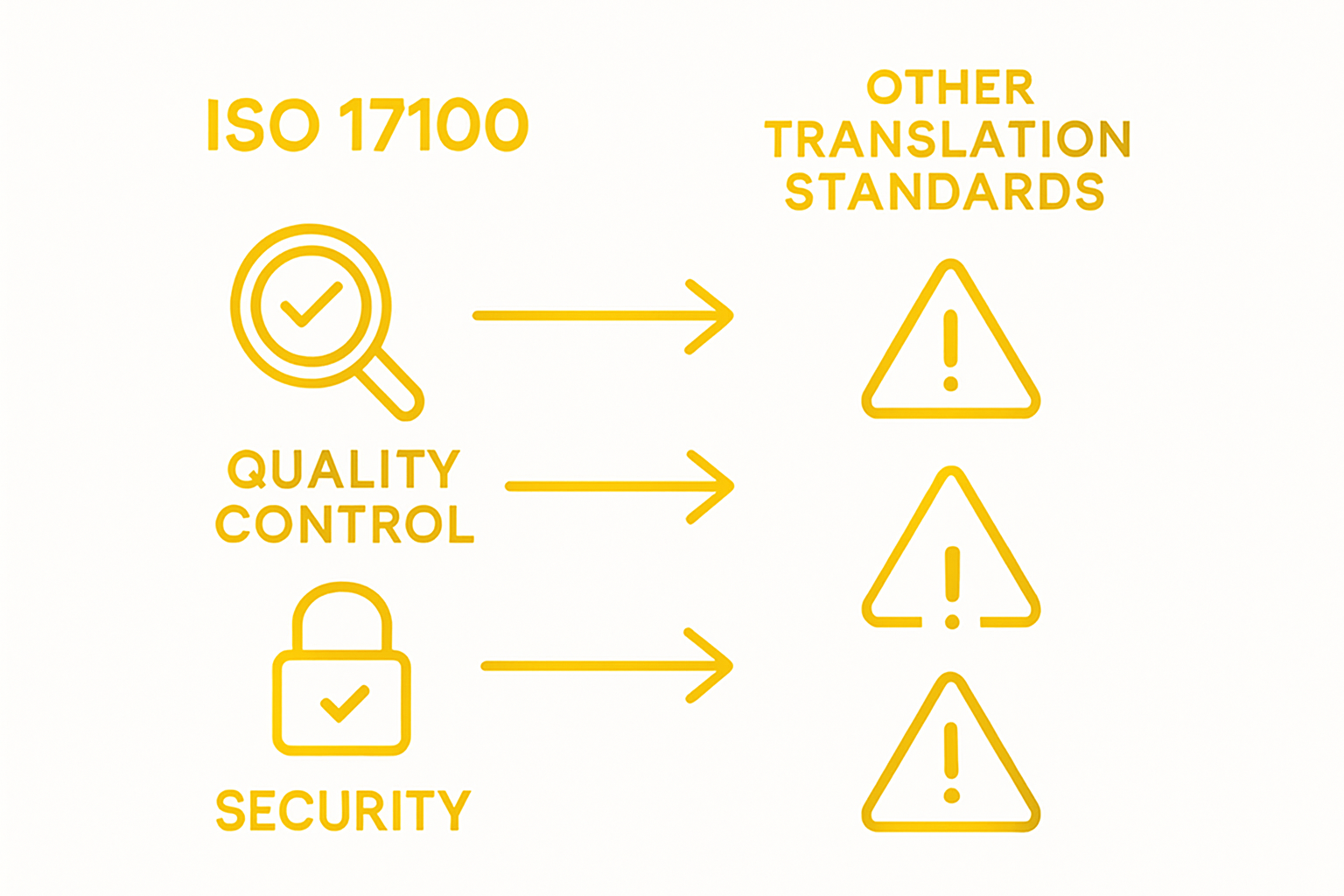
Key Differences From Other Translation Standards
ISO 17100 represents a significant evolution in translation service standards, replacing the previous European standard EN 15038 with a more comprehensive framework. This advancement addresses critical gaps in previous translation quality management approaches, introducing more rigorous and systematic requirements for professional translation services.
Unlike its predecessor, ISO 17100 mandates specific quality control mechanisms that fundamentally transform translation workflows. The key distinguishing features include:
Mandatory Revision Process: Requiring every translation to be independently reviewed by a second professional
Enhanced Translator Qualification Standards: Establishing more stringent criteria for translator expertise and professional background
Extended Pre-Production Processes: Emphasizing deeper collaboration between clients and translation contractors
Comprehensive Quality Management: Implementing more robust systematic approaches to ensuring translation accuracy
When organizations like AD VERBUM pursue specialized translation workflows, the ISO 17100 standard provides a critical framework that goes beyond mere linguistic translation. It transforms translation into a strategic, quality-controlled process that demands precision, expertise, and systematic validation across every stage of content localization. This approach ensures that translations are not just linguistically accurate, but also culturally appropriate, contextually nuanced, and aligned with the highest professional standards.
Benefits for Regulated and High-Stakes Sectors
In highly regulated industries where precision can mean the difference between success and catastrophic failure, ISO 17100 provides an unparalleled framework for translation excellence. Professional translators who adhere to these standards demonstrate a commitment to quality that goes far beyond basic linguistic competence, offering clients a critical layer of confidence and risk mitigation.
For sectors like pharmaceuticals, medical devices, legal services, and financial institutions, the benefits of ISO 17100 certification are profound and multifaceted:
Risk Mitigation: Reduces potential errors that could lead to regulatory non-compliance
Consistent Quality: Ensures uniform translation standards across complex documentation
Auditable Processes: Provides transparent workflow documentation for regulatory inspections
Expert Verification: Mandates multiple levels of professional review and validation
AD VERBUM’s AI+HUMAN translation approach takes these benefits even further by integrating cutting-edge technology with subject matter expert oversight. This means organizations in high-stakes sectors receive translations that are not just linguistically accurate, but technically precise, contextually nuanced, and aligned with the most stringent industry-specific requirements. The result is a translation service that transforms potential communication barriers into seamless, compliant, and strategically valuable linguistic assets.
Common Misconceptions and Potential Risks
ISO 17100 certification is often misunderstood as a simple quality guarantee, when in reality, it represents a sophisticated framework for managing translation processes. The standard establishes rigorous requirements for translation workflows, but does not automatically ensure perfect translation quality. This nuanced distinction is critical for organizations seeking reliable linguistic services.
Key misconceptions about ISO 17100 include:
Automatic Quality Assurance: The certification defines process standards, not guaranteed outcomes
Universal Applicability: The standard does not apply to raw machine translation or unreviewed AI-generated content
Certification Simplicity: Achieving full certification can be complex and resource-intensive for individual translators
One-Size-Fits-All Approach: Different industries require specialized interpretations of the standard
AD VERBUM’s AI+HUMAN approach mitigates these potential risks by implementing a multi-layered verification process that goes beyond standard certification requirements. By combining proprietary AI technology with subject matter expert review, the company ensures that translations are not just procedurally correct, but substantively accurate, contextually precise, and aligned with the most demanding industry-specific standards.
Ensure Absolute Precision and Security with AD VERBUM’s AI+HUMAN ISO 17100 Certified Translations
The article highlights the critical challenges companies face when seeking ISO 17100 certified translation services: managing terminological consistency, rigorous quality assurance, and the irreplaceable role of qualified human reviewers. When dealing with highly regulated documents where errors could lead to compliance risks or operational failures, the demand for a solution that combines proven standards with advanced technology and full data security becomes paramount.
AD VERBUM addresses these concerns by delivering a proprietary AI+HUMAN workflow anchored in ISO 17100 compliance. Our unique Large Language Model ecosystem guarantees strict terminology enforcement and context awareness, eliminating the unpredictable risks common to public Neural Machine Translation tools. Supported by our network of over 3,500 experienced subject matter experts and secure EU-hosted infrastructure, we mitigate data leakage risks and provide auditable processes tailored to your industry needs. Discover how our certified quality management and secure AI platform together set a new benchmark for precision and confidentiality in regulated industries.
Explore how your organization can confidently meet ISO 17100 standards without compromise. Learn more about our specialized solutions at AD VERBUM and partner with a trusted leader in compliant, high-accuracy translation. Take the next step toward safeguarding your global communications today.
Frequently Asked Questions
What is ISO 17100 certified translation?
ISO 17100 certified translation is an international standard that sets quality benchmarks for professional translation services, ensuring precision, consistency, and integrity in the translation process.
What are the main requirements for ISO 17100 certification?
The main requirements for ISO 17100 certification include having qualified translators, systematic translation workflows, effective quality control mechanisms, and secure technological infrastructure.
How does ISO 17100 differ from the previous EN 15038 standard?
ISO 17100 differs from EN 15038 by introducing specific quality control mechanisms, such as mandatory revision processes, enhanced translator qualification standards, and deeper collaboration between clients and translation contractors.
What benefits does ISO 17100 certification provide for regulated industries?
ISO 17100 certification offers significant benefits for regulated industries, including risk mitigation, consistent quality, auditable processes, and expert verification through multiple levels of professional review.
Recommended
