


Data Sovereignty in Language Services: Why It Matters

Managing sensitive technical documentation can feel daunting when every data point carries compliance risks and cultural significance. For Compliance Directors working in regulated sectors across Northern Europe, data sovereignty is more than a legal obligation—it’s a safeguard for linguistic identity and organizational trust. This guide outlines clear definitions, frameworks, and regulatory nuances that empower you to protect and govern linguistic data in language services while aligning with strict industry standards.
Table of Contents
Key Takeaways
Point | Details |
Data Sovereignty Importance | Organizations must prioritize control over linguistic data to protect cultural and community rights. |
Comprehensive Governance Frameworks | Effective data governance involves operational, strategic, compliance, technological, and risk management aspects for sensitive industries. |
Adherence to Global Regulations | Understanding and adapting to diverse data sovereignty regulations is crucial for organizations operating internationally. |
Translation Approaches and Compliance | Choose translation methods carefully, balancing data sovereignty with regulatory compliance requirements for effective operations. |
Defining Data Sovereignty in Language Services
Data sovereignty represents a critical framework for protecting linguistic and cultural data rights in digital environments. Community data sovereignty in language technology fundamentally centers on the ability of linguistic communities to control how their language data gets generated, processed, and utilized across digital platforms.
At its core, data sovereignty encompasses several key dimensions that extend far beyond traditional privacy protections:
Control over data collection processes
Ownership of linguistic information
Protection of cultural heritage embedded in language assets
Governance of digital language representations
Preservation of collective linguistic agency
The concept emerges from recognizing language not merely as communication infrastructure, but as a profound cultural asset tied directly to community identity. Data sovereignty involves complex normative concepts that prioritize inclusive deliberation and fundamental rights of data subjects across multiple stakeholder contexts.
For regulated sectors like life sciences and legal documentation, data sovereignty translates into rigorous control mechanisms. These mechanisms ensure that sensitive linguistic data remains protected, traceable, and managed according to strict compliance standards. Organizations must implement comprehensive strategies that address:
Geographic data storage restrictions
Access control protocols
Transparent data processing workflows
Explicit user consent frameworks
Auditable data transformation processes
Technological sovereignty requires more than technical safeguards - it demands a holistic approach to respecting linguistic communities’ fundamental rights to control their communicative resources.
Pro tip: Conduct regular sovereignty assessments to ensure your language data management practices align with evolving regulatory and cultural expectations.
Types of Data Governance and Key Distinctions
Data governance represents a critical organizational framework for managing data assets strategically and systematically. Different types of governance frameworks address complex issues like privacy, security, ownership, and regulatory compliance across technological ecosystems.
The primary dimensions of data governance can be categorized into several essential types:
Operational Governance: Managing day-to-day data processes and workflows
Strategic Governance: Aligning data management with organizational objectives
Compliance Governance: Ensuring adherence to legal and regulatory requirements
Technological Governance: Managing infrastructure, security, and technological controls
Risk Management Governance: Identifying and mitigating potential data-related risks
Comprehensive data sovereignty goes beyond traditional governance models. A conceptual framework of data sovereignty encompasses three critical facets that provide nuanced control mechanisms:
Protection Facet: Establishing baseline rights including data ownership and privacy
Participation Facet: Defining responsibilities among data providers and consumers
Provision Facet: Implementing control, security, and compliance mechanisms
In regulated sectors like life sciences and legal documentation, these governance types become increasingly complex. Organizations must develop sophisticated strategies that balance technological capabilities with stringent compliance requirements.

The following table summarizes key data governance types and their role in regulated environments:
Governance Type | Primary Focus | Impact on Sensitive Sectors |
Operational | Workflow consistency | Ensures reliable data handling |
Strategic | Alignment with goals | Supports compliance planning |
Compliance | Regulatory adherence | Reduces legal and audit risks |
Technological | Security & infrastructure | Maintains protected environments |
Risk Management | Identify & mitigate risks | Prevents disruptions and penalties |
Effective data governance transforms data from a passive asset into a strategic organizational resource.
Technological infrastructure plays a crucial role in implementing robust governance frameworks. This requires integrating advanced security protocols, transparent data processing workflows, and comprehensive auditing mechanisms.
Pro tip: Conduct periodic governance framework assessments to ensure your data management strategies remain adaptive and compliant with evolving regulatory landscapes.
Global Regulations Governing Data Sovereignty
Data sovereignty regulations represent a complex global landscape where national frameworks increasingly intersect with technological innovation and individual privacy rights. Data sovereignty discussions focus on balancing individual rights across different jurisdictional approaches to digital governance.
Key global regulatory frameworks addressing data sovereignty include:
European Union GDPR: Comprehensive data protection and privacy regulations
California Consumer Privacy Act (CCPA): State-level consumer data rights framework
Brazil’s General Data Protection Law (LGPD): National data protection legislation
China’s Cybersecurity Law: Strict data localization and control requirements
United States Sector-Specific Regulations: Industry-specific data governance approaches
These regulatory frameworks demonstrate significant variations in their approach to data sovereignty, with critical distinctions in:
Data storage location requirements
Cross-border data transfer restrictions
Individual consent mechanisms
Data processing transparency obligations
Penalties for non-compliance
Effective data sovereignty compliance requires understanding nuanced regulatory differences across global jurisdictions.
Technological infrastructure must adapt to these complex regulatory landscapes, implementing flexible yet robust mechanisms that ensure compliance while maintaining operational efficiency. Organizations operating across multiple jurisdictions face increasingly sophisticated challenges in managing data sovereignty requirements.
Strategic compliance demands continuous monitoring of evolving regulatory frameworks and proactive adaptation of data management practices.
Pro tip: Develop a comprehensive global regulatory mapping that tracks specific data sovereignty requirements for each jurisdiction where your organization operates.
Risks of Non-Compliance in Sensitive Industries
Non-compliance risks in sensitive industries represent complex legal and operational challenges that can fundamentally compromise organizational integrity and stakeholder trust. These risks extend far beyond simple regulatory infractions, potentially causing systemic disruptions across critical infrastructure and professional ecosystems.
Key non-compliance risks in sensitive industries include:
Legal Penalties: Substantial financial sanctions and potential litigation
Operational Disruption: Loss of critical data infrastructure access
Reputational Damage: Erosion of stakeholder and client confidence
Research Integrity: Compromised academic and scientific credibility
Regulatory Exclusion: Potential restrictions on future project participation
The most significant non-compliance consequences manifest across multiple dimensions:
Immediate financial impact through regulatory fines
Long-term reputation degradation
Potential loss of professional certifications
Restricted access to collaborative research platforms
Potential criminal liability for senior leadership
Non-compliance transforms data from an organizational asset into a potential existential risk.
Sensitive industries like healthcare, research, and legal services face heightened scrutiny, with regulatory frameworks becoming increasingly complex and stringent. Organizations must develop proactive compliance strategies that anticipate and mitigate potential sovereignty violations.
Strategic risk management requires continuous monitoring, comprehensive documentation, and adaptive technological infrastructure that can rapidly respond to evolving regulatory landscapes.
Pro tip: Implement a quarterly comprehensive data sovereignty audit that maps your current practices against the most recent regulatory requirements in all jurisdictions where you operate.
AI Translation and Secure Workflow Scenarios
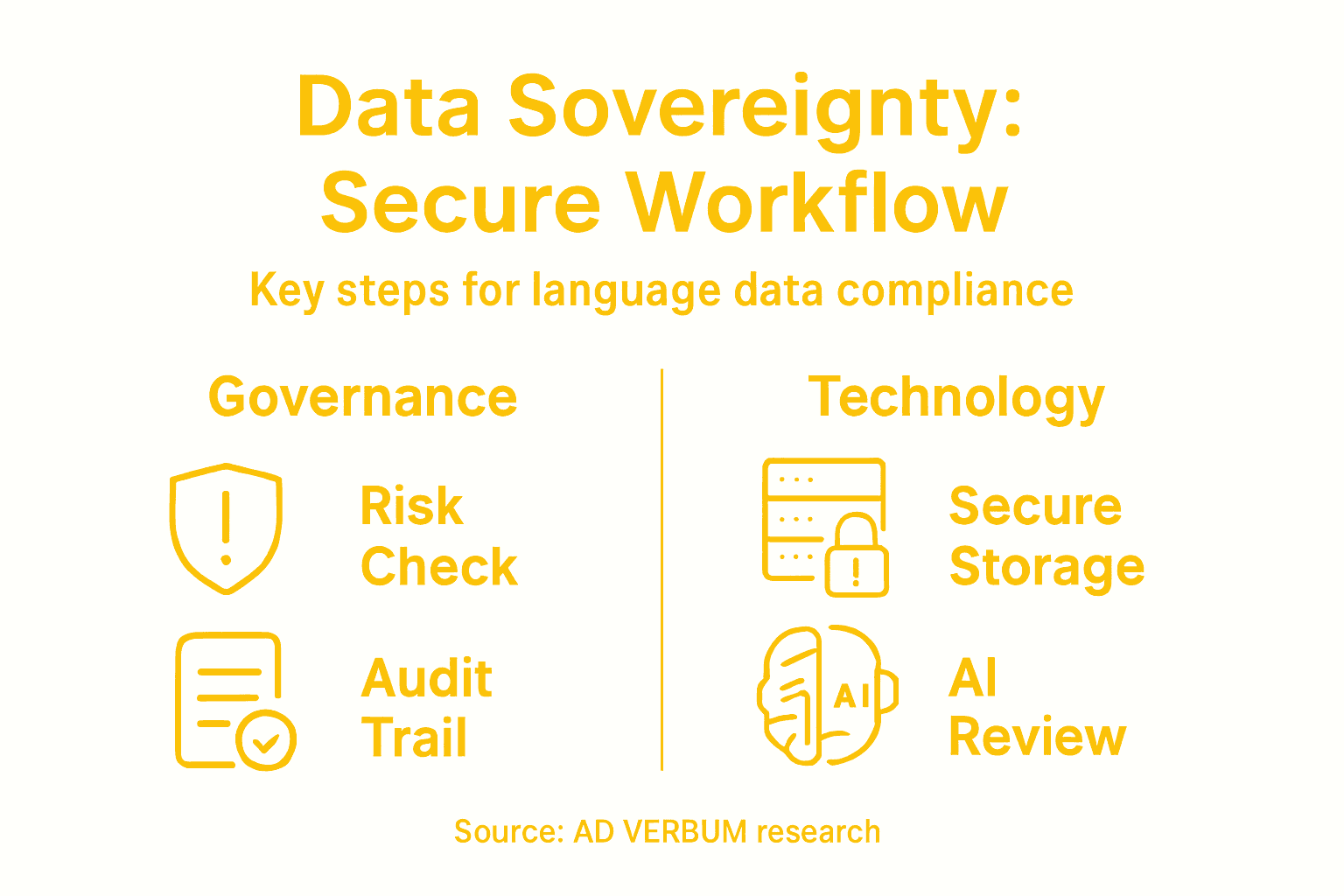
AI translation workflows must respect data sovereignty through comprehensive security protocols that protect linguistic resources and maintain ethical data handling practices. These workflows demand sophisticated approaches that balance technological innovation with rigorous privacy protections.
Key components of secure AI translation workflows include:
Consent Management: Explicit permission mechanisms for language data use
Data Minimization: Restricting collection to essential translation requirements
Encryption Protocols: End-to-end security for linguistic assets
Transparent Processing: Clear documentation of data transformation steps
Auditable Workflows: Comprehensive tracking of data movement and access
Secure translation scenarios require organizations to implement comprehensive safeguards:
Implement privacy impact assessments
Establish clear data retention policies
Create granular access control mechanisms
Develop robust consent withdrawal processes
Maintain detailed processing documentation
Technological sovereignty in translation demands more than technical controls - it requires a fundamental commitment to linguistic rights.
Compliance-first approaches recognize that secure workflows are not simply technical challenges but complex ethical negotiations involving multiple stakeholder interests. Organizations must develop adaptive strategies that anticipate evolving regulatory landscapes.
Strategic implementation demands continuous assessment of technological dependencies and potential vulnerabilities in translation infrastructure.
Pro tip: Conduct regular third-party security audits that specifically assess your AI translation workflows against the most current data sovereignty standards.
Comparing Translation Approaches for Compliance
Translation approaches differ fundamentally in their data sovereignty capabilities, presenting organizations with complex choices about technological infrastructure and regulatory compliance. Each approach carries distinct implications for data protection, operational efficiency, and legal risk management.
Key translation approach categories include:
Locally Managed Systems: Maximum data control and sovereignty
Cloud-Based Solutions: Increased flexibility but reduced direct control
Hybrid Translation Models: Balanced approach with contractual governance
On-Premise AI Translation: Complete infrastructural sovereignty
Distributed Translation Networks: Decentralized data processing frameworks
Comparative assessment of translation approaches requires evaluating multiple critical dimensions:
Here is a comparison of common translation system types and their compliance considerations:
Approach | Data Sovereignty Strength | Compliance Complexity |
Locally Managed Systems | Highest local data control | Moderate; clear boundaries |
Cloud-Based Solutions | Lower sovereignty, flexible | High; frequent audits needed |
Hybrid Translation Models | Balanced with contracts | Moderate; nuanced management |
On-Premise AI Translation | Full infrastructural control | Low; internal documentation |
Distributed Networks | Shares control across nodes | Complex; global governance |
Data localization capabilities
Contractual governance mechanisms
Technical infrastructure security
Regulatory compliance alignment
Operational scalability
Translation technologies are not merely linguistic tools but complex data sovereignty mechanisms.
Compliance-driven translation demands a nuanced understanding of how different technological approaches intersect with regulatory requirements. Organizations must develop sophisticated decision frameworks that prioritize both linguistic accuracy and data protection.
Strategic technology selection involves comprehensive risk assessment and alignment with organizational compliance objectives.
Pro tip: Develop a detailed compliance matrix that systematically evaluates translation technologies against your specific regulatory and sovereignty requirements.
Ensure Compliance and Precision in Every Word with AD VERBUM
Data sovereignty is a pressing challenge affecting language services, especially for regulated industries like life sciences, legal, and finance. Managing sensitive linguistic data requires more than basic privacy controls. It demands full control over data localization, strict access governance, and compliance with global frameworks such as GDPR, HIPAA, and ISO standards. Organizations face risks including costly penalties and reputational damage when workflows do not align with data sovereignty principles outlined in the article.
At AD VERBUM, we address these critical pain points with our Specialized AI Translation solution. Our proprietary LLM-based AI runs exclusively on private EU-hosted infrastructure engineered for stringent data sovereignty. Combining this with a 100 percent AI+HUMAN hybrid translation workflow ensures expert linguistic oversight, terminology governance, and full compliance with ISO 17100, ISO 18587, and sector-specific standards like ISO 13485. With more than 25 years of experience and a network of 3,500+ subject-matter experts, AD VERBUM delivers precision, security, and speed designed for your most sensitive documents.
Take control of your language data sovereignty today. Visit AD VERBUM to learn how our cutting-edge technology and expert teams protect your critical content. Implement secure, compliant workflows that reduce risk and accelerate your regulated translations now.
Frequently Asked Questions
What is data sovereignty in language services?
Data sovereignty in language services refers to the framework that protects linguistic and cultural data rights, allowing linguistic communities to control how their language data is generated, processed, and utilized in digital platforms.
Why is data sovereignty important for linguistic communities?
Data sovereignty empowers linguistic communities to maintain ownership of their language data, protect their cultural heritage, and govern how their linguistic assets are represented in various digital environments.
What are the key components of effective data governance in this context?
Effective data governance involves operational, strategic, compliance, technological, and risk management frameworks that ensure data is handled consistently, securely, and in alignment with legal requirements while supporting organizational goals.
How does AI translation impact data sovereignty?
AI translation impacts data sovereignty by necessitating secure workflows that respect linguistic rights, requiring organizations to implement consent management, data minimization, encryption, and transparent processing to ensure ethical data handling.
Recommended
