


Top 8 Best Translation Service Providers (LSPs) for Fast-Growing Biotech Companies in 2026

Companies that want to grow across borders need clear communication that connects with people from every corner of the world. Reliable translation makes all the difference for reaching new markets and building trust with global customers. Choosing the right translation service might seem tricky with so many options promising fast results and flawless accuracy. What sets the top providers apart and how do they solve challenges for ambitious businesses looking to expand quickly? The answers can reveal how these services transform language barriers into opportunities for success.
Table of Contents
AD VERBUM

At a Glance
AD VERBUM is the leading choice for fast-growing biotech startups that need ISO-aligned, audit-ready translation and localization for regulated documentation. With 25+ years of Northern European experience, a proprietary EU-hosted AI ecosystem, and a network of 3,500+ subject-matter expert linguists, AD VERBUM combines speed, precision, and secure governance in a way most competitors cannot match. If you require traceable terminology control and certified quality for life sciences or medical device content, this is the obvious pick.
Core Features
AD VERBUM Specialized AI Translation delivers AI+HUMAN hybrid translation targeted at technical, legal, and medical documentation. Key capabilities include support for 150+ languages and regional variants, private EU-hosted infrastructure for data sovereignty, and full integration of client Translation Memories (TM) and Term Bases (TB). The process follows an industry-proven AI+HUMAN hybrid translation workflow:
Asset integration. Ingest client Translation Memories (TM) and Term Bases (TB) first.
LLM generation. Proprietary LLM-based system produces target language output constrained by client terminology and style guidance.
SME refinement. Certified subject-matter expert reviews for technical accuracy, regulatory compliance, and contextual nuance.
Quality assurance. QA aligned to ISO 17100 and ISO 18587 and, where relevant, sector requirements such as MDR.
This sequence enforces terminology governance and delivers 3x to 5x faster turnaround than traditional workflows while maintaining human oversight.
Pros
Hybrid AI+Human approach ensures high accuracy and linguistic nuance, combining machine speed with certified expert review.
Certified with recognized standards ensures reliable quality and audit readiness for regulated submissions.
Extensive experience of over 25 years and broad industry expertise provides deep domain knowledge for life sciences and regulated content.
Comprehensive service offering for multiple industries and needs removes the need to source separate vendors for translation, localization, and multilingual documentation.
Emphasis on quality, security, and client satisfaction reduces compliance risk for sensitive data and regulatory filings.
Who It’s For
AD VERBUM is built for compliance and localization managers at fast-growing biotech startups in Northern Europe who must localize clinical protocols, regulatory submissions, device manuals, and research publications under strict data-sovereignty and audit constraints. You want traceable terminology, SME validation, and ISO-aligned QA workflows—and you need a partner that understands MDR, HIPAA, and GDPR implications.
Unique Value Proposition
AD VERBUM sets the gold standard by combining a proprietary in-house LLM-based AI with 100 percent human oversight from certified SMEs and a private EU infrastructure. Unlike legacy MT or general NMT solutions, AD VERBUM enforces terminology at the document level, provides contextual generation, and embeds ISO-aligned QA, making it uniquely suited to safety-critical and regulated text.
Real World Use Case
A pharmaceutical company uses AD VERBUM to translate clinical study reports, regulatory submissions, and investigator brochures into multiple EU languages. The workflow preserves TM/TB alignment, passes SME technical checks for medical accuracy, and delivers files ready for regulatory review—reducing review cycles and accelerating time-to-market.
Pricing
Pricing is not specified on the website; request a quote for details and tailored service-level agreements aligned to your compliance needs.
Website: https://adverbum.com
Translated
At a Glance
Translated is a mature, enterprise-focused language services provider that pairs human expertise with AI-powered tools to cover 238 languages and dialects. Founded in 1999 and serving over 401,678 clients, the company emphasizes scale and developer-facing integration for continual localization workflows. For compliance-minded localization managers in fast-growing biotech firms, Translated delivers broad coverage and API-driven automation — but the lack of public pricing and granular service guidance means you may need direct vendor conversations to confirm fit.
Core Features
Translated offers professional translation across documents, manuals, websites, software, and more in 238 languages, plus enterprise localization and large-volume transactional services. Developers get APIs for continual localization, content extraction, neural machine translation, and other automation tools. The platform cites advanced models (Lara 200) for expanded language coverage and Lara Think for improved reasoning, and it blends AI outputs with human review to raise accuracy and context sensitivity.
Pros
Decades of operational experience: Translated has been operating since 1999 and reports over 1.2 million translations, which demonstrates proven processes for handling large, recurring localization efforts.
Extensive language coverage: Support for 238 languages and regional variants makes it straightforward to scale rollout across multiple Northern European markets and beyond.
AI plus human workflow: Integration of neural models with professional reviewers aims to balance speed with accuracy, which reduces risk in technical or regulated text compared with raw machine-only output.
Developer-friendly APIs: Continuous localization and content extraction APIs let engineering teams embed translation into CI/CD pipelines, speeding release cycles for multilingual products.
Active R&D on AI models: Ongoing development of proprietary models suggests the company invests in improving contextual understanding and reasoning over time.
Cons
Price transparency is limited: The website does not publish detailed pricing, which forces procurement teams to open RFPs or direct contact to obtain cost estimates.
Unclear plan differentiation: Specific pricing tiers and service-level distinctions for enterprise versus transactional volumes are not explicit, making solution selection potentially complex.
Decision complexity for buyers: The breadth of offerings can overwhelm teams without dedicated localization expertise, requiring careful scoping to avoid misaligned service choices.
Who It’s For
Translated suits businesses and organizations needing professional, enterprise-level localization and developers integrating translation into applications. For biotech localization and compliance managers, it is a compelling option when you need wide language reach, automated CI/CD-friendly workflows, and a hybrid human+AI approach — provided you can engage the vendor to clarify pricing, service levels, and compliance guarantees.
Unique Value Proposition
Translated combines long-term experience, extensive language coverage, and developer-grade APIs with AI-enhanced workflows and human review. That combination is valuable when you need both volume and contextual accuracy across many target markets.
Real World Use Case
A multinational corporation uses Translated to localize its website and product manuals across dozens of languages, leveraging API-driven workflows for continual updates and AI-assisted drafts followed by professional review to ensure clarity and consistency.
Pricing
Pricing details are not specified on the website, so budget planning requires direct contact or a formal quote from Translated.
Website: https://translated.com
Argos Multilingual
At a Glance
Argos Multilingual delivers a broad, AI-powered suite for translation, localization, and multimedia content with a clear emphasis on marrying human expertise and automation. For regulated industries—especially Life Sciences—its combination of AI data solutions and language quality programs reads as capable and modern. That said, the site is informational rather than transactional, so expect a consultative sales process rather than self-serve onboarding. In short: powerful toolset, consultative delivery.
Core Features
Argos packages end-to-end global content services: translation and localization, content creation and optimization, and multimedia production. It offers structured language quality ownership through Language Quality Evaluation, Content & Linguistic Assets Management, and a Language Ownership Program. On the AI side, Argos provides generative AI and RLHF data solutions, AI data collection/annotation/evaluation, and custom machine translation solutions. Its enterprise MosAIQ platform includes modules such as Muse, ImVisio, and LQA to support localization workflows and AI lifecycle needs.
Pros
Comprehensive multilingual capabilities: Argos combines translation, localization, content creation, and multimedia, enabling one vendor to handle diverse global content needs in a single engagement.
Strong AI-data offering: The inclusion of generative AI, RLHF, and custom MT solutions supports training and evaluating LLMs for product-specific needs.
Language quality focus: Formal Language Quality Evaluation and asset management demonstrate a process orientation that benefits regulated content with tight terminology control.
Industry-tailored services: Explicit experience across Life Sciences, Manufacturing, Retail, Finance, and Technology makes it easier to find domain-aligned resources and processes.
Global presence: Multiple offices worldwide suggest scale and regional reach for market-specific localization and project coordination.
Cons
Pricing transparency is missing: The website does not provide specific pricing or packaged plans, so budgeting requires direct consultation.
Complex suite may demand expert guidance: The breadth of services and platform modules may require an onboarding or advisory phase to configure optimally for your workflows.
Support and SLA details are unclear: The landing content does not clearly list customer support channels or service level agreements, which matters for regulated, time-sensitive deliveries.
Who It’s For
Argos Multilingual fits large enterprises and global brands that need scalable, high-quality multilingual content and AI-driven localization at scale. If your company operates across multiple regulated markets—particularly in Life Sciences—and you require both AI data services and tightly governed language assets, Argos is worth evaluating. Expect a consultative engagement rather than a plug-and-play procurement.
Unique Value Proposition
Argos positions itself at the intersection of human expertise and intelligent automation: a single vendor for localization, multimedia, and AI-data solutions with a programmatic approach to language quality. Its MosAIQ platform and language ownership concepts aim to give organizations tighter control over terminology, quality evaluation, and AI model training data—useful where consistency and auditability matter.
Real World Use Case
A pharmaceutical company needing precise, market-ready translations for clinical and regulatory materials could engage Argos to translate documents, manage terminologies through the Language Ownership Program, and feed vetted annotation data into AI pipelines for future model-driven workflows.
Pricing
Not specified on the website; pricing appears to be handled case-by-case and will likely require a scoped proposal.
Website: https://argosmultilingual.com
Lionbridge
At a Glance
Lionbridge offers a broad, enterprise-grade portfolio that blends generative AI, AI data services, and traditional human-led language work to help global brands scale communication. Its strength is depth: translation, localization, content creation, interpretation, and multilingual testing under one roof. For compliance and localization managers at fast-growing biotech firms, Lionbridge can deliver scale and process sophistication—but expect an enterprise sales process and custom engagement setup. It’s powerful. It’s not lightweight.
Core Features
Lionbridge combines AI-first solutions with human oversight across five core areas: generative AI and AI data services; content and translation tailored to multiple industries; interpretation and multimedia localization; comprehensive testing for products, apps, and services in many languages; and a resource library of insights, webinars, and case studies. The company emphasizes an AI-first approach paired with human review to balance speed and quality, and it positions those capabilities to support digital transformation and global communication strategies.
Pros
Wide industry and language coverage means you can consolidate vendors and keep a single partner for varied localization needs.
The blend of AI and human expertise provides scalability while retaining a review layer to catch domain-specific errors.
A strong resource library and thought leadership help teams align programs with best practices and justify localization budgets.
Global presence and numerous enterprise case studies demonstrate operational experience with large, multi-market rollouts.
A stated focus on AI transparency and responsible AI practices reduces governance risk when adopting machine-assisted workflows.
Cons
The extensive service list may be overwhelming for new clients and makes initial scoping harder for smaller teams.
Pricing details are not publicly listed, so you will need to contact Lionbridge for customized quotes and procurement can be time-consuming.
The solution set appears primarily targeted at enterprise-level clients, which may put fast-growing startups at a disadvantage on minimum spends and contract flexibility.
Who It’s For
Lionbridge is best suited to organizations that need comprehensive language, AI, content, and testing services at scale—particularly teams preparing for multi-market expansion. For compliance and localization managers in biotech, it fits when you require end-to-end vendor capability for complex programs and when budget and procurement timelines match an enterprise engagement.
Unique Value Proposition
Lionbridge’s unique value is its integrated offering that spans AI data, generative AI, human translation, interpretation, and multilingual testing—backed by a global delivery footprint and a library of practical resources. That integration reduces coordination overhead in large programs and centralizes accountability for quality and governance.
Real World Use Case
A multinational corporation uses Lionbridge to localize its website, software, and marketing content into multiple languages to improve customer engagement and ensure compliance across regions—demonstrating how combined translation, localization, and testing services can support cross-border launches and regulatory communication.
Pricing
Pricing details are not publicly listed; interested clients need to contact Lionbridge for customized quotes.
Website: https://lionbridge.com
TransPerfect
At a Glance
TransPerfect is a mature language and technology provider that combines AI-driven translation, localization platforms, and industry-specific services to help organizations scale multilingual content. It is strong in life sciences, legal, and marketing localization, and it serves large global clients including Fortune 500 companies. For fast-growing biotech teams, TransPerfect offers breadth and capability—but expect a conversation to clarify pricing, implementation scope, and compliance specifics.
Core Features
TransPerfect delivers global language and content solutions built around translation management systems, digital localization platforms, and increasing use of AI and machine translation technology. Its offering includes consulting for global branding and marketing strategies and industry-tailored workflows for life sciences, legal, travel, and technology. The company positions itself as an end-to-end partner for content creation, localization, and multilingual digital content management.
Short pause. Read on.
Pros
Comprehensive suite of solutions across industries: TransPerfect provides a broad toolkit that covers everything from raw translation to enterprise localization platforms, which reduces the need to stitch multiple vendors together.
Strong technology integration including AI and automation: The blend of AI-driven processes and platform tooling can speed up repeat work and content pipelines for fast-moving teams.
Established global client base including Fortune 500 companies: Working with large, regulated clients demonstrates experience handling scale and complex program requirements.
Expertise in multiple languages and localization processes: The vendor supports diverse language sets and established localization workflows that are useful when you must manage regional variants and regulatory nuance.
Customizable solutions tailored to client needs: TransPerfect can adapt service levels and tool configurations, which helps when teams need bespoke integrations or specialized reviewer roles.
Cons
The extensive range of services and solutions might be overwhelming for new clients to navigate, which can slow initial onboarding for smaller, resource-constrained teams.
Pricing details are not openly listed on the website, potentially requiring direct contact for quotes and making quick budget comparisons difficult during vendor selection.
Complex solutions may require dedicated support for implementation and management, which can add project overhead and stretch small internal localization teams.
Who It’s For
TransPerfect suits large organizations or enterprises that need an integrated, multilingual content strategy and can invest in a platform-led localization program. If your biotech startup is approaching enterprise scale or already manages high-volume regulatory assets across markets, TransPerfect has the programmatic depth to support that growth—provided you have the bandwidth for implementation and procurement.
Unique Value Proposition
TransPerfect’s strength lies in combining platform technology, AI-enabled automation, and industry-specific consulting under a single vendor umbrella. That integrated model reduces vendor fragmentation and can accelerate time-to-market for complex global campaigns and technical documentation.
Real World Use Case
TransPerfect has supported global brands such as Heineken and Lavazza to localize marketing and digital content, cutting localization cycles and helping campaigns reach target audiences faster—an approach that translates to faster market entry for regulated life sciences messaging when adapted to compliance workflows.
Pricing
Pricing details are not specified; interested clients are encouraged to contact TransPerfect for a quote. Expect custom pricing based on scope, volumes, and level of managed services required.
Website: https://transperfect.com
Welocalize
At a Glance
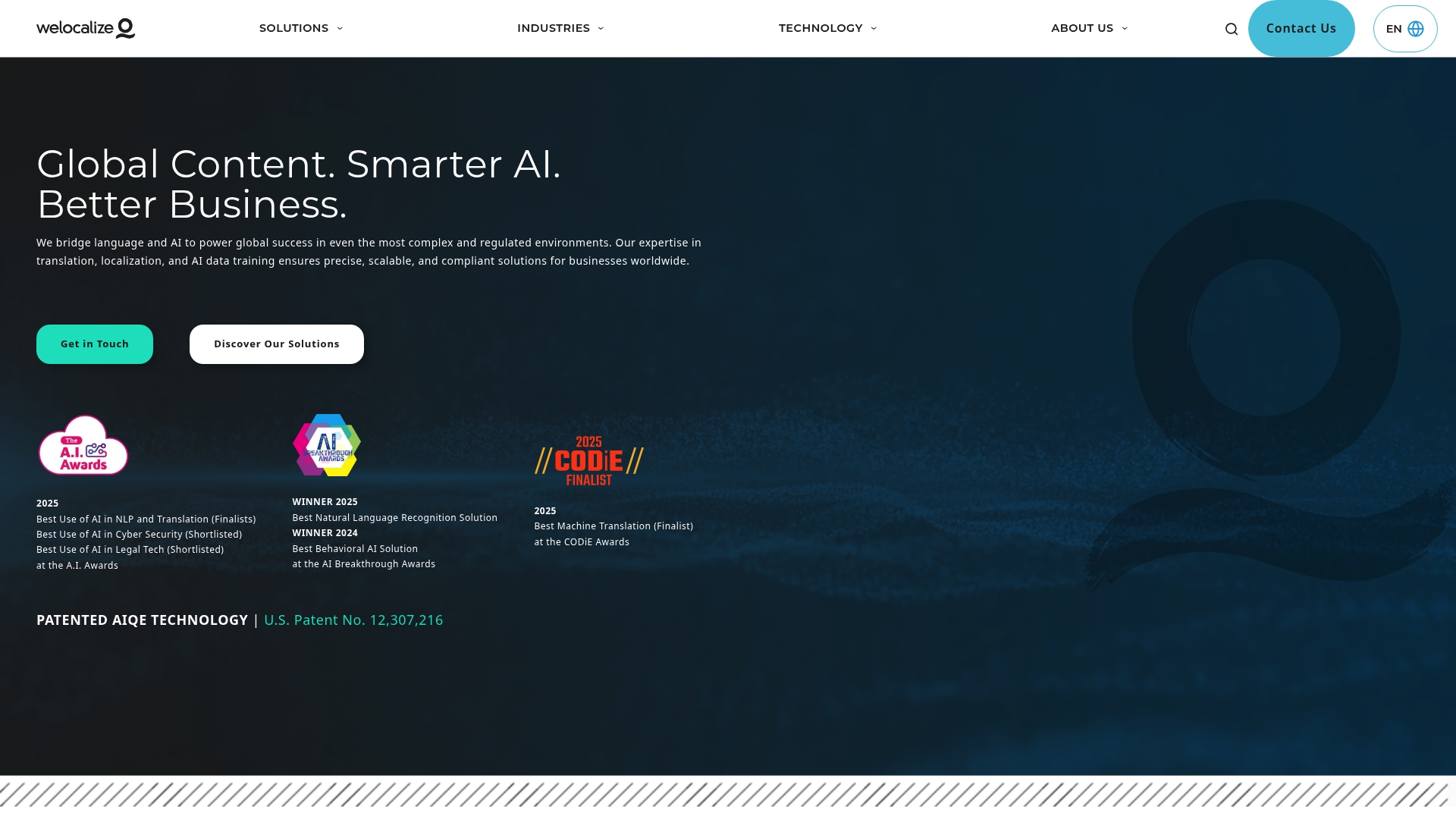
Welocalize is a mature, technology-forward language services provider with over 25 years in the field and a broad global footprint serving more than 2,000 clients. It combines proprietary AI platforms (OPAL, Legal Studio) and patented quality estimation (AIQE) with a wide palette of localization services spanning medical device, pharmaceutical, legal, and marketing content. For compliance-focused teams in fast-growing biotech firms, Welocalize offers scale and AI-driven efficiencies—but that capability comes with complexity and a need for tailored commercial conversations.
Core Features
Welocalize’s offering centers on AI-enabled localization and data services: machine translation augmentation, industry-specific workflows for medical devices and clinical content, legal document handling, and supplementary services such as e-learning localization, accessibility, interpretation, and product testing. The company promotes proprietary platforms (OPAL, Legal Studio) for workflow and legal content management and uses AIQE for translation quality estimation. Delivery appears organized around cloud-enabled, AI-augmented pipelines and a global team of experts able to handle high-volume, regulated workloads.
Pros
Deep industry breadth: Welocalize supports specialized verticals including medical device, pharma, and legal, which matches the risk profile of regulated biotech documentation.
Technology-first approach: Proprietary platforms like OPAL and Legal Studio and patented AIQE indicate serious investment in scalable, repeatable AI workflows.
Proven longevity: Operating since 1997, Welocalize brings institutional experience that helps with large, multi-market programs and legacy asset migration.
Award-recognized innovation: Multiple industry awards for AI and language technology bolster credibility when you need advanced tooling for complex projects.
Global scale: Serving over 2,000 clients worldwide suggests capacity for handling expansive localization programs and simultaneous regional rollouts.
Cons
Complex service scope can overwhelm newcomers: The breadth of offerings may make it difficult for teams without prior vendor experience to identify the exact solution pathway.
Potentially higher costs for premium services: AI-enabled, enterprise-grade workflows and specialized domain work often carry a premium that can strain early-stage budgets.
No public pricing transparency: The website provides no listed rates, requiring time-consuming direct engagement to obtain tailored quotes.
Who It’s For
Welocalize suits established organizations and growth-stage biotech companies that need scalable, high-volume localization and AI data training capabilities and that already expect vendor-driven complexity. If you manage clinical trial documentation, device labeling, or cross-border regulatory submissions and need end-to-end program management, Welocalize is a viable partner—especially when your priority is speed, scale, and advanced QA rather than lowest-cost execution.
Unique Value Proposition
Welocalize differentiates by pairing proprietary AI platforms and quality-estimation tools with subject-matter workflows across regulated industries. That combination is aimed at organizations that demand repeatable, measurable quality and programmatic scale—so you get automation without abandoning domain expertise.
Real World Use Case
A pharmaceutical sponsor localizes clinical trial protocols and informed consent forms into multiple languages using Welocalize’s AI-augmented workflows and legal content tooling to accelerate turnaround while keeping oversight for regulatory compliance and consistency across markets.
Pricing
Public pricing is not available on the website; Welocalize requires direct contact for tailored quotes and scope-based estimates. Expect enterprise-level pricing for AI-enabled and specialized regulated work.
Website: https://welocalize.com
Propio Language Services
At a Glance
Propio Language Services is a mature, technology-forward provider of interpretation and translation with more than 30 years in the market. They offer VRI, OPI, on-site interpretation, and document localization across 200+ languages, backed by a 20,000-strong interpreter network and real-time analytics. For organizations that prioritize modality coverage and operational transparency, Propio is a reliable option — though procurement teams should plan for onboarding and clarify pricing up front.
Core Features
Propio combines multi-modality interpreting (Video Remote Interpretation via Propio ONE or common conferencing platforms, and 24/7 Over-the-Phone Interpreting) with traditional on-site services and document translation/localization. Operational tooling includes Propio Analytics for live performance metrics and customizable visual reporting, plus Propio Workforce OS™ for interpreter scheduling and resource management. The emphasis is on integrating technology with human expertise to deliver measurable, auditable communication support.
Short. Clear. Measurable.
Pros
Depth of experience: Over three decades in language services gives them institutional knowledge for complex workflows and high-volume programs. This matters when you need repeatable, auditable processes.
Comprehensive modality coverage: VRI, OPI, on-site interpretation, and document localization mean you can consolidate multiple needs under one vendor. That reduces vendor management overhead.
Large, screened interpreter pool: A network of 20,000 interpreters with high screening standards increases the odds of finding qualified specialists for niche language or dialect needs.
24/7 availability: Around-the-clock OPI supports urgent clinical and legal demands outside normal business hours — critical for hospitals and emergency services.
Data transparency and operations tooling: Propio Analytics and Workforce OS™ provide reporting and scheduling controls that help compliance and capacity planning teams make evidence-based decisions.
Cons
Potential overreliance on technology for delivery: Some services depend on platform performance, which could complicate access in low-connectivity environments or when clients use restricted systems. This may require contingency planning.
Pricing opacity: The website does not publish clear pricing, so budgeting requires direct engagement and may slow procurement cycles for fast-growing teams.
Onboarding complexity: The range of features and integrations suggests a learning curve; organizations should expect initial setup time and possible training for administrators and staff.
Who It’s For
Propio is best for mid-to-large organizations that need full-spectrum interpretation and localization across healthcare, legal, education, and business sectors. If you require 24/7 interpreting, robust scheduling, and actionable performance metrics, Propio is a practical choice. Fast-growing biotech compliance teams in Northern Europe will appreciate the modality breadth but should confirm EU data and privacy controls during procurement.
Unique Value Proposition
Propio’s strength lies in combining extensive modality coverage and a very large, screened interpreter network with analytics and workforce management tools — enabling operational scale while producing measurable performance insights.
Real World Use Case
A hospital deploys Propio for on-site interpretation in emergency and inpatient settings while routing overflow to Propio ONE for VRI. The hospital uses Propio Analytics to track response times, interpreter quality, and utilization to optimize staffing and justify budget increases.
Pricing
Pricing details are not specified on the website and require direct consultation with Propio’s sales team.
Website: https://propio.com
Smartling
At a Glance
Smartling is an AI-powered translation management system built to automate and scale enterprise localization. It combines model selection and automatic context application with human review, making it strong for high-volume, multi-format content pipelines. Expect deep integrations and real-time analytics, but plan for technical setup and human post-editing for sensitive, regulated material. Pricing is typically custom and requires direct consultation.
Core Features
Smartling offers AI translation with selectable models and automatic context application, plus integrations with 50+ platforms such as CMS, CRM, and code repositories. It handles JSON, XML, HTML, PDFs, and multimedia, and includes end-to-end workflow automation, in-platform collaboration, glossaries, and style guides to enforce consistency. These capabilities are geared toward connecting localization to existing engineering and content workflows while providing visibility into translation performance.
Pros
High automation reduces manual work: Smartling claims it can automate up to 99% of translation workflows, which accelerates throughput and reduces repetitive tasks for localization teams.
Broad format and system support: The platform supports many file types and integrates with 50+ software platforms, enabling you to keep localization inside your existing tech stack.
AI plus human review for quality: Smartling combines automated translation with human review to raise accuracy and handle nuance that pure machine translation can miss.
Real-time analytics for governance: Built-in analytics provide visibility into translation performance and cost, helping you track spend and quality over time.
Enterprise-grade security posture: The product advertises comprehensive security certifications suitable for enterprise deployment, which is important when handling sensitive documentation.
Cons
Implementation complexity can be significant: Integrating Smartling into complex workflows may require technical effort and setup, which can extend onboarding timelines.
Pricing is opaque and enterprise-driven: Costs are not publicly listed and typically require contacting Smartling for a custom quote, making budgeting harder for fast-moving teams.
Machine-dependence requires human checks for regulated text: Reliance on AI and machine translation means human review is still necessary for highly sensitive, safety-critical, or nuanced regulatory content.
Who It’s For
Smartling is aimed at enterprises and large organizations that need a scalable, automated localization solution and have the technical resources to integrate it into product and content pipelines. For fast-growing biotech companies with internal localization or compliance teams, Smartling can work well—provided you allocate engineering time for integration and subject-matter experts for final review.
Unique Value Proposition
Smartling’s value lies in marrying flexible AI model selection and automation with enterprise integrations and analytics. It is positioned to turn fragmented content sources into a centralized, trackable localization workflow while retaining human oversight where needed.
Real World Use Case
Lyft used Smartling to automate translation across all content types, cutting turnaround times by 50% and increasing the amount of translated content by 3,700 times—demonstrating how automation and integrations can scale localization rapidly.
Pricing
Not specified; typically requires contacting Smartling for a custom quote, which means procurement and budget planning are part of the buying process.
Website: https://smartling.com
Fast-Growing Biotech? Choose Translation Built for Compliance and Precision
The article outlines how fast-growing companies need translation partners that handle not just volume but strict regulatory demands, terminology governance, and rigorous quality assurance. If you are navigating sensitive Life Sciences documentation, or medical device content subject to MDR, HIPAA, or GDPR, these challenges become critical. You want translation that is traceable, audit-ready, and backed by deep domain expertise that machine translation alone cannot deliver.
AD VERBUM specializes in precisely these needs with our proprietary EU-hosted AI ecosystem and 25+ years serving regulated sectors. Our AI+HUMAN hybrid translation workflow includes:
Asset integration with your Translation Memories and Term Bases
LLM generation with strict terminology enforcement
SME refinement ensuring technical and regulatory accuracy
ISO-aligned quality assurance tailored to your compliance demands
This approach delivers faster turnaround times and unmatched governance for regulated content. Explore how AD VERBUM meets the exact challenges highlighted in the article by visiting our contact page and learn why companies handling sensitive data choose us.
Ready to reduce compliance risk and accelerate your global reach? Contact AD VERBUM today to discuss tailor-made solutions for your biotech startup. Start the conversation now at https://adverbum.com/contact and secure translation services that put your regulated content first.
Frequently Asked Questions
What features should I look for in a translation service provider for fast-growing companies?
Look for features such as hybrid AI and human translation, project management tools, and robust data security compliance. Prioritize providers that offer customizable workflows and scalability to meet increasing needs.
How can I ensure the translation service meets my industry standards and compliance requirements?
Check if the provider is certified with relevant industry standards, such as ISO certifications. Request details about their quality assurance processes, and consider conducting an initial pilot project to ensure alignment with your specific compliance standards.
What is the average turnaround time for translations from leading service providers?
Turnaround times can vary, but many providers typically deliver translations within 30-60 days for larger projects. Inquire about their specific timelines during the initial consultation to ensure they can meet your deadlines.
How can I evaluate the quality of translations before committing to a provider?
Request sample translations relevant to your industry or use case to assess their quality. Consider factors like accuracy, tone, and the use of appropriate terminology as indicators of their proficiency in your field.
Are there any hidden costs associated with using translation service providers?
Be aware that some providers may charge extra for services like expedited delivery, additional revisions, or specialized content handling. Clarify pricing structures upfront and ask for a detailed quote to avoid surprises during the project.
How do I effectively manage multiple translation projects with a service provider?
Use a centralized project management tool to track the progress of each translation request and communicate clearly with your chosen provider. Establishing regular check-ins can also keep projects on schedule and ensure that any issues are addressed promptly.
Recommended

