


AI vs NMT in Industry Translation: Risks and Rewards

Protecting regulatory submissions from errors and data mismanagement is a daily concern for compliance managers in European life sciences firms. Document translation mistakes—especially in pharmaceutical labeling or Medical Device Regulation files—can stall approvals and increase risk. The difference between standard neural machine translation and AI+HUMAN hybrid workflows with integrated terminology governance determines whether your submissions are accepted and your data remains sovereign. This guide clarifies how advanced AI solutions support compliance, accuracy, and audit demands for organizations operating under European regulatory scrutiny.
Table of Contents
Key Takeaways
Point | Details |
AI and NMT Selection Matters | The choice between NMT and AI+HUMAN hybrid translation affects regulatory compliance, documentation quality, and data governance. |
Terminology Governance is Critical | Integrated terminology enforcement during generation minimizes errors and enhances compliance in life sciences documentation. |
Audit Trails are Essential | Documentation of terminology governance and quality assurance processes supports regulatory acceptance and reduces compliance risks. |
Evaluate Complexity and Risk | Select translation technology based on document criticality, terminology consistency, and regulatory environment to ensure appropriate compliance strategies. |
Defining AI and NMT in Industry Translation
Artificial intelligence in translation operates across a spectrum of technology types, each with distinct capabilities and limitations. Understanding these distinctions matters because your choice of translation technology directly impacts regulatory compliance, data sovereignty, and documentation quality in life sciences workflows.
AI (Artificial Intelligence) in the translation context refers to computer systems designed to emulate human linguistic intelligence. This is a broad category that encompasses multiple technology architectures, ranging from rule-based systems to advanced deep learning models. When vendors mention “AI translation,” they may refer to anything from legacy approaches to cutting-edge large language models. The critical distinction lies in how the technology handles context, terminology enforcement, and regulatory constraints.
NMT (Neural Machine Translation) represents a specific subset of AI technology that uses deep neural network architectures to process language translation. Neural machine translation applies deep learning models that analyze source language input across multiple layers of artificial neural networks, attempting to generate target language output with improved fluency compared to older statistical machine translation systems. NMT became the industry standard for publicly available translation engines during the 2010s and powers many consumer-grade and enterprise SaaS translation platforms. However, NMT alone does not guarantee regulatory compliance or terminology control without additional human oversight layers.
The critical difference for compliance-focused organizations: NMT is a technology layer, not a complete translation solution. An NMT engine generates candidate translations, but it does not inherently enforce your terminology governance, apply domain-specific constraints, or provide the quality assurance alignment required by ISO 17100, ISO 18587, or sector-specific regulations like the Medical Device Regulation (MDR). Many vendors offer NMT as their core technology and layer human review on top. This creates variable quality because the NMT output itself may require substantial correction, particularly in safety-critical or legally binding documentation where terminology precision determines regulatory acceptance. Consider a pharmaceutical labeling translation: an NMT system may correctly recognize medical terminology but may struggle with negations, contraindications, or conditional statements that appear in clinical warnings. The human reviewer must then identify and correct these errors after the fact, which is reactive rather than preventive.
AI systems built on large language models (LLMs) represent a newer category that differs from standard NMT in architecture and operational design. The Transformer model underpins recent breakthroughs in translation technology, enabling systems to handle document-level context, maintain longer-range semantic relationships, and follow explicit constraints more reliably than earlier NMT approaches. Proprietary LLM-based systems, when integrated with subject-matter expert review and governed terminology assets, can enforce terminology before generation rather than correcting errors after generation. This preventive approach aligns with regulated documentation workflows where consistency and accuracy are non-negotiable.
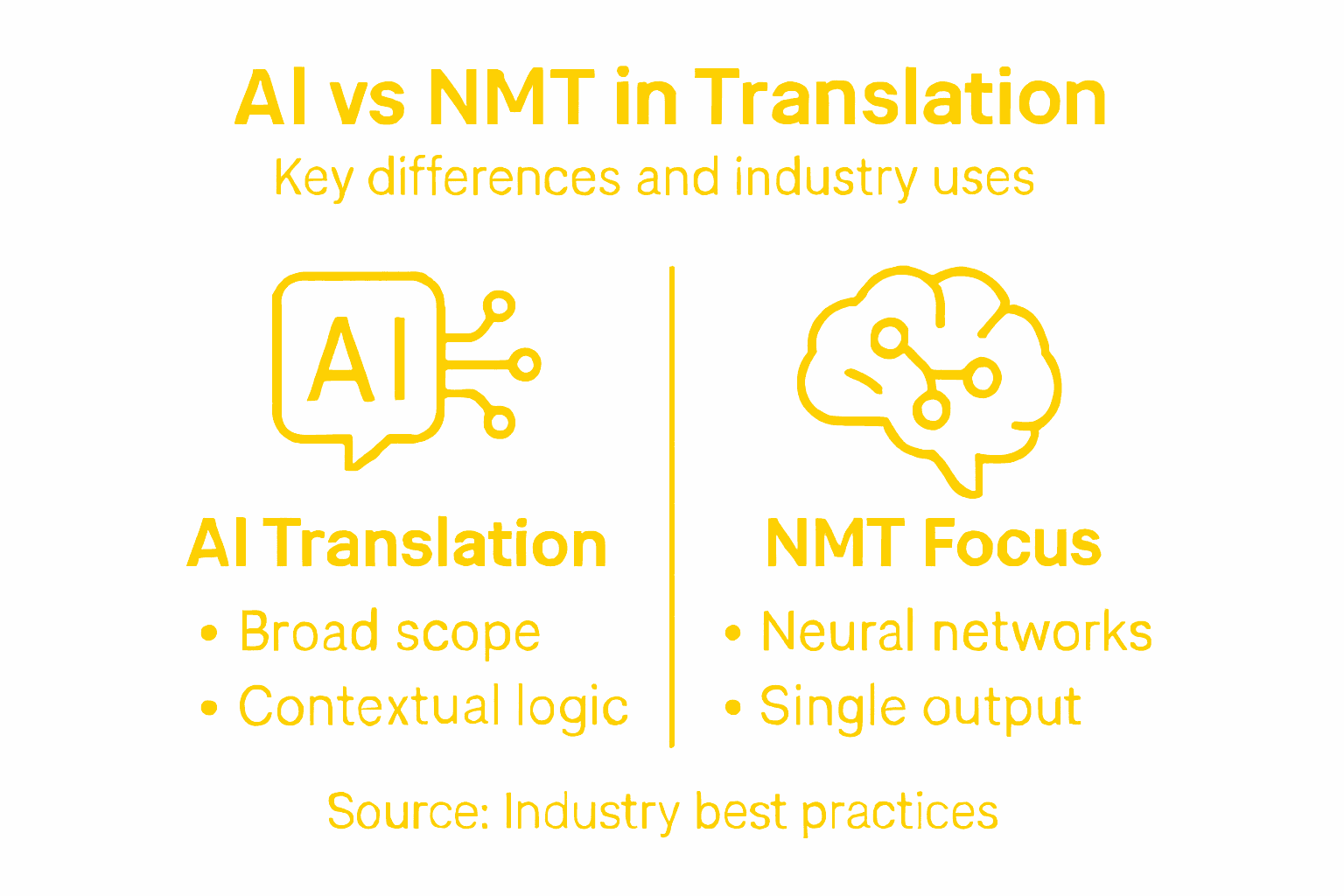
For life sciences compliance professionals, the operational distinction matters most: Does the translation system enforce your terminology and regulatory constraints during generation, or does it rely on human reviewers to catch errors afterward? NMT alone typically operates in generation-then-review mode. Advanced AI+HUMAN hybrid approaches operate in constraint-guided-generation-then-verification mode. The second model reduces rework cycles and provides audit trails showing how terminology governance was applied. In a regulated environment, audit traceability is not optional. Your translation provider must document how terminology was enforced, how style guidance was applied, and how subject-matter experts verified compliance at each stage.
Pro tip: When evaluating translation providers, request their quality assurance workflow in writing and ask whether terminology enforcement happens before or after AI generation. Providers using preventive terminology governance integrated into LLM-based systems will have lower revision cycles and stronger audit documentation for regulatory submissions.
Types of Translation: MT, NMT, and Hybrid AI
Translation technology has evolved through distinct generations, each representing different engineering approaches to the problem of converting text between languages. For compliance professionals evaluating translation providers, understanding these categories matters because each has specific strengths, failure modes, and suitability for regulated documentation. The choice between them directly affects your audit trail, terminology control, and regulatory acceptance.
Machine Translation (MT): The Foundation Layer
MT (Machine Translation) refers to automated translation using computer systems without real-time human intervention during generation. Early MT systems used rule-based approaches: linguists encoded grammar rules, vocabulary dictionaries, and transformation logic directly into software. These systems were predictable but rigid, often producing awkward or technically incorrect output because they lacked context awareness. Statistical Machine Translation (SMT), which emerged in the 1990s and 2000s, improved fluency by analyzing patterns in large parallel text corpora and calculating probability scores for word choices and phrase orderings. However, SMT still struggled with long-range dependencies, ambiguous pronouns, and domain-specific terminology without extensive human correction.
For your purposes as a compliance professional: legacy MT and SMT systems are rarely suitable for safety-critical or legally binding documentation in life sciences. They lack the contextual sophistication needed for pharmaceutical labeling, clinical protocols, or regulatory submissions. Most modern translation providers have moved away from these approaches, but some budget-oriented services still rely on them, which is why contract language specifying translation methodology matters.
Neural Machine Translation (NMT): The Current Standard
NMT replaced statistical approaches by applying deep neural networks to translation tasks. Hybrid AI approaches combine rule-based, statistical, and neural techniques to enhance output quality through greater control and linguistic accuracy. Standard NMT works by encoding source language text into numerical vectors, processing those vectors through multiple layers of artificial neurons, and decoding the result back into target language text. This approach handles context better than earlier systems and produces more fluent output. NMT powers most commercial translation platforms today, including major cloud-based SaaS providers.

The operational reality: NMT generates a single best guess at translation. It does not inherently enforce your terminology governance, apply regulatory constraints, or produce audit trails showing how decisions were made. An NMT system processes “warfarin contraindicated in pregnancy” and may generate a technically correct target translation, but it has no built-in mechanism to verify that your organization’s terminology database was consulted or that the negation and clinical context were preserved correctly. The system was not trained on your documentation style, your terminology preferences, or your regulatory requirements. This is why standalone NMT, without human expert review and terminology governance, creates compliance risk in regulated environments.
Hybrid AI and LLM-Based Translation: The Integrated Approach
Hybrid AI translation combines multiple technology layers. Different machine translation approaches offer distinct advantages and limitations depending on the context. Advanced hybrid systems integrate LLM-based generation with explicit constraint enforcement and subject-matter expert verification. The critical operational difference from standard NMT: terminology and style guidance are embedded into the generation process itself, not applied after the fact.
Consider how this works in practice. AD VERBUM’s AI+HUMAN hybrid workflow operates as follows: first, your Translation Memories ™ and Term Bases (TB) are ingested into the system before generation begins. Your proprietary terminology is now a constraint on what the LLM can output. The system generates candidate translation text guided by your terminology dictionary, your style guidance, and your regulatory requirements. Next, a certified subject-matter expert reviews the output specifically for technical accuracy, regulatory compliance, and contextual nuance. Finally, quality assurance staff verify alignment with ISO 17100 and ISO 18587 standards and, where applicable, sector-specific requirements like the Medical Device Regulation. This preventive approach means errors are caught during controlled refinement phases, not discovered later by regulatory reviewers.
The audit trail difference matters. With standalone NMT plus post-hoc human review, your documentation shows “NMT generated text, then person X reviewed it.” With hybrid AI plus integrated terminology governance, your documentation shows “LLM generated text constrained by Term Base XYZ, then SME reviewed it for technical accuracy, then QA verified ISO compliance.” Regulators increasingly expect this level of traceability in translated safety documentation.
Here’s how key translation technologies compare for compliance-driven documentation:
Technology Type | Context & Terminology Handling | Regulatory Alignment | Typical Use Cases |
Machine Translation (MT/SMT) | Limited: lacks domain context | Not suitable for audited submissions | General texts, legacy or non-critical applications |
Neural Machine Translation (NMT) | Better fluency, weak on governance | Needs added human review for compliance | Consumer, marketing, low-risk documentation |
Hybrid AI + LLM-Based (AI+HUMAN) | Enforces constraints during generation | Built-in audit trails, SME verification | Pharma, regulatory filings, medical/life sciences |
Practical Selection Criteria
Choose your technology based on three factors: documentation criticality, terminology complexity, and regulatory environment. For routine marketing collateral or internal communications, standard NMT with light human review may suffice. For pharmaceutical labeling, clinical protocols, legal contracts, or regulatory submissions, hybrid AI with integrated terminology governance and mandatory SME review is appropriate. For high-complexity medical device documentation requiring ISO 13485 compliance, proprietary LLM-based systems with private infrastructure alignment and full audit traceability are necessary.
Pro tip: Request your translation vendor’s technology specification in writing and ask whether terminology enforcement happens during generation or after. Vendors using integrated terminology governance will deliver first-draft accuracy that reduces revision cycles and creates stronger regulatory documentation trails.
How LLM-Based AI Enhances Accuracy and Control
Large Language Models represent a fundamental shift in translation capability compared to standard NMT systems. Where traditional NMT excels at fluency but lacks contextual depth, LLM-based translation systems can maintain domain-specific accuracy, enforce terminology governance, and produce audit trails that satisfy regulatory requirements. For compliance professionals managing pharmaceutical, medical device, or clinical documentation, this distinction translates directly into reduced revision cycles, stronger regulatory acceptance, and lower litigation risk.
How LLMs Handle Context and Complexity
Standard NMT systems process translation as a fixed sequence of mathematical operations: input text flows through encoder layers, then decoder layers, producing output. The system optimizes for statistical probability of word sequences but has no built-in mechanism to understand safety implications, regulatory constraints, or domain-specific meaning. An NMT system translating “do not use” might generate technically fluent output, but it operates without explicit awareness that this negation carries clinical significance. The translation is statistically plausible but contextually detached from the document’s purpose.
LLM-based translation systems enhance accuracy by correcting errors and producing culturally and contextually appropriate translations that standard NMT might miss. LLMs operate differently. They are trained on vast amounts of text that include not just parallel translations but also regulatory guidance, clinical literature, legal documents, and technical specifications. When an LLM processes pharmaceutical labeling, it carries implicit understanding of contraindication language, warning structures, and regulatory expectations. This context awareness enables better handling of negations, conditional statements, and domain-specific terminology without requiring post-hoc correction.
Consider a concrete example from life sciences translation. A clinical protocol states: “Subjects must discontinue use if symptoms persist beyond 48 hours.” Standard NMT might produce grammatically correct target language output, but the temporal condition (48 hours) and the safety implication (discontinuation requirement) are treated as generic words to be translated, not as safety-critical constraints requiring verification. An LLM-based system can recognize that this sentence structure appears consistently in safety documentation across pharmaceutical and medical device domains, can enforce your organization’s standard phrasing for discontinuation guidance, and can flag the sentence for mandatory SME review because of its safety classification. The system operates with domain awareness, not just statistical fluency.
Terminology Governance and Control Mechanisms
Terminology control is where LLM-based translation creates the most measurable operational advantage for regulated environments. LLM-based translation systems perform equally or better in managing complex linguistic phenomena and domain-specific terminology when compared to state-of-the-art NMT systems. In a traditional NMT workflow, your terminology database exists outside the translation engine. The NMT system generates output, then a human reviewer checks whether your terminology was used. If not, the reviewer corrects it. This is reactive correction: errors must be caught and fixed after the fact.
LLM-based systems integrated with AI+HUMAN hybrid workflows enforce terminology before generation occurs. Your Term Base becomes a constraint on what the LLM can output. If your term database specifies that a particular pharmaceutical ingredient must be translated as “active ingredient X” (not the more general “ingredient X” or a technical descriptor), the LLM respects that constraint during generation. The output reflects your terminology governance from the start. Subject-matter experts then review for accuracy and compliance, not for terminology correction. This preventive approach reduces revision cycles by 30 to 50 percent compared to post-hoc correction workflows.
The audit trail difference matters for regulatory submissions. When the U.S. Food and Drug Administration (FDA) or European Medicines Agency (EMA) reviews translated documentation, they increasingly expect evidence that terminology was controlled consistently throughout the document. With preventive terminology governance, your submission includes documentation showing: (1) Translation Memory and Term Base used, (2) LLM generation constrained by those assets, (3) SME verification of accuracy and compliance, (4) QA alignment with ISO 17100. This chain of custody strengthens your regulatory position because it demonstrates systematic control, not ad-hoc human judgment.
Risk Mitigation Through Explicit Oversight
LLM-based translation systems are not autonomous. They function within the AD VERBUM AI+HUMAN hybrid model: generation, refinement, verification. Each phase includes explicit decision points where errors can be caught. An LLM might generate plausible but contextually inappropriate phrasing for a negation or warning. A certified subject-matter expert catches this during refinement and corrects it with full documentation of the change. Quality assurance then verifies that the correction aligns with regulatory standards. This multi-phase approach means that error detection happens in controlled environments where corrections are documented, not in regulatory reviewer offices where corrections trigger requests for information (RFIs) or deficiency notifications.
The control advantage extends to cultural and linguistic nuance. LLM-based systems can recognize when a direct translation produces technically correct but culturally inappropriate phrasing. In European regulatory contexts, specific terminology conventions apply. An LLM trained on European regulatory documentation can generate output aligned with those conventions without requiring post-generation correction. For example, Medical Device Regulation (MDR) documentation has specific terminology expectations for risk management language. An LLM-based system trained on MDR submissions will generate output closer to regulatory expectations than a generalist NMT system would.
When LLM-Based Translation Delivers Maximum Value
LLM-based AI translation delivers its strongest return on investment for documentation that requires high terminology consistency, regulatory audit traceability, or significant domain-specific knowledge. Pharmaceutical labeling, clinical protocols, regulatory dossiers, medical device technical files, and legal contracts are appropriate use cases. Marketing collateral, user guides with standardized content, or high-volume routine translations may not justify the SME review overhead. The decision depends on your risk tolerance, regulatory environment, and documentation complexity. For life sciences organizations under European regulatory jurisdiction prioritizing data sovereignty and audit readiness, LLM-based translation with proprietary infrastructure and integrated terminology governance is the lower-risk option.
Pro tip: When negotiating translation contracts, specify that the provider must document their terminology governance mechanism in writing and provide sample quality assurance reports showing how terminology enforcement occurred during generation. Providers using preventive terminology control through LLM-based systems will have clear documentation; those using post-hoc correction will show higher revision counts and weaker terminology traceability.
Compliance, Data Security, and Sector Requirements
Translation technology operates within regulatory boundaries that vary significantly by sector and geography. For life sciences organizations, these boundaries are not negotiable. Your translation provider’s ability to meet GDPR, HIPAA, ISO 13485, and Medical Device Regulation requirements directly determines whether your translated documentation is acceptable to regulators or triggers deficiency notices. The choice between NMT and AI+HUMAN hybrid translation is ultimately a compliance decision, not just a technology preference.
Data Security and Privacy Regulations
Compliance with data security regulations such as GDPR and HIPAA is essential for trustworthy AI translation deployment in healthcare, finance, and legal sectors. GDPR applies to any organization processing personal data of European Union residents, regardless of where your company is located. HIPAA applies to covered entities and business associates handling protected health information in the United States. Both regulations impose strict requirements on data processing, access control, and breach notification.
The practical compliance challenge: many commercial NMT platforms operate on shared cloud infrastructure where your data is commingled with other customers’ data, where data retention policies are set by the vendor rather than by you, and where your proprietary terminology and translation memories may be used to improve the platform’s general models. This creates several compliance risks. First, data residency. GDPR article 32 requires that personal data be processed securely and that storage be configured to prevent unauthorized access. If your translation data flows to servers outside the European Union, you may violate GDPR residency expectations, even if the vendor claims they have safeguards in place. European regulators increasingly scrutinize cross-border data transfers. Second, data retention. When you submit a translation to a public SaaS platform, how long does the vendor retain your source and target text? Can they delete it on demand, or does it remain in their training datasets? Can you audit their retention practices, or do you accept their standard terms? Third, purpose limitation. GDPR restricts data use to specified purposes. If your translation data is used to improve the platform’s general models, that secondary use may violate the principle of purpose limitation unless you explicitly consented to it. Most SaaS terms do not provide granular consent options.
Private, EU-hosted infrastructure changes this equation. AD VERBUM operates proprietary AI infrastructure hosted on European Union servers with no reliance on outsourced public cloud tooling for core processing. This means your data never leaves European Union territory unless you explicitly authorize it. Data retention is governed by your contract, not by vendor defaults. Purpose limitation is enforced because your data is processed for your project only, not to improve shared models. Auditability is built in: you can request data processing records showing where your data was stored, who accessed it, and how long it was retained.
Sector-Specific Regulatory Requirements
Life sciences organizations operate within overlapping regulatory frameworks, each with specific translation requirements. The Medical Device Regulation (MDR) in Europe requires that device documentation, including translations, meet specific quality and accuracy standards. ISO 13485 certification for quality management systems in medical device manufacturing includes requirements for document control and record-keeping that extend to translated documentation. ISO 17100 and ISO 18587 specify translation quality assurance processes. HIPAA in the United States requires that protected health information, including translations, be processed securely and that access be logged.
Here is where the technology choice matters operationally. NMT platforms typically provide no built-in audit trail showing how specific terminology was handled, which expert reviewed the translation, or when quality assurance occurred. You have generated text and human-reviewed text, but limited documentation of the decision process. Regulators reviewing your submission will see the final translated document but cannot verify that your terminology governance was applied, that your experts verified domain-specific accuracy, or that your quality standards were met systematically. This creates compliance ambiguity.
AD VERBUM’s AI+HUMAN hybrid workflow generates comprehensive audit documentation at each phase. When you submit a translation project, the system documents (1) Translation Memory and Term Base ingested, (2) LLM generation parameters and constraints applied, (3) Subject-matter expert identity and review decisions, (4) QA verification against ISO 17100 and sector-specific standards. This documentation becomes part of your regulatory file. When the FDA or EMA reviews your submission, you can demonstrate not just that translation occurred, but how it was controlled and verified. This distinction strengthens your compliance position significantly.
Sector-Specific Vulnerability Management
Rigorous data handling protocols are necessary to address vulnerabilities and compliance risks in industry translation workflows. Pharmaceutical organizations must protect clinical trial data, adverse event reports, and drug safety information. Medical device companies must protect design specifications, risk analyses, and post-market surveillance data. These are high-value targets for competitive espionage or regulatory fraud. If a translation platform stores your data with inadequate access controls, competitors or bad actors could potentially access your proprietary information.
Standard NMT platforms implement general security controls, but those controls may not be designed for life sciences data. Public SaaS platforms segment data by customer but use shared infrastructure, shared backup systems, and shared security monitoring. A vulnerability in one customer’s setup could theoretically expose another customer’s data. Private infrastructure eliminates this risk because your data is processed in isolated systems with dedicated security controls.
Consider also the supply chain risk. Your translation provider may subcontract work to freelance linguists or downstream vendors. Each subcontractor represents a potential security gap. Does your provider vet subcontractors? Do they enforce confidentiality agreements? Are subcontractors located in jurisdictions where data protection laws are weaker? AD VERBUM’s model uses a vetted network of 3,500 plus subject-matter expert linguists with explicit confidentiality obligations and security training. All work is conducted within secure, audited systems. You know the identity and credentials of the experts handling your data.
Pro tip: Request your translation provider’s data security documentation in writing: ask for evidence of ISO 27001 certification, proof of EU data residency, and a data processing addendum (DPA) that specifies retention periods, access controls, and your right to audit. Providers unable to provide these documents are using standard commercial infrastructure that may not meet regulated sector requirements.
Choosing the Right Solution for High-Stakes Content
The decision between NMT and AI+HUMAN hybrid translation is not abstract. It is a specific choice that determines whether your regulatory submissions are accepted or rejected, whether your terminology governance is auditable, and whether your organization bears compliance risk. For European life sciences organizations, this decision should be made with full clarity about what each technology can and cannot deliver under regulatory scrutiny.
Risk-Based Decision Framework
Start with a simple assessment: what is the regulatory and financial consequence if the translation is inaccurate? For pharmaceutical labeling, the answer is high. Incorrect terminology in dosage instructions, contraindications, or adverse event warnings can result in patient harm, regulatory action, product recalls, or civil litigation. For clinical protocols used in trials generating data for regulatory submissions, inaccuracy compromises the integrity of the trial itself. For medical device technical files submitted to European notified bodies, translation errors trigger requests for information or rejection. For legal contracts governing supply or distribution, mistranslation creates liability exposure. In all these scenarios, the cost of error is measured in regulatory delays, financial penalties, or reputational damage.
Conversely, routine marketing materials, internal communications, or general informational content carries lower consequence. Standard NMT with human review may be appropriate for these lower-stakes uses. The key distinction is not whether the content is important to your organization, but whether mistranslation directly affects regulatory acceptance, patient safety, or legal liability.
Hybrid approaches that blend human expertise with AI tools optimize quality and accountability for sensitive industry requirements. This is not marketing language. It is operational reality. When you combine LLM-based AI generation with integrated terminology governance, subject-matter expert review, and quality assurance aligned to ISO standards, you eliminate the single points of failure that exist in standalone NMT workflows. You reduce the probability that an error reaches regulatory reviewers. You create an audit trail that demonstrates systematic control. These operational advantages directly reduce compliance risk.
Decision Criteria: Regulatory Environment
European regulatory frameworks impose specific expectations on translation quality and documentation. The Medical Device Regulation requires that technical documentation, including translations, be prepared by qualified personnel and verified for accuracy. ISO 13485 requires that document control processes extend to all documentation, including translations. European notified bodies evaluating medical device submissions increasingly scrutinize translation methodology. They ask: How was terminology controlled? Which experts reviewed the translation? What quality assurance was performed? Can you provide evidence of each step? Organizations using AD VERBUM’s AI+HUMAN hybrid workflow can answer these questions directly with audit documentation. Organizations using standalone NMT with light human review struggle to provide evidence of systematic control.
United States regulatory frameworks (FDA, HIPAA) also expect that translated documentation meet the same accuracy and traceability standards as English-language originals. The FDA’s expectations around translation are not codified in regulation but are reflected in guidance and deficiency letters. Organizations submitting translated pharmaceutical or device documentation should assume that FDA reviewers will scrutinize translation methodology with the same rigor they apply to clinical data or manufacturing processes. Again, audit documentation demonstrating controlled workflow is advantageous.
Decision Criteria: Terminology Complexity
If your documentation requires high consistency in domain-specific terminology, terminology governance becomes mission-critical. Pharmaceutical documentation uses precise, standardized terminology for active ingredients, dosage forms, routes of administration, and adverse events. Medical device documentation uses specific terminology for design features, risk categories, and performance specifications. Legal and regulatory documents use defined terms that must be consistent throughout.
Standalone NMT systems have no built-in mechanism to ensure that “active ingredient” is translated consistently as your organization defines it, that “risk” in risk management contexts is distinguished from “risk” in financial contexts, or that your organization’s preferred terminology is used instead of generic alternatives. Human reviewers can enforce this, but only reactively, after the NMT system has generated output. This creates higher revision cycles. AI+HUMAN hybrid systems with integrated terminology governance enforce consistency preventively. Your Term Base is a constraint on generation. The LLM knows your terminology rules before it generates output. This reduces revisions and improves first-draft accuracy.
Decision Criteria: Data Sovereignty and Compliance Infrastructure
For European organizations subject to GDPR, data residency is non-negotiable. Your translation data must remain within European Union territory. Your infrastructure must be auditable. Your data retention must be controllable. Most commercial NMT platforms do not offer these guarantees. They operate on shared cloud infrastructure outside European Union territory, with data retention policies set by the vendor, and with limited auditability.
Private, EU-hosted infrastructure like AD VERBUM’s proprietary AI ecosystem eliminates this risk category. Your data stays in European Union territory. Your infrastructure is auditable. Your contracts specify data retention and access controls. For compliance-sensitive organizations, this infrastructure advantage alone justifies the choice of AI+HUMAN hybrid translation.
When to Choose Standalone NMT
Standalone NMT with human review is appropriate for: routine marketing and promotional content; general informational materials with lower regulatory exposure; high-volume translations where cost efficiency is prioritized over audit trail; content that does not require high terminology consistency; jurisdictions with less stringent translation oversight.
When to choose AI+HUMAN hybrid: pharmaceutical and medical device documentation; regulatory submissions and technical files; legal and compliance-critical content; European organizations subject to GDPR and MDR; documentation requiring audit traceability; high-complexity terminology governance; safety-critical content where error has significant consequence.
Pro tip: Create a translation governance matrix for your organization that maps content type to required technology: list each category of documentation you generate (labeling, protocols, technical files, contracts) and specify whether it requires audit documentation, terminology governance, and SME review. Use this matrix to make technology choices based on risk, not cost alone. Organizations that treat translation as a commodity to be cheaply outsourced consistently encounter compliance problems; those that treat it as a controlled process with documented methodology consistently pass regulatory review.
This table summarizes decision factors for selecting translation solutions:
Decision Factor | When NMT Is Sufficient | When Hybrid AI+HUMAN Is Needed |
Documentation Complexity | Routine, low-complexity | Technical, high-stakes, safety-critical |
Terminology Consistency | Low to moderate importance | High or strict, domain-driven |
Regulatory Environment | Minimal legal exposure | Subject to ISO, MDR, HIPAA, or GDPR |
Audit Trail Requirement | Not required by regulator | Essential for compliance verification |
Navigate the Complexities of Industry Translation with Confidence
The article highlights the critical challenges that life sciences and regulated industries face when choosing between AI translation technologies such as MT, NMT, and advanced AI+HUMAN hybrid systems. Key pain points like ensuring strict terminology governance, achieving regulatory compliance, maintaining data sovereignty under GDPR and HIPAA, and producing robust audit trails for documents like pharmaceutical labeling and medical device files demand more than standard AI or public NMT solutions can offer. When errors in translation can lead to regulatory delays, patient safety risks, or costly legal consequences, relying on technology that only generates output without integrated controls becomes a costly gamble.
AD VERBUM addresses these challenges directly through its Specialized AI Translation service that combines proprietary LLM-based AI generation with 100 percent subject-matter expert refinement and rigorous quality assurance aligned to ISO standards. Our AI+HUMAN hybrid translation workflow ensures your Translation Memories ™ and Term Bases (TB) guide the LLM output from the start, preventing errors instead of fixing them later. Hosted on private EU servers with ISO 27001 certification, we guarantee data residency, security, and compliance with GDPR, HIPAA, MDR, and ISO 13485 frameworks. With over 3,500 expert linguists in life sciences, legal, and manufacturing sectors, we bring the precision and auditability your regulated documentation requires.
Ready to minimize compliance risks and accelerate your translation cycles? Discover how AD VERBUM’s solution can provide traceable, terminology-consistent, and regulation-ready translation workflows tailored to your needs. Connect with our experts today through AD VERBUM Contact for a consultation. Explore how we implement terminology governance in our AI+HUMAN Hybrid Workflow and why data security on EU-hosted infrastructure is essential by visiting AD VERBUM Contact. Take the first step toward translation you can trust now.
Frequently Asked Questions
What is the difference between AI and NMT in translation?
AI refers to computer systems mimicking human linguistic intelligence and encompasses various technologies, while NMT (Neural Machine Translation) is a specific subset of AI that uses deep neural networks for language translation.
How does NMT handle compliance and terminology control?
NMT generates translations but does not inherently enforce terminology governance or regulatory constraints. Additional human oversight is often needed to ensure compliance and maintain terminology precision.
Why is terminology governance important in life sciences translation?
Terminology governance is critical in life sciences because consistent terminology directly affects regulatory acceptance, document quality, and patient safety. Inaccuracies can lead to significant compliance risks.
What are the advantages of hybrid AI over standard NMT for regulatory submissions?
Hybrid AI combines NMT with human oversight, integrating terminology governance during translation generation. This approach reduces errors, enhances accuracy, and ensures comprehensive audit trails, making it ideal for regulated documentation.
Recommended

